
Will he make taxation fairer and more efficient and just by introducing a single tax?
N.B. I have posted this writeup as a response to an inspiring article about an open letter by a number of senior economists to Andy Burnham pleading with him that upon becoming prime minister he should aim to make taxation in Britain fairer, more efficient and just. They are calling for a single levy to replace six key taxes to raise money for public services and to encourage a more inclusive economic growth, to “unlock the gridlock that plagues the country”.
In short, the main aim of this writeup is firstly to highlight the important points raised in the said open letter. Then, to offer a time-honoured possible alternative available to the new prime minister by recalling a few gems on this subject from our GCGI. INFO archive.
Tax, tax and more taxes! Taxes on everything. Taxes even on living and dying! So many taxes that are even driving the sane to madness!
Then, there are so many who want to evade or avoid taxes, legally or illegally. So many are on the gravy train! Even the honest ones are pushed to dishonesty and fraud!

Photo via aims.co.uk
There is no official answer but some studies have revealed there are over 100 different taxes applicable in the UK – if you know the exact number I love to hear from you.
These taxes are Income Tax, National Insurance (NICs), Value Added Tax (VAT), Council Tax, Fuel Duty, Corporation Tax, Business Rates, Capital Gains Tax (CGT), Inheritance Tax (IHT), Stamp Duty Land Tax (SDLT), and then there are ‘Other Specific Duties’: Includes Air Passenger Duty, Insurance Premium Tax, Excise Duties, and various "sin taxes" like Tobacco and Alcohol Duty.(So, how many taxes do you think we have?)
Now some sane and honest people and organisations are asking a fundamental question: Why on earth can’t there be only one tax?
Is there a single tax that can replace all the existing taxes?
The Case for the Single Tax
Can the Old Dream of ‘Government Without Taxation’ be ever Realised?
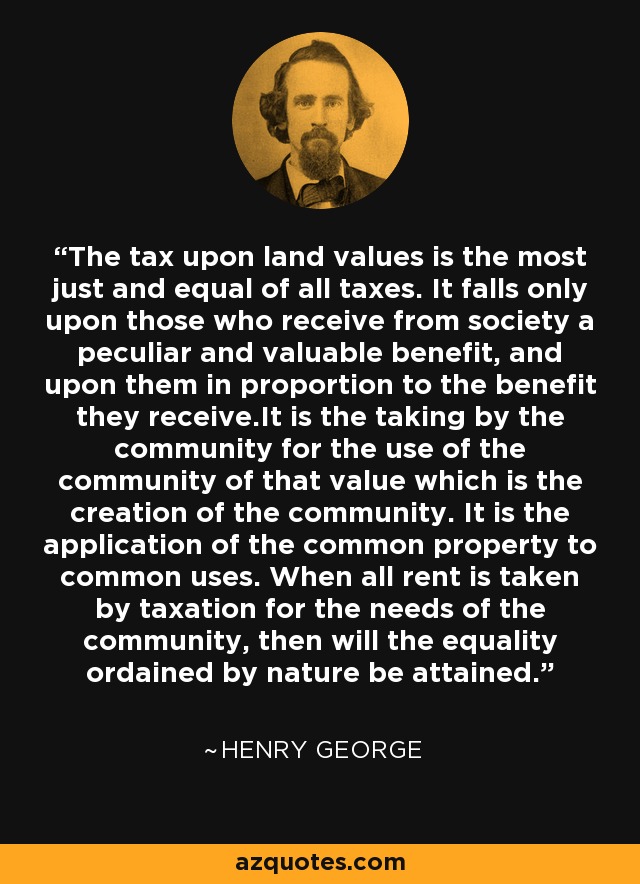
In 1879, Henry George, an American political economist, social philosopher and journalist and the pioneer thinker behind ‘Land Value-taxation’ argued that wealth derived from land value belonged to the people. Today, there is new interest in his ideas as a way to combat wealth disparities, poverty, inequality by recognising that a single-tax (Land Value-taxation) could be a path to a more equitable, prosperous and just society. More to follow later.
‘A generation has now passed since Henry George infused new life into the dry bones of political economy by writings which, if slow to win acceptance in the universities, made an immediate and profound impression upon the popular mind. Whatever may be thought of the Single-Tax doctrine, — whether it be regarded as the key to industrial freedom or as the worst of heresies, — the multiplication of its adherents, and its progress in actual legislation, have removed it from the realm of questions purely academic and make pertinent a restatement of its aims and accomplishments.’- F. W. Garrison, in The Atlantic, December 1913 Issue.
‘Andy Burnham urged to scrap income tax and NI in radical fiscal overhaul’: The Open Letter
Economists including Jim O’Neill, Jonathan Portes, Danny Sriskandarajah, John Muellbauer, and Henrietta Moore, amongst others, note that:
‘Taxes in Britain are rising faster than in any comparable economy while public services deteriorate. The country spends £100bn a year in debt interest, more than the entire defence budget and equivalent to half of NHS spending.
‘Seven prime ministers in 10 years have inherited the same challenge and failed to solve it for the same reasons: the problems are structural and systemic.’
They suggest the starting point should be the blueprint for a drastic overhaul of tax and public services laid out in a new report from the institute, published on Thursday. Prosperity 2030 suggests replacing six key taxes, including income tax, capital gains tax, inheritance tax and national insurance contributions, with a single levy.
These “national contributions” would be paid on all income, regardless of whether from work, from the sale of assets or from a late relative’s estate.
The authors of the report claim that depending on the rate it was set at, this could raise a whopping additional £75bn a year within five years. They call for the proceeds of these and other tax reforms, including a trebling of air-passenger duty, to be spent on providing universal services to the public – including free bus services and free lunches for all primary schoolchildren, for example.
Moore said: “Prosperity 2030 is about rebuilding the systems that shape everyday life, work, care, housing, skills and the cost of living. It is a plan for an economy that measures success by whether people can live secure, dignified and hopeful lives.”
The report also advocates scrapping stamp duty and council tax in favour of a national 1% levy on the value of property, with the proceeds remitted to local authorities, according to their population.
The latter proposal echoes a suggestion made by the Sheffield Heeley MP Louise Haigh, a key member of Burnham’s team, in a recent pamphlet for the Tribune group of Labour MPs. Burnham himself has talked about the benefits of a “land value tax” levied on property…’-Heather Stewart, economics editor, The Guardian
Would Henry George (September 2, 1839 – October 29, 1897) an American political economist, social philosopher and journalist and the pioneer thinker behind ‘Land Value-taxation’ be the answer to a fairer, more efficient and just taxation?
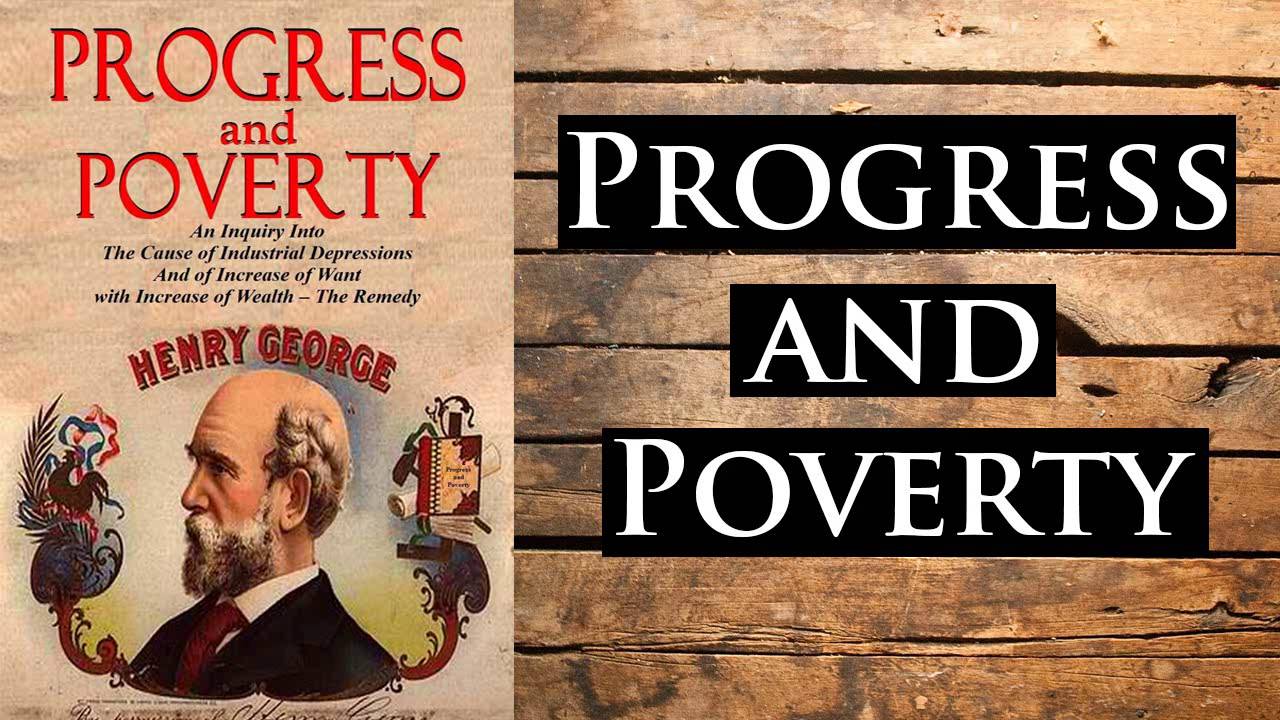
'Even a cursory look reveals a world now gripped by numerous wars over territory, and bedeviled by political instability, economic insecurity and growing social inequality. Towards the end of the nineteenth-century a book was written which analysed these enormous social problems and provided a remedy. This book was Progress and Poverty. Its author was an American, Henry George.'- Association for Good Government, Australia
‘In Progress and Poverty Henry George sought the ‘cause of industrial depressions and the increase of want with the increase of wealth’ and offered a ‘remedy’ which remains as relevant to the problems of poverty and inequality we face today, as when he first wrote, but it also opens a new way of dealing with environmental pollution.
To understand the relevance of the ‘remedy’ we need to understand what causes poverty and inequality. The cause is institutionalised, just as slavery once was. As Mandela pointed out in his Trafalgar Square speech in 2005: 'Like slavery and apartheid, poverty is not natural. It is man-made and it can be overcome and eradicated by the actions of human beings.'
What is the institution that makes poverty inevitable? Adam Smith described it very succinctly in The Wealth of Nations:
‘As soon as land becomes private property, the landlord demands a share of almost all the produce which the labourer can either raise, or collect from it. His rent makes the first deduction from the produce of the labour which is employed upon land.’
More recently (27th Dec 2009) in the Financial Times John Kay wrote:
‘You can become wealthy by creating wealth or by appropriating the wealth created by other people. When the appropriation of the wealth is illegal it is called theft or fraud. When it is legal, economists call it rent-seeking.’
But, economists will say, private property in land is essential for economic development. Without security of tenure, nobody is going to invest in sowing crops or building a business. As Hernando de Soto pointed out in The Mystery of Capital, economic success has everything to do with the legal structure of property and property rights.’...
…’In 1881, a contemporary of Henry George, Dr Thomas Nulty, Bishop of Meath in Ireland, came independently to recognise the injustice of the private ownership of land and called in a pastoral letter for a radical reform of the Irish land tenure system. He acknowledged that evil social institutions had long endured - the slave owner's right of property was regarded as sacred as any other property right - but the world’s approval, the bishop argued, could not justify injustice. The death knell of slavery was only sounded when public attention was fixed on the intrinsic nature of slavery. Then it was no longer acceptable.
History has shown that land enclosure creates two classes in society, the landowners and the landless. The latter can only live by paying a rent to the former for the right to use land which is God’s gift to all humanity. The landowner is thus in receipt of an unearned income simply because society permits land to be owned, just as it once permitted slaves to be owned. Adam Smith was in no doubt about the effect: the landowner ‘acts always as a monopolist, and extracts the greatest rent which can be got for the use of his ground’. Winston Churchill was even more explicit:
‘No matter where you look or what examples you select, you will see every form of enterprise, every step in material progress, is only undertaken after the land monopolist has skimmed the cream for himself, and everywhere today the man or the public body that wishes to put land to its highest use is forced to pay a preliminary fine in land values to the man who is putting it to an inferior one, and in some cases to no use at all.
All comes back to land value, and its owner is able to levy a toll upon all other forms of wealth and every form of industry. A portion, in some cases the whole, of every benefit which is laboriously acquired by the community increases the land value and finds its way automatically into the landlord's pocket. If there is a rise in wages, rents are able to move forward, because the workers can afford to pay a little more. If the opening of a new railway or new tramway, or the institution of improved services, of a lowering of fares, or of a new invention, or any other public convenience affords a benefit to workers in any particular district, it becomes easier for them to live, and therefore the ground landlord is able to charge them more for the privilege of living there.’
He then gave an example which illustrates why the welfare state is no solution to poverty and the widening gap between rich and poor:’- Would Henry George’s ‘Remedy’ help us combat today’s global crises?
Can taxation be fair? Can tax avoidance and tax evasion become a thing of the past?
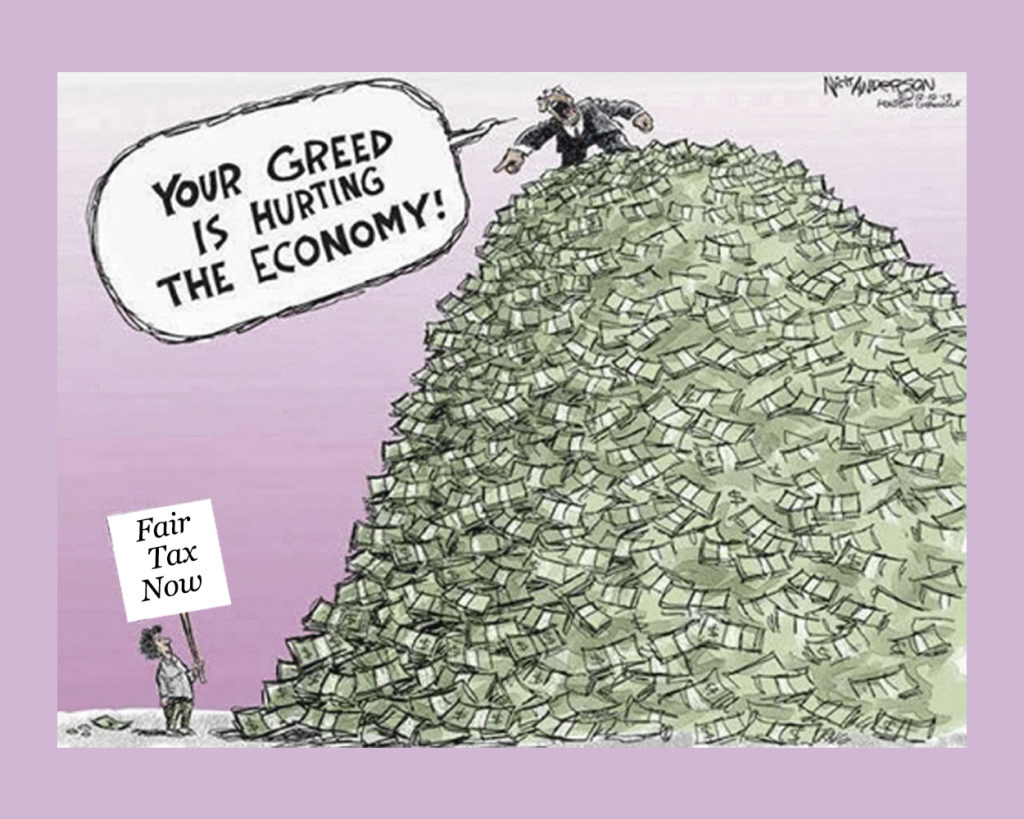
This illustration was created by Nick Anderson for the Houston Chronicle.
'The Times in London has run a series of articles shedding light on the secretive tax avoidance industry, revealing how the rich and famous have resorted to complex schemes which have in some cases reduced the amount of tax paid to one or two percent. The evidence was gained by investigative reporters posing as potential tax avoiders seeking ways of reducing the tax they needed to pay. As the journalists have pointed out the schemes are perfectly legal, though questions have been raised as to whether they are moral.
The problem of tax avoidance in nothing new. The problem is that it is only the rich who can afford these schemes. Years ago a retired judge told me that, when he was a top earning QC, his accountant had said to him: ‘Now, Sir Kenneth, you are earning enough not to pay tax’.
Rather than pillorying individuals and giving the taxman more Draconian powers over our lives, undermining our civil liberties, why do we not acknowledge that our present tax system is unfair and not fit for purpose? To do that, of course, is to raise the question: What is the alternative?...'-Can taxation be fair?
Is there an alternative to business rates that are killing businesses?

Photo via Blackpool Gazette
The UK’s business rates system is “uneconomical, unsustainable and frankly unintelligible” and reform of the property-based tax “cannot come soon enough”.- John Allan, the president of the CBI employers group, 2019
'Britain’s business leaders are demonstrably the modern Bourbons, forgetting nothing and learning nothing. They permanently complain about the manifest iniquities of business rates, but completely fail to grasp the obvious alternative despite it being regularly set out and available for more than a hundred years.'
'Very simply – one taxes land, not property. When one reads of property prices rising it is not that bricks and mortar have increased in value but the land. Why? Because they stopped making it aeons ago and its supply is limited. Also, the value of a site is largely dependent on the planning permission it holds, i.e. the decision of the public authority. The value of my house in Leeds is double what it would be if one applied general inflation rather than land value inflation. Why should I have this potential windfall?-Business rates are killing the business. Is there an alternative?
See also:
The Case for the Single Tax
“It may be described as government without taxation, for, if the Georgian contention is true, the rent of land belongs not to the individual who would be required to surrender it, but to the community as a whole.” By F. W. Garrison, The Atlantic, December 1913 Issue
Further related readings from our archive:
The Path to a just free market economy
In conclusion, we must be aware that to reform the UK’s tax system, opt for and implement the Georgian Single-Tax will not be easy. There are many powerful vested interests that will be rising against it, doing their utmost to defeat it.
The alternative, doing nothing and carrying on as usual, though, will be very costly and damaging.
In the wise words of Jim O’Neill and others noted already:
‘Taxes in Britain are rising faster than in any comparable economy while public services deteriorate. The country spends £100bn a year in debt interest, more than the entire defence budget and equivalent to half of NHS spending.
‘Seven prime ministers in 10 years have inherited the same challenge and failed to solve it for the same reasons: the problems are structural and systemic.’
All said and done, Andy Burnham must play his cards right and well. I am sure he knows better than anyone that the continuation of managed decline by passing the opportunities given to him must not be his preferred option. To become the 8th prime minister to be forced out in a couple of years time would not be anything to be proud of.
And now for your interest and reflection my own Open Letter to Andy Burnham