
- Details
- Written by: Kamran Mofid
- Hits: 3086
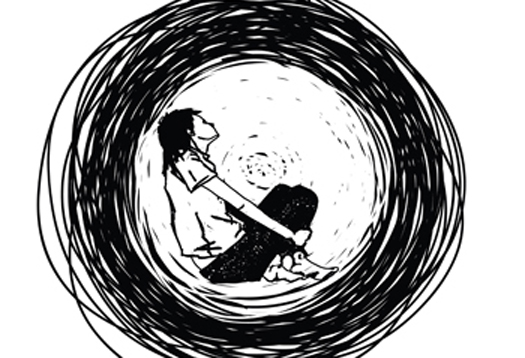
Photo: futurity.org
In the last few years I have done my utmost to highlight the tragic consequences of mental health crisis amongst our children, young adults, the youth and students.
Today I was reading a very important report which further highlights my concerns and anxiety about our collective failure to come together and to see how we may come to help our young people to cope better with the disaster that the so-called modern life has unleashed on them.
Young Britons living in 'suspended adulthood', research finds
Significant numbers of under 30s lack self-confidence and are at risk of mental health problems, with women worst affected, says report

Photo: youthnet.org
Anxious, worn down and fearing for the future: Major survey of 18-30 year olds reveals a generation in crisis, with young women worst affected
Millions of young people in Britain are being hit by serious financial and work problems and pessimism about the future with young women worst affected, according to a major new study of 18-30 year olds by the charity Young Women’s Trust.
Drawing on findings from a major poll of 4,000 18-30 year olds carried out by Populus Data Solutions, No Country for Young Women, reveals a despairing and worn down generation of 18-30 year olds, many of whose lives are on hold because of financial, work and housing problems.
Worries about work, finances and housing
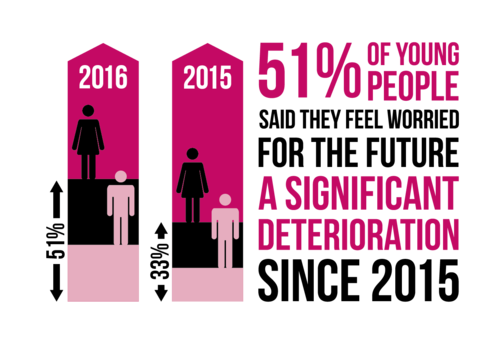
Photo: youngwomenstrust.org
As a result of financial pressures, young people aged 18-30 are having to put their lives on hold. Almost half (48%) said they may have to put off having children. 43% still live at home and a quarter (24%) had to move back in with their parents because they couldn’t afford to live independently. 56% of young people said they would consider moving abroad for work.
This is unsurprising given the difficulties in earning enough money reported by many young people. Three in ten young people had been offered a zero hours contract (30%). More than one in five reported having been paid less than the minimum wage (22%), and 28% of young people in work said they didn’t have enough paid hours. Almost half (48%) said they are worried about how much their job pays.
Financial pressures are particularly affecting young women, with 39% of young women saying it was a real struggle to make their cash last until the end of the month (compared with 27% of young men). 42% of young people said it would be a big financial problem if they had to replace a large item such as a fridge or washing machine this year (45% of young women, 39% of young men). Fewer than four in ten young people (36%) thought they would be debt-free by the time they are 40. One in 12 parents (8%) aged 18-30 reported having to use a foodbank to survive.
The survey also found that 30% of young women had experienced sex discrimination when working or looking for work. A majority of young people said women still face discrimination in the workplace, with young women (72%) more likely to recognise this than young men (54%).
The future’s not bright for young people
The psychological effect of these pressures facing millennials is taking its toll. The survey found that amongst 18-30 year olds:
- 47% lack self-confidence, with young women (54%) much more likely to say this than young men (39%)
- Over half of young people said they feel worried for the future (55% of young women, 47% of young men)
- Four in ten (42%) said they feel worn down (46% of young women, 38% of young men)
- One in three said they were worried about their mental health (38% of young women, 29% of young men).
In response to the survey findings, Young Women’s Trust is calling for addressing the challenges faced by young people to be at the heart of policymaking across government. Amongst the measures the charity wants to see are:
- A Minister established within central government with responsibility for overall youth policy, including youth employment
- A commitment from Government to moving towards extending the National Living Wage to under 25s
- A greater focus, including through JobCentre Plus, on supporting young adults – especially young women - with confidence, emotional wellbeing and employability.
Speaking today, Dr Carole Easton, Chief Executive of Young Women’s Trust said:
“At a time of life traditionally characterised by youthful confidence and optimism, it is distressing that so many young people, especially young women, are struggling to make ends meet, and are increasingly worn down and worried about the future.
Make no mistake about it, we’re talking about a generation of young people in crisis. And while life is hard for many young people, our survey shows it’s likely to be considerably tougher if you are a young woman.
It’s not in any of our interests to write off an entire generation. Much more needs to be done to improve young people’s prospects, including through creating a Minister for young people, extending the National Living Wage to under 25s, delivering on Government commitments to improve housing options for young people and tackling workplace discrimination. Our findings also show that there needs to be a particular focus on better understanding the needs of young women who are at real risk of being left behind.”
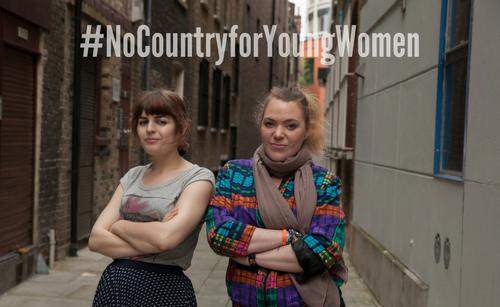
Photo: youngwomenstrust.org
Read the report: No Country for Young Women
Life's Big Questions:
What is this life all about?
Why am I here? What’s my Life’s purpose? How can I make the most of my Life?
The Wisdom Corner
The links noted below are amongst my Blog postings which are there to provide ideas for inspirational stories for everyone, encouraging contemplation, soul searching and spiritual enrichment.
Whenever you get a chance, please take a few minutes to watch, listen and read some of the amazing narratives below: They are some examples of the many gems I have discovered in my life journey from the wisdom of others. They have opened new horizons in my life. For that I cannot be grateful enough.
Here, by sharing their wisdom with you, I hope they will do the same for you: Life's Big Questions: My Wisdom Corner
- Details
- Written by: Kamran Mofid
- Hits: 1571

Photo: picturequotes.com
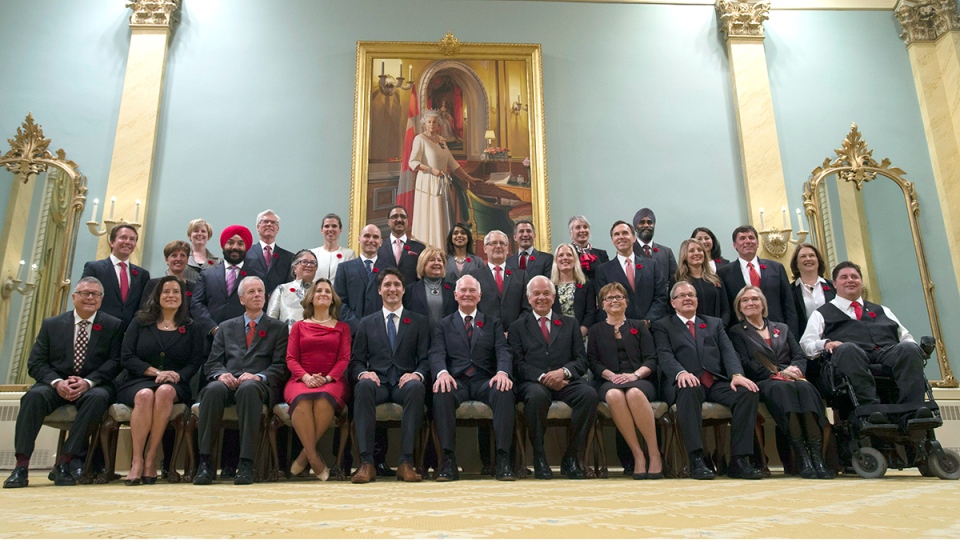
“It’s important to be here before you today to present to Canada a cabinet that looks like Canada”- Justine Trudeau
Photo: ctvnews.ca
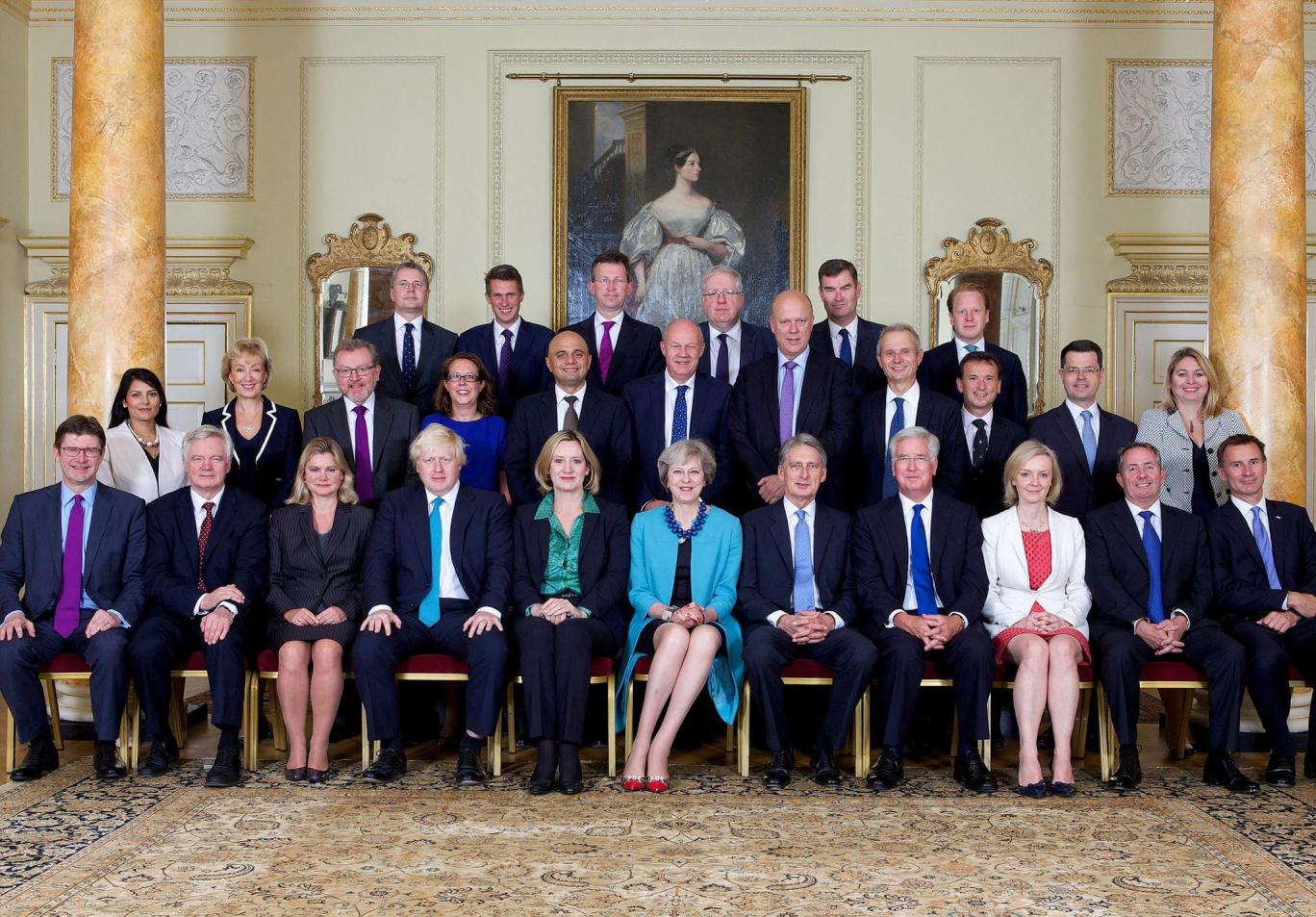
Photo: independent.co.uk
Dear Mrs. May: Can you say the same about your cabinet?
Then, it is true: “A picture is worth a thousand words”
I rest my case.
Thank you.
- Details
- Written by: Kamran Mofid
- Hits: 3023
Photo: ja-nae.net
First: A bit of food for thought, much needed for the coming revolution-
Before we start this timely, wise, spiritual, none-violent, loving and kind revolution for the common good, let us pause for a moment, think and reflect on some wonderful wisdom-heritage we are blessed to have, to guide and inspire us for the coming education revolution!
The playwright, T.S. Eliot posed the pertinent questions:
"Where is the Life we have lost in living? Where is the wisdom we have lost in knowledge? Where is the knowledge we have lost in information?"
Whilst, the poet, W. H. Davies, reminded us of what this life is all about:
WHAT is this life if, full of care,
We have no time to stand and stare?
No time to stand beneath the boughs,
And stare as long as sheep and cows:
No time to see, when woods we pass,
Where squirrels hide their nuts in grass:
No time to see, in broad daylight,
Streams full of stars, like skies at night:
No time to turn at Beauty's glance,
And watch her feet, how they can dance:
No time to wait till her mouth can
Enrich that smile her eyes began?
A poor life this if, full of care,
We have no time to stand and stare.
Then, the philosopher, Lao Tzu, told us what a values-led education may look like:
Some say that my teaching is nonsense.
Others call it lofty but impractical.
But to those who have looked inside themselves,
this nonsense makes perfect sense.
And to those who put it into practice,
this loftiness has roots that go deep.
I have just three things to teach:
simplicity, patience, compassion.
These three are your greatest treasures.
Simple in actions and in thoughts,
you return to the source of being.
Patient with both friends and enemies,
you accord with the way things are.
Compassionate toward yourself,
you reconcile all beings in the world.
And the economist E. F. Schumacher reminded us that the main problem with modern education is that it has abandoned the search for wisdom:
“All through school and university I had been given maps of life and knowledge on which there was hardly a trace of many of the things that I most cared about and that seemed to me to be of the greatest possible importance to the conduct of my life.”

Photo: youthvoices.net
Now is the Time to say NO to all those who have destroyed all that was once good in our education
‘It's time for a slow teaching revolution’
By Roy Peachey*
We have slow food, slow travel, even slow journalism.
Responding to the relentless 'McDonaldisation' of the world, the slow food movement reminds us of the value of locally produced, seasonal food, just as slow travel brings us back in contact with the local communities and local traditions we miss as we fly off in search of peak experiences.
In a 24-hour news era, slow journalism eschews the frenetic demands of the breaking story, revisiting and reflecting on old news and forgotten tragedies.
In almost every area of life, we are turning away from the restlessness of modernity towards another vision of the world, one where time is not a luxury but a resting place. We have reached a point where slowness is hardly counter-cultural. It’s almost a necessity.
But not in schools. Schools still march to the shrill demands of the bell. Courses are crammed into short half terms. Lessons have to be fast paced.
From the moment we step through the school gates to the time we pile out again a few short hours later, there must be activity, busyness, speed. Reflection is out. Breaks are monitored. Silence exists only to be filled.
But it needn’t be that way.
Let’s look at the world we and our students inhabit, the fast-paced, consumer-driven, connected world that has provoked the trend towards 'slow'.
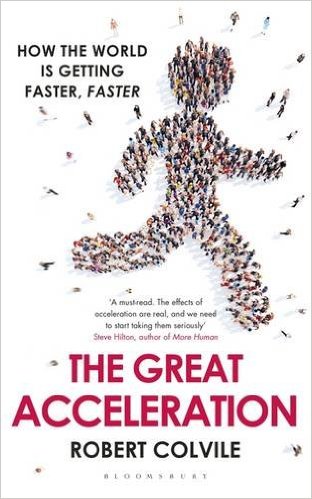
According to Robert Colvile in his recent book, 'The Great Acceleration', "the cult of disruption in Silicon Valley, the ceaseless advance of technology and our own fundamental appetite for novelty and convenience have combined to speed up every aspect of daily life."
For Colvile, the speed of the modern world is not so much a problem as a fact. In fact, he goes further, arguing not only that acceleration is a good thing, but it is something we have actively chosen.
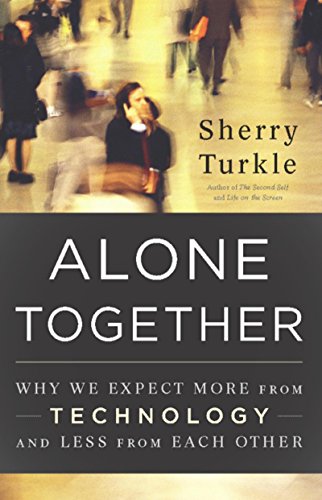
Others are less sanguine. In 'Alone Together: why we expect more from technology and less from each other', Sherry Turkle warns of the human cost of speed-driven technology, while in 'The Shallows: how the internet is changing the way we think, read and remember', Nicholas Carr argues that distraction and speed are essential to the working of the internet and inimical to human flourishing.
No one is immune from the problems that the pace of modern life presents. Distracted from distraction by distraction, students and teachers alike are beset by demands on their time, demands they are unable to ignore. Time, tide and exam classes wait for no man.
But not every class is an exam class. Not all schools have to follow the national curriculum. Now that A-level reform is underway, not every school year is lost. With the lower sixth form about to be untethered from public examinations, we have time to decide, as schools if not as individuals, what to do with our teaching time.
Take reading. We don’t give students the time they need to read. They turn to second-rate substitutes instead. Why read Plato when you can read a book about Plato? Why read 'Great Expectations' when you can find the plot on Wikipedia?
The answer, of course, is that what Plato wrote is much more interesting, much more dramatic and enjoyable, than any of the thousands of books that have been written about him. The answer is that reading 'Great Expectations' can be a life-changing experience in a way that flicking between Wikipedia and York Notes never will be.
Slow teaching means giving students time to read. It also means giving them time to think. How often do we demand immediate answers to our questions? Silence is more often uncomfortable than golden in the classroom.
Slow teaching also means resisting the temptation to wrap up every discussion. Plenary sessions are often unsubtle attempts to bring thinking to an end. But we needn’t be tied to arbitrary lesson lengths: slow teaching encourages us to work for as long as the topic demands.
We should reflect on whether our current structures create the type of schools and quality of work we want. I once met a friend, a published poet, on the last day of his holiday and the first day of mine. “How’s the poetry going?” I asked. “It’s been a good week,” he replied. “ I wrote three lines.” Would we accept that rate of return from our students?
The example of Charles Causley, who was a schoolteacher as well as a wonderful poet, suggests we should. He gave his pupils all year to write their poems because that’s how long poetry takes.
And not just poetry either. When the students of St Paul’s Convent School in Hong Kong built a plane it took them seven years. If teachers think big they also need to think long. Neither planes nor Rome were built in a day.
Slow teaching means giving students time to explore and time to learn. Time to explore the natural world and scientific concepts. Time to learn their tables and their poems. Time to read whole books. Time to go outside the curriculum and further into it.
Yet I can hear protests. All of this is slow-cooked pie in the sky. We live in the 21st century and speed is of the essence.
But we are not automata. We have time for slow teaching, just as we have time to read, think and be with our families. We do have a choice and that choice is to teach differently. We may not be able to cram as much information into each lesson as we did before but our lessons will be deeper, fuller, better.
It isn’t pace that makes lessons great. It’s knowledge, enthusiasm and humour.
Slow teaching isn’t a pipe dream. We know that it could work because it already does. Slow teaching, like slow cooking, is already here: in the home school movement; in Montessori schools; in the Catechesis of the Good Shepherd. And if they’re just names to you, then you might want to slow down and check them out.
There’s more to be said about slow teaching – of course there is – but there’s also time to say it. The question we need to ask ourselves is whether we’re prepared to slow down, step back and join in.'
*Roy Peachey, head of higher education and careers Woldingham School
Read the original article which was first published in The Telegraph on 13 September 2016:
It's time for a slow teaching revolution
For more readings on this and other related topics please see:
Books to read:
Photos: amazon.co.uk