
- Details
- Written by: Kamran Mofid
- Hits: 3802
Photo: volonteurope.eu
For the Common Good: Unleashing the Power of Passion, Purpose& Hope
Why common good matters
‘Only by inspiring a spiritual and practical commitment to the common good can we help make our common life better.’
There is an ancient idea that we have lost, but can and should find again. It’s called simply the common good. It goes back many centuries, but the need for a new dialogue about what it means and what its practice would require of us has never seemed more critical.
But what is the Common Good? A Brief Introduction
Notions of the Common Good have been central to conceptions of society since Plato and Aristotle, and have been described in fairly consistent ways since then. There has been general agreement that the search for “…the common good is disciplined yearning, deliberation, judgment, and action in concrete realization of the best, most choiceworthy way to live” and that “Its most basic meaning is that the community and its institutions should serve the good of all its citizens and not just the restricted good of a particular ruler or class.”
Put more simply, the Common Good is advanced when society’s institutions, including foundations, operate in the interests of the broadest possible swath of people.
In short, the Common Good is much more than the aggregate of individual goods and accomplishments. Rather, it reflects both the morality and the enlightened self-interest that allows institutions across society to operate so that all might enjoy a life of justly and humanely distributed resources, rewards, responsibilities and obligations.
The Journey to Build a Better World for the Common Good
- Details
- Written by: Kamran Mofid
- Hits: 5335
We are more than taxpayers!

Taxes, if informed by the common good, can be a positive way to fulfill our calling to do public justice. Photo:bing.com
These days, led by neoliberalism, we are more likely to hear ourselves referred to as “taxpayers” than “citizens.” What if we viewed ourselves as citizens first? We might stop asking “what’s in it for me?” and begin to ask “what’s in it for everyone?”
As it has been noted by many with an eye on justice, fairness and the common good, ‘Taxes raise the revenues used to pay for democratic institutions and to provide government programmes and services. Taxes can also be used to promote other economic and social policy goals through the use of tax expenditures. Over the past decade, significant changes have been made to our tax system, including deep cuts to tax rates. The impact of these changes is cause for concern: there has been a significant loss or erosion of public services that benefit us all, a loss of progressivity in the tax system, and growing income inequality between the rich and the poor with significant costs and consequences for all.
At the same time, there has been an erosion of democratic control and accountability for taxation and public spending. The context for debate has also been very hostile to an open and honest conversation about taxes and the services they pay for. A more positive perspective on taxes views them as an important part of citizenship and democratic representation and a contribution to the common good.
A related perspective views taxes as dues paid in recognition of the common wealth each citizen benefits from, passed on by earlier generations. Taxes can also represent a form of income redistribution over the course of an individual lifetime, as well as an efficient and effective way for individuals to procure services by doing so collectively. Taxes are also an important form of income redistribution in society.
Taxes are one way in which we as citizens fulfil our obligation to promote justice and to respect the right of all people to live in dignity. For governments, tax policy can be used to foster justice, in addition to tax revenues paying for infrastructure and public services that benefit all and promote an equitable society. Public justice also supports a progressive distribution of taxes, and transparent and accountable decisions from governments on taxation and spending.’
Following on what was noted above, today I read a very interesting article on how we may be able to explain and understand ‘tax as a force for common good’, which I very much enjoyed reading and thus, would like to share it with you.
However, in order to appreciate the wisdom of this article, it is necessary to understand and to get-to-know the real Adam Smith. This is important. As the article has highlighted, it is the organisations, such as the Adam Smith Institute, that have poisoned the debate on “Taxation” by using the different Adam Smith, to the one I discovered many years after being a student of economics, or indeed, when I became an economic lecturer. Let me explain a bit more by quoting a passage or two from an article I had written a while back:
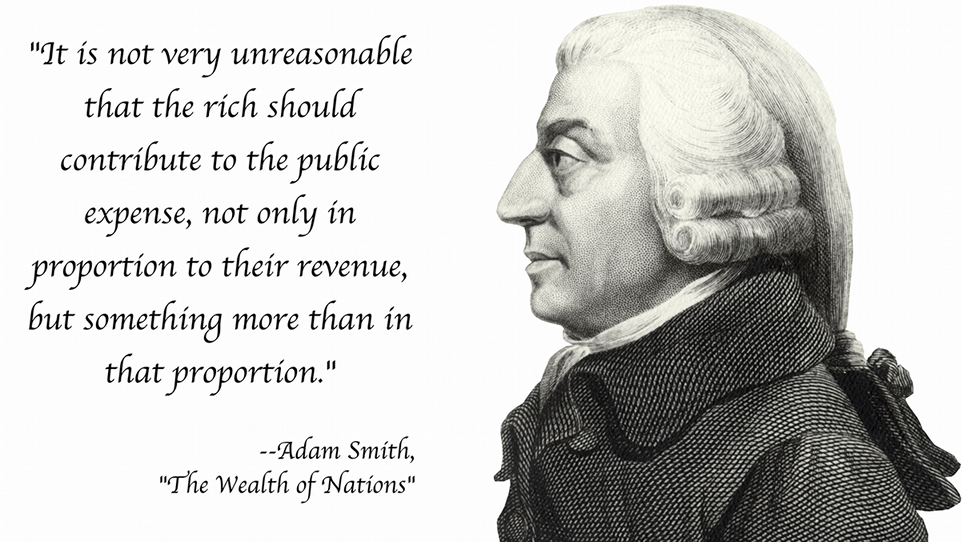
Photo: imgur.com
‘These days I am inspired by the “Real” and “True” Adam Smith, known the world over as the Father of New Economics. We should recall the wisdom of Adam Smith, who was a great moral philosopher first and foremost. In 1759, sixteen years before his famous Wealth of Nations, he published The Theory of Moral Sentiments, which explored the self-interested nature of man and his ability nevertheless to make moral decisions based on factors other than selfishness. In The Wealth of Nations, Smith laid the early groundwork for economic analysis, but he embedded it in a broader discussion of social justice and the role of government. Today we mainly know only of his analogy of the ‘invisible hand’ and refer to him as defending free markets; whilst ignoring his insight that the pursuit of wealth should not take precedence over social and moral obligations.
We are taught that the free market as a ‘way of life’ appealed to Adam Smith but not that he thought the morality of the market could not be a substitute for the morality for society at large. He neither envisioned nor prescribed a capitalist society, but rather a ‘capitalist economy within society, a society held together by communities of non-capitalist and non-market morality’. As it has been noted, morality for Smith included neighbourly love, an obligation to practice justice, a norm of financial support for the government ‘in proportion to [one’s] revenue’, and a tendency in human nature to derive pleasure from the good fortune and happiness of other people.
He observed that lasting happiness is found in tranquillity as opposed to consumption. In their quest for more consumption, people have forgotten about the three virtues Smith observed that best provide for a tranquil lifestyle and overall social well-being: justice, beneficence (the doing of good;active goodness or kindness;charity)and prudence (provident care in the management of resources;economy; and frugality).
I am only very sorry that, no one taught me these when I was a student of economics, and then, I did not tell the truth about Adam Smith to my students when I became an economics lecturer; something that I very much regret and something that am trying hard to rectify, now that I am a “Recovering and Repenting” economist for the common good. At the end of the day, it is our honesty, humility and our struggle to seek the truth that will set us free and allow us to hold our head high, nothing less, nothing more.”
Now that I have introduced you to the real Adam Smith, let me share the article I was talking about with you:
‘Let’s talk about tax as a force for common good – or we lose the debate’
‘Tax Freedom Day is another sad example of how our contribution to society is regarded as theft. This cannot go unchecked’

‘For the first 212 days of the year, every penny you’ve earned you’ve kept for yourself. In the meantime, you’ve been enjoying and helping others enjoy the health service for free.’- Photo: bing.com
31 July should have been a day of great civic celebration. For the first 212 days of the year, every penny you’ve earned you’ve kept for yourself. In the meantime, you’ve been enjoying and helping others enjoy the health service, public education, kerbside waste collection, policing, defence, pensions, roads and welfare payments, all for free. Only since Sunday have you started to contribute your share to all these and many more benefits of a modern, developed state.
No one is celebrating such a social solidarity day yet. However, for several years the Adam Smith Institute and the Taxpayers Alliance have been advocating something they call tax freedom day, which fell this year on 3 June. They tout this as “the first day of the year that you start earning money for yourself”, since on average all we earn for 154 days of the year we pay in taxes.
Social solidarity day and tax freedom day are of course two ways of looking at exactly the same objective phenomenon: that on average, 154 calender days earnings are taxed. The meaning of this fact, however, is changed by how we frame it. For economic libertarians, taxation is a deprivation of what is ours by natural right. For those who favour a welfare state, taxation is (or at least should be) a fair payment towards a well-functioning, just society that protects the weak as well as the strong.
Tax freedom day has been an effective rhetorical tool for advancing the tax-as-theft worldview. It is now as politically difficult to speak positively of tax as it is easy to praise the things we spend these taxes on, as though we can be in favour of the NHS while being against what funds it.
The demonisation of tax is part of a wider ideological battle to get us to think more like Americans and less like our fellow Europeans. Government is portrayed not as the servant of the people but as our tyrannical master. The state doesn’t act on our behalf, it interferes in our affairs. We are not governed in but ruled by London and Brussels.
The spread of these ways of thinking have contributed to the decline in trust in politics and disdain for mainstream politics. Countering it is a vital task for all who value anything like European social democracy. This requires reframing the debate around taxation in three key ways.
First, there is the issue of waste and inefficiency in government spending. This is real but often exaggerated. For example, international reports have repeatedly shown that the NHS is one of the most, if not the most, efficient health systems in the world. Where there is waste, however, we increasingly see only an opportunity to cut.
For example, last year the Labour peer Lord Carter led a review which suggested up to £5bn per year could be saved in the NHS through procurement improvements and minimising the use of agency staff. Almost everyone took this as meaning we could spend £5bn less on the NHS when it could equally mean having an extra £5bn to spend expanding services. Time and again the war on waste is waged in the name of tax cuts when it could be fought in the cause of better services.
Second is the issue of fairness. Take the complaint that multinationals operating in the UK pay hardly any tax here. Too often it is assumed that this means that others are paying too little and so we are paying too much. The key problem, however, is simply that taxes that could help run the country are going uncollected. The debate has become one about paying a fair share when it is more importantly one about increasing the size of the pot we pay into.
Third, we need to counter the subtle ways in which we are complicit in the taxophobics’ game. Think about how every newspaper and news outlet reports the budget. The bottom line is always presented in terms of whether tax changes leave specific types of people better or worse off, usually by mere pennies per week. The most important test of a budget should not be how taxes hit individuals’ pockets, but whether overall government is sustainably improving the state of the nation. Taxing less than we need to is as bad as taxing more than is necessary.
These changes in how we think and talk might strike you as modest and uncontroversial. Proof that they are anything but is that a campaign to start celebrating social solidarity day would today be laughed off as some kind of politically correct joke. Unless and until we make it normal to see taxation primarily as a valuable contribution to our own and the common good, the narrative that government is the enemy and tax is theft will continue to prevail.
This article was first published in the Guardian on Monday 1 August 2016.
See the original article:
Let’s talk about tax as a force for common good – or we lose the debate
For further reading see:
- Details
- Written by: Kamran Mofid
- Hits: 1794
Money, Money, Money. What is money for? Photo: britannica.com
‘Our attitude towards wealth played a crucial role in Brexit. We need a rethink’
‘Money was a key factor in the outcome of the EU referendum. We will now have to learn to collaborate and to share’
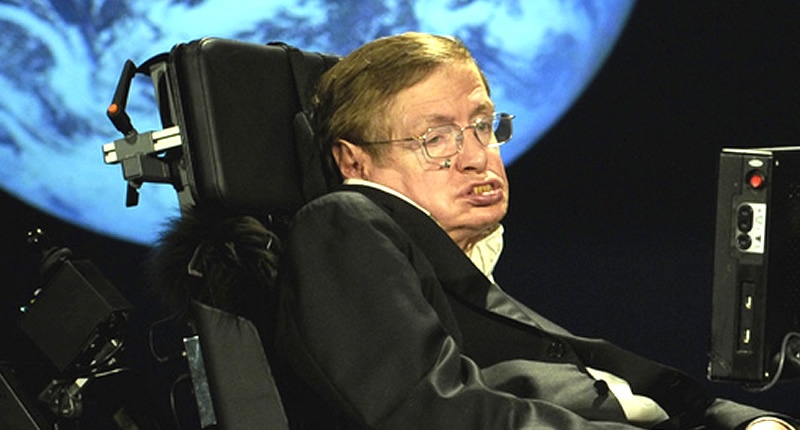
‘But we can and will succeed. Humans are endlessly resourceful, optimistic and adaptable. We must broaden our definition of wealth to include knowledge, natural resources, and human capacity, and at the same time learn to share each of those more fairly. If we do this, then there is no limit to what humans can achieve together.’ Photo: rawstory.com
Does money matter? Does wealth make us rich any more? These might seem like odd questions for a physicist to try to answer, but Britain’s referendum decision is a reminder that everything is connected and that if we wish to understand the fundamental nature of the universe, we’d be very foolish to ignore the role that wealth does and doesn’t play in our society.
I argued during the referendum campaign that it would be a mistake for Britain to leave the European Union. I’m sad about the result, but if I’ve learned one lesson in my life it is to make the best of the hand you are dealt. Now we must learn to live outside the EU, but in order to manage that successfully we need to understand why British people made the choice that they did. I believe that wealth, the way we understand it and the way we share it, played a crucial role in their decision. As the prime minister, Theresa May, said in her first week in office: “We need to reform the economy to allow more people to share in the country’s prosperity.”
We all know that money is important. One of the reasons I believed it would be wrong to leave the EU was related to grants. British science needs all the money it can get, and one important source of such funding has for many years been the European commission. Without these grants, much important work would not and could not have happened. There is already some evidence of British scientists being frozen out of European projects, and we need the government to tackle this issue as soon possible.
Money is also important because it is liberating for individuals. I have spoken in the past about my concern that government spending cuts in the UK will diminish support for disabled students, support that helped me during my career. In my case, of course, money has helped not only make my career possible but has also literally kept me alive.
On one occasion while in Switzerland early on in my career, I developed pneumonia, and my college at Cambridge, Gonville and Caius, arranged to have me flown back to the UK for treatment. Without their money I might not have survived to do all the thinking that I’ve managed since then. Cash can set individuals free, just as poverty can certainly trap them and limit their potential, to their own detriment and that of the human race.
So I would be the last person to decry the significance of money. However, although wealth has played an important practical role in my life, I have of course had a different relationship with it to most people. Paying for my care as a severely disabled man, and my work, is crucial; the acquisition of possessions is not. I don’t know what I would do with a racehorse, or indeed a Ferrari, even if I could afford one. So I have come to see money as a facilitator, as a means to an end – whether it is for ideas, or health, or security – but never as an end in itself.
Interestingly this attitude, for a long time seen as the predictable eccentricity of a Cambridge academic, is now more widely shared. People are starting to question the value of pure wealth. Is knowledge or experience more important than money? Can possessions stand in the way of fulfilment? Can we truly own anything, or are we just transient custodians?
These questions are leading to a shift in behaviour which, in turn, is inspiring some groundbreaking new enterprises and ideas. These are termed “cathedral projects”, the modern equivalent of the grand church buildings, constructed as part of humanity’s attempt to bridge heaven and Earth. These ideas are started by one generation with the hope a future generation will take up these challenges.
I hope and believe that people will embrace more of this cathedral thinking for the future, as they have done in the past, because we are in perilous times. Our planet and the human race face multiple challenges. These challenges are global and serious – climate change, food production, overpopulation, the decimation of other species, epidemic disease, acidification of the oceans. Such pressing issues will require us to collaborate, all of us, with a shared vision and cooperative endeavour to ensure that humanity can survive. We will need to adapt, rethink, refocus and change some of our fundamental assumptions about what we mean by wealth, by possessions, by mine and yours. Just like children, we will have to learn to share.
If we fail then the forces that contributed to Brexit, the envy and isolationism not just in the UK but around the world that spring from not sharing, of cultures driven by a narrow definition of wealth and a failure to divide it more fairly, both within nations and across national borders, will strengthen. If that were to happen, I would not be optimistic about the long-term outlook for our species.
But we can and will succeed. Humans are endlessly resourceful, optimistic and adaptable. We must broaden our definition of wealth to include knowledge, natural resources, and human capacity, and at the same time learn to share each of those more fairly. If we do this, then there is no limit to what humans can achieve together.
This article was first published in The Guardian on Friday 29 July 2016
Read more:
Dear Prime Minister-Britain needs a New Economic Model
- Prime Minister May- Britain needs a New Economic Model
- Doing Good for the Common Good is Good for Us: A Proven Fact Now
- Our Emotional Inheritance and the need for Emotional Education
- Brexit: The Key Lessons- Now is the time for hope to build on the ruins
- EU Referendum: An Open Letter to British people - One man's view of Britain and the British