ABOUT KAMRAN’s Blog and GUEST BLOG
I- KAMRAN’s Blog: Dedicated to the Common Good- aiming to be a source of hope and inspiration; enabling us all to move from despair to hope; darkness to light and competition to cooperation. “Let the beauty we love be what we do.”-Rumi
II- KAMRAN MOFID’s GUEST’s BLOG: Here on The Guest Blog you’ll find commentary, analysis, insight and at times provocation from some of the world’s influential and spiritual thought leaders as they weigh in on critical questions about the state of the world, the emerging societal issues, the dominant socio-economic logic, globalisation, money, markets, sustainability, dialogue, cooperation, environment, media, spirituality, faith, culture, the youth, the purpose of business and economic life, the crucial role of leadership, and the challenges facing economic, business, management, education, and more.
“When we are dreaming alone it is only a dream. When we are dreaming together it is the beginning of reality.”—Helder Camara

Angel Oak Tree, Charleston, South Carolina, USA
Photo: pinterest.com
- Details
- Written by: Kamran Mofid
- Hits: 13859
'The real science of political economy, which has yet to be distinguished from the bastard science, as medicine from witchcraft, and astronomy from astrology, is that which teaches nations to desire and labour for the things that lead to life; and which teaches them to scorn and destroy the things which lead to destruction.' -John Ruskin- 'Unto This Last'
Bastard Economics, Neoliberalism and Peoples’ Tragedy
Ethics boys
(Letter to the editor of the Times on 8 March 2011)
Sir, Around 1991 I offered the London School of Economics a grant of £1 million to set up a Chair in Business Ethics. John Ashworth, at that time the Director of the LSE, encouraged the idea but had to write to me to say, regretfully, that the faculty had rejected the offer as it saw no correlation between ethics and economics. Quite. Lord Kalms, House of Lords
And now, the first paragraph of a letter I wrote to Her Majesty Queen Elizabeth II on 27th November 2008, regarding her question at London School of Economics, when she asked: “Why did nobody notice?”
“I note, with much interest, Your Majesty’s recent visit to the London School of Economics. Given the current financial calamity, Your Majesty asked a very pertinent and important question: “Why did nobody notice?”
I firmly believe that the director of research and his colleagues present there, should have provided Your Majesty with truthful and honest answers. However, given what I have read in the press, I do not believe this was the case. Their failure to do so, clearly goes a long way to prove the detachment of economists and the modern neo-liberal economics from the real world. They have turned our profession and subject into a comedy of errors, a dismal science of irrelevance.
This is very sad indeed Your Majesty. An entire profession now appears to have suffered a collapse. Trust and confidence in my profession has all but been demolished, the “dismal science” at its worst.
Many mistakes have been made. Many economists have compromised themselves and their profession by remaining silent, not criticising the extremism and the neo-liberal fundamentalism present in their profession. Lessons should be learnt, someone should be held accountable. Otherwise the same mistakes will be repeated and nobody will believe what an economist says again. In other words, Your Majesty deserves a proper and honest answer…”
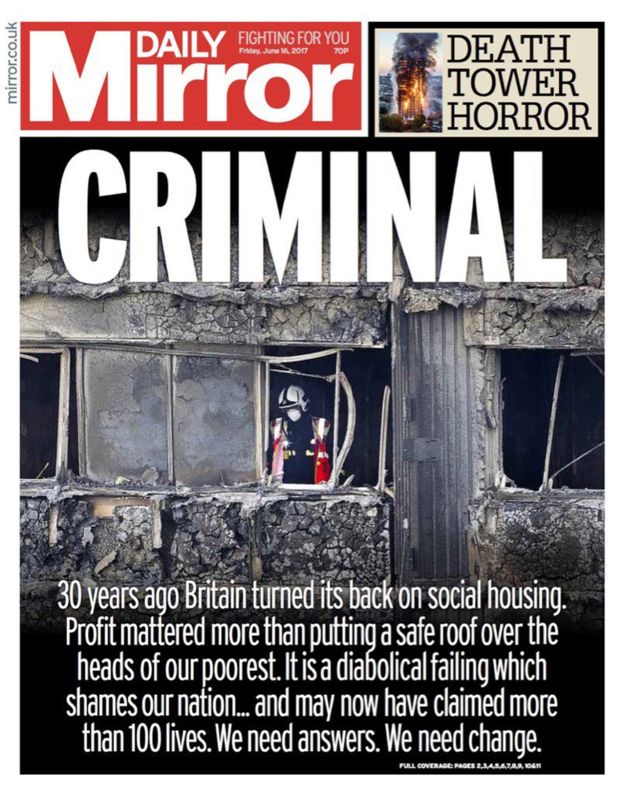
'On September 11, 1973—now referred to as the “other 9/11”—Augusto Pinochet staged a successful coup to oust Chile’s democratically elected president, Salvador Allende. Backed by the CIA, American business interests, and the blessings of Henry Kissinger, Pinochet, enlisting economists trained under Milton Friedman and the so-called “Chicago boys,” restructured the Chilean economy in the image of what has now come to be known as “neoliberalism,” that state apparatus which seeks to deregulate markets, privatize formerly public assets, minimize the power of unions, unleash all manner of austerity measures—in short, to ensure, in the name of freedom, an increasingly frictionless flow of capital across borders and into the bank accounts of those in power.’+
'Today the dominant narrative is that of market fundamentalism, widely known in Europe as neoliberalism. The story it tells is that the market can resolve almost all social, economic and political problems. The less the state regulates and taxes us, the better off we will be. Public services should be privatised, public spending should be cut and business should be freed from social control. In countries such as the UK and the US, this story has shaped our norms and values for around 35 years: since Thatcher and Reagan came to power.'
+People’s Tragedy: Neoliberal Legacy of Thatcher and Reagan
The Social Responsibility of Business is to Increase Its Profits, whilst the businesses' sole purpose is to generate profit for shareholders”- Milton Friedman, Nobel Memorial Prize in Economic Sciences
"The only reliable, durable and perpetual guarantor of independence is profit" – James Murdoch, Chief, News Corp
The Destruction of our World and the lies of Milton Friedman
Marketisation, privatisation, liberalisation, deregulation, self-regulation, downsizing, outsourcing, cost-cutting, profit-maximisation, cost-minimisation, highest returns to the shareholders, values-free actions and education, alternative facts, falsehood, lies and deceitful thoughts, brainwashing, bribery and corruption,…:
These are the main ingredients of the Bastard Economics of Neoliberal Ideology
And
These are the 72 MPs that voted against making homes fit for human habitation
Over 170 years after Engels, Britain is still a country that murders its poor
‘Spending cuts, deregulation, outsourcing: between them they have turned a state supposedly there to protect and support citizens into a machine to make money for the rich while punishing the poor. It’s never described like that, of course. Class warfare is passed off as book-keeping. Accountability is tossed aside for “commercial confidentiality”, while profiteering is dressed up as economic dynamism. One courtesy we should pay the victims of Grenfell is to drop the glossy-brochure euphemisms. Let’s get clear what happened to them: an act of social murder, straight out of Victorian times.’
‘…While in Victorian Manchester, Friedrich Engels struggled to name the crime visited on children whose limbs were mangled by factory machines, or whose parents were killed in unsafe homes. Murder and manslaughter were committed by individuals, but these atrocities were something else: what he called social murder. “When society places hundreds of proletarians in such a position that they inevitably meet a too early and an unnatural death, one which is quite as much a death by violence as that by the sword or bullet; its deed is murder just as surely as the deed of the single individual,” he wrote in 1845, in The Condition of the Working Class in England.
Over 170 years later, Britain remains a country that murders its poor. When four separate government ministers are warned that Grenfell and other high rises are a serious fire risk, then an inferno isn’t unfortunate. It is inevitable. Those dozens of Grenfell residents didn’t die: they were killed. What happened last week wasn’t a “terrible tragedy” or some other studio-sofa platitude: it was social murder…’Over 170 years after Engels, Britain is still a country that murders its poor
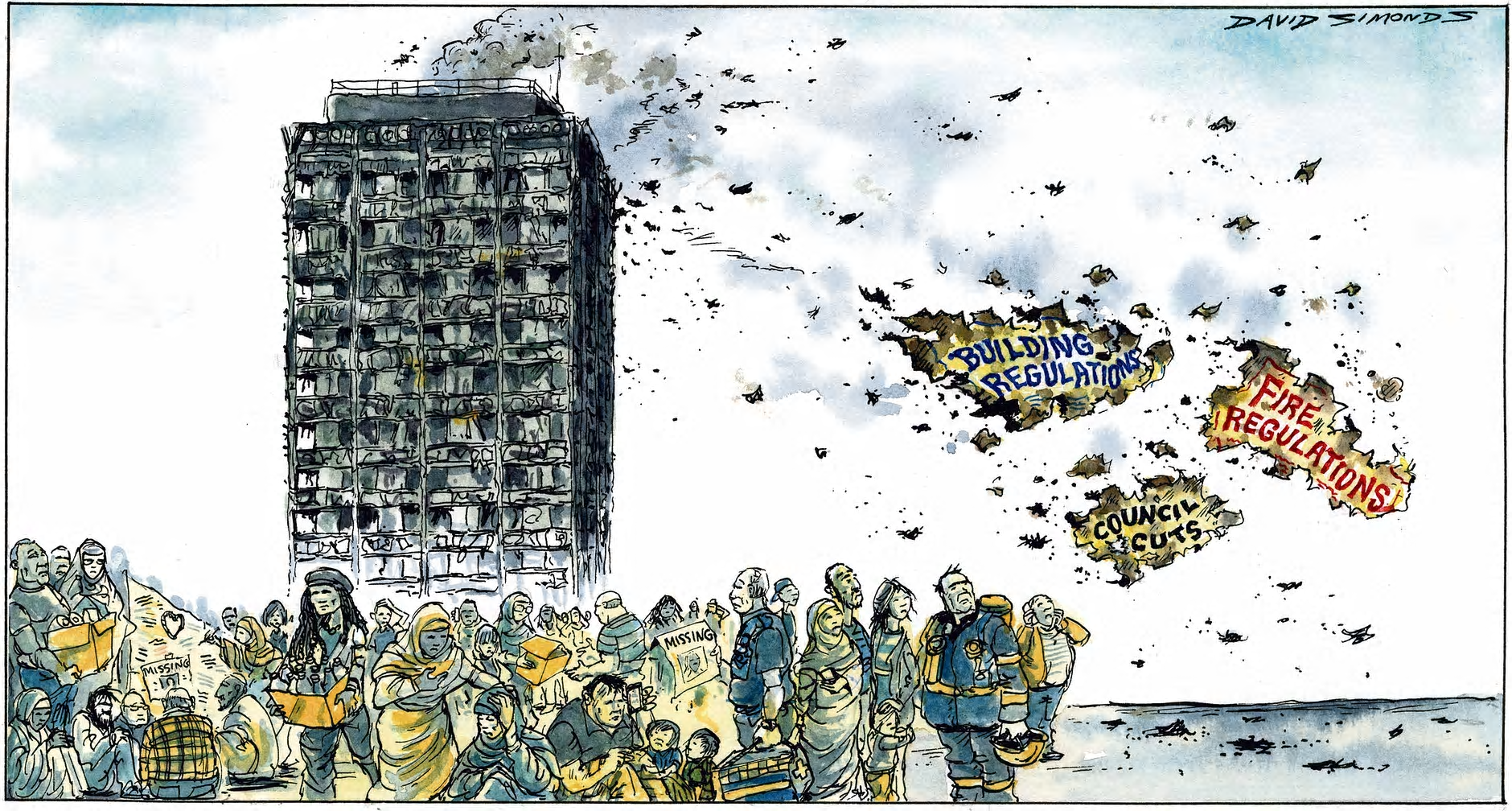
Drawing by David Simonds, The Observer, 18 June 2017
'In spite of the utter failure of academic and professional economists to predict, explain or find solutions to the financial and economic crises sweeping the globalised, marketised world they have created, there is still little challenge to the narrow and one-sided way that economics is taught in our universities. In spite of the fact that economics is about complex human relationships, and is therefore bound to be the subject of debate and disagreement, there is no problem with university courses that only teach the neoclassical pro-market approach.’Calling all academic economists: What are you teaching your students?

“The faces of Grenfell Tower victims are the faces of the residents of tower blocks across Britain: working-class, poor and often reliant on the state for their housing and safety. Yet for decades we have been pushing the state out and bringing the private sector in. We privatise profits for shareholders, but it is the insurance policy the state provides that lets them get away with it, always stepping in when the failures of the private sector spill over.
When we privatise hospital cleaning, we get MRSA. When the private sector fails to build affordable housing, the taxpayer foots the bill through soaring housing benefit costs. This week we got firefighters running towards a burning building following serious shortcomings on the part of a landlord.
This goes way beyond party politics and left v right. In 2017 we have to ask serious questions about what we have become when refurbishments were made to the outside of Grenfell Tower last year at great expense, as much to improve the view from the luxury flats that have been built around it as to improve conditions for residents. In one of the country’s richest boroughs there could be no starker encapsulation of the grotesque inequalities that plague our capital city.”- David Lammy, Labour MP for Tottenham and the former minister for higher education
'The Grenfell Tower fire makes vivid, in the most horrible way, the fact that nothing embodies more than housing the inequalities and incompetencies of the country Britain has become. There has been a rumble for years that the established, mostly market-led responses are not sufficient. That rumble is now a roar.' The Grenfell tragedy exposes a tawdry culture that has held sway for too long
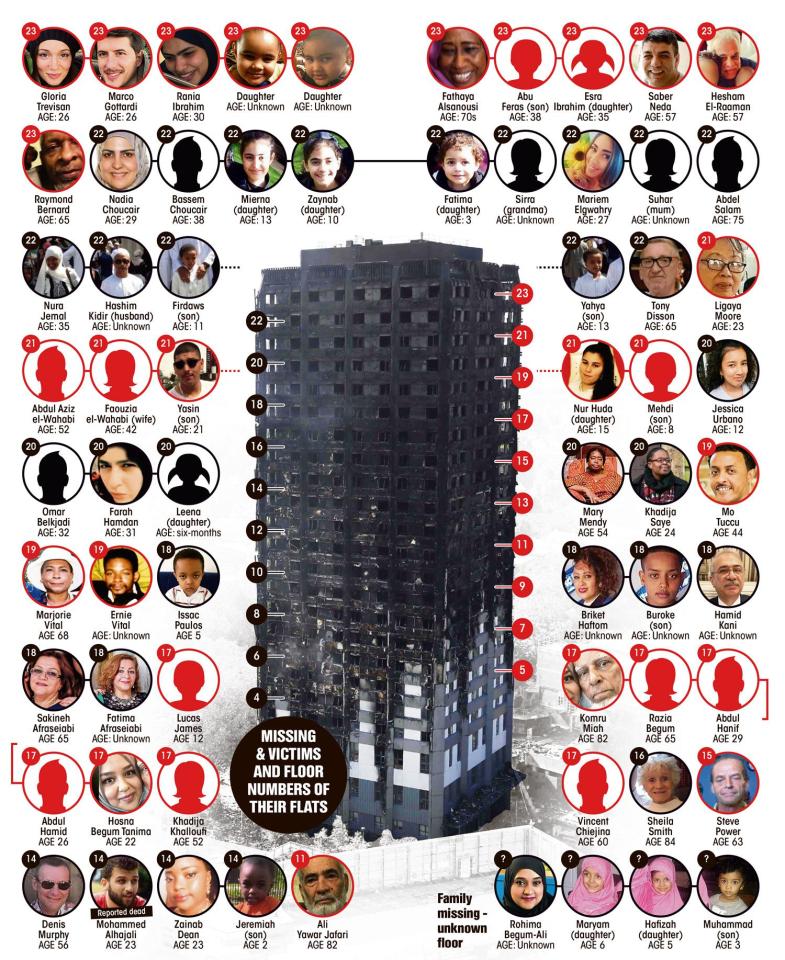
Photo:thesun.co.uk
With Grenfell Tower, we’ve seen what ‘ripping up red tape’ really looks like
‘Too often safety has been sacrificed to an agenda of deregulation backed by lobbyists: it’s time to put the public interest above corner-cutting and greed’-George Monbiot*
“For years successive governments have built what they call a bonfire of regulations. They have argued that “red tape” impedes our freedom and damages productivity. Britain, they have assured us, would be a better place with fewer forms to fill in, fewer inspections and less enforcement.
But what they call red tape often consists of essential public protections that defend our lives, our futures and the rest of the living world. The freedom they celebrate is highly selective: in many cases it means the freedom of the rich to exploit the poor, of corporations to exploit their workers, landlords to exploit their tenants and industry of all kinds to use the planet as its dustbin. As RH Tawney remarked, “Freedom for the pike is death for the minnows.”
“…But both Conservative and New Labour governments have been highly reluctant to introduce new public protections, even when the need is pressing. They have been highly amenable to tearing down existing protections at the behest of trade associations and corporate lobbyists. Deregulation of this kind is a central theme of the neoliberal ideology to which both the Conservatives and Labour under Tony Blair succumbed.
In 2014, the then housing minister (who is now the immigration minister), Brandon Lewis, rejected calls to force construction companies to fit sprinklers in the homes they built on the following grounds:
“In our commitment to be the first Government to reduce regulation, we have introduced the one in, two out rule for regulation … Under that rule, when the Government introduce a regulation, we will identify two existing ones to be removed. The Department for Communities and Local Government has gone further and removed an even higher proportion of regulations. In that context, Members will understand why we want to exhaust all non-regulatory options before we introduce any new regulations.”
In other words, though he accepted that sprinklers “are an effective way of controlling fires and of protecting lives and property”, to oblige builders to introduce them would conflict with the government’s deregulatory agenda. Instead, it would be left to the owners of buildings to decide how best to address the fire risk: “Those with responsibility for ensuring fire safety in their businesses, in their homes or as landlords, should and must make informed decisions on how best to manage the risks in their own properties,” Lewis said.
This calls to mind the Financial Times journalist Willem Buiter’s famous remark that “self-regulation stands in relation to regulation the way self-importance stands in relation to importance”. Case after case, across all sectors, demonstrates that self-regulation is no substitute for consistent rules laid down, monitored and enforced by government.
Crucial public protections have long been derided in the billionaire press as “elf ’n’ safety gone mad”. It’s not hard to see how ruthless businesses can cut costs by cutting corners, and how this gives them an advantage over their more scrupulous competitors.”
And now, please God help us, the powerless in Britain- with Brexit, We are all going to be Victims and more Powerless
“The “pollution paradox” (those corporations whose practices are most offensive to voters have to spend the most money on politics, with the result that their demands come to dominate political life) ensures that our protections are progressively dismantled by governments courting big donors.
Conservative MPs see Brexit as an excellent opportunity to strip back regulations. The speed with which the “great repeal bill” will have to pass through parliament (assuming that any of Theresa May’s programme can now be implemented) provides unprecedented scope to destroy the protections guaranteed by European regulations. The bill will rely heavily on statutory instruments, which permit far less parliamentary scrutiny than primary legislation. Unnoticed and undebated, crucial elements of public health and safety, workers’ rights and environmental protection could be made to disappear.
Too many times we have seen what the bonfire of regulations, which might sound like common sense when issuing from the mouths of ministers, looks like in the real world. The public protections that governments describe as red tape are what make the difference between a good society and barbarism. It is time to bring the disastrous deregulatory agenda to an end, and put public safety and other basic decencies ahead of corner-cutting and greed.”
*With Grenfell Tower, we’ve seen what ‘ripping up red tape’ really looks like
‘As the country fell silent yesterday for the Grenfell Tower victims, David Davis was opening negotiations to take the UK out of the EU. How did it come to this great kamikaze mission? What fired up a small and eccentric group of rightwing extremists to hammer away over the decades until they dragged us away from our closest neighbours?
One word captures their intent – and it concerns the Grenfell residents: “deregulation”. These Brexiteers are driven by a kind of fever to tear down restrictions, regulations, laws and constraints on business to let free enterprise run wild. That’s what they mean by “take back control”, though it’s not how they explained their shrink-the-state passion to referendum voters’: Brexiteers call it useless red tape, but without it people die
But, what about the human cost of the Bastard Economics of Cost-cutting and Deregulation?
‘…Shahrokh Aghlani blamed the government for “cutting costs, cutting costs, cutting costs” and neglecting the building’s fire safety system. “There wasn’t even a fire extinguisher there. I’m a taxi driver in London. If I don’t have a fire extinguisher in my car, they wouldn’t give me a licence. How come they would allow a building without sprinklers or fire extinguishers?” he asked. Iranian family of Grenfell victims call on UK to grant them visas
Now, here you have it, a bastard ideology, guiding market-fundamentalists, building towering infernos, creating killing fields, and much more, all in the interest of greed and huge profits for a few. Where is justice, when you need it, you may justifiably ask.
Apartheid London: social cleansing ruined the minestrone streets I grew up in: Ed Vulliamy tells of his grief and rage at the ruthless development that has divided the Grenfell Tower area where he was raised
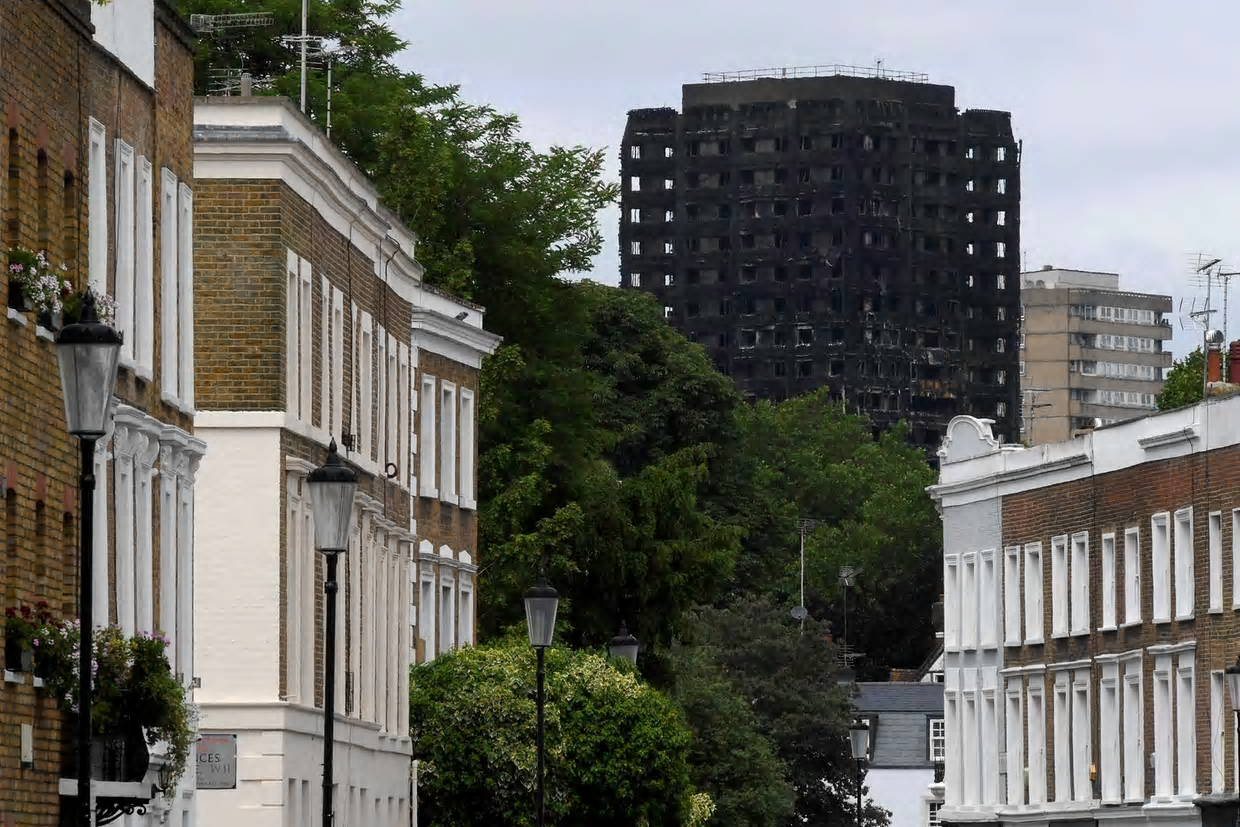
Grenfell Tower seen from wealthy Holland Park, very close to the street where Ed Vulliamy grew up.
Photo:theguardian.com
'Last Thursday evening my mother and I looked out from our stairway landing at what is now the outrageous crematorium on the skyline. By Friday morning I’d counted only a couple of hours’ sleep, as the hollow eyes of charred Grenfell Tower stared through the window; the nights haunted with ghosts of those missing – some from my local pub – and with grief and rage.
'...Local government became as much like running a private railway company as an authority: not to provide a service so much as make money. This, in practice, meant to wield little actual authority– but the reverse: to serve those whose creed is greed. I am not the first person to publicly use the word “apartheid” this week, though we’ve used it in private for years to describe what happened to Notting Hill. It was deployed by a presenter on LBC radio on Friday morning, who said that the rich and poorer communities lived “a few hundred yards away, but worlds apart, from one another”.
With the changes, lines have been drawn. The threads of that complex, convivial weave in which I grew up have been torn out and re-sewn, managed into a tapestry of brutal lines, on one side of which lies today’s road whence mum and I beheld the now skeletal Grenfell Tower.' Apartheid London: social cleansing ruined the minestrone streets I grew up in
For an alternative to Bastard Economics and Ideology of Neoliberalism see the link below:
What is this life all about?
Why am I here? What’s my Life’s purpose? How can I make the most of my Life?
- This says it all: Greed is the Killer-A Lesson for All
- Let’s Go to the Woods When Life Feels Overwhelming and Impossible
- I went to the woods to live deliberately- Henry David Thoreau
- The ‘Earth’s Desire’: Remembering the Life and Legacy of Fr. Thomas Berry on the 15th anniversary of his passing
- Is your glass of life half full or half empty, or both or neither? This is the Question!
- What does democracy look like? A view from a 14th Century fresco in Siena, Italy and today’s Trump’s America
- The GCGI-SES 2018 Joint Conference: Lucca, Tuscany