
- Details
- Written by: Kamran Mofid
- Hits: 6078
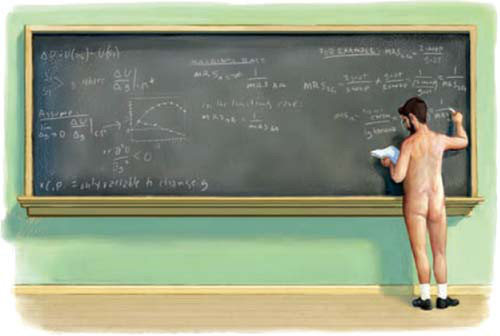
"Today's neoclassical economist is an emperor with no clothes who's fooled us all long enough."
Photo: transitionvoice.com
“This book outlines the foundations of new economics, where justice, human dignity, compassion, and reverence for life are the guiding values. Contrary to the assumption of mainstream economists that economics is a value-free science, new economics must make its values explicit.”
I came to know about “Economics Unmasked” when I read Prof. Herman Daly’s excellent review*. I then ordered a copy for myself. It arrived two days ago. I cannot explain it adequately how much I am enjoying reading it.
I cannot wait until a later date, when I will be able to share my own review with you. Thus, in my haste and utmost wish to bring this book to your attention, I now wish to share Prof. Daly’s review with you.
Please order a copy of this book. Believe me you will not be disappointed.
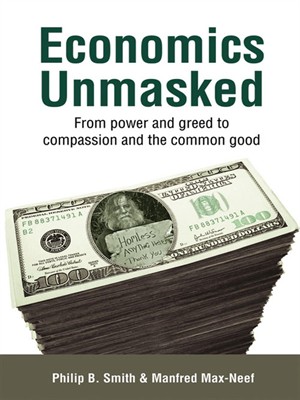
Economics Unmasked: From Power and Greed to Compassion and the Common Good
Philip B. Smith& Manfred Max-Neef
First edition- Green Books, Cambridge, Great Britain, 2011
Reviewed by Herman Daly
“Manfred Max-Neef is a Chilean-German economist noted for his pioneering work in human scale development and his threshold hypothesis on the relation of welfare to GDP, as well as other contributions, for which he received the Right Livelihood Award in 1983. Phillip B. Smith (deceased, 2005) was an American–Dutch physicist with a devotion to social justice that led to an interest in economics. Smith died before this collaborative work was completed, so it fell to Max-Neef to finish it, respecting what Smith had done. Although this results in differences in style and approach between chapters, Max-Neef informs us that they both read and approved each other’s contributions, so it is a true collaboration. These differences between the physical and social scientists are complementary rather than contradictory.
As clear from the title, the book argues that modern neoclassical economics is a mask for power and greed, a construct designed to justify the status quo. Its claim to serve the common good is specious, and its claim to scientific status is fraudulent. The latter is sought mainly by excessive mathematical formalism to the neglect of concrete facts and real values. The mathematical formalism is in imitation of nineteenth century physics (economics viewed as the mechanics of utility and self-interest), but without any empirical basis remotely comparable to physics. Pareto is identified a villain here, and to a lesser extent Jevons…
Continue to read:
*Economics Unmasked « Center for the Advancement of the Steady State Economy
See also:
- Details
- Written by: Kamran Mofid
- Hits: 6346
"Simplicity is the sign of mastery. You’ve not avoided the difficulties, you’ve solved them. And then everything falls neatly (and with apparent ease) into place. True work, we might say, is making the simple feel easy."
"When we say we’d love a simple life, part of what we’re saying is we’d like to be confident enough to have a simple life, confident not to mind the sarcasm and judgements of others. Simplicity is the opposite of pretension, where we must pretend we are more than we are in order to please others; here we can take the risk of being very minimal, sure that we don’t need the approval of the crowd."
Have you ever stopped and thought about what this life is all about? Have you ever asked yourself questions such as these: How fast is your life moving? Do you ever wish you could slow it down? Ever wish you had a few more hours in the day so you could get everything done you need to get finished? What if, instead of always trying to do more, we slowed down a little and embraced a slower paced life. What if we didn’t try to do everything, but slowed down and concentrated only on the things that are truly valuable and important to us.
We’re discovering the big meaning of simplicity in our lives. In the past, there were times when no one wanted simplicity. Few people had enough, stimulation was in short supply, dull routine was the norm. Simplicity could look like deprivation, boredom or lack of opportunity. Now it’s so different. We’ve got too much to do, we’re constantly assailed by demands and offers, we’re brought up against too much complexity all the time. We’re realising we positively need simplicity: it’s a guide to a better life.
Simplicity is in short supply. We need a lot more of it.
What follows is a short diagnostic of simplicity:
Why a Simple Life Matters: The Path to peace and happiness lies in the simple things in life
- Details
- Written by: Kamran Mofid
- Hits: 12668
To give a Nobel Prize In Economics, year in, year out, mainly and predominantly to a male economist from the United States’ Ivy League Universities, regurgitating the same mathematical/neo-liberal nonsense is neither Noble nor clever. Is it?
“Facing a similar crisis of legitimacy, the prize needs to prove it is much more than an award for stockmarket speculators”
“There is no doubt that, as noted by scores of observers around the world, the reputation of the Nobel Prize in Economics, as well as the economists themselves are in urgent and desperate need of repair and building up, not only in the wake of the global financial crisis of 2008, but even well before that. As much of mainstream economics became obsessed with navel-gazing esoteric mathematical models or theories designed to justify market liberalism, the public became relatively more alienated from the activities of economists. In such a context, the Nobel Prize has been a useful tool not only to proclaim the conceptual advances supposedly made by "the dismal science" but also to encourage certain types of economic analysis and research. So its power extends beyond public recognition, altering the very production of economic knowledge.”…**
How to make the Nobel Prize in Economics Noble?
The answer lies in simplicity, wisdom, the common sense and the common good
Nobel Prize in Economics in the Interest of the Common Good
The Prize should be given to those economists who can prove beyond reasonable doubt that they are now truly “Recovered” economists and not “toxic” anymore.
This “Recovery” can be established by their willingness to sign up to the following statement:
As a “Recovered” teacher of economics, I acknowledge that the teaching of economics today is a scandal. Furthermore, I now know that I was wrong to believe:
that we do not want any philosophical or empirical questioning of the canonical assumptions upon which the whole superstructure of mathematical deduction in modern economics is based, and that growth must not be questioned because it is by definition the solution to all problems — even those that it causes.
I now recognise that our socio-economic problems are closely linked to our spiritual problems and vice versa. Moreover, socio-economic justice, peace and harmony will come about only when the essential connection between the spiritual and practical aspects of life is valued. Necessary for this journey is to discover, promote and live for the common good. The principle of the common good reminds us that we are all really responsible for each other – we are our brothers' and sisters' keepers – and must work for social conditions which ensure that every person and every group in society is able to meet their needs and realize their potential. It follows that every group in society must take into account the rights and aspirations of other groups, and the well-being of the whole human family.
I declare that I have given up my arrogance. I am now a humble economist and am able to show my humility by accepting and supporting the following principles:
Dialogue: Communication is the most appropriate vehicle for understanding “others”, enhancing intercultural cooperation, creating goodwill, and establishing sound international relations.
Justice: Justice is the key factor in dealing with all human relationships and activities. It is the creation of a global atmosphere in which all people are treated in a humane and just manner. Justice in society is not possible without a greater commitment to a more equitable distribution of both income and wealth.
Sustainability: In this fast changing world of today, our choices will determine not only how we live in the short run but also how succeeding generations will live in the distant future. We must bear in mind the needs of future generations.
Ecology: Human society and human economics must also make room for other species to thrive. This also is a moral imperative.
Service: The most appropriate personal and collective actions through which we can achieve social justice and ecological integrity throughout the world.
And finally, I will do my utmost to achieve the above by teaching my students to discover “simplicity, patience and compassion” as they embark on their studies, by reminding them of the wisdom of ancient traditions and philosophies:
“Some say that my teaching is nonsense.
Others call it lofty but impractical.
But to those who have looked inside themselves,
this nonsense makes perfect sense.
And to those who put it into practice,
this loftiness has roots that go deep.
I have just three things to teach:
simplicity, patience, compassion.
These three are your greatest treasures.
Simple in actions and in thoughts,
you return to the source of being.
Patient with both friends and enemies,
you accord with the way things are.
Compassionate toward yourself,
You reconcile all beings in the world.”-Lao Tzu
Dear Nobel Prize Committee for Economics and Board of Riksbanken,
I hope you are listening. I would like to conclude by saying that economics must find its true path and needs to re-ground itself in moral philosophy to cope with the deeper, broader questions of human existence, meaning of life, and happiness, ever mindful that humanity is part of a larger community of multiple species and elements, necessary for our survival and health.
The current, continuing and deepening global crises of social injustice, inequality, loss of community and thereby dire economic insecurity for hundreds and hundreds of millions of people shows no sign of ending soon. At the same time the environmental crisis, consisting of climate change, habitat loss, pollution, and waste, grows exponentially, even as human institutions and structures prove themselves to be both incapable of dealing effectively with the crises and at the same time standing in the way of needed progress.
It is time that all those economists aspiring to be good acknowledge that we, as a global human society must set our sights upon the Common Good and this involves four basic realizations:
1) Human Beings need contact with other human beings. We need relationships as we are social beings. It is in our relationships that we find genuine happiness and meaning.
2) Human Beings need community, apart and distinct from our individual relationships with other human beings. There is a connection to the whole, a belonging to the community which is key to happiness and meaning. Such is manifest in socializing and education among many other aspects of community.
3) A respect for the Common Good is essential for the psychological and spiritual health of the individual.
4) Nature, the web of life, and the integrity of the earth are also part of the Common Good, and neither the human community nor the individual person can be healthy without this aspect of the Common Good.
In order for Economics to be not only part of the transition and change which is so desperately needed, but also to play a leading, constructive role, of which it is capable, we call for a significant change in Economics and among Economists in the face of the need for dialogue to find specific solutions.
Good economists must acknowledge that, there is a need to go well beyond the standard models and the typical mathematical assumptions. We must reach out more deeply and more broadly for wisdom. Now is the time for a revolution in Economic thinking.
Economists must find ways to incorporate all of the lessons in equality, social justice, ecological balance, and respect for the earth, community and relationship into its standard approach. And that incorporation will be the revolution in economic thinking for which I am calling.
Economics must change. Economists must change. What we teach students must change. It must change if it is to play a constructive role in solving the multiple and multi-dimensional crises that have engulfed our world, our species, the fabric of human community, relationships, and the web of life. We are running out of time. If our discipline does not change, if the revolution in thinking we have called for does not happen, if we do not revisit the rich and fertile soil from which our subject sprang, that is moral philosophy, to find answers to the broader questions of human existence, meaning of life, and ecology, then not only will we have retreated from the chance to play a constructive role in solving these crises, we will inherit well deserved scorn and contempt. The opportunity is upon us. Let us seize it. Carpe Diem!
Read more:
** Dismal Scientists Discover the Truth: The Prize is not Noble and Economics is not a Science
- The chairman of Barclays agrees with me: Better late than never
- Dismal Scientists Discover the Truth: The Prize is not Noble and Economics is not a Science
- A New Nobel Prize: Economics in the Interest of the Common Good
- Yet another Nobel Prize in Economics: An affront to humanity and truth
- Remembering a Heroine Called Nurse Edith Cavell