
- Details
- Written by: Kamran Mofid
- Hits: 4344
“...tomorrow morning Coventry will lie in smoke and ruins.” – Josef Goebbels, Ministry of Propaganda
At this time of nationalism and bombast, the Coventry message of hope reminds us of our shared humanity across backgrounds, faiths, civilisation and cultures. And at a time when our country is divided, pitting itself against our European neighbours, we’d do well to remember the hopeful and enduring story of Coventry.
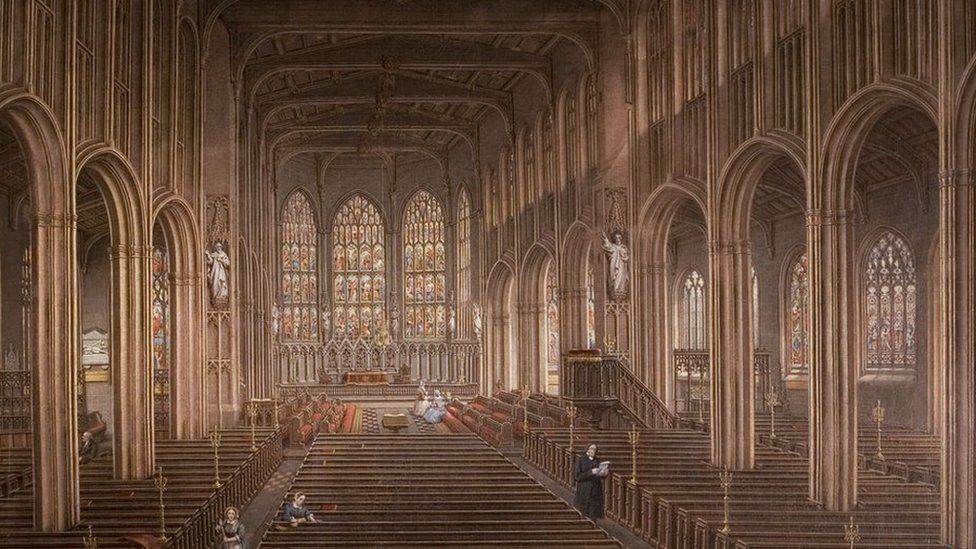
St Michael's was elevated to cathedral status in 1918 but destroyed in 1940- Bridgeman Images
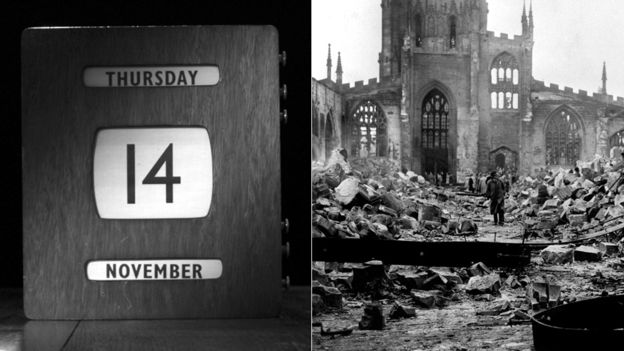
Photo:PA
The Enduring Beauty and Wisdom of Coventry Cathedral
This is Why Coventry Cathedral Has Inspired the World
After the devastation of World War Two, Coventry Cathedral, inspired by its visionary Provost, Richard Thomas HOWARD, did something remarkable – they sought forgiveness and reconciliation rather than revenge and more wars of destruction.
A Portrait Of Humanity: Provost Howard’s Gift to the World

The very Reverend Richard Thomas HOWARD (12 June 1884– 1 November 1981), Provost, Coventry Cathedral, 1933 to 1958
Richard Howard: The Man who has inspired us all to reimagine a better world: A World of Hope and Healing
This is Coventry’s Message to the World: Remember and Forgive, Reconcile and make Peace
A Message of Humility, Kindness and Hope
A Message for Our Time, A Message for All Time
14 November 1940: The Destruction and Rebirth of Coventry
“On 14 November 1940 the Luftwaffe launched its most devastating bombing raid of the Second World War so far. The target was Coventry, a manufacturing city in the heart of England with a beautiful medieval centre.”
‘in just one night more than 43,000 homes, 71 factories, the entire city centre, two hospitals, two churches and the police station had been destroyed by 449 German bombers, dropping 30,000 incendiary bombs. An estimated 568 people had died in the raid on the first night of bombing, with over one thousand people sustaining serious and life-threatening injuries;
‘as a result of their efforts, the Nazis coined the verb Coventrierung (literally, to Coventrate) to describe total annihilation of a city through aerial bombardment;
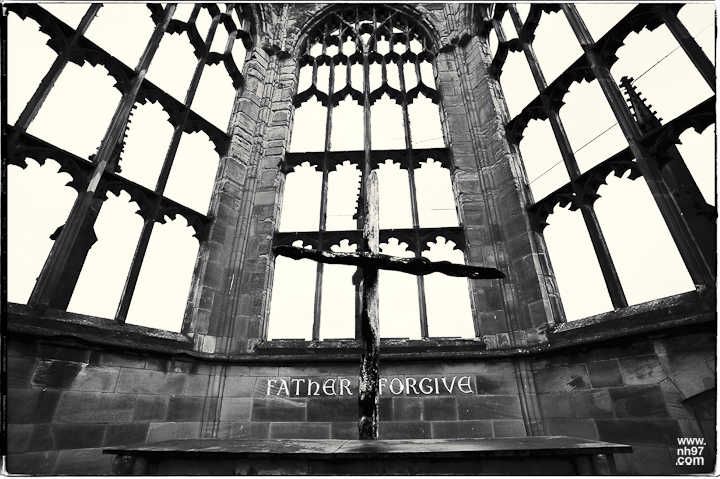
‘the next morning, while the rubble was still smouldering, Richard Howard, the cathedral Provost, had taken a piece of chalk and written on the sanctuary wall: “Father, Forgive”;
‘Richard Howard had made a bold move to break the cycle of vengeance. When the 1940 BBC Christmas Day service was broadcast from amongst the ruins of the cathedral, he vowed that, once the war was over, the cathedral would work with the people who had previously been their enemies “to build a kinder, more Christ-like world”;
‘inspired by the cathedral’s stonemason, who had made a wooden cross from the debris, Provost Howard made a cross from the nails that originally held the roof together. The destroyed altar was remade from the rubble, the crosses were placed on the new altar and the words “Father, Forgive” were inscribed on the wall behind;
‘after the war ended, the cathedral donated a “Cross of Nails” to the Kaiser Wilhelm Memorial Church in Berlin, which was also destroyed in the war. Today there are over 170 Cross of Nails Centres across the globe, each one owning a cross made from three nails from Coventry Cathedral, symbolizing the road to forgiveness and reconciliation…’ Continue to read: Father Forgive: It’s Impact on Me
The Coventry Litany of Reconciliation: The Charter for Forgiveness and Reconciliation the World Ever Needs
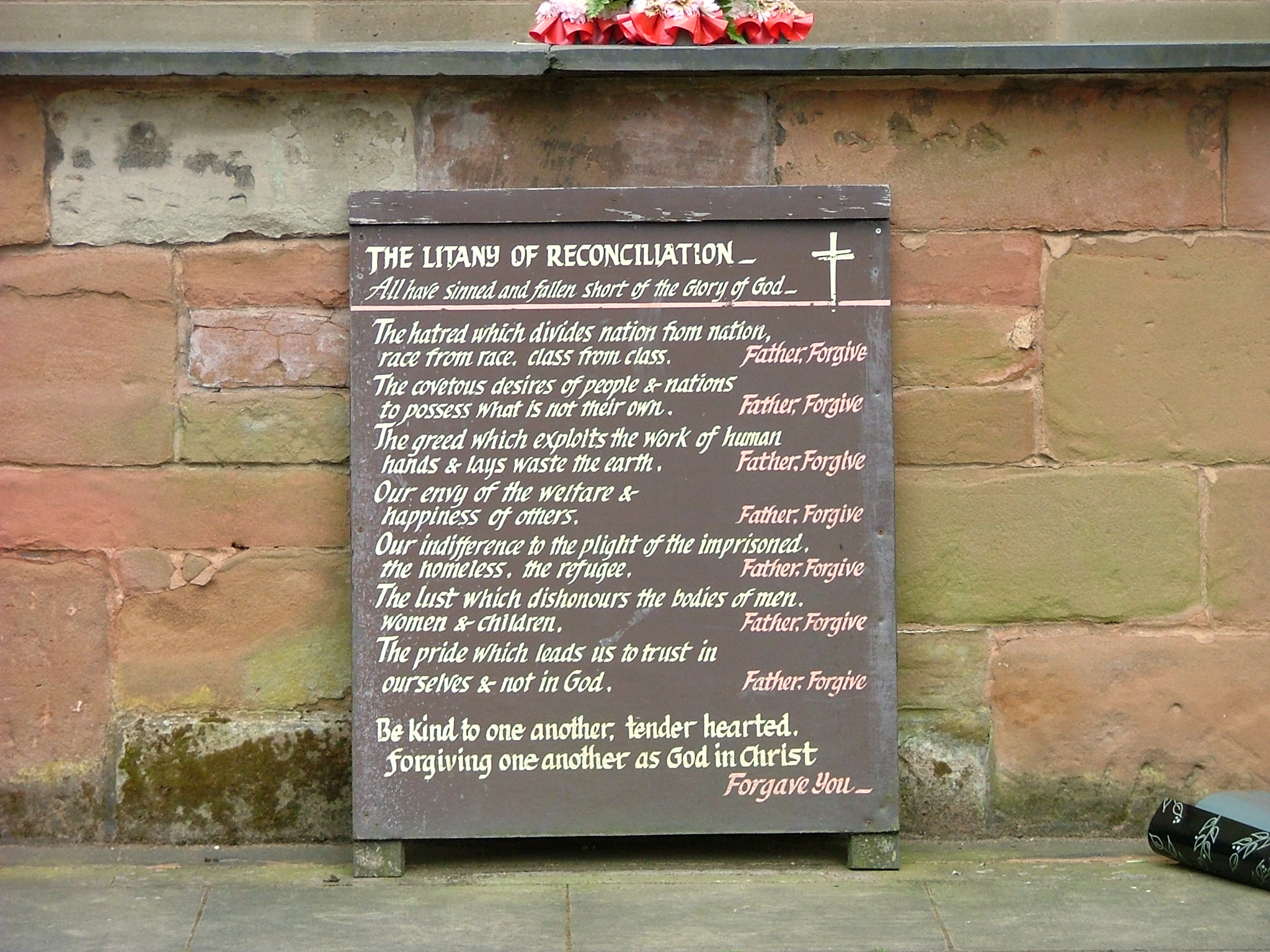
Photo: kmyra.ca
This is, once again, the timeless and noble message from Provost Richard Howard and Coventry Cathedral to those who think anger, revenge, retribution and war are what is needed to settle personal, regional and international disputes:
‘In the midst of war – a time when anger and defiance could have ruled the day – Provost Howard chose the harder, more transformative path. I wonder how our world might be changed today if we took on living the words of this Litany.’
‘After the bombing of Coventry Cathedral in 1940, Provost Richard Howard put the words “FATHER FORGIVE” on the wall behind the charred cross in the ruins of the destroyed cathedral in 1948. Not “Father forgive Them” – because we all have sinned and fallen short of the glory of God (Rom 3,23). These words have moved generations of people and are prayed in the Litany of Reconciliation every Friday at noon outside in the ruins, and in many other places around the world.
The Litany of Reconciliation, based on the seven cardinal sins, was written in 1958 by Canon Joseph Poole, the first Precentor of the new Cathedral. It is a universal and timeless confession of humanity’s failings, but it evokes us to approach these sins and weaknesses in the forgiveness of God’s love.’...Continue to read
...And this is What Provost Howard’s ‘FATHER FORGIVE’ has Meant for Today: Lest We Forget
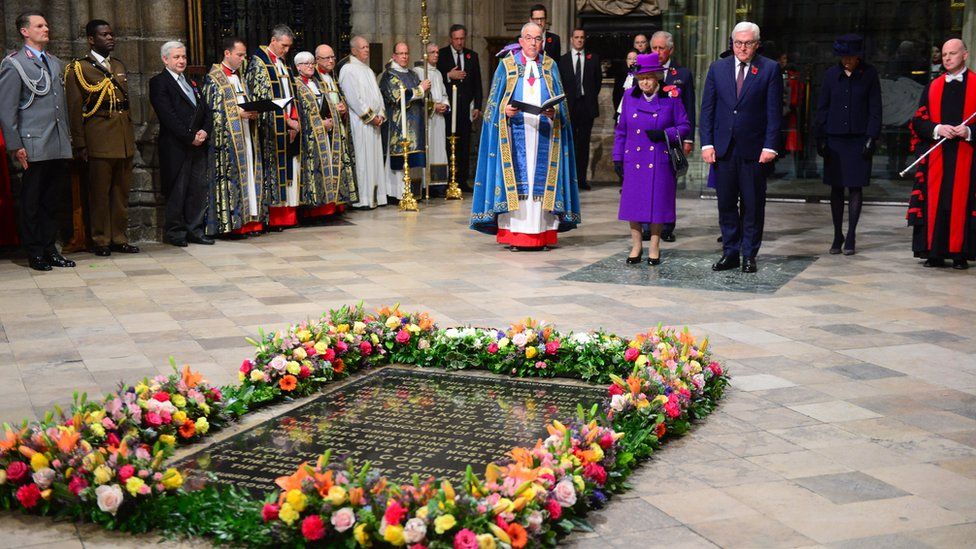
The Queen and Germany's President Frank-Walter Steinmeier attending a remembrance service at Westminster Abbey for those killed and wounded in the First World War, on Sunday 11 November 2018, 100 years since Armistice Day. GETTY IMAGES
Thank you Provost Howard. Thank You.
- Details
- Written by: Kamran Mofid
- Hits: 2342

Photo:bing.com
'Corinthian, a behemoth of the for-profit college industry that marketed its vocational and post-secondary programs to single mothers at or below the poverty line...'
Last week I posted a Blog asking a pertinent question: What is EDUCATION if it is not about VALUES?
Today, after reading a fascinating article about the tragic and inhumane tale of profit-driven colleges in the US, scamming society’s most vulnerable (The new form of slavery), I came to appreciate even more the significance and the wisdom of the question I had asked above.
So, here you have it. Please first read What is EDUCATION if it is not about VALUES? If you have not done so already, and then, read the excellent review of the FAIL STATE by Jake Nevins, and begin to pity our world that has become so corrupt and values/moral/ humanity-free, destroying every fabric of our lives.
'Phenomenally saddening': inside the sordid world of America's for-profit colleges

Photo:documentary.org
The new documentary Fail State, tells the 50-year tale of profit-driven colleges scamming society’s most vulnerable in America
A Review by Jake Nevins*
In 2014, film-maker Alex Shebanow read about Corinthian Colleges, one of America’s largest for-profit college companies, while working on a documentary about student loan debt.
Relying heavily on federal student loans, from which it took $1.4bn in yearly revenue, Corinthian was on the brink of collapse after the department of education halted the company’s flow of federal funding due to evidence of rampant fraud in its reporting of grades and job placements.
Corinthian, a behemoth of the for-profit college industry that marketed its vocational and post-secondary programs to single mothers at or below the poverty line, was already under investigation by various federal agencies, the education department, and 20 different state attorneys general when it said it could not operate for more than a few days without an influx of cash. Internal documents revealed the for-profit specifically targeted “isolated” and “impatient” individuals with “low self-esteem”.
It was this run-in with the sordid underbelly of the predatory for-profit college industry – and a multi-state investigation into a company, QuinStreet, that set up an ostensibly government-run website funneling veterans to for-profits – that inspired Shebanow to expand the scope of his project. The result is his new documentary Fail State, an expansive and infuriating account of the rise of profit-driven colleges, their devastating effects on low-income students, and the ways Republicans and Democrats have aided and abetted their treachery.
“I don’t know how these people can sleep at night,” says Shebanow, whose work so impressed Dan Rather that the famed journalist signed on as an executive producer. “A lot of people don’t realize what’s percolating beneath the surface. It was crazy that no one had done a documentary on this until now and that it took a bunch of twentysomething film-makers to do it. I was always so worried someone was going to come out with a documentary of their own because the story is so big and important. I thought there was no way we were the only ones doing it. But somehow, that was the case.”
As Fail State explains in broad, digestible fashion, all of this began in 1972, when for-profits, often called proprietary, vocational, or career-driven colleges, became eligible for federal student aid under an amendment to Lyndon B Johnson’s Higher Education Act of 1965. The rerouting of financial aid money from institutions to students themselves was meant to allow private universities to compete with public ones, whose low costs made enrollment swell. But this opened the door for profit-driven colleges, who took advantage of the desire to make higher education more inclusive by encouraging students to take out huge sums of financial aid money.
These companies promised students eventual employment and, since the money was coming from taxpayers, had no vested interest in whether or not the students could pay back their loans. As an expert says in Fail State, for-profits had what amounted to risk-free access to the US treasury. Predictably, default rates soared in the 1980s, with almost half of all students at these colleges defaulting on their loans. By 1992, however, lawmakers began to wise up to the predatory recruitment practices and the virtually useless degrees these colleges were offering students.
At the time, a series of congressional hearings, and the attention of Congresswoman Maxine Waters (who appears in the documentary), helped set in motion a series of provisions that would allow for oversight of the for-profit industry: the 85-15 rule, requiring that at least 15% of the companies’ revenue came from sources other than government student aid; the 50/50 rule, ensuring no more than half of college courses were offered online or by mail; and the incentive compensation rule, banning college recruiters from receiving bonuses based on how many students they lured to the program. In the following decade, though, congressional interest in policing the for-profit sector waned and many of these regulations were dismantled or otherwise softened.
Shebanow’s documentary guides viewers through all this potentially wonky information with a careful hand, emphasizing the fact that Democrats and Republicans alike have been guilty of lenience toward and even support for profit-driven colleges. Sally Stroup, George W Bush’s assistant secretary for postsecondary education, was previously a lobbyist for the Apollo Education Group, which runs several for-profit institutions such as the University of Phoenix and Western International University. Nancy Pelosi and members of the Congressional Black Caucus, too, have also been historically cozy with representatives of the for-profit sector.
“It wasn’t like we set out to make the most non-partisan film that we could,” says the director. “It was more like, ‘Here are the facts’. And it was in some ways a happy accident that this issue transcends red and blue politics.”
Where Fail State makes its greatest impact is in the testimony it provides from students who were scammed. They attest to being harassed with phone calls, emotionally manipulated, deceived about costs, and persuaded that their post-secondary educations would land them implausibly high-paying jobs. A two-year investigation by the Senate health, education, labor and pensions committee, producing what Shebanow calls one of the most “damning” reports on a single industry in congressional history, found evidence of aggressive and insidious practices like the “pain funnel”, a script from which recruiters would read that was designed to prod at emotionally or financially susceptible prospective students.
A year into production, Shebanow and his team scoured the internet for these students and found hundreds of them commiserating in comments sections and company reviews.
“Part of what is so phenomenally saddening to me is that the people who are being affected and preyed upon by these schools are some of the most voiceless in our society, and their arcs are very similar,” says Shebanow, noting that students often encountered television, subway or internet advertisements for for-profits and received countless phone calls thereafter until they enrolled.
“They were promised the world. It was affordable. You don’t need to worry about your student loan debt. And they enrolled and realized their education was leading nowhere, or some realized the scam halfway through and dropped out, but had all this debt they’d taken on.”
That the president himself once ran a criminal for-profit education company – and that he’d appoint in education secretary Betsy DeVos a willing foot soldier for their cause – was not something Shebanow and his team anticipated when they began work on Fail State back in 2013. The saga of Trump University has been well-documented, but DeVos’s overtures toward the for-profit industry, including the elimination or rollback of Obama-era gainful employment and student borrower defense regulations, have gone mostly under the radar. DeVos, the director explains, is also tinkering with rules mandating “substantive teacher-student interaction”, which ensures students at for-profits are not navigating their coursework alone.
“As a journalist, you always dream of that hard-hitting story,” he says. “But the better the story, the worse the human tragedy. When I started this film I’d have never believed anyone who told me the film would be more relevant almost six years down the line.”
* This review by Jake Nevins was first published in the Guardian on Friday 9 November 2018
Lest We Forget
After giving us the 'BEST' University in the World
He then went on to become the 'BEST' Leader of the Very Free World!!
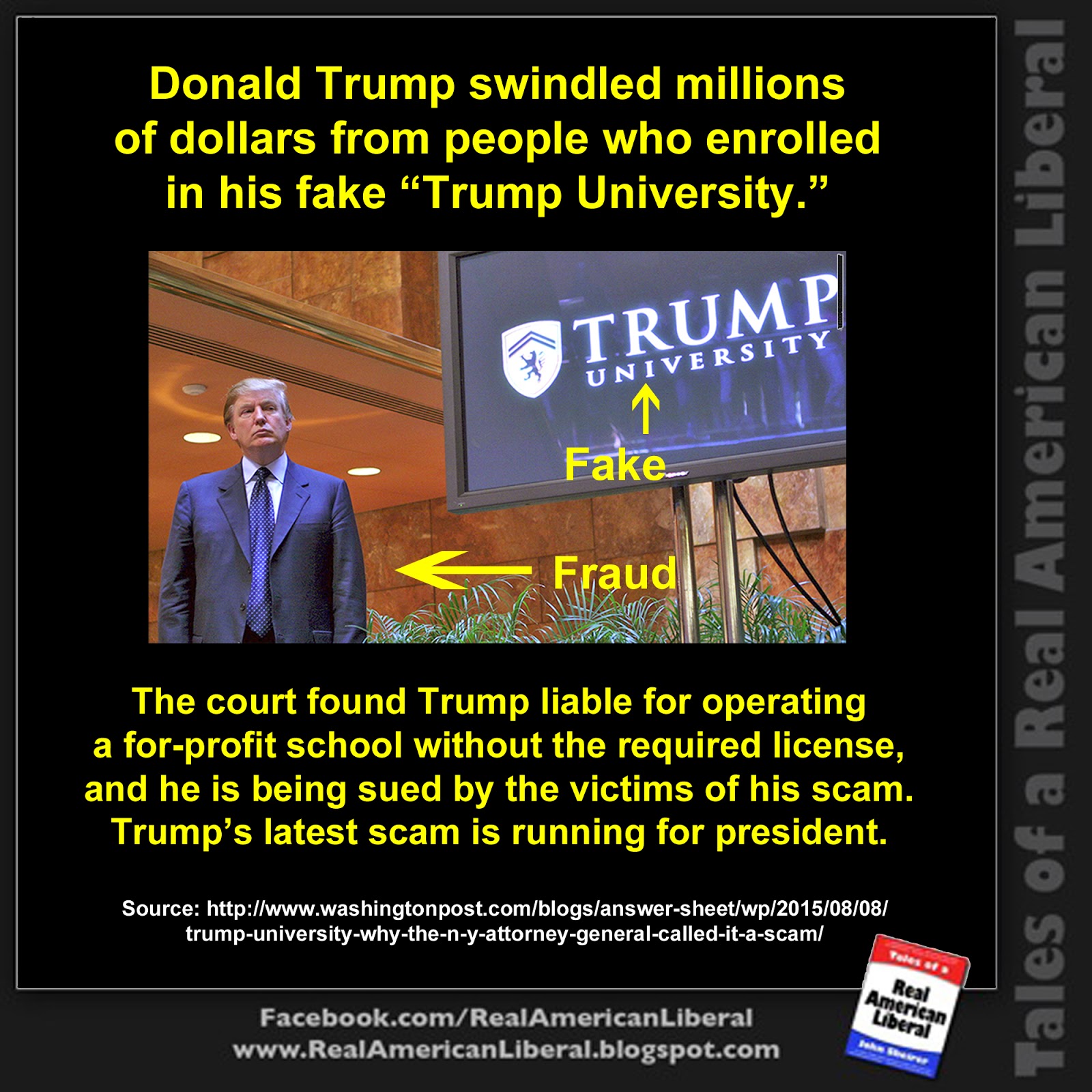
Yes, Trump University Was a Massive Scam
Trump University: It’s Worse Than You Think
And Now the Big Question:
What is the True Purpose of Education?
Values-led EDUCATION to Make the World GREAT Again
So away with the current values-free, for-profit education and usher in the new education model:
"Education to Build a Better Future for All"
Some say that my teaching is nonsense.
Others call it lofty but impractical.
But to those who have looked inside themselves,
this nonsense makes perfect sense.
And to those who put it into practice,
this loftiness has roots that go deep.
I have just three things to teach:
simplicity, patience, compassion.
These three are your greatest treasures.
Simple in actions and in thoughts,
you return to the source of being.
Patient with both friends and enemies,
you accord with the way things are.
Compassionate toward yourself,
you reconcile all beings in the world.-Lao Tzu
'We live in a world with many complex problems, at all levels, local, regional and global. It is said that education is the key that opens the door to a more harmonious world.
The pertinent question is: What kind of education and learning would help us address these challenges and create a sustainable world and a better life for all?
T.S. Eliot posed the question: "Where is the Life we have lost in living? Where is the wisdom we have lost in knowledge? Where is the knowledge we have lost in information?"
Reflecting on the questions above, we are going to need an education system that respects planetary boundaries, that recognises the dependence of human well-being on social relations and fairness, and that the ultimate goal is human well-being and ecological sustainability, not merely growth of material consumption.
The new education model recognises that the economy is embedded in a society and culture that are themselves embedded in an ecological life-support system, and that the economy can't grow forever on this finite planet.
In short, we need to listen to our hearts, re-learn what we think we know, and encourage our children to think and behave differently, to live more in synch with Nature.
If we do this successfully we can become wiser as a species, more “eco-logical.” We and the planet that gave birth to us can be happier and healthier, healed and transformed.'...
- Details
- Written by: Kamran Mofid
- Hits: 3010
The Enduring Lessons of John Law
The 18th-century financial genius has left us a remarkable legacy of economic concepts from a time when economic conceptualization was very much at an embryonic stage, and pioneered ideas about banking and monetary policy that are important to this day
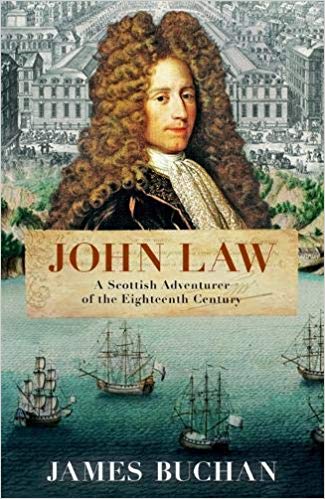
‘At the summit of his reputation in 1720, a period lasting just over one hundred days, Law was the most powerful man in France after the Regent, the Duke of Orléans. He was also the richest private citizen in Europe.
For France, brought to the brink by the wars and extravagances of the Sun King, Louis XIV, the Scotsman's financial innovations were a lifeline, but had for consequence a stock-market boom that came spectacularly to grief. The Mississippi Bubble, as it came to be known, left in France a fear of financial modernity that crippled her in her rivalry with Great Britain.
Over the centuries, John Law has been portrayed as a crook, a rake and a madman. James Buchan shows Law was none of those but a powerful mind in pursuit of a vision of public prosperity that overrode all ties to country, property or happiness. Many of his ideas are now the plainest orthodoxy.
Using Law's letters and writings, neglected family papers in Scotland and English county towns, bank ledgers in Genoa and Holland, notarial records and secret police reports in France and Venice, as well as the archive of the Jacobite court in exile, James Buchan resurrects Law's vagabond career. The result is a glimpse of one of the most astonishing lives ever lived.'-amazon.com
John Law: A Scottish Adventurer of the Eighteenth Century
By James Buchan
A Review by Jesse Norman*
‘John Law was by any standards a quite remarkable man. At the apogee of his power in 1720, he was the richest private citizen in Europe and controller-general of finance in France, responsible not merely for the country’s income and expenditure but for its commerce, navigation, agriculture and industry.
He created and presided over one of the earliest and greatest of all stock market boom-and-busts, that of the ‘Mississippi Company’, and inspired another, the South Sea Bubble. And he pioneered ideas about banking, monetary policy and financial markets that were revolutionary in his own time, and retain their importance three centuries later.
Yet Law was not French, not a noble, not an intellectual. On the contrary: he was a Scot, the largely self-educated son of an Edinburgh goldsmith, and a brilliant gambler. Oh yes, and a convicted murderer, who had escaped from jail days before his execution, fled Britain and gone on the run across Europe with his common- law wife.
The story is no less remarkable than the man himself. But both have almost been lost to view. The evidence is scant and scattered, Law himself something of an enigma, his era caught in a turn-of-the-18th-century limbo between the more familiar territories of the so-called ‘Age of Revolutions’, Glorious, American and French. And he is no one’s hero.
Until now, that is. For into this gap steps the polymathic figure of James Buchan: writer of fiction, history and reportage, and author among much else of an excellent life of Adam Smith.
Buchan tells the story and portrays the man with enormous sweep and brio. He has clearly done a vast amount of research among the primary sources, yet somehow manages to combine the historian’s sense of the wider picture with the epigrammatic wit of the novelist, and the antiquarian’s delight in curios.
Of the now forgotten Banbury Peerage case, for example, which first came to the House of Lords in 1661, was renewed in 1883 and may not quite be settled even today, he drily remarks that it was ‘a lawsuit beside which Jarndyce vs. Jarndyce… is an instance of judicial panic’.
This all makes for a heady mixture, which gives a slightly disjointed feel to a complex narrative on occasion, especially in the early chapters. There are few moments of summary and repose in which the reader can gather their thoughts and work out who everyone is, what exactly is going on and what is at stake. But once Law has settled in Paris in 1714 — having absorbed Dutch finance in the Hague and developed his ideas on banking (and made a fortune) in Genoa — then the story really takes off.
Rarely can an entry have been better timed, for the death of the Sun King Louis XIV the following year created turmoil in France. Politically, it led to a power vacuum, soon filled by the Duke of Orléans acting as regent for Louis’s five-year-old great-grandson Louis XV. It also laid bare the true extent of France’s depleted finances. The most powerful nation in Europe was broke. Decades of warfare had exhausted the public coffers and run up huge debts, while the king — and so the state — was forced to divert income to support a huge rentier class of office-holders.
To make matters worse, what taxes there were fell most heavily on the poor. Desperate attempts were made to cut costs by annulling the value of traded debt; the result was a rapid drop in trade and social uproar met by vicious repression.
France needed liquid capital, and it needed it fast. Little wonder, then, that Law’s banking scheme was taken up with enthusiasm by the Duke. In 1716 Law founded the General Bank — soon nationalised as the Banque Royale — which issued its own banknotes, paper money redeemable by coin.
But this was merely the start. Law soon turned his attention from finance. For him, the true purpose of money was not as a store of value but as a means to stimulate trade. Without new sources of revenue, France could never escape the merry-go-round of debt and devaluation. Accordingly, in 1717, he set up the Mississippi Company to build up trade in the vast new territory of Louisiana. Buoyed by favourable subscription terms, investors flocked to buy shares, which rocketed in value, fuelling a wider mania.
In due course, however, Law found himself consumed by his own creation: Company revenues were wildly overestimated and slow to grow, while supporting the Company’s shares with purchases funded by the issuance of banknotes broke the link with coin, leading to a bank run and a huge devaluation.
Yet this was no simple story of swindling, boom and bust. Unlike its South Sea counterpart, the Mississippi Company was a very serious commercial undertaking. In his brief period as controller-general, Law sought a radical simplification of the corrupt, complex and regressive French tax system.
His General Bank was an important innovation, which prefigured modern fractional reserve banking, and many of Law’s insights into money, political economy, monetary policy and banking remain profoundly important today. In effect, he sought to modernise France; to create what Adam Smith would later call a ‘commercial society’, and turn its rentiers into investors at risk. The irony is that his efforts set back France’s commercial development and ultimately compounded many of the problems he sought to solve; problems that would later set the scene for the French Revolution.
Law himself was no self-dealing Gordon Gekko: if anything, he was naive in his personal dealings to a degree. When the bank failed, he and his family were reduced to near poverty, the kindness of others and his own flickering prowess at the gaming table. It is a fascinating, poignant, almost heroic story, and we must thank James Buchan for giving us this masterly account of it.’
*This review by Jesse Norman was first published in The Spectator on 8 September 2018.
John Law
A Reflection by Eric Walberg*
Law’s law: Money = m*c2
‘The power to create money is equivalent to splitting the atom.’
And thus, The Big Question is: ‘So who should create the money?’
'John Law (1671--1729) is a forgotten prophet of economic theory, though everything we do today is based on his Money and Trade Considered: with a Proposal for Supplying the Nation with Money (1705). Schumpeter described him as “in a class by himself … in the front ranks of monetary theorists of all time.”
But it was Marx that really understood Law, “the pleasant character mixture of swindler and prophet.” Law’s misuse of his own theory exposed in embryo, spectacularly (and disastrously), how the stock market and speculation would lead to “a new mode of production”, where “enrichment through exploitation of the labour of others [becomes] the purest and most colossal form of gambling and swindling,” reducing “more and more the number of the few who exploit the social wealth.”
1893, 1929, 2008, anyone? Law was dismissed as a charlan and murderer,* the confidence man behind the Mississippi bubble in 1720. A Scottish economist who believed that money was only a means of exchange that did not constitute wealth in itself, and that national wealth depended on trade. Did I hear ‘banking is theft’ and ‘globalization’?
Gold as money: misplaced concreteness
Adam Smith took Law’s trade angle and spun it into his Invisible Hand. Smith plagiarized Law’s theory of value as based on supply and demand. He used Law’s diamond example of something that was both scarce (i.e., takes lots of labour to produce) and in high demand, which gave it ‘value’.
Money is the exception. It only represents the value by which commodities are exchanged, not having value per se. Worshipping gold as the magic substance that God gave to manage our economies is a classic case of Whitehead’s misplaced concreteness -- attributing an abstract quality to a physical substance.
Why do we think of gold** as money? As valuable? It is accepted as a reliable measure of exchange because its supply is scarce and it has demand (having a use ‘value’ in itself). But it creates trouble (deflation -> recession) because of its extreme scarcity. We can do better. That’s what Law figured out.
From gambler to economist
Law came by his interest in money naturally, as his father was Deacon of the Goldsmiths of Edinburgh. He was a lazy student and forewent university for hedonism and adventure, frittering away his inheritance.*** He applied his mathematical skills to gambling, recouped his fortune, and was appointed Controller General of Finances of France under the Duke of Orleans (regent to Louis XV).
Paper currency was Law’s bombshell. China had it from the 7th century, based on merchant receipts of deposit, though copper coins remained the basis of Chinese currency. In Europe, banknotes first appeared in 1661 in Sweden, guaranteed by the state, backed by gold. Law went a step further, establishing the Banque Générale in 1716, three-quarters of its capital consisting of French government bills and notes, effectively making it the central bank de la France, one of first in history, putting the state in charge.*** No need for gold backing.
Law realized what looks too simple to be true: that money creation will stimulate the economy, that paper money is preferable to metallic money, and that shares are the highest form of money since they pay dividends. Money producing money. Swindler? Confidence trickster? Yes, but blame capitalism, not Law.
He argued that anything could act as backing for money: gold, silver, land. But that ultimately, the backer was the sovereign. The buck/ sovereign stops here. As long as the sovereign is wise and everyone had confidence in him, there will be no bank runs; the economy will purr along.
Gold was traditionally the standard, because its scarcity acted as a strict control mechanism on an overly ambitious monarch. The king could at best debased his gold coins, but could only fool people so far, as price inflation set in with excessive spending.
Law’s policy of using state backed money to stimulate employment and regulate the economy trickled down from the 1930s on, but only when capitalism was in danger of being replaced by socialism. It took the desperation of the US economy hemorrhaging during the Vietnam war for his theory of fiat money to explode onto the world stage. On the 300th anniversary of his birth in 1971, Nixon took the US off the gold standard, making the world’s money the US dollar. Period. Nixon became our ‘wise monarch’, though in deference to the banksters, he didn't go as far as Lincoln's greenbacks and take away their money creating power.
Bubble economics
Law was working for Louis XV in the 18th century, not a reliable monarch to be the producer of money, and there were only the crudest statistics about the economy at that time.
The wars waged by Louis XIV had left the country completely wasted, both economically and financially. The resultant shortage of precious metals led to a shortage of coins in circulation, which in turn limited the production of new coins. Law proposed to stimulate industry by replacing gold with paper credit and then increasing the supply of credit.
As Controller General of Finances in 1720, Law effectively had control over external and internal commerce. His policies both dramatically increased trade and economic activity. He tried to break up large land-holdings to benefit the peasants; he abolished internal road and canal tolls; he encouraged the building of new roads, the starting of new industries (even importing artisans but mostly by offering low-interest loans), and the revival of overseas commerce—and indeed industry increased 60% in two years, and the number of French ships engaged in export went from sixteen to three hundred.
Galileo sans telescope
Law was économiste extraordinaire, the darling of Europe. But he was under Louis’ thumb. Louis took Law’s secret formula and ran with it. His wild spending created a mess, printing money that was used to build his palaces and to purchase the shares in Law’s brainchild, the Mississippi Company. That gained a crazed momentum of its own, leading to the bubble.
During the stock market bubble, the rush to convert paper money to coins led to sporadic bank hours and riots. Squatters now occupied the square of Palace Louis-le-Grand and openly attacked the financiers that lived there. It was under these circumstances and the cover of night that John Law fled Paris in disgrace, barely saving his own neck.
The peaceful atom
To get it right means having: *a stable ruler (NOT an absolute monarch or a populist demagogue), and *sophisticated statistical instruments to estimate the amount of money needed in production/ consumption, and its velocity of turnover.****
The power to create money is equivalent to splitting the atom. Money mobilizes society’s Energy, and economics' Einstein realized it equals the social equivalent of Mass times the Speed of light squared, something like labour power (supply) times desires (demand). As Meyer Rothschild said: Give me control of the nation’s money supply, and I control the nation. Unleashing Law’s theories in the 18th century could only lead to disaster.
It’s fine for Louis to create the money, but not for his own luxuries/ wars; rather, for the good of his people, and according to the needs of the economy.
So who should create the money?
In the first place, it is essential to take the money creating role away from banks. Their interest is ‘interest’, profit. Period. Not social well being. Secondly, the 2008 financial crisis demonstrated once again that bankers are always tempted to gamble, that they should be limited to issuing loans based on 100% of their reserves, i.e., full reserve banking).
Sovereign money should be issued by a central bank under the direct authority of the ‘sovereign’, society's embodiment. Why leave the real economic decisions up to bankers? Let the state determine how the economy should develop, using as its secret weapon the creation of money (with proper oversight and the help of well-intentioned investment bankers). Atomic power used rationally.
Ultimately Law failed as policy-maker, in part because of the profligate king and the entrenched interests of the day, in part because of the lack of statistical instruments. It’s time to ‘take up the torch’.
*He killed an opponent in a duel and was sentenced to death, later commuted to a fine. The victim’s brother appealed and Law had to escape to Amsterdam. After his spectacular career as French finance minister, he pined away abroad, and died in poverty, forgotten to all.
**Silver or copper are too plentiful, making storage a problem
***His mother rescued the family home, buying it from him to pay off his debts
***There were six such banks that issued paper money, along with Sweden, England, Holland, Venice, and Genoa.
^Velocity of money = Nominal GDP/ money in circulation'
*This article was first published at EricWalberg.com on Saturday, 03 November 2018