- Details
- Written by: Kamran Mofid
- Hits: 2500
The sad and dysfunctional image of humanity that has been created by economists
"Today's neoclassical economist is an emperor with no clothes who has fooled us all along"

Photo: transitionvoice.com
'In spite of the utter failure of academic and professional economists to predict, explain or find solutions to the financial and economic crises sweeping the globalised, marketised world they have created, there is still little challenge to the narrow and one-sided way that economics is taught in our universities. In spite of the fact that economics is about complex human relationships, and is therefore bound to be the subject of debate and disagreement, there is no problem with university courses that only teach the neoclassical pro-market approach.’- Gaian Economics

Following on my recent Blog 2008-2018 Crises: Have we learned anything? and a few more before that, see a small sample below:
The Shaming of Economics Education
Calling all academic economists: What are you teaching your students?
The Destruction of our World and the lies of Milton Friedman
Bastard Economics of Greedy Neoliberalism and the Killings of the Innocents in London Tower
People’s Tragedy: Neoliberal Legacy of Thatcher and Reagan
Neoliberalism and the rise in global loneliness, depression and suicide
Economics and Economists Engulfed By Crises: What Do We Tell the Students?
Then, today, I came across a beautiful article by Kate Raworth, who is a senior visiting research associate at Oxford University’s Environmental Change Institute and a senior associate of the Cambridge Institute for Sustainability Leadership.
I was so happy reading it, all music to my ears. Thus, I am happy to share Kate’s wise words with you. I hope you will enjoy it as much as I have.
Economic Man vs. Humanity: A Puppet Rap Battle Challenging outdated economics with rap and puppetry
By Kate Raworth*
In the age of the selfie, one particular self-portrait matters more than the rest: the image of humanity that has been created by economists. Like most selfies, this one distorts reality, but unlike most, it has far-reaching implications because it, quite literally, alters who we become – and not for the better.
Rational economic man, or Homo economicus, is the infamous protagonist of mainstream economic theory. In my book Doughnut Economics I decided he needed to be made visible, so I drew him: a man, standing alone, money in hand, calculator in head, ego in heart, and nature at his feet. He hates work, loves luxury, and knows the price of everything.

The Rational Economic Man, Useless and Self-Centered, only loves money
Photo: evonomics.com
Of course, this is an absurd description of who we are – and no economist would say they actually believed it – but for over a hundred years this character has represented humanity in economics textbooks and mainstream models and is still central to the economic mindset that is taught to the next generation of economic policymakers worldwide.
Here’s the disturbing thing: research has found that merely studying Homo economicus can alter us. A study in Israel found that third-year economics students rated altruistic traits – such as helpfulness, honesty and loyalty – as being far less important than did their freshman equivalents. After taking a course in game theory (a study of strategy which assumes self-interest in its models), economics students in the US behaved more selfishly and expected others to do so too.
The implication? Who we tell ourselves we are shapes who we become.
Since publishing Doughnut Economics in early 2017, I have been contacted by many economics teachers around the world – especially those teaching in secondary schools – who want to encourage their students to critique this narrow text-book model of man and to offer them a far richer understanding of human behaviour. So that got me thinking…
In the spirit of challenging out-dated economics as playfully as possible, I teamed up with the brilliant duo of puppet designer Emma Powell and songwriter Simon Panrucker to create a one-of-a-kind critique of rational economic man. We decided it was time for a puppet rap battle, with savvy students pitched in debate with their old-school professor.
We would be delighted for teachers, students, networks, institutes, community groups – anyone with an interest in new economic thinking – to share the video in classrooms and online, teach with it, and use it to create discussion and debate (the video ends with a question for that very reason). The fully sourced words and lyrics are available for anyone who wants to catch every detail, and for a deeper dive, read chapter 3 of Doughnut Economics, on which this video project is based.
It’s time for a showdown: Economic Man vs. Humanity. Sit back and enjoy the puppet rap battle – sing along, pass it on, and wave farewell to Rational Economic Man. We need a better portrait of who we are.
*This article by Kate Raworth was first published on Evonomics on 8 September 2018
Click here to read the original article
Read more:
- Details
- Written by: Kamran Mofid
- Hits: 3277
14th GCGI International Conference
And
The Fourth GCGI and SES Joint Conference, Lucca, Tuscany, Italy
‘OUR SACRED EARTH: Spiritual Ecology, Values-led Economics, Education and Society Responding to Ecological Crisis’
Villa Boccella, Tuscany, Italy, 28 August-1 September 2018
A Reflection from Tamas Veress*
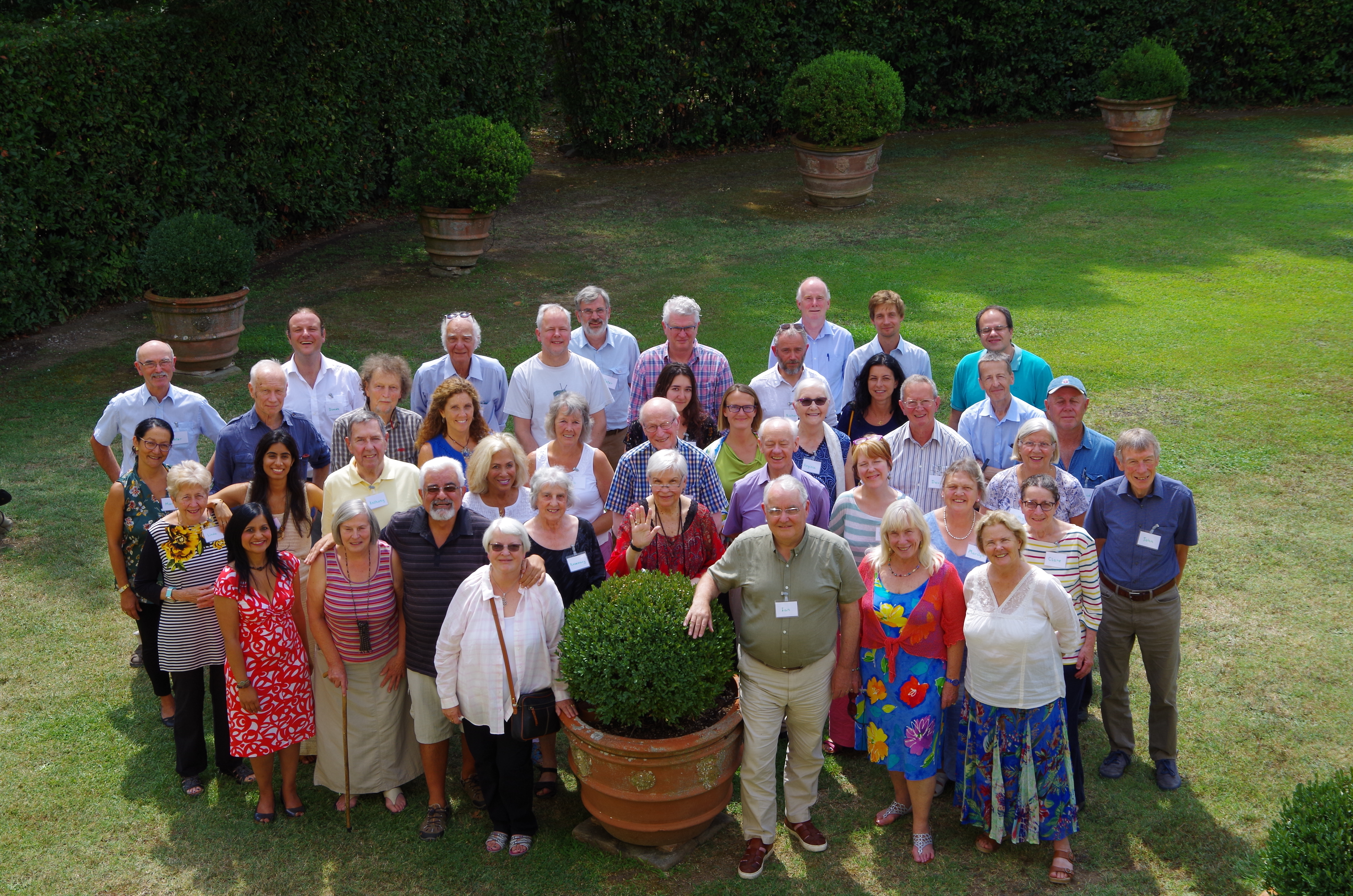
Group Photo-GCGI-SES Lucca 2018. Photo Credit: Angela Bowman
We arrived at Villa Boccella, a truly magical 17th century estate, set among the hills, vineyards and olive groves of Northern Tuscany. The locals - living within and around the medieval city of Lucca - have been growing and producing with respect towards Gaia for generations; today they combine scientific knowledge with traditional - organic, fossil excluding (chemicals, machinery) - ways of agricultural practices. The setting was perfect for us - participants from diverse life-paths -, to learn and to share our meals (thankfully to the selfless spirit of volunteering friends) as well as our thoughts, ideas and feelings regarding our sacred Earth.
In their opening talks Ian Mason, principle of School of Economic Science, and Kamran Mofid, founder, the Globalisation for the Common Good Initiative (GCGI), set the tone by welcoming and acknowledging each participants presence in ubuntu philosophy fashion "If you wouldn't be here, this event would not exist". We discussed the ills of the Anthropocentric worldview and talked about connections, relations towards our non-human fellow beings. Spirituality has to accompany our ecological knowledge and understanding about life's multi-focality; life doesn't exist by itself, life is the web of connections. Therefore economics based on the principle of utility seeking individuals is outdated. Sociability and fraternity are genuine and core elements of economic activities. In order to re-introduce responsibility and intentionality, we are to re-shape economics as a moral science. Within economics we have to create space for discussions, ideas which are intended to deal with questions such as "What should, and could be done?", and also "How will we get there?".
Importantly, during our thought exchanges we recognized that in parallel with intellectual work, emotional and spiritual work is ahead of us, as Mother Earth's and each beings' liberation is bound to one another - "I am because we are".
*Tamas Veress, GCGI Youth Ambassador, is a PhD student at the Business Ethics Center, the Corvinus University of Budapest. He is involved in community building activities and self-awareness, life-path planning workshops directed towards high school students, young adults and teachers.
- Details
- Written by: Kamran Mofid
- Hits: 3217
14th GCGI International Conference
And
The Fourth GCGI and SES Joint Conference, Lucca, Tuscany, Italy
‘OUR SACRED EARTH: Spiritual Ecology, Values-led Economics, Education and Society Responding to Ecological Crisis’
Villa Boccella, Tuscany, Italy, 28 August-1 September 2018
A Reflection from Susan Eirich*
Group Photo-GCGI-SES Lucca 2018. Photo Credit: Angela Bowman
My overwhelming reaction was to the warmth of the conference - and warmth allows people to open to new possibilities. Really, it had the form of a conference, but the feel was that of humans concerned about the fate of the Earth, coming together to share their wisdom, research, thoughts and hopes about what can be done, and what they are doing. It could almost have been around a campfire, but instead it was at an Italian villa built in the 1600’s, farmed sustainably for hundreds of years for grapes, wine and olive oil.
Several themes ran throughout the conference: that relationship and interconnection are the essence of life on every level, and perhaps even the source of life; the importance of joining head to heart so we act from deeply felt and intuited values; and truly including wild animals, plants, and the Earth in our circle of community. This idea of including all Life in our consideration has led to the emerging field of nature’s rights. As one speaker noted, “There is no environment. We are the Earth’s extended body.” There was the theme of healing, from the incredible courage of the One Community Institute City of Hope initiative at Auschwitz, to be built on the very the site where the atrocities occurred, to the calming and healing qualities of the Earth accessed through Earth-based educational programs, and aboriginal wisdom received through The Dreaming.
It was such a rich conference it is not possible to do justice to all the presentations and conversations. They ranged from careful, precise academic work to deep spiritual understandings. Here are a few ideas that capture the imagination:
- Questioning may be the meaning of life.
- If we change the story we change the future.
- Make part of the business school curriculum being outdoors.
- The concepts of Eco-crime; Eco-spirituality; Ecological consciousness.
- The universal calming effect of being in contact with the Earth, and what that implies.
- Don’t wait for leaders. We all carry the power of solutions.
- Real solutions are big solutions.
- Economics is a human study. Economics must be rejoined with values.
- Justice is a state of mind – not an external ministry.
- Our institutions are built on faulty foundations, accepting the logic of the market.
- Happiness for humans is belonging - being in community. And that is also where true healing takes place.
- Exploring whether ending poverty is a pipe dream or an essential element of a sustainable and harmonious world.
- It takes massive energy to maintain our separation from nature.
- Our system of law treats living beings as objects or property, an economic paradigm assuming endless growth that is coupled with the destruction of nature. We need laws that recognize the intrinsic value of nature, and a legal framework that aligns with ecology to sustain life. This is beginning to happen.
- Cell life, the basis of all life, has a globally distributed and emergent quality. There is no one place we can point to in a cell that is “life.” It is in the relationship of the parts that life emerges. Death is when connections are broken.
- All Life is sentient. It is not all conscious, but it is sentient. That includes animals, plants and the Earth.
- Our Earth is a massive information processor and source of information. We can ask the land what it wants and use that as a model for developing lifeways not just to the sustain us but help us thrive. After all, our Earth did generate Life and the incredible systems that sustain it.
- The Earth is waiting for us to invite her in.
I mentioned the warmth of the conference. Warmth creates a sense of safety. A particularly thought-provoking presentation suggested that we humans, who were all originally indigenous peoples, have been colonized and traumatized since the beginning of agriculture and have carried that burden from generation to generation for 10,000 years. Without a sense of safety, we cannot drop into our hearts and come up with a loving, Life-oriented culture based on heart values.
Trauma destroys our sense of safety, and the ensuing intense inner state of chaos is so terrifying that the human brain copes by shutting down. This leads to losing sight of the big picture; of our connection with the Earth; of the long-term consequences of our actions, and focusing instead on threats, a sense of urgency, details and the immediate. From that position we continue a semblance of life. Born into it, we see this coping method as normal and hold it up as the ideal. Over 10,000 years we adapted to a traumatized world, and to feel safe we need more - ever more, which is a driver of capitalism. In addition, with the growth of a sense of separation from the rest of life and the importance of individuality, we have lost the profound sense of an interconnected community that supports healing from trauma. The result is a need for things to replace an inner sense of security we have lost, the ultimate driver of capitalism.
I personally think part of the problem is also innate, lying deep in our biological hardwiring, and we need to find cultural ways of overriding it. This includes education that develops use of our forebrain, including mindfulness practice. I think development of spirituality is another way of overriding and integrating our biological wiring. These approaches, along with many others presented at the conference all have value to consider. We also need to find ways to combine spirituality and practicality, which two approaches are often separated, with disastrous results. Another way of saying it is the quote from Kamran’s introductory talk, “Material and spiritual are the two wings of existence of the human being. Like the bird, which needs two wings to fly, we need them both to live in a balanced way and fly to our goal. A bird with one wing cannot fly, it goes round and round in a circle, until it is exhausted, out of breath and drops dead.”
We have the capacity to move towards a sustainable world where all Life thrives, using both our incredible creative brain power and our innate spirituality. This conference, both the careful creative thought that went into designing and convening it, and the hope, care and talent of those participating, moves us forward in that direction. I look forward to the next one, and to keeping in contact with each other until then. It was an honor and a delight to be part of it.
All these ideas, via papers, and videotapes, will be available on the GCGI website.
*Susan B. Eirich, Ph.D. GCGI Senior Ambassador, Co-founder of Earthfire Institute, a non-profit wildlife sanctuary and retreat center near Yellowstone National Park, Susan is an inspirational voice for all life. She has lived with rescued wildlife native to the Rocky Mountains of North America for 25 years. With degrees in psychology and biology, she works to bridge scientific and spiritual understandings of wild animals and connections between all life. She has lived and taught around the world, always trying to see through others’ eyes.
- 14th GCGI International Conference and the 4th Joint GCGI-SES Forum, Lucca: A Reflection from John Thompson
- In terms of value creation, garbage men outweigh bankers
- The London Banker who Invented the Offshore that has broken the world
- 2008-2018 Crises: Have we learned anything?
- GCGI-SES Forum: In Praise of All that Matters