
- Details
- Written by: Kamran Mofid
- Hits: 2938
'Time Can Make You Happier Than Money'*

Photo:elemental.medium.com
‘People who value time over money tend to be happier, according to multiple studies. And new research in the journal Science Advances shows that this is particularly true as a person leaves college, facing weighty career choices while perhaps saddled with debt. Graduates who value time over money are more likely to pursue things they enjoy, including hobbies, social relationships, internships, and careers that provide intrinsic satisfaction rather than merely seeking compensation, the study suggests.
Researchers asked 1,000 graduating students at the University of British Columbia to rate how satisfied they felt with their lives overall, and the extent to which they had experienced positive emotions (like joy and happiness) and negative emotions (like sadness and stress) over the past four weeks. A year later, the graduates were surveyed again.
In both surveys, about 62% of them said they value time more than money, and those people were happier. Comparing the time-money trade-off to other well-established happiness factors, the researchers found that valuing time over money brought double the magnitude of happiness related to materialism in general and happiness known to accrue from high parental income. And while the study does not prove cause and effect, it suggests that valuing time over money can also predict how happy the graduates become as adults. The graduates in the study came from families with incomes ranging from low to high, but family socioeconomic status was not predictive of their tendency to prioritize time or money.
In Praise of Frugality: Materialism is a Killer
What is Money? Is it Money Money Money, Must be funny?
Memento mori, Memento vivere and the Madness of Black Friday
“People who value time make decisions based on meaning versus money,” says study leader Ashley Whillans, an assistant professor of business administration at Harvard Business School. “They choose to do things because they want to, not because they have to.”
It must be noted that the study surveyed students at the University of British Columbia in Canada. It’s unclear, without a separate study, how the results might be different among U.S. graduates. Whillans guesses — and she emphasizes that this is a guess — that what matters isn’t where students go to school but how much debt they graduate with. “If they graduate with more debt, they might feel happier in the short term valuing money more than time” and choosing a job to pay the bills, she says. “If they graduate with less debt, they might feel less happy in the short term valuing money more than time.”
Other research links time to happiness throughout adulthood. A 2016 study of 4,000 U.S. adults found that people who valued time more than money were “happier and more satisfied with life than the people who chose money,” even after the researchers accounted for differences in age, income, and the amount of time people spent at work or at leisure. In a Pew Research Center survey, when asked to rank various activities based on meaningfulness, people chose spending time with family, outdoors, and with friends as the top three, followed by spending time with pets, listening to music, reading, and religion. In eighth place: job or career.
Of course, reality forces everyone to place some value on money. “Work equals status in U.S. work culture,” Whillans says. “We are taught that time equals money, and financial insecurity makes us focus more on money and less on time.”
Money can buy some happiness — but only up to a point, research has shown. In the United States, the threshold is about $95,000. People making up to that amount annually tend to report being happier than people who make less. “Once the threshold was reached, further increases in income tended to be associated with reduced life satisfaction and a lower level of well-being,” researchers stated last year in the journal Nature Human Behavior.
Meanwhile, there’s no known ceiling on the happiness generated by a few hours carved out for friends and family or days of well-spent leisure time. Older adults seem to be wiser about this. “As people age, they often want to spend time in more meaningful ways than just making money,” Whillans says.
In this respect, the following words and sentiment by a young German executive rings so true: “Now it's all about Productivity, Pay, Performance and Profit- the four Ps- which is fuelled by the three Fs: Fear, Frustration and Failure. Just sometimes I wish that in the midst of these Ps (& Fs), there was some time left for another set of four Fs: Families, Friends, Festivals and Fun.”
Can we price everything, or are somethings in life just priceless?
In previous research, Whillans and a colleague, psychology professor Elizabeth Dunn at the University of British Columbia, found that buying time — such as paying for someone to cook or to clean the house — brings more satisfaction than buying stuff. In a survey of more than 6,000 people in the United States, Denmark, Canada, and the Netherlands, those who spent the most on time-saving purchases reported higher levels of life satisfaction.
With that knowledge in mind, the researchers gave 60 people $40 each to spend on a time-saving purchase one weekend, and another $40 to spend on a material purchase another weekend. No surprise, the people felt happier after buying some time. But in another survey, when working adults were asked how they’d spend a sudden windfall of $40, only 2% said they’d invest in time.
Perhaps that helps explain why Americans suffer from what Whillans calls a “famine of time.” The sense of “having enough time” is at an all-time low, she wrote earlier this year in the Harvard Business Review, adding that this feeling doesn’t just reduce happiness, it raises levels of anxiety, stress, and depression.
To reduce “time stress,” you need a change in mindset, Whillans advises. Start by making plans for free time. You may favor spontaneity, but lack of planning leads to wasted nights and weekends, she says.
Consider volunteering. “Even giving up a few hours of a paycheck to volunteer at a food bank may have more bang for your buck in making you feel happier,” Whillans says. Multiple studies have found that people who volunteer their time are happier, healthier, and live longer. One study even found that volunteering time makes people feel like they have more of it, perhaps because “giving away time boosts one’s sense of personal competence and efficiency,” the researchers speculate.
And get active. Hanging out with friends, exercising, heading to the mountains or the beach for a dose of awe, or doing just about anything physical “is profoundly better at combating time stress than passive leisure” such as watching TV, Whillans says.’
In this troubled world let the beauty of nature and simple life be our greatest teachers
*This article by Robert Roy Britt was first published on Elemental by Medium on 18 September 2019
Can too much money, well above satisfying your personal and familial needs, make you happy? Perhaps not! See below!
Money, Meaningful Life, Self-worth, Wisdom and Happiness
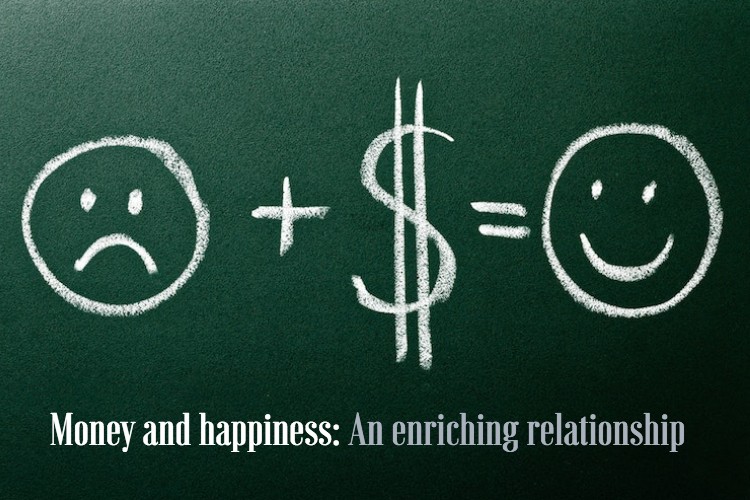
Photo:thriveglobal.com
‘In 1923, a very important meeting was held at Edgewater Beach Hotel in Chicago. Attending this meeting was nine of the world’s most ‘successful’ financiers and businessmen. Those present were: the President of the largest independent steel company; the President of the largest utility company; the President of the largest gas company; the greatest wheat speculator; the President of the New York Stock Exchange; a member of the President’s cabinet; the greatest ‘bear’ in Wall Street; the head of the world’s greatest monopoly; and the President of the Bank of International Settlement. This, we must admit, was a gathering of some of the world’s most successful men – or at least men who had found the secret of making money. Twenty-five years later (1948) let us see what had happened to these men:
the President of the largest independent steel company had died, bankrupt, having lived on borrowed money for five years before his death; the President of the largest utility company had died a fugitive from justice, penniless in a foreign land; the President of the largest gas company was insane; the greatest wheat speculator had died abroad – insolvent; the President of the New York Stock Exchange had recently been released from Sing Sing penitentiary; the member of the President’s cabinet had been pardoned from prison so that he could die at home; the greatest ‘bear’ in Wall Street had died– a suicide; the head of the world’s greatest monopoly had died– a suicide; the President of the Bank of International Settlement had died – a suicide
All these men learned well the art of making money but none of them learned how to live, commented the original compiler of this list. It seems that the business world (who should know better, given what was described above) has changed not one iota. For them economic growth, the corporate bottom line and the pursuit of self-interest are what matters most. More recent observations also show that the self-interested pursuit of wealth brings only misery. Since 1950 there has been much economic growth and wealth creation in the West, but also a tenfold increase in the incidence of depression and a massive rise in the number of people suffering from sub-clinical neuroses, anxiety and profound self-dissatisfaction, drugs and alcohol abuse, self-harm, suicide, and more…”
What a powerful and telling story! A lesson to all those who think that what matters most is money and money and loads of it.’... Continue to read
What are the true determinants of a happy and fulfilling life?
Photo:wilkihow.com
- Details
- Written by: Kamran Mofid
- Hits: 3101
NO PRICE TAG, BUT PRICELESS…

Photo:jillhewlett.com
I am an economist. I know the price of everything, and the value of nothing!!
‘Economists are often accused of believing that everything — health, happiness, life itself — can be measured in money. What we actually believe is even odder. We believe that everything can be measured in anything.’-David Friedman, ‘Hidden Order: The Economics of Everyday Life.’
Oscar Wilde once remarked – “An economist is someone who knows the price of everything and the value of nothing.” This observation may, or may not be totally true. But economists right from Adam Smith, Bentham, Marx, Jevons and Marshall, Pigou, to Joan Robinson, Chamberlin and Hicks have been engaged in explaining how prices are determined and why and when they are high or low. This, in a nutshell, is the subject matter of price theory, and I have no quarrel with that.
My concern from day one, decades ago, when I started to study economics, has always been: Should economists try to determine the price of everything, including those that are indeed priceless? More on this later.
- Details
- Written by: Kamran Mofid
- Hits: 3397
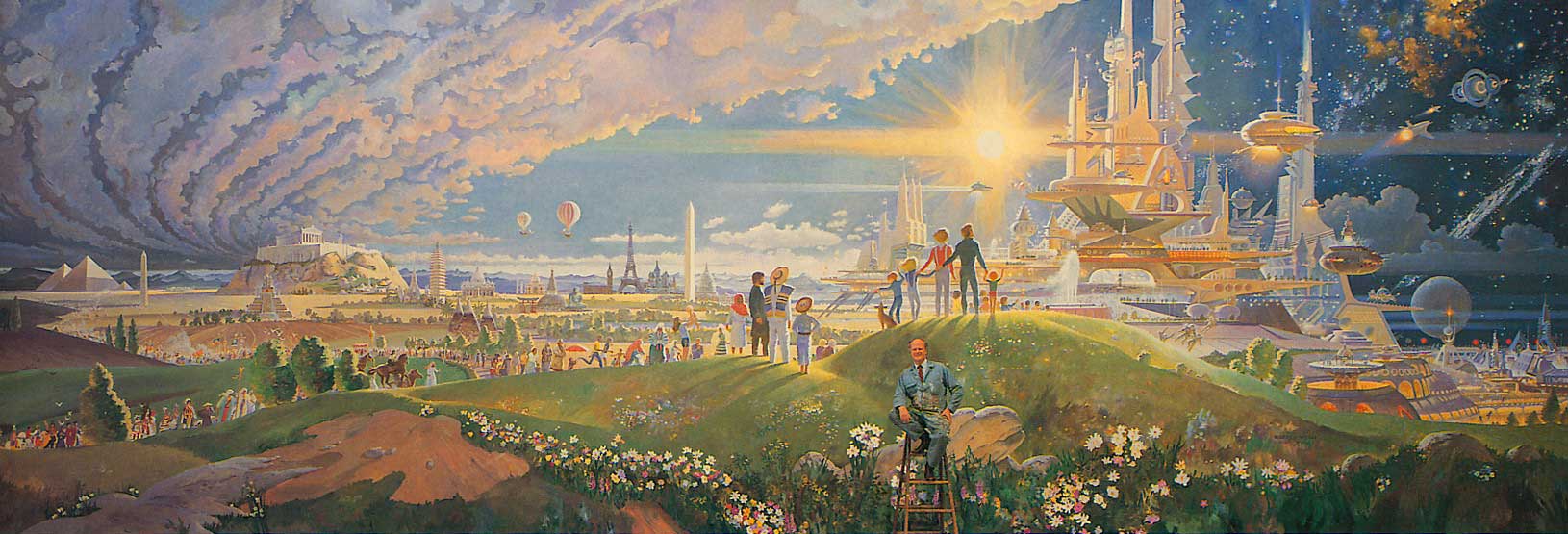
A version of Utopia from last century-Robert McCall 1983 Mural, The Prologue and the Promise-Photo: mccallstudios.com
Dreaming about Utopia where we spend less time thinking about the Dow Jones and more time about contributing to the collective good
What is a perfect society, what is a good business and economy? What is a good life? What is a good person?
Reflecting on these and other similarly ‘Big’ questions, we seem to be able to achieve good and goodness in all we do, when and where our system is run by dreamers who call themselves realists. That is, hopefully, people like you and me!
Utopia
For thousands of years human beings have dreamt of perfect worlds, worlds free of conflict, hunger and unhappiness. But can these worlds ever exist in reality?
In 1516 Sir Thomas More wrote the first 'Utopia'. He coined the word 'utopia' from the Greek ou-topos meaning 'no place' or 'nowhere'. But this was a pun - the almost identical Greek word eu-topos means a good place. So at the very heart of the word is a vital question: can a perfect world ever be realised?
In this Blog today, I wish to look at Utopian Capitalism, and see if this can somehow assist me in my struggles to find some possible answers to the questions I asked above. Let us see!
Utopian Capitalism
Via The Book of Life
‘The system we know as Capitalism is both wondrously productive and hugely problematic. On the downside, capitalism promotes excessive inequality; it valorises immediate returns over long-term benefits; it addicts us to unnecessary products and it encourages excessive consumption of the world’s resources with potentially disastrous consequences – and that’s just a start. We are now deeply familiar with what can go wrong with Capitalism. But that is no reason to stop dreaming about some of the ways in which Capitalism could one day operate in a Utopian future:
In the Utopia, we’d spend less time thinking about the Dow Jones.

Photo:wxyz.com
The Dow Jones, which is the world’s most prestigious financial index, takes a daily temperature reading of the US, assigning it a very precise number, which is widely reported in the news and which we tend to treat with a high degree of reverence. Such financial data seems to be telling us something of immense importance. It hints at an answer to the great questions of existence: are things going well or badly, is the world doing OK? How is life on earth?
It’s really worth asking such questions and reflecting heavily upon them. This is what philosophers traditionally like to do. But the numbers do not actually answer our questions, for the links between the Dow Jones figures and what is actually going on in human lives (their rise or fall) is far more elusive. It’s not that there is no connection whatsoever. The financial health of major US companies does have indirect, distant links to the economic side of everyone’s life. Yet the quality and character of daily life is powerfully affected by a great many things which the financial data does not recognise, for example, your health, the view from your window, the quality of your relationship, the amount of time you have to spend commuting, the connections you have with the neighbours, the state of your ambitions, your degree of envy, how your kids are doing. These may, indeed, be rather more important in determining ‘how things are going’ than the Dow Index. But the Dow doesn’t entirely admit this. It seems to be making a larger claim: to know how your life is going – and it brings to this claim a panoply of impressive arrows, charts and incomprehensible acronyms which cow us into believing in its authority, rather as our ancestors might have trusted in the confused mumblings of a priest sitting on top of an altar in a darkened temple.
For all our expertise, we have not yet learned how to devise reliable indicators of the state of nations and individuals. We do not have a daily set of figures to record what truly matters. It might help, for example, to know the incidence of unnecessary embarrassment or whether arrogance is becoming 0.1% more or less common. We don’t have figures measuring supplies of patience, tact and forbearance. We don’t have indices around envy, infidelity and fury.
In the absence of these vital indicators, we cling to the signals offered to us by Wall Street. We use words like depression and exuberance, terms well known from personal life, to describe the movements of stocks and shares. To ask for better indices of national well being sounds whimsical. Yet it ought not to, for we need data that homes in on things that matter greatly for what our lives are actually like. Issues like jealousy, boredom, beauty, frustration or anger shape our destinies just as much – if not more – than the fortunes of 3M (the Minnesota Mining Company) and the twenty nine other corporations whose trading forms the basis for calculating the Dow Jones figures.
The big issue is how we can get a diversity of indicators on our national dashboards. We are not suggesting the suppression of the Dow Jones Industrial Average. What we want to see is the rise of other – equally important – figures that report on a regular basis on elements of psychological and sociological life and which could form part of the consciousness of thoughtful and serious people. Today, a government cannot get rewarded, or chastised, for the impact its policies have on the frequency of domestic rows because rows are not recorded. When we measure things – and give the figures a regular public airing – we start the long process of collectively doing something about them.
In the Utopia, we wouldn’t just care about unemployment, we’d also worry about misemployment.
Employment means being, generically, in work. But misemployment means being in work but of a kind that fails to tackle with any real sincerity the true needs of other people: merely exciting them to unsatisfactory desires and pleasures instead. Like this fellow, dressing up as a hotdog to entice customers.
A man employed by the casino chain Las Vegas Sands to hand out flyers to tourists so as to entice them to use slot machines is clearly ‘employed’ in the technical sense. He’s marked as being off the unemployment registers. He is receiving a wage in return for helping to solve some (small) puzzle of the human condition of interest to his employers: that not enough tourists might otherwise leave the blue skies and cheerful bustle of a south Nevada city’s main street to enter the dark air-conditioned halls of an Egyptian-themed casino lined with ranks of ringing consoles.
The man is indeed employed, but in truth, he belongs to a large subsection of those in work we might term the ‘misemployed’. His labour is generating capital, but it is making no contribution to human welfare and flourishing. He is joined in the misemployment ranks by people who make cigarettes, addictive but sterile television shows, badly designed condos, ill-fitting and shoddy clothes, deceptive advertisements, artery-clogging biscuits and highly-sugary drinks (however delicious). The rate of misemployment in the economy is very high.
And while we may be genuinely grateful for a job and give our best to do it well, at the back of our minds we do – as employees – nurture the hope that our work contributes in some real way to the common good; that we are making, modestly, a difference.
It’s not just the most dramatically harmful kinds of work that register as misemployment. We intuitively recognise it when we think of work as ‘just a job’; when we sense that far too much of our time, effort and intelligence is spent on meetings that resolve little, on chivvying people to sign up for products that – in our heart of hearts we don’t admire.
Economists and governments have, with moderate success, been learning techniques to reduce the overall rate of unemployment. Central to their strategy has been the lowering of interest rates and the printing of money. In the language of the field, the key to bringing down unemployment has been to ‘stimulate demand.’
Though technically effective, this method fails to draw any distinction between good and bad demand and therefore between employment and misemployment.
Fortunately, there are real solutions to bringing down the rate of misemployment. The trick isn’t just to stimulate demand per se, the trick is to stimulate the right demand: to excite people to buy the constituents of true satisfaction, and therefore to give individuals and businesses a chance to direct their labour, and make profits, in meaningful areas of the economy.
In a nation properly concerned with misemployment, the taste of the audience would be educated to demand and pay for the most important things. 20 percent of the adult population might therefore be employed in mental health and flourishing. At least another 30 per cent would be employed in building an environment that could satisfy the soul. People would be taught to respect good furniture, healthy food, wholesome clothes, fruitful holidays…
To achieve such a state, it isn’t enough to print money. The task is to excite people to want to spend it on the right things. This requires public education so that audiences will recognise the value of what is truly valuable and walk past what fails to address their true needs.
This isn’t to suggest that the employment figures are irrelevant – they matter a great deal. They are the first thing to be attended to. All the same the raw figures mask a more ambitious index – and a central question: are we deploying human capital admirably?
In the Utopia, we wouldn’t just blame big evil corporations for everything.
It seems natural to point the finger of blame at many bad states of affairs at big corporations. But, in truth, there is an unexpected, and more important, cause of dispiriting jobs, garish signage, environmental abuse and troubling fast-food ingredients: our taste. Collectively, it is we, the consumers, who opt for certain kinds of ease and excitement over others. And once that basic fact is in place, everything else follows in the slipstream. It’s not companies that primarily degrade the world. It is our appetites, which they merely serve.
The people who run fast food companies don’t, in their cunning hearts, think that their offerings are ideal, or that the job opportunities they provide are humane. They are not driven by a fixed desire to cook rubbish or create repetitive, stressful low-paid employment. They just want, very badly, to make a profit, but they’d make it anywhere if they could. If we wanted to buy wild salmon or pay a little extra for staff medical insurance, they’d let us.
We should be deeply bothered by poor quality food, exploitative jobs and ugly environments; but in the hugely important task of unleashing a workable social and economic revolution, it matters a great deal where we point the finger of blame. The sobering news is that if all the managers and board members of certain objectionable conglomerates were sacked, similar pathologies of capitalism would spring up again at once.
The problem isn’t what these businesses are offering, since an offer can always be politely declined; it’s what we are choosing. The reform of capitalism hinges on an odd-sounding, but critical task: the education of the consumer.
In the Utopia, we’d work for companies we’d be proud to live and die for.
The idea of living and dying for the sake of your work in a hospital or with the army seems utterly credible. The idea of living and dying for your accountancy firm or tanning salon sounds absurd.
That’s because we don’t typically think of corporations as claiming or deserving any kind of special place in our deep selves. We tolerate the companies who provide the fabric of our incomes by selling phones and shoes, flights, groceries, insurance, trousers, electricity. One might be a bit better than another, offer attractive deals or provide decent service. But this is miles away from deep admiration or love.
We’ve come to think that that’s exactly how things should be. It’s normal to think that if you’re keeping your wits about you, you should be a touch cynical about – and detached from – the corporate world. Companies sometimes like to talk in terms of love and big missions; but they never quite convince us when they do. It’s easy to satirise their efforts. The slogans are neat (‘We try harder’, ‘Just do it’, ‘I’m lovin’ it…’), but we’re all world-weary enough to shrug our shoulders and walk past with wry disregard.
So right now, most corporations don’t deserve our deep admiration – and they don’t get it either. But at various times, we can catch glimpses of how it could be very different. In 1895, it wouldn’t have been at all strange for a station master to get married in his Great Western Railway uniform. Not because he was slavish. But because the ideals of the transport company – with its elegant locomotives, its impeccable service across miles of countryside, its commitment to ethical behaviour and responsible capitalism – resonated so deeply with his own better nature. The company’s devotion to service and reliability, the grandeur of its big stations, the sense of dignity in its pension schemes – these were things someone could take to heart and feel justifiably proud to be part of.
What would it take for corporations to be worth a wedding suit or indeed our lives? They’d have to engage our better selves, do proper good in the world and help us to become who we want to be. Given how much of our lives we give to our work, these sound like highly necessary and not unrealistic ambitions.
In the Utopia, we wouldn’t loathe the rich or try to tax them more; we’d give them honour and status.
Why do the rich keep on working? Why do they enter stressful negotiations, constantly take on large risks, battle ambitious, hard-hearted rivals, and scheme and plot until the day they collapse? What are they doing it for? Why aren’t they satisfied with the extensive assets and large piles of money they already have?
Ironically, the one thing the hard-working rich don’t actually want and are not in any way motivated by is money itself. They have far more than enough of that already and they know it. Their every material need is catered for (one can nowadays buy a comfortable life for a year using what they earn in a day). Nor – at this point in the history of civilisation – are the rich likely to be working for the sake of their children. There are too many examples of large fortunes that have driven kids insane with guilt for any modern plutocrat to be able to tell themselves that they are doing it for the next generation.
Surveying the problems of Capitalism, the standard response of the left has been to suggest that one simply tax the rich more. But this fails to grasp, and therefore properly to exploit, the real psychological motives of the rich. The rich only pursue money fanatically (to our great collective cost) because wealth appears to be the primary, most objective source of honour in the modern world. If only we can fix how honour is obtained, we will be able to redirect their mania to more socially beneficial ends in ways that don’t demand that the rich become ‘nice’.
At present, a natural inclination is to force the rich to give up their wealth using the instrument of new taxes, but this strategy simply won’t work. The chances of people running away and taking their assets with them is too great. We know that entrepreneurial energy and competitive drive can too easily be depleted; the economic balloon can deflate and all will suffer. We need to go down a different route. We need to harness the talents and drives that the rich are currently using to squeeze the earth and its people too hard – and ensure that these energies are made to address the collective needs of society.
The aim should be to seduce the rich – to make them want to benefit their societies in return for giving them what (we know) they deep down really want but haven’t until now reliably been able to get except through money: namely, honour.
We know well enough that societies can motivate people very powerfully through honour: soldiers will perform extraordinary feats on the battlefield in return for the highest gratitude from their countries (they don’t even ask to be paid very much – paid to die…). Scientists will labour in poverty for decades in the hope of winning a Nobel Prize. Yet as societies, we are only just beginning to explore what good can come out of vanity in the realm of business. In the commercial world, there are at present no systematic, fail-safe methods for gaining status in return for doing what society desperately needs capitalists to do: treat their workers well and produce useful, safe, environmentally-sound goods and services. In some countries, there may be the odd hope of a medal from the president or the queen if one behaves well, but the chances of securing one are simply too remote and unpredictable to motivate hard-headed capitalists in their actions from day to day: it remains far more rational to peg one’s hopes for status on the verifiable criterion of money than on the vague chance of an invitation from the palace.
This is precisely what needs to be changed – and urgently. Society should do a systematic deal with capitalists: it should give them the honour and love they so badly crave in exchange for treating their workers as human beings, not abusing customers and properly looking after the planet. A standard test should be drawn up to measure the societal good generated by companies (many such schemes already exist in nascent form), on the basis of which capitalists should then be given extraordinarily prestigious titles by their nations in ceremonies with the grandeur and thrill of film premieres or sporting finales. It might be something to go after their names (for example, RC: Responsible Capitalist), a title that would have some of the same associations as the Nobel Prize, the Victoria Cross and the Pulitzer prize – in other words, a fitting target for the most ambitious and narcissistically craven and damaged people in society to strive for.
The founding figure of modern economics, Adam Smith, adroitly recognised the two chief motivating factors in human life: the love of riches and the love of glory. He knew that these two things are what people ultimately want and what they work hardest for. A wise society must therefore learn how to harness the love of glory at times, like now, when the public good comes into conflict with the love of riches.
As Adam Smith put it, “The great secret of education is to direct vanity to proper objects.” That is, we should target the vanity of the rich and encourage them to act well from that most powerful of desires: the desire to be loved. Our side of the deal will be to applaud very heartily when they behave well and to ensure we lavish upon them all the respect they so deeply crave. It will be a very small price to pay in return for the contentment of the planet.
In the Utopia, businesses wouldn’t just satisfy our bodies, they’d take care of our souls.
"In Search of the Virtuous Economy: A Plea for Dialogue, Wisdom, and the Common Good"
Generous, thoughtful, sensitive people are often drawn to the view that we shouldn’t expect economies to ‘grow’. After all, the earth and its resources are limited, so why keep asking for GDP to expand? We don’t need more commercial activity or more businesses. We are destroying the planet fast enough as it is.
According to the environmental story, Capitalism pillages the planet for the sake of producing vast quantities of material possessions, many of which we do not really need and only crave because we are duped by relentless advertising.
The implication is that we need to wind back consumerism in order to improve society and lead better lives. It’s understandable if this opinion is widespread. But perhaps the good future depends not on minimising Capitalism but on radically extending it.
Economic Growth: The Index of Misery
At its best, Capitalism should address the full range of needs of mankind as efficiently and effectively as possible. This is not currently happening: despite all the factories, the concrete, the highways and the logistics chains, the economy is as yet far too small and desperately undeveloped.
Over the last two centuries, in the wealthy nations, Capitalism has evolved to meet many basic material needs, for sanitation, shelter, food supply and health care. The largest and most successful corporations have been those that satisfied appetites that we would categorise as belonging at the bottom of Abraham Maslow’s famous pyramid of needs: oil and gas, mining, construction, retail, agriculture, pharmaceuticals, electronics, telecommunications, insurance and banking.
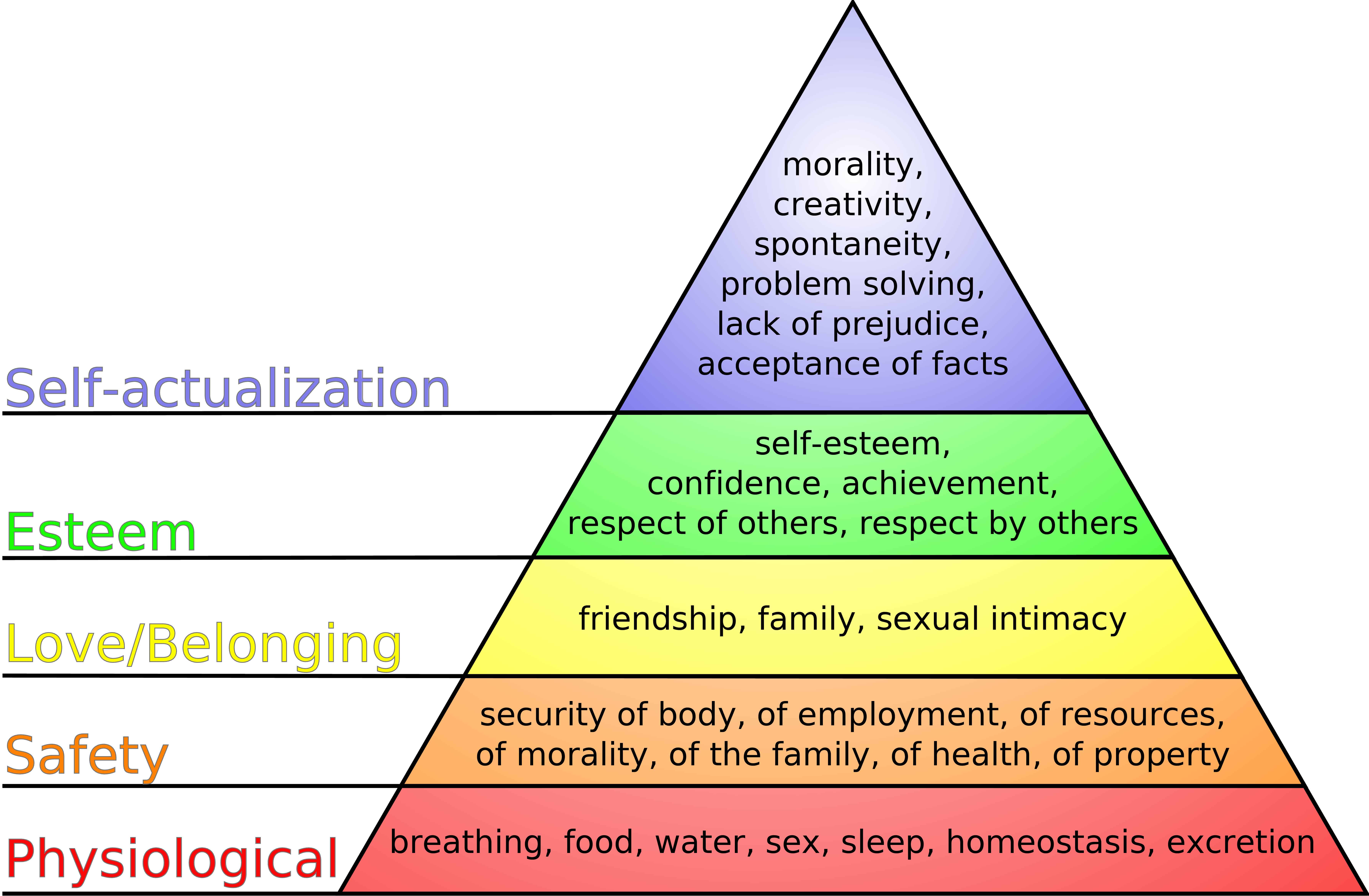
Photo: via wikipedia
The briefest glance at the pyramid reveals a fascinating possibility: that the future growth of business will lie in an assault on a vast array of needs further up the pyramid, in the areas of love and belonging, esteem and self-actualisation. Capitalists and companies are seemingly – semi-consciously – aware of this issue. The evidence lies in advertising. Advertising almost always tries to sell us stuff with an appeal to our higher needs, by tugging obliquely at our longings for emotional fulfilment, authenticity, good relationships and a sense of true achievement.
But, as yet, the corporations who pay for the adverts are not actually devoted to meeting the needs that their marketing people have so skilfully evoked. We get promised friendship or love and end up with a 4×4 or a new barbecue set. Advertising is always hinting at the future shape of the economy; it already trades on all the right fantasies. It’s just that there are as yet very few of the truly right products and services out there.
For example, only in the last five minutes of our history have we realised that there are very big business opportunities to be found in friendship. And yet Facebook is still making only a rudimentary contribution to the ideal development of this activity. Similarly, only very recently has there been commercial exploration of the fact that we need to keep secrets, yet feel very drawn to raw, dramatic confession as well. A new app which helps us in this area – https://www.secret.ly/ – is now a very successful business enterprise in Silicon Valley, worth tens of millions of dollars.
An organised response to our higher needs is not novel. Religions used to address them. Catholicism, if seen as a business, would be the second largest corporation in the world, bigger than Ford or BP or Samsung. Art galleries and museums shared some of the character of religions and similarly tried to address our higher needs, although their clients tended to be governments and nations rather than individual customers.
What we call ‘a business idea’ is at heart just an as yet unexplored need. To trace the future shape of Capitalism, we only have to think of all the needs we have that are, currently, poorly understood and neglected by the commercial world.
There’s no shortage: we need help in forming a cohesive, interesting communities. We need help in bringing up children. We need help in calming down at key moments (the cost of our high anxiety and rage is appalling in aggregate). We require immense assistance in discovering our real talents in the workplace and understanding where we can best deploy them (a service in this area would matter a great deal more to us than pizza delivery). We have unfulfilled aesthetic desires. Elegant town centres, charming high streets and sweet villages are in desperately short supply and are therefore absurdly expensive – just as, prior to Henry Ford, cars existed but were very rare and only for the very rich.
These higher needs are not trivial or minor wants, little things we could easily survive without. They are, in many ways, absolutely central to our lives. We have simply accepted, without really thinking about it, that there is nothing we can do to address them. And yet to be able to structure businesses around these needs would be the commercial equivalent of the discovery of steam power or the invention of the electric light bulb.
We don’t know, today, quite what the businesses of the future will look like. Just as in 1975, no one could describe the current corporate essence of Facebook or Google. But we know the direction we need to head to: we need the drive and inventiveness of Capitalism to tackle the higher, deeper problems of life. This will offer an exit from the failings and misery that attend Capitalism today. In a nutshell, the problem is that we waste resources on unimportant things. And we are wasteful, ultimately, because we lack self-knowledge, because we are using consumption merely to divert or quieten anxieties or in a vain search for status and belonging.
If we could just address our deeper needs more directly, our materialism would be refined and restrained, our work would be more meaningful and our profits would be more honourable. That’s the ideal future of Capitalism.
Conclusion
At the moment we tend to think that the definitive goal of business is to turn a profit. We assess the success of companies really only in financial terms: the more profitable they are, the better the business.
In the Utopia, businesses would of course have to be profitable. But the success of a business would primarily be assessed in terms of its contribution to the collective good. The aim would not be to maximise profits, but to maximise the amount of good that could be done, while still being profitable. In the Utopia it would be understood that the proper end of business is the good.’- The Book of Life
I Have a Dream My Friends! Can You Help Me to Realise it?
I have a dream that one day, in the not too distant future, we can build a better world by building a better education, economics and business.
Please see and read more about my dreams:
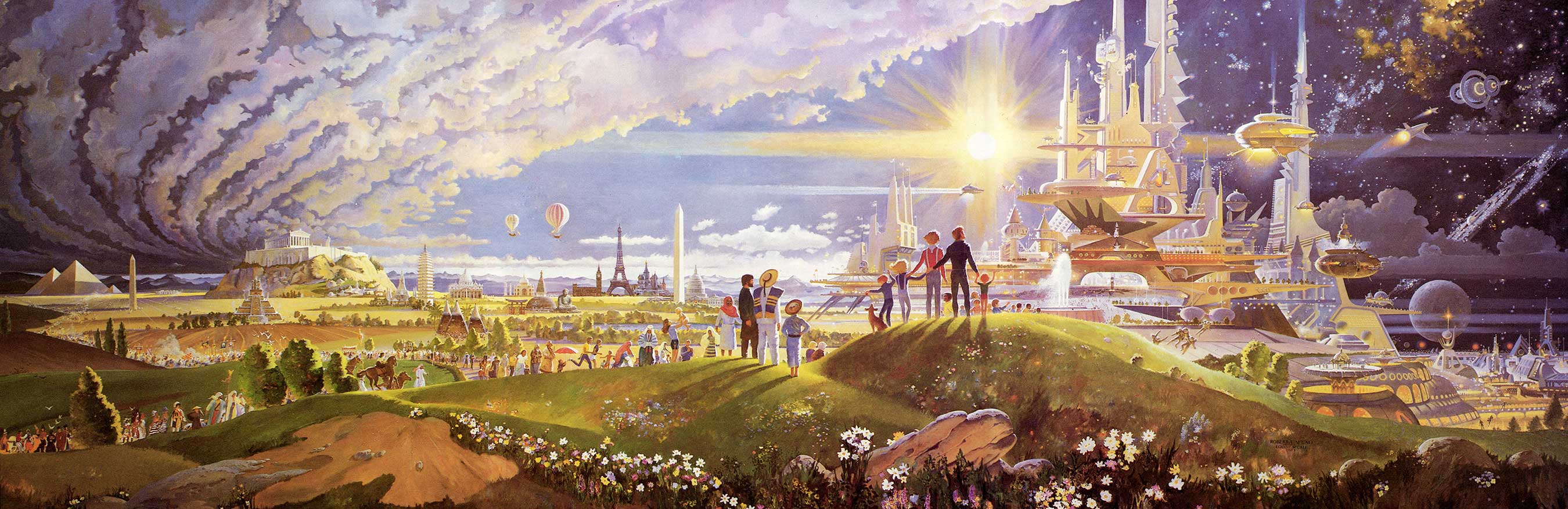
Photo:mccallstudios.com
The Value of Values: Values-led Education to Make the World Great Again
Composing a New Life: In Praise of Wisdom
My Economics and Business Educators’ Oath: My Promise to My Students
- A Message from and to the US on Labour Day 2019
- ‘Why Are Our Politicians So Crap?’ The rise and fall of Britain’s political class
- German president, Frank-Walter Steinmeier, asks Poland for forgiveness at WWII ceremony
- British democracy is brought to its knees
- On the Road to Serfdom, Death and Destruction With the Koch Brothers