- Details
- Written by: Kamran Mofid
- Hits: 2423
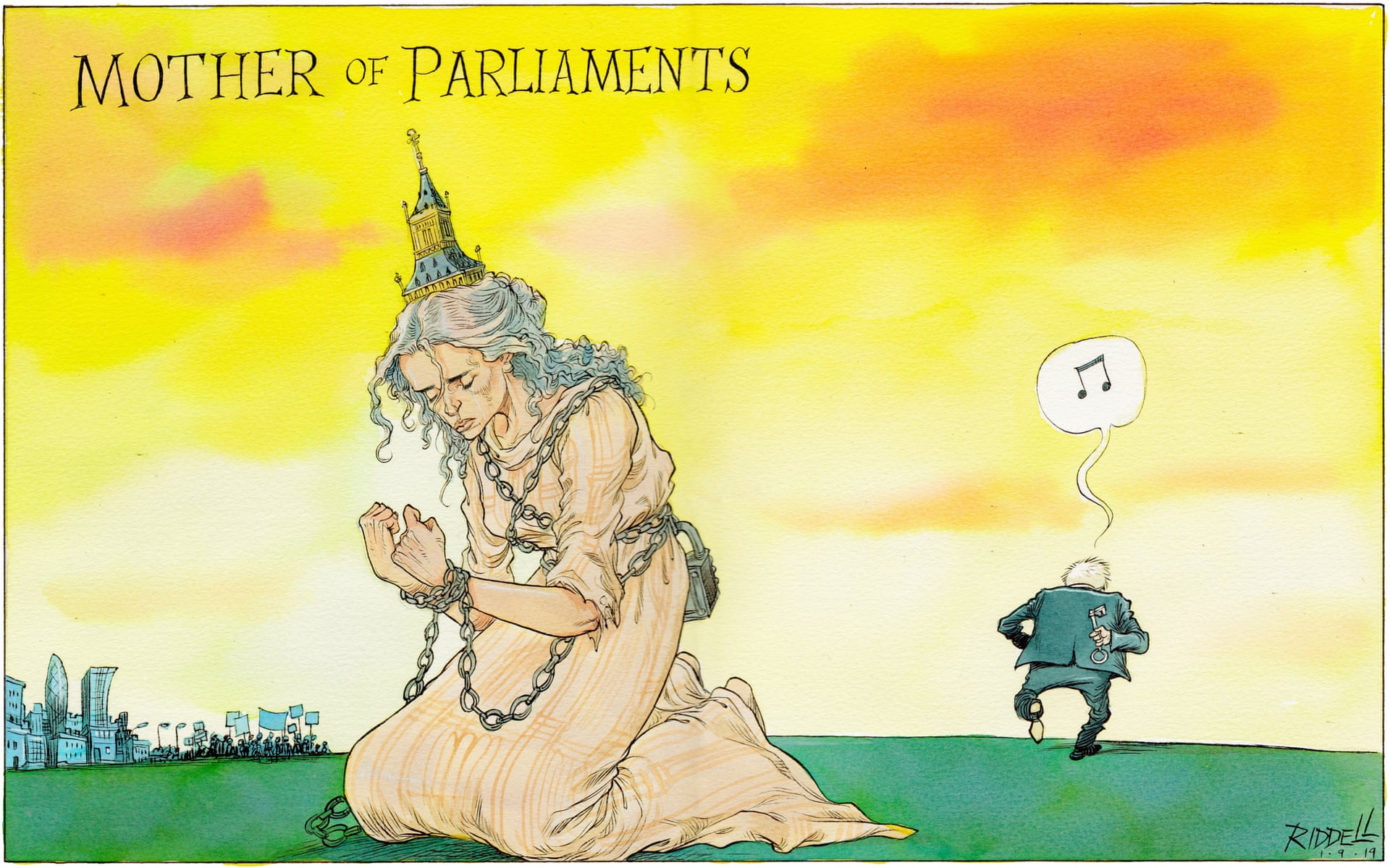
Photo: British democracy is brought to its knees
We have become a land of permanent crisis. This suits the blustering liars of Brexit
‘This government’s shameless thirst for power is such that it will stop at nothing to deliver no deal’
‘Boris Johnson’s lies encapsulate Britain’s democratic decay. They are the bluster of a man who holds parliament and political accountability in contempt. They reveal the corruption of a Brexit movement that has no purpose now other than to secure an empty victory, whatever its original intentions and whatever damage it does to the traditions of Britain’s democracy, once thought to be indestructible and now revealed to be as ephemeral as dust in the wind.’- Continue to read
The sheer scale of the crisis facing Britain’s decrepit constitution has been laid bare
‘To achieve no-deal Brexit, Boris Johnson has exploited the weakness of our democracy.’
‘Representative democracy is never easy. It’s been obvious for decades that the eight-word British constitution established in 1689 – what the crown assents in parliament is law – is a decaying, time-worn construct on which to protect and advance today’s democracy. It may have seemed “glorious” in the 17th century to hit upon the-then revolutionary notion that the crown can continue, but only if it delegates its monarchial sovereignty to whoever commands a majority in parliament. But it’s a wheeze that today too easily collapses into a highly centralised executive acting dictatorially because of its monarchial authority – and becomes toxic if that dictatorial dimension becomes legitimised by the “will of the people” in a referendum. A constitution with a bias to being an elective dictatorship, as Lord Hailsham famously characterised it, too easily slides into dictatorship by referendum.’- Continue to read
Britain’s Reichstag Fire moment
‘Weimar warns us about what happens when politicians give up on their own parliament.’- Richard J Evans
Are there any Paradigms and parallels, between then and now, Britain and Germany?
‘At first glance, there are obvious parallels, not least with the UK: democratic institutions such as parliament and the press are widely distrusted; the political system is polarised. As in the Weimar Republic, there are rising physical threats against politicians, and the language of betrayal is back in vogue. The left is divided, and nationalism and nostalgia are in the air—in some circles the British Empire is being lauded just as the supposedly glorious medieval German Empire was in the 1920s and early 1930s. There are economic parallels, too, between the Depression and the long shadow cast by the financial crisis of 2008…’- Continue to read
My Lord, My Lord, Why Have You Forsaken Us!!
A man, voted our prime minister, by just 0.13 per cent of the population, roughly the size of a decent football crowd, is shutting down people’s elected parliament, and calls this act of barbarism ‘Democracy’!!
Photo:http://flickriver.com
I was Boris Johnson’s boss: he is utterly unfit to be prime minister
Please also see below:
Britain today and the Bankruptcy of Ideas, Vision and Values-less Education
The Age Of Perpetual Crisis: What are we to do in a world seemingly spinning out of our control?
- Details
- Written by: Kamran Mofid
- Hits: 3848
David Koch, US businessman, free marketeer, rightwing activist and a neoliberal fundamentalist par excellence, who passed away on 23 August 2019, is said to have bequeathed the world the legacy of ‘Death and Destruction.’*
‘As David Koch’s family mourns his loss, we are taking a moment to pause and grieve, too. We grieve for the families who lost loved ones due to limited health care access. We grieve for the Black communities living alongside waterways polluted by Koch’s chemical plants. We grieve for the Indigenous nations whose lands were used to build Koch’s industrial wealth. We grieve the destruction of democratic values through Koch’s investments in higher education…’-David Koch Is Dead. We Must Now Take On His Harmful Legacy in Higher Education.
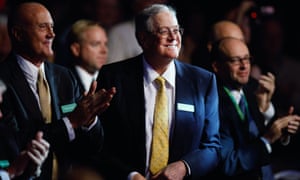
David Kotch, The architect of ‘Death and Destruction’
Photo: Dark Money review: Nazi oil, the Koch brothers and a rightwing revolution
‘How does one eulogize a villain? It’s a question I find myself asking today after reading the news that David H Koch has died. What else can we really call a man who spent his entire adult life enriching himself at the expense of the world around him, leaving in his wake millions of destroyed lives, a planet on the brink of ecological catastrophe, and a nuclear superpower governed by a far-right political party?
While it is generally impolitic to castigate someone after death, in the case of David Koch, it’s hard not to point out that his life’s work was the destruction of others.
Koch went by many titles — billionaire industrialist, businessman, philanthropist, entrepreneur, conservative activist, libertarian vice presidential candidate — and I expect we’ll see many of those thrown around today. But “villain” is the one that suited him best…’ David Koch reshaped America for the worse. His life's work was the destruction of others
…’Alongside his older brother Charles, he built his family’s company into one of the US’s biggest conglomerates and each brother’s share was estimated to be worth more than $50bn. They used their fortunes to influence American politics in a rightward direction following their libertarian ideology. They wanted to “minimise the role of government and maximise the role of the private economy ... and personal freedoms”, but the brothers’ philosophy was self-serving, protecting their worth and working against regulation of their business interests.’+
The Koch brothers tried to build a plutocracy in the name of freedom
‘The Kochs have always believed that rich people had the right to rule over everyone else, democracy be damned.’
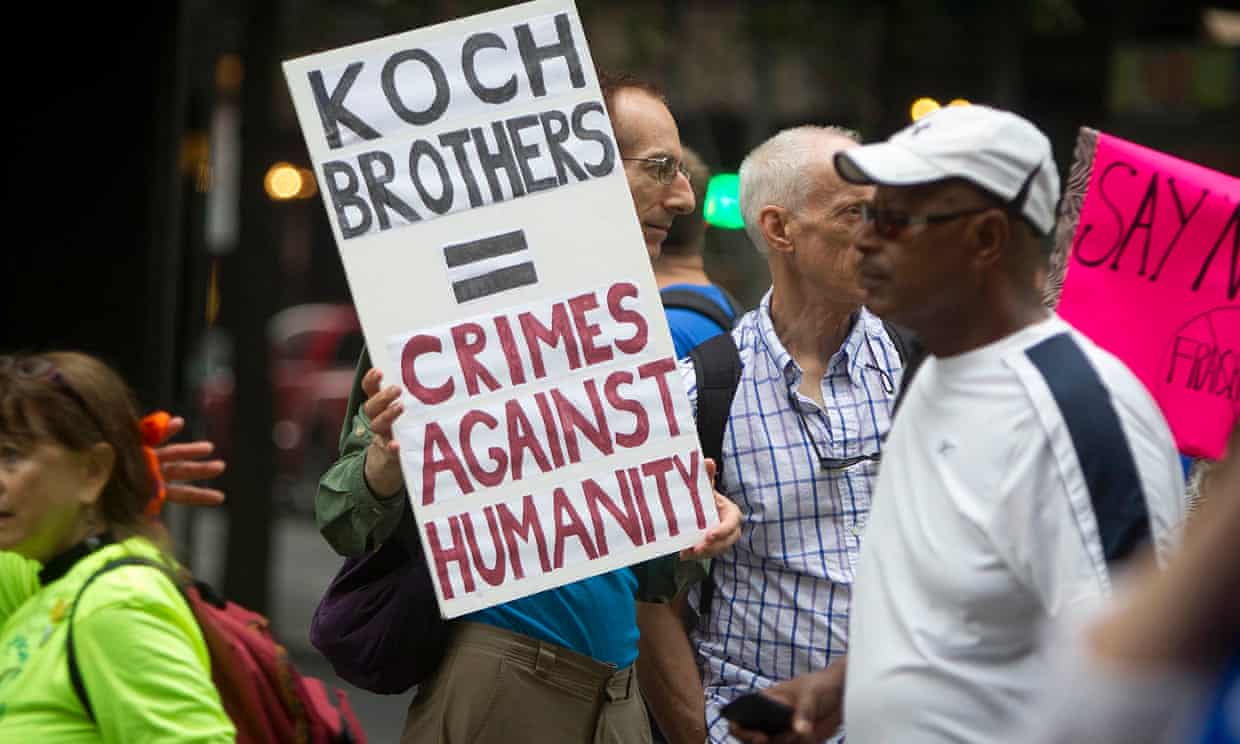
A protester holds up a sign against the Koch Brothers at the ‘People’s Climate March’ in Manhattan in September 2014. Photograph. Photo: theguardian.com
'It is the hope of every rich megalomaniac that they will “leave a legacy”. David Koch, who died last week aged 79, left a significant legacy indeed. In fact, along with his brother Charles, he can probably claim to have changed the world. Unfortunately, he changed it by setting it on fire.
It’s hard to describe just what a negative force the Koch brothers have been in United States politics over the past several decades. They have used every means at their disposal to subvert democracy. They funded academic posts, thinktanks, lobbying groups, fake grassroots operations, and political campaigns. They used their tremendous wealth to push a radically far-right economic vision in which government protections and welfare programs would essentially cease to exist. They may even have been directly responsible for the election of Donald Trump,...
David Koch has now left this earth, while the rest of us are still here to clean up his mess. His brother Charles lingers, and will surely try to keep up the family business of poisoning American politics. We must make sure he does not succeed, and all of humanity can look forward to the day when the Koch Brothers’ influence is nothing but an unpleasant memory.'-Nathan Robinson, the editor of Current Affairs
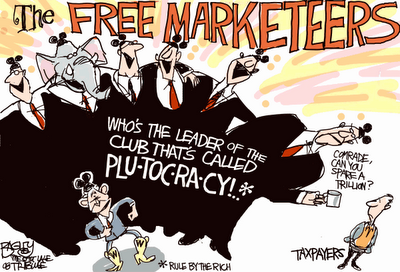
Photo: theoldspeakjournal.com
‘Everyone knows that millions of Americans are in trouble. They’ve lost their jobs, their homes, and their savings. Their grown children have moved back in with them. Their state and local taxes are rising. Teachers and firefighters are being laid off. The roads and bridges they count on are crumbling, pipelines are leaking, schools are dilapidated, and public libraries are being shut. Why isn’t government working for us? Because it’s been bought off. It’s as simple as that. And until we get clean money we’re not going to get clean elections, and until we get clean elections, you can kiss goodbye government of, by, and for the people. Welcome to the plutocracy.’- Bill Moyers
More on these later. First, it will be most beneficial if I recall what I had noted on the consequences of the Koch brothers demented ideology of neoliberalism on my country, which, by and large, has destroyed everything that was once good and valueable in Britain, so to speak.
Nota bene
Neoliberalism: The Broken Economic Model
(First published as an email to the GCGI members in May 2011)
Dear Friends,
“Do you remember that Margaret Thatcher, the so-called Iron Lady!! She told the Brits that she was going to put the “Great” back into the “Great” Britain. Do you remember? Then, she told us this can only happen if we accept and implement the “Washington Consensus”, the so-called dreaded neo-liberalism. She told us that there was no alternative. She told us we will all prosper and develop more fairly and equitably. She won election after elections. Everything was privatised, deregulated, self-regulated. Industry, manufacturing, (the real economy) was destroyed. Instead, the banks and the bankers were encouraged to rule the world. The economists with no principles and values were “bought” and the business schools, such as Harvard and Columbia were showered with money to act as “Cheerleaders” for the dreaded neoliberalism (see the Inside Job for evidence). Communities were dis-mantled and dis-organised. We were told that there is nothing as a society and community. We are all in it just for ourselves, we were told. Destructive competition at the expense of life-enhancing cooperation, collaboration and dialogue was greatly prompted. We were told to say no to love, kindness, generosity, sympathy and empathy and say yes to selfishness, individualism and narcissism, as these values will fire the engine of capitalism and wealth creation! In short, the hell with the common good, we were encouraged to believe.
We were brained-washed. Our other Prime Ministers repeated her nonsense and have carried on her footsteps. It is now over 30 years since the neo-liberalism experiment in Britain. Are we any “Greater” than we were in 1979? Are we any fairer or more equitable? The country is nearly bankrupt, with public and private debt at unprecedented levels, with the greatest levels of poverty and wealth disparity ever. The house of neo-liberal capitalism is now at its nadir of decadence.”
You see, all those interested in life’s bigger picture, have been saying the same, over and over. The neo-liberals are not in touch with humanity. They will prostitute all in the interest of profit maximization, cost minimization, highest return to shareholders, and the biggest and juiciest bonuses for the CEOs and their lackeys.”- The Broken Economic Model
Read more on the devastation, destruction and lies of neoliberalism:
The Destruction of our World and the lies of Milton Friedman
The Neoliberal Road to Serfdom
People’s Tragedy: Neoliberal Legacy of Thatcher and Reagan
Neoliberalism destroys human potential and devastates values-led education
Neoliberalism and the rise in global loneliness, depression and suicide
Why are people in the US living shorter lives?
Selling off our Motherland: The Biggest Crime of the Broken Economic Model
Economic Growth: The Index of Misery
The Neoliberal Road to Serfdom
How markets became masters and humans became ‘serfers’**!
(** A Serfer is the modern equivalent to bonded labour of the olden days (KM). This is the world’s most widespread form of modern slavery, thanks largely to the lies of Friedrich Hayek, Milton Friedman and their disciples. )
“We have become, in the United States, and increasingly all over the world, a society with only two classes: Those who own, and those who owe.” –Thom Hartmann
Owners and Owers- Rich and Poor
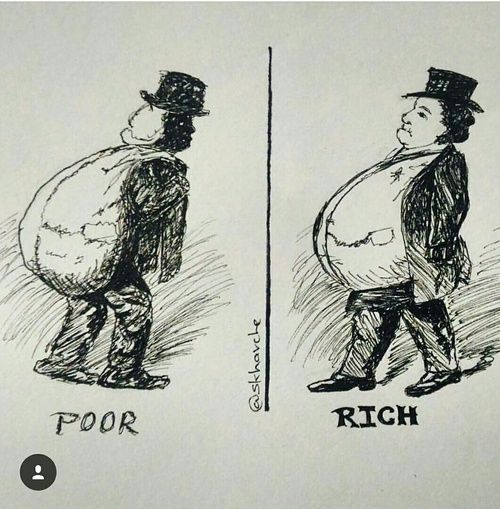
Photo: pinterest.com
“The demands of the ultra-rich have been dressed up as sophisticated economic theory and applied regardless of the outcome.”
A reflection on the global application of a fraudulent economic theory which has brought the world to its knees. Yet for those in power, it offers riches well beyond the wildest dreams of the ordinary working classes.
Death and destruction. That is David Koch’s legacy.*
Alex Kotch, Via The Guardian
‘Anarcho-capitalism was the real cancer plaguing the billionaire libertarian. And it spread across universities, halls of Congress and the White House.’
This is the tragic mindset of many a rightwing oligarch: the toils, the woes, the maladies of humankind are irrelevant – unless they happen to me, or perhaps my close family members’
'In 1992, billionaire industrialist David Koch was diagnosed with advanced prostate cancer and given just a few years to live. Thanks to his enormous wealth, he was able to purchase the best treatment in the world, and he survived 27 more years until his death last week.
For all his adult life, he’d led Koch Industries, a diversified manufacturing conglomerate, with his older brother Charles. Now taking in around $110bn per year, the company creates chemicals and fertilizers; it produces synthetic materials such as Lycra; it sells lumber and churns out paper and glass products; it makes electronics components used in weapons systems. But first and foremost, Koch Industries mines and refines petroleum and operates pipelines to spread it throughout North America.
Koch Industries, a private company, is the United States’ 17th-largest producer of greenhouse gases and the 13th-biggest water polluters, according to research from the University of Massachusetts Amherst – ahead of oil giants Exxon Mobil, Occidental Petroleum and Phillips 66. The conglomerate has committed hundreds of environmental, workplace safety, labor and other violations. It allegedly stole oil from Indian reservations, won business in foreign countries with bribery, and one of its crumbling butane pipelines killed two teenagers, resulting in a nearly $300m wrongful death settlement. The dangerous methane leakage, carbon emissions, chemical spills and other environmental injustices enacted by Koch’s companies have imperiled the planet and allegedly brought cancer to many people. But it took Koch’s own struggle with the disease for him to care about cancer and fund research to combat it.
This is the tragic mindset of many a rightwing oligarch: The toils, the woes, the maladies of humankind are irrelevant – unless they happen to me, or perhaps my close family members. I’ve never struggled to live on $7.25 per hour, so why is it a problem? An ailment has never caused me to go bankrupt, so why would anyone possibly need government subsidies to pay for life-saving medical care? Climate change has never directly affected my life so I’ll keep on denying that humans have anything to do with it. Even though I inherited a business and a fortune, I earned every cent of my astronomical net worth. If you worked as hard as I have, you would have what I have, too.
Koch epitomized this grotesquely selfish mentality during his 1980 vice presidential campaign on the Libertarian ticket, when he ran on abolishing Social Security, Medicare and Medicaid, welfare benefits, the minimum wage and the Environmental Protection Agency. He put $2m of his own money into the effort and campaigned to ax all campaign finance laws so he and his brother could maximize their bloated political influence without any pesky rules attempting to honor the constitutional premise of American elections: “One person, one vote.”
It is this cruel mindset that was the real cancer plaguing David Koch. It wouldn’t kill him, but it would spread itself into university curricula, the halls of Congress, regulatory agencies, and the White House. It possessed the unfathomably rich who came before him, and it will infect the opulent oligarchs who come after him. It is the cult of anarcho-capitalism, the faithful worship of the divine free market that has shined so brightly on Koch and his family. If only we could do away with government altogether, we’d become a true utopian society: a handful of corporate monarchs ruling over billions of wretched serfs who toil away until their deaths, faithfully adding zeros to the quarterly revenues of the select few at their own fatal expense.
Not only did Koch help unleash countless metric tons of greenhouse gases from the earth, he was a key funder of climate change denialism, stiff-arming scientists in order to further plunder the earth he was destroying. Revelations in Christopher Leonard’s new book, Kochland, show that Koch played an even greater role in funding climate change denialism than we previously knew. As we careen towards a climate catastrophe that seems more and more likely to happen within the next 11 years, we can rightly pin a portion of the blame on David and his brother.
With Charles, David funded and participated in a network of free-market thinktanks that produced academic literature in support of slashing taxes and gutting regulations in order to aid mega-corporations like Koch Industries. These ideological centers include the Cato Institute, which the Kochs founded and where David was a longtime board member; the American Enterprise Institute, where he was a member of its National Council; George Mason University’s Mercatus Center and the Institute for Humane Studies; and the Heritage Foundation. Now alumni of the Koch academic and policy networks have become government administrators, regulatory officials, political advisers and lifetime judges.
In 1984, David co-founded the predecessor to the non-profit Americans for Prosperity (AFP), among the first of many political major groups the brothers would fund and operate. The Kochs increased their political spending and engagement over decades, using AFP and other groups to publicize the thinktanks’ laissez-faire policy proposals and pressure members of Congress to support them. In 2009, AFP helped get the allegedly grassroots Tea Party off the ground, as it and other Koch network organizations began years of campaigning against President Obama’s effort to give millions of low-income Americans health insurance and expanded Medicaid. David has funded research into cancer therapies but appears to believe that only the financially secure deserve treatment.
Spending by the Kochs’ political groups and campaign donations from the Kochs and their company’s Pac made a wave of rightwing ideologues into lawmakers at the state and federal levels. The Tea Party sweep in 2010, a phenomenon that laid the groundwork for a rightwing nationalist president, would not have been nearly what it was without the Koch largesse. Now the Koch political network claims to be distressed at President Trump’s cruel immigration policies and tariff wars, yet the network championed the contemporary far-right movement that has seated countless lawmakers who revel in anti-immigrant and nationalist policymaking.
In the current decade, while Koch-backed state legislators made sweetheart deals with oil and gas companies and crippled the progress of solar companies, Koch beneficiaries in the House and Senate were cutting taxes, undoing federal regulations, and doing all they could to kick millions of Americans off of their health care coverage.
When you walk around Cambridge, Massachusetts, you’ll pass by MIT’s David H Koch Institute for Integrative Cancer Research or the David H Koch Childcare Center. When taking in upper-crust Manhattan arts and culture, you’ll come across Lincoln Center’s David H Koch Theater. For those who don’t know about Koch’s business and political operations, he must seem like a generous man.
The directors of these institutions are ever grateful to Koch (This is how the super-rich have bought up the universities. KM)
“David Koch was a model philanthropist who funded initiatives across a swath of cultural, scientific, and medical institutions,” Robert Millard, chair of the MIT Corporation, said in MIT News. “His generosity has benefited humanity broadly – from the arts to cancer research to science. MIT is deeply thankful for his many contributions to our community.”
“His contributions to medical research will live on forever; they have and will continue to benefit millions of Americans and others around the world,” said Jonathan Simons, CEO of the Prostate Cancer Foundation, in a tribute to Koch. “We will miss his sense of humor, his wisdom and his insightfulness.”
Koch may have kept some arts institutions on life support, bolstered the Natural History Museum’s dinosaur exhibition, or employed cancer researchers, but we must not let these philanthropic acts cover for a billionaire whose corporate greed has gravely endangered the future of the planet and the human species. This is the point of these seemingly magnanimous contributions: to cast the Kochs in a positive light, deflecting criticism of Koch Industries’ shameful business practices and defending the legacy of a heartless robber baron.
What was the prime motivator behind the life and career of Koch, an MIT-educated chemical engineer who denied the existence, and harms, of man-made climate change? Was it his extreme distaste for authority, birthed during his youth under a strict, Nazi-supporting nanny and an often absent father? Was it a religious commitment to free-market capitalism and an honest belief that the market, if truly unfettered, will solve every daunting problem for humanity? Was it a sincere belief that, although he and his brother were born to a wealthy oil executive, every single poor and working-class person could pull themselves up from nothing, with no help from anyone, in a drastically unequal society, if they just tried harder?
I don’t think it was any of these explanations. The answer is very simple. It was greed, the blind pursuit of horrifying wealth and power. An addiction that has left the country less equal and the planet endangered.
David Koch died as the eleventh-richest man in the world, with an estimated net worth of $51bn. His name is plastered on the facades of New England cancer centers and Manhattan hospitals and performance halls. But these historical imprints are temporary and relatively inconsequential compared to his lasting legacy, something far more significant, and terrifying. Koch’s never-ending quest for obscene wealth no matter the consequences – and that of his brother, his fellow oligarchs and his political allies – will be part of every future climate change-intensified weather disaster; every city undone by catastrophic sea level rise; every animal species that goes extinct because of warmer waters, desertification, or biblical floods; and every desperate climate refugees.'- *Death and destruction. That is David Koch’s legacy.
...And now read about the possible paths on how we may put right what has so tragically gone wrong, on how to stop death and destruction and how we may begin to value and nurture life again
I am positive and hopeful. We can change the world for the better. Come with me on this journey of self discovery in the interest of the common good
Yes, We can win over death and destruction, the neoliberalism, If we listen to the Voice of Hope, echoing across the world,
Photo:twr.org
Remaking Economics in an age of economic soul-searching
The World would be a Better Place if Economists had Read This Book
In Praise of Darwin Debunking the Self-seeking Economic Man
Composing a New Life: In Praise of Wisdom
Brexit, Trump and the failure of our universities to pursue wisdom
Calling all academic economists: What are you teaching your students?
Values-free, Market- Driven Education: What a Disaster!
The Journey to Sophia: Education for Wisdom
My Economics and Business Educators’ Oath: My Promise to My Students
What might an Economy for the Common Good look like?
The Age Of Perpetual Crisis: What are we to do in a world seemingly spinning out of our control?
- Details
- Written by: Kamran Mofid
- Hits: 3672
This is the Manifesto to Make the World Great Again
The key that will unlock the door to world’s greatness is values-led education

Photo: missionself.com
As Nelson Mandela used to remind us again and again, “Education is the most powerful weapon which you can use to change the world. ”Education is the key to eliminating gender inequality, to reducing poverty, to creating a sustainable planet, to preventing needless deaths and illness, and to fostering peace, harmony, justice, egalitarianism, equality, good race relations, progress and prosperity, for many and not the few.
In short, education is an investment, and for that matter, it is one of the most critical investments we can make. I hope that one day soon this will be realised by all, and thus, when it comes to the annual governmental budget allocations, to my mind, spending on education should not be seen as expenditure, but as an investment in people and in humanity.
T.S. Eliot posed the question: "Where is the Life we have lost in living? Where is the wisdom we have lost in knowledge? Where is the knowledge we have lost in information?"
- Neoliberalism destroys human potential and devastates values-led education
- The World would be a Better Place if Economists had Read This Book
- A Must Read Book about how Adam Smith can change your life for better
- Austerity driven Homeless children put up in Shipping Containers in ‘Great Britain’
- In Praise of Darwin Debunking the Self-seeking Economic Man