
- Details
- Written by: Kamran Mofid
- Hits: 1432
Labour Day, Celebrating solidarity and shared struggle 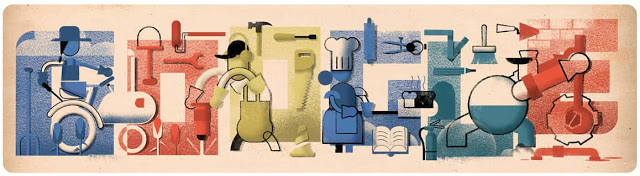
Photo:google.com
Happy Labour Day!
Union members earn on average 22% higher wages than their non-union peers. Unions also help raise wages for people of color and provide protections against discrimination. Union members tend to be happier, more content and more fulfilled by their work. Employees are supported not just by the benefits of their contract, but by the culture of solidarity and shared struggle that exists in many union workplaces.
(These are all common sense, are they not? Surely, happier, more content, more fulfilled workers are better workers, more productive, more imaginative, and thus, by definition, far better for their employers too. But, the pertinent question is: Will the feral, greedy, self-serving neoliberal capitalists ever see this for what it is, or will their love for exploitation trump everything else?)
First, lest we forget: ‘On the morning of September 5, 1882, spectators lined lower Broadway in Manhattan, near City Hall, waiting for the start of America’s first Labor Day parade. Finally, Matthew Maguire, a machinist from New Jersey, who is widely believed to have come up with idea of Labor Day, announced that a jewelers’ local from Newark had arrived—with its marching band—and the parade set off. As the band turned up Broadway, playing a piece from a Gilbert and Sullivan opera, a small crowd of workers and spectators fell in line behind it. By the time they reached Reservoir Park, where the main branch of the New York Public Library now stands, the procession had expanded to more than ten thousand people...’- Continue to read
'This Labor Day, I’m Grateful To Be Part of a Union for the First Time.'
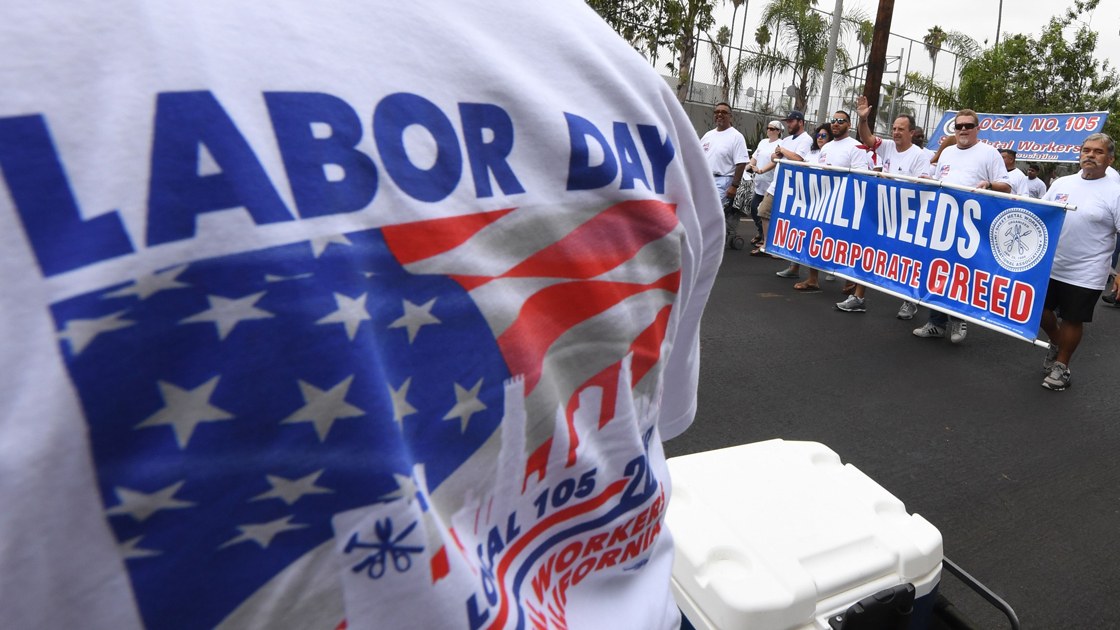
Photo:teenvogue.com
In this op-ed, Katie Barrows, vice president of communications for the Nonprofit Professional Employees Union (NPEU) explains why she's glad to be celebrating Labor Day as a union member.
‘This Monday marks my first Labor Day as a union member. With union members making up only 12% of the full-time U.S. workforce, I — like most young professionals — have spent most of my career in non-union workplaces. Now that I’ve experienced working at an organization where employees have a union, I know the difference being a union member makes.
I began working in D.C. as an unpaid intern on the Hill, in hopes of landing my dream job as a congressional staffer. Realizing I couldn’t make the sacrifice of going unpaid indefinitely, I took a position outside of Congress. It was my first paid job in Washington, D.C., but I was earning only $30,000, my housing and transportation costs ate up half of my income, and I lived in constant fear of being fired. This job made me depressed and miserable, and I left after just under a year.
My next job was at a non-profit with a mission I loved. My salary was still low to live comfortably in D.C., but it was an increase from my previous job. I found it challenging to ask for a pay increase I thought I deserved because people weren’t open about their salaries, and I didn’t know where I stood in comparison to others with comparable positions.
At my current job, I am now a member of the Non-profit Professional Employees Union (NPEU). If I’d known earlier in my career what I know now about the benefits of a union, I would have talked to my coworkers about our shared problems and organized one. But back then I still had the mentality that I would have to make sacrifices to do what I wanted to do. I thought that working in the field of non-profit advocacy meant that I shouldn’t expect fair pay, and should instead be grateful for the few benefits that I had. I was wrong.
As I later learned, union members earn on average 22% higher wages than non-union members. I know from the contracts of my fellow union members that joining together can substantially raise wages at non-profits and similar organizations. One NPEU first contract raised members’ pay by nearly 10% on average, and most contracts establish minimum salaries and guarantee annual raises.
About half of all employees say discussion of salary information is not allowed or discouraged in their workplace. Clearly, I was not alone in my experience with pay secrecy. But this doesn’t have to be the case. NPEU members have negotiated for open and clear pay scales that allow pay to be transparent. Additionally, pay transparency is good for workplaces. It has been shown to help close the wage gap and increase employees’ productivity.
Instead of being “at-will” employees who can be fired at anytime, for any reason (except for an illegal one) or no reason at all, most union members — including NPEU members — have “just cause” protections in their contracts. This prevents employees from being dismissed without a fair and justified reason. Having this protection provides union members like myself with a feeling of stability because we know our managers cannot suddenly take our livelihood away.
Many union contracts establish clear procedures that create standards for fair and equal treatment in the workplace. Some of these procedures include standardized evaluations with clear paths for advancement and progressive discipline systems that give employees the opportunity to improve. NPEU members have also negotiated for protocols that encourage diversity in hiring and commitments to inclusion. Many union contracts call for the creation of labor-management committees, which provide employees with a platform to bring up workplace issues and collaborate with managers to solve them.
Research shows that unions also help raise wages for people of color and provide protections against discrimination. Union members tend to be happier and more fulfilled by their work. Employees are supported not just by the benefits of their contract, but by the culture of solidarity and shared struggle that exists in many union workplaces.
This week, I’m grateful for my union. With workplace policies that raise pay, provide for workplace transparency, and require fair and equal treatment, NPEU members can have long-term, sustainable careers at organizations doing critical research, advocacy, and organizing. This Labor Day, instead of suffering through your organization’s workplace problems, think about empowering yourself to make your job better by joining with your colleagues in union.’- Katie Barrows, Via teenVOGUE
Learn more about the Nonprofit Professional Employees Union (NPEU)
What a Labor Union Is and How It Works
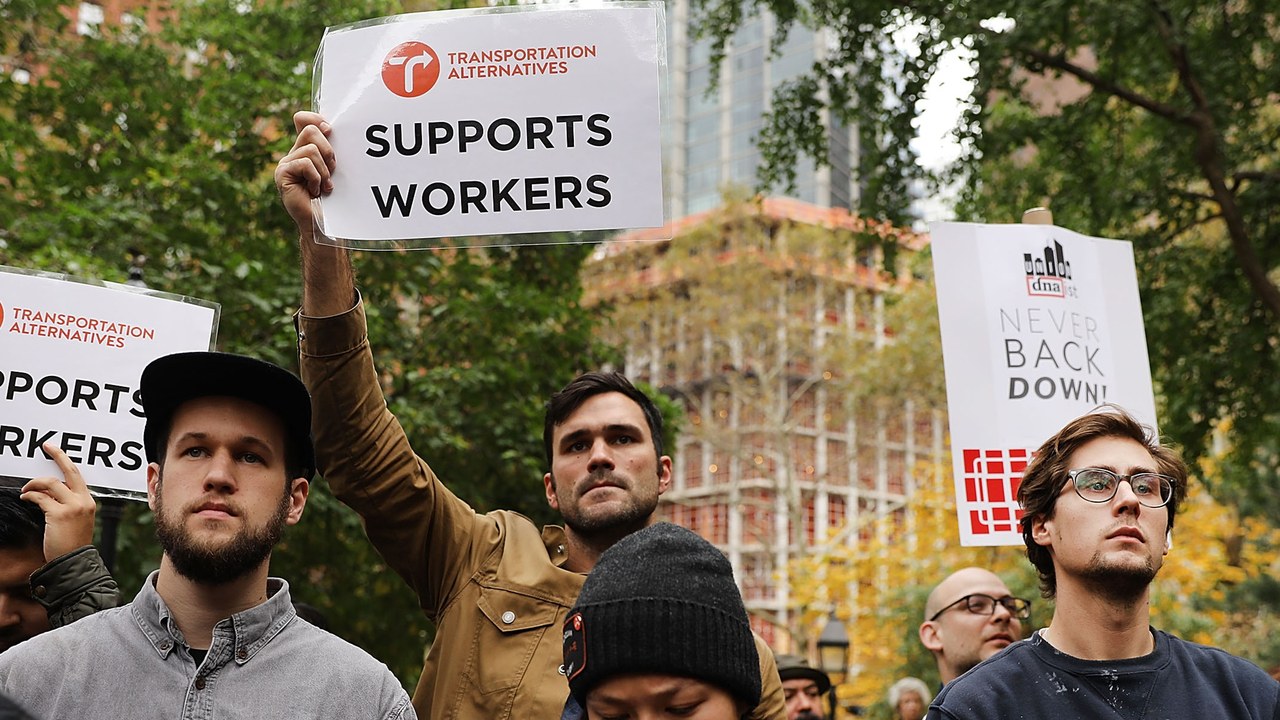
Photo:teenvogue.com
Why Unions are Needed More than Ever Before: A View from Britain
UK faces Victorian age of inequality, says TUC general secretary
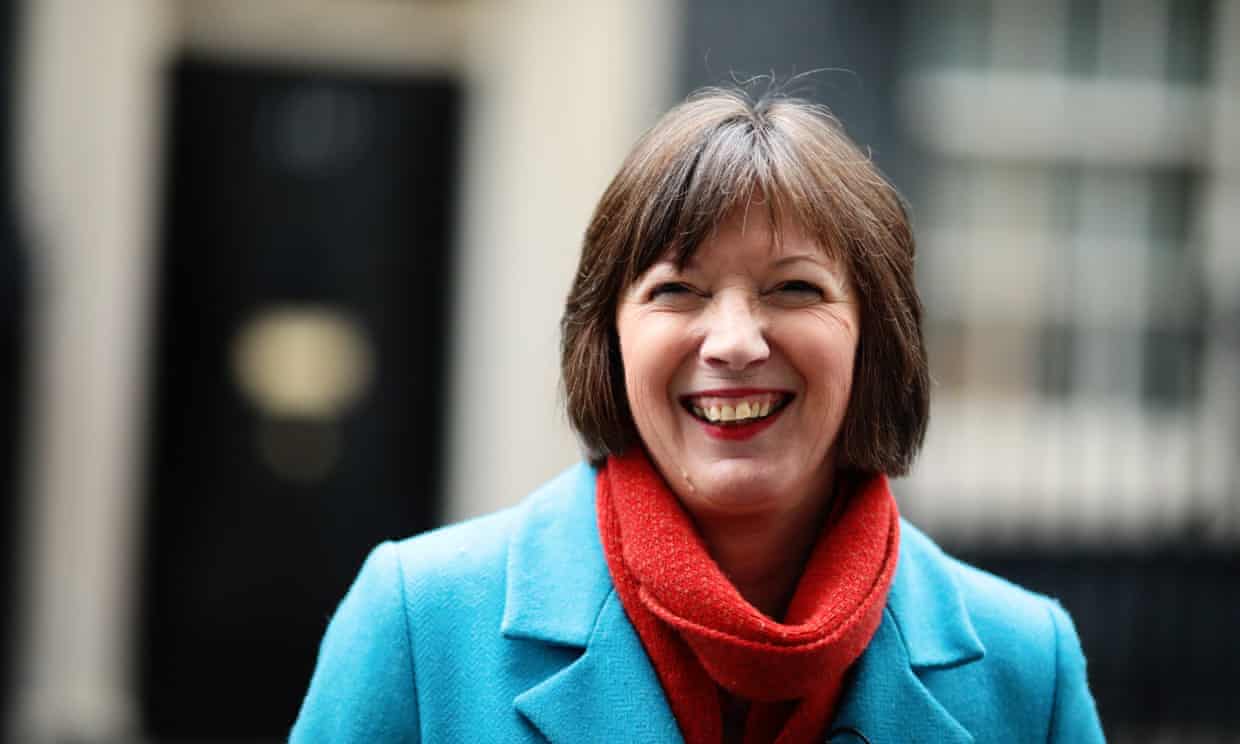
Frances O’Grady said millions of workers have no control and no voice at work and there needs to be a shift in power from employers to unions
‘Britain risks turning the clock back to the working conditions of the Victorian age unless unions have greater powers to organise and negotiate, the head of the TUC has said.
Photo:theguardian.com
Frances O’Grady, the TUC’s general secretary, said that without a shift in the balance of power from employers to unions the UK would face rising inequality and insecurity at work.
Ahead of its annual conference next week, the TUC said in a report there were 3.7 million people in insecure work, and 1.85 million self-employed people earning less than the minimum wage. Despite the recent pick-up in earnings, it said workers were still facing the longest pay squeeze for 200 years.
The report added that the share of economic output going to wages had declined from an average of 57% in the three decades after the second world war to 49% in 2018.
During the same period, the TUC said anti-trade union laws and industrial change had resulted in union membership and collective bargaining coverage falling – from 54% and over 70% in 1979 to just 23% and 26% respectively in 2018.
O’Grady said: “We’re at risk of going back to 19th-century working conditions. Millions of workers have no control and no voice at work, with increasing numbers stuck on low pay, zero-hours contracts, and in sham self-employment.
“We urgently need to reset the balance of power in our economy and give people more of a say about what happens to them at work. We know that collective bargaining is the best way to raise wages and improve conditions – so let’s expand it across the whole workforce.”
The TUC says that increasing the number of workers covered by collective bargaining agreements was the best way to raise wages and improve conditions. In addition to a £10-an-hour minimum wage and a ban on zero-hours contracts, the TUC is seeking:
- for unions to have the right of access to all workplaces to tell workers about the benefits of trade union membership.
- new rights to make it easier for working people to negotiate collectively with their employers, on issues that go beyond pay including workload and family friendly rights.
- sectoral collective bargaining, which would involve the creation of new mandatory joint bodies for unions and employers to negotiate pay, conditions and training for all employees working in a specific sector. The process would start with the hospitality and social care sectors where the TUC says low pay is endemic.
TUC research has found that low wages are linked to unsecured borrowing hitting record levels, with one in five families stuck in problem debt. Unsecured debt per household stood at £15,880 in the first quarter of 2019, up £1,160 on a year earlier.
Young people were disproportionately likely to be in debt, the TUC said, with 70% of 18-34 year-olds having a type of unsecured debt compared to 33% of the over-65s.
O’Grady said Britain needed to have a debt reality check. “We need to rebuild family finances or we are stuffed. This has always been the canary in the mine.
“This is not about people splashing the cash. It is about paying for the basics. It is about wages still not back to where they were before the crash and prices in the shops going up.”
The TUC general secretary said that a hard Brexit would hit poor people first and hardest.
“Michael Gove is talking about bumps along the road but they will be earthquakes for those drowning in debt who haven’t got a magic money tree at the bottom of the garden.”
O’Grady said that many of those who voted leave in the referendum did so because of frustration about low wages, insecurity and zero-hour contracts and “uber-globalisation”, which had seen “a shift in power and wealth to a tiny minority at the top while everybody else had to do with the crumbs.”- The Guardian, 5 September 2019
Further reading:
Neoliberalism destroys human potential and devastates values-led education
Death and Destruction on Brothers’ Road to Serfdom
Remaking Economics in an age of economic soul-searching
The World would be a Better Place if Economists had Read This Book
In Praise of Darwin Debunking the Self-seeking Economic Man
Composing a New Life: In Praise of Wisdom
Brexit, Trump and the failure of our universities to pursue wisdom
Calling all academic economists: What are you teaching your students?
- Details
- Written by: Kamran Mofid
- Hits: 2357
‘From Westminster to Whitehall, elites are failing and our political system is collapsing.’
'Why Are Our Politicians So Crap?'
How much more destruction should they cause for us to take their CRAPNESS seriously?
If this is not the time to wake up, then, when is it?

I was Boris Johnson’s boss: he is utterly unfit to be prime minister Photo:flickriver.com
Brexit: The Key Lessons- Now is the time for hope to build on the ruins
The ‘Independence Day’, Not Long to Go!
How Low a 'Crap' Can Fall?
This man is the leader of the House of Commons!
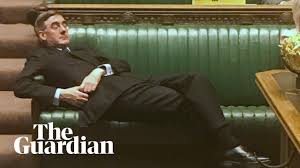
'It was one of the most consequential debates in parliamentary history. Indeed, the grave subject of whether or not to hand control of the Brexit process to those seeking to avoid no deal appeared to weigh particularly heavily on the shoulders of Jacob Rees-Mogg, who spent a significant portion of the time slouched on the government front bench.'-The Guardian
’You see my friends, when you privatise and deregulate everything, then, sooner or later, you start to privatise and deregulate yourself, losing your identity and moral compass, not knowing who/what/why you are, and become a total moron and crap!’

Photo:theguardian.com
‘Unquestionably the trust in UK politicians is at an all time low. A steady decrease in trust has taken place for over 10 years, fuelled by different scandals, particularly the expenses debacle and more recently, everyone’s favourite topic they are fed up with, Brexit. However, there is far more to it as Jeremy Paxman attempts to reveal in this hour long programme on Channel 5. Searching deeply into the past he seeks through other issues raised by the public, including first past the post, spin doctoring, putting their own interests before that of the electorate, their class background, the list goes on and on…’ TVMucho See also: AVAILABLE ON MY5

Photo:parliament.uk
Incompitent, Untrustworthy, Corrupt, Selfish, Greedy, Self-serving,...you name it!
This is what we think about our Politicians.
The pertinent questions must surely be: But Why?
What Has Gone Wrong, and How it May be Put Right Again?
There are for sure many reasons for such an outcome. But, to my mind, the main reason is NEOLIBERALISM, which was worshipped and introduced to this country, by MARGARET THATCHER, (whilst the same was implimented in the US by Ronald Reagan. It is interesting to note that both countries are now facing the same crisis!)
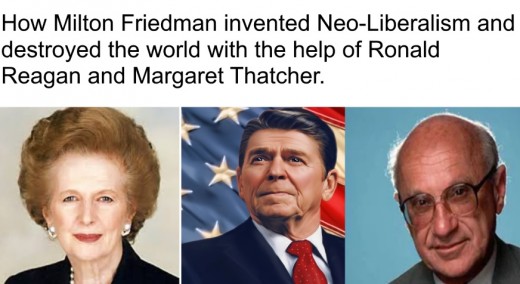
Photo: How Milton Friedman's Neo-Liberalism Destroyed the Economy of the US and the UK
In Britain, Thatcher destroyed every good value this country once had, and now today, her so-called foolish children, learning their lessons from her, have excelled themselves and have become a bunch of carp buffoons, good for nothing.
You see my friends, when you privatise and deregulate everything, then, sooner or later, you start to privatise and deregulate yourself, losing your identity and moral compass, not knowing who/what/why you are, and become a total moron and crap!
Let me remind you of what I had noted years ago, very much relevant to why politicians, and indeed, a hell of a lot more, have become nothing but useless crap!
Nota bene
Neoliberalism: The Broken Economic Model
(First published as an email to the GCGI members in May 2011)
Dear Friends,
“Do you remember that Margaret Thatcher, the so-called Iron Lady!! She told the Brits that she was going to put the “Great” back into the “Great” Britain. Do you remember? Then, she told us this can only happen if we accept and implement the “Washington Consensus”, the so-called dreaded neo-liberalism. She told us that there was no alternative. She told us we will all prosper and develop more fairly and equitably. She won election after elections. Everything was privatised, deregulated, self-regulated. Industry, manufacturing, (the real economy) was destroyed. Instead, the banks and the bankers were encouraged to rule the world. The economists with no principles and values were “bought” and the business schools, such as Harvard and Columbia were showered with money to act as “Cheerleaders” for the dreaded neoliberalism (see the Inside Job for evidence). Communities were dis-mantled and dis-organised. We were told that there is nothing as a society and community. We are all in it just for ourselves, we were told. Destructive competition at the expense of life-enhancing cooperation, collaboration and dialogue was greatly prompted. We were told to say no to love, kindness, generosity, sympathy and empathy and say yes to selfishness, individualism and narcissism, as these values will fire the engine of capitalism and wealth creation! In short, the hell with the common good, we were encouraged to believe.
We were brained-washed. Our other Prime Ministers repeated her nonsense and have carried on her footsteps. It is now over 30 years since the neo-liberalism experiment in Britain. Are we any “Greater” than we were in 1979? Are we any fairer or more equitable? The country is nearly bankrupt, with public and private debt at unprecedented levels, with the greatest levels of poverty and wealth disparity ever. The house of neo-liberal capitalism is now at its nadir of decadence.”
You see, all those interested in life’s bigger picture, have been saying the same, over and over. The neo-liberals are not in touch with humanity. They will prostitute all in the interest of profit maximization, cost minimization, highest return to shareholders, and the biggest and juiciest bonuses for the CEOs and their lackeys.”- The Broken Economic Model
Other Main Reasons for Our State of Crappiness
Values-less Education and Narcissism (Both the Consequences of Neoliberalism)
Neoliberalism destroys human potential and devastates values-led education
Britain today and the Bankruptcy of Ideas, Vision and Values-less Education Details
Read more on the devastation, destruction and lies of neoliberalism:
Death and Destruction on Brothers’ Road to Serfdom
The Destruction of our World and the lies of Milton Friedman
The Neoliberal Road to Serfdom
People’s Tragedy: Neoliberal Legacy of Thatcher and Reagan
Neoliberalism destroys human potential and devastates values-led education
Neoliberalism and the rise in global loneliness, depression and suicide
Why are people in the US living shorter lives?
Selling off our Motherland: The Biggest Crime of the Broken Economic Model
Economic Growth: The Index of Misery
Further reading on why there is so much crap around!
Britain today and the Bankruptcy of Ideas, Vision and Values-less Education
The Age Of Perpetual Crisis: What are we to do in a world seemingly spinning out of our control?
British democracy is brought to its knees
...And now read about the possible paths on how we may put right what has so tragically gone wrong, on how to stop death and destruction and how we may begin to value and nurture life again
I am positive and hopeful. We can change the world for the better. Come with me on this journey of self discovery in the interest of the common good
Yes, We can win over death and destruction, the neoliberalism, If we listen to the Voice of Hope, echoing across the world,

Photo:bing.com
The Value of Values: Why Values Matter
Pursuing Common Values: A Call to Recover our Moral and Spiritual Imagination, Transforming Society
Remaking Economics in an age of economic soul-searching
The World would be a Better Place if Economists had Read This Book
In Praise of Darwin Debunking the Self-seeking Economic Man
Composing a New Life: In Praise of Wisdom
Brexit, Trump and the failure of our universities to pursue wisdom
Calling all academic economists: What are you teaching your students?
Values-free, Market- Driven Education: What a Disaster!
The Journey to Sophia: Education for Wisdom
My Economics and Business Educators’ Oath: My Promise to My Students
What might an Economy for the Common Good look like?
The Age Of Perpetual Crisis: What are we to do in a world seemingly spinning out of our control?
- Details
- Written by: Kamran Mofid
- Hits: 1625
“In no other square in Europe do I find it more difficult to speak, and to address you in my native language of German ... I ask for forgiveness for Germany’s historical guilt and I recognise our enduring responsibility.” Frank-Walter Steinmeier, Piłsudski Square, Warsaw, 1 September 2019
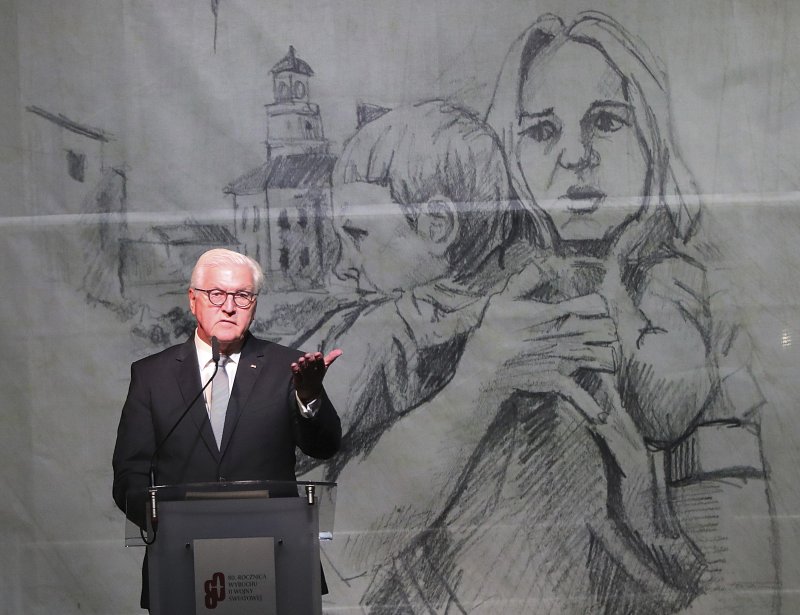
German President Frank-Walter Steinmeier speaks at the commemoration ceremony of the 80th anniversary of the start of WWII,
in Wielun, Poland, Sunday 1 September 2019. Photo: time.com
Germany’s president expressed deep remorse for the suffering his nation inflicted on Poland and the rest of Europe during World War II, warning of the dangers of nationalism as world leaders gathered Sunday in the country where the war started at incalculable costs.
“This war was a German crime,” President Frank-Walter Steinmeier told Poland’s top leaders. Steinmeier expressed his sorrow over the mass killings Adolf Hitler’s regime committed in Poland, which paid a huge price for being the place war began on Sept. 1, 1939. The German president expressed gratitude to Poles for the gestures of forgiveness Poland has bestowed in return.
Eighty years ago, the Second World War began
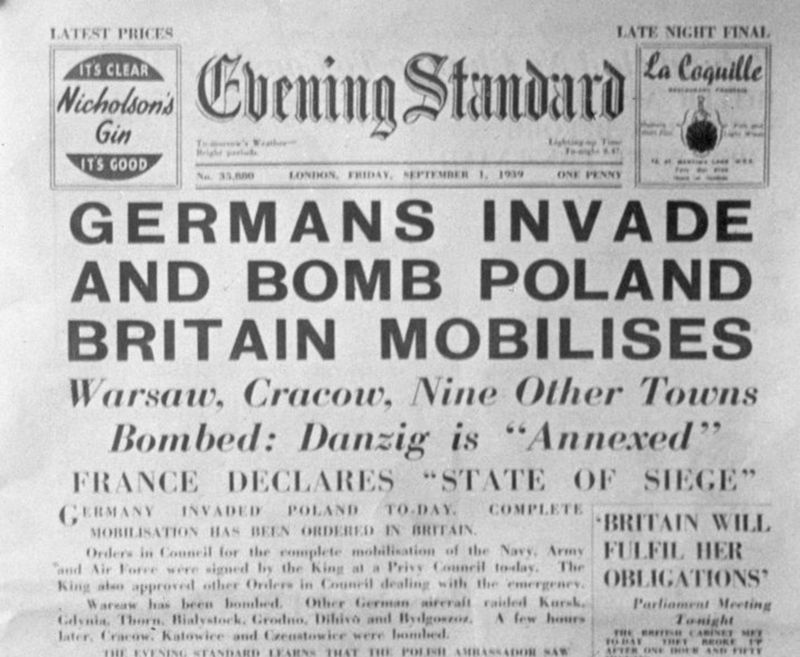
The front page of London’s Evening Standard newspaper on 1 September 1939, announcing the German invasion of Poland
‘Germany, the "Third Reich," invaded Poland, effectively drawing the entire world into war. It was a war that raged for six years in Europe, Africa, the Middle East and in the Pacific, arming some 110 million people. By the end, over 60 million people had died.
Six million European Jews were murdered in the Holocaust. Europe was laid to waste. Millions had been driven from their homes. Or deported. And for the first and only time in human history, atomic weapons were used.
When it comes to the question of who was responsible, there was and remains today not the slightest doubt - in contrast to the historical debate about the First World War. The Nazis wanted this war and started it. By the end, Germany was not only defeated - it was annihilated. With the Holocaust, it committed a crime that will never be forgotten.
In addition, more than 9 million Germans lost their lives - among them, 3 million civilians. Cities were lost in the Allied carpet bombings. Germany lost land in the east. Twelve million were driven from their homes. The country lay, after this devastating war, in ruins.’- Deutsche Welle (DW) Editor-in-Chief Alexander Kudascheff, writing on the 75th anniversary of the WWII.
Nota bene
Not forgetting Coventry's Message of Hope and Wisdom
The Most Important Lessons of WWII: Remember, Forgive and Reconcile: These were the Lessons of Coventry Cathedral’s Provost Howard to the World
“...tomorrow morning Coventry will lie in smoke and ruins.” – Josef Goebbels, Ministry of Propaganda
At this time of nationalism and bombast, the Coventry message of hope reminds us of our shared humanity across backgrounds, faiths, civilisation and cultures. And at a time when our country is divided, pitting itself against our European neighbours, we’d do well to remember the hopeful and enduring story of Coventry.
The Enduring Beauty and Wisdom of Coventry Cathedral
This is Why Coventry Cathedral Has Inspired the World
After the devastation of World War Two, Coventry Cathedral, inspired by its visionary Provost, Richard Thomas HOWARD, did something remarkable – they sought forgiveness and reconciliation rather than revenge and more wars of destruction.
A Portrait Of Humanity: Provost Howard’s Gift to the World

The very Reverend Richard Thomas HOWARD (12 June 1884– 1 November 1981), Provost, Coventry Cathedral, 1933 to 1958
Richard Howard: The Man who has inspired us all to reimagine a better world: A World of Hope and Healing
This is Coventry’s Message to the World: Remember and Forgive, Reconcile and make Peace
A Message of Humility, Kindness and Hope
A Message for Our Time, A Message for All Time
14 November 1940: The Destruction and Rebirth of Coventry
“On 14 November 1940 the Luftwaffe launched its most devastating bombing raid of the Second World War so far. The target was Coventry, a manufacturing city in the heart of England with a beautiful medieval centre.”
‘in just one night more than 43,000 homes, 71 factories, the entire city centre, two hospitals, two churches and the police station had been destroyed by 449 German bombers, dropping 30,000 incendiary bombs. An estimated 568 people had died in the raid on the first night of bombing, with over one thousand people sustaining serious and life-threatening injuries;
‘as a result of their efforts, the Nazis coined the verb Coventrierung (literally, to Coventrate) to describe total annihilation of a city through aerial bombardment;
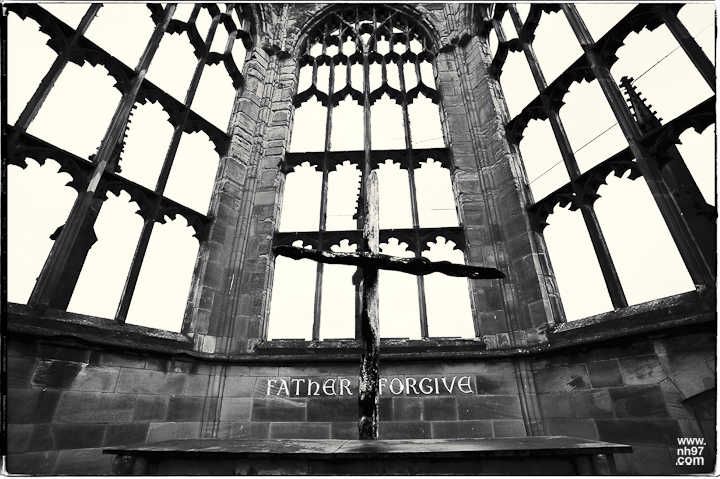
‘the next morning, while the rubble was still smouldering, Richard Howard, the cathedral Provost, had taken a piece of chalk and written on the sanctuary wall: “Father, Forgive”;
‘Richard Howard had made a bold move to break the cycle of vengeance. When the 1940 BBC Christmas Day service was broadcast from amongst the ruins of the cathedral, he vowed that, once the war was over, the cathedral would work with the people who had previously been their enemies “to build a kinder, more Christ-like world”;
‘inspired by the cathedral’s stonemason, who had made a wooden cross from the debris, Provost Howard made a cross from the nails that originally held the roof together. The destroyed altar was remade from the rubble, the crosses were placed on the new altar and the words “Father, Forgive” were inscribed on the wall behind;
‘After the war ended, the cathedral donated a “Cross of Nails” to the Kaiser Wilhelm Memorial Church in Berlin, which was also destroyed in the war. Today there are over 170 Cross of Nails Centres across the globe, each one owning a cross made from three nails from Coventry Cathedral, symbolizing the road to forgiveness and reconciliation…’ Father Forgive: It’s Impact on Me
The Coventry Litany of Reconciliation: The Charter for Forgiveness and Reconciliation the World Ever Needs
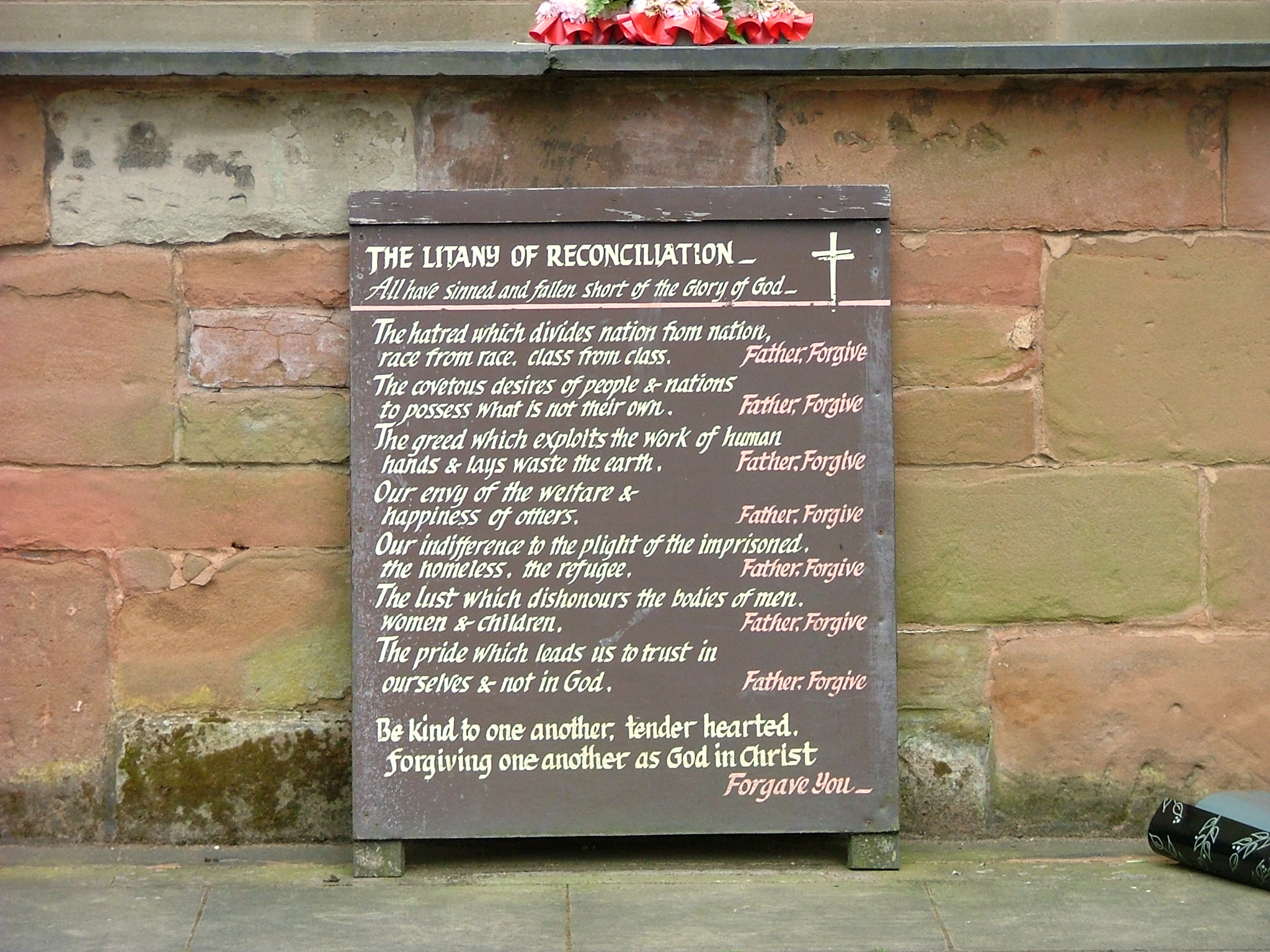
Photo: kmyra.ca
This is, once again, the timeless and noble message from Provost Richard Howard and Coventry Cathedral to those who think anger, revenge, retribution and war are what is needed to settle personal, regional and international disputes:
‘In the midst of war – a time when anger and defiance could have ruled the day – Provost Howard chose the harder, more transformative path. I wonder how our world might be changed today if we took on living the words of this Litany.’
‘After the bombing of Coventry Cathedral in 1940, Provost Richard Howard put the words “FATHER FORGIVE” on the wall behind the charred cross in the ruins of the destroyed cathedral in 1948. Not “Father forgive Them” – because we all have sinned and fallen short of the glory of God (Rom 3,23). These words moved generations of people and are prayed in the Litany of Reconciliation every Friday at noon outside in the ruins, and in many other places around the world.
The Litany of Reconciliation, based on the seven cardinal sins, was written in 1958 by Canon Joseph Poole, the first Precentor of the new Cathedral. It is a universal and timeless confession of humanity’s failings, but it evokes us to approach these sins and weaknesses in the forgiveness of God’s love.’...Continue to read
There you have it: This is Coventry's Message of Hope
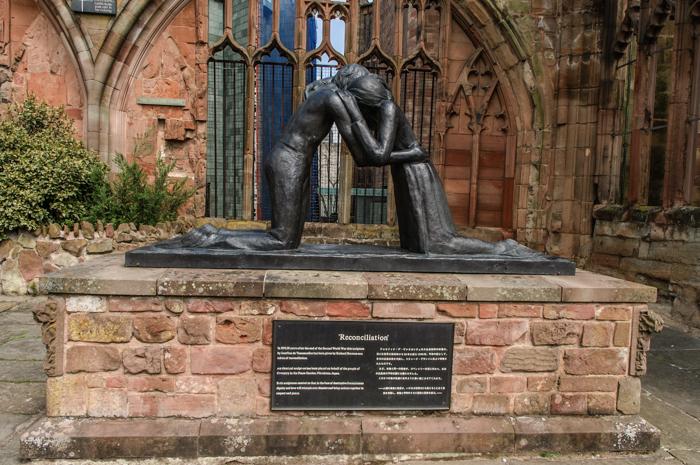
Photo: Anne Mofid
- British democracy is brought to its knees
- On the Road to Serfdom, Death and Destruction With the Koch Brothers
- The Value of Values: Values-led Education to Make the World Great Again
- Neoliberalism destroys human potential and devastates values-led education
- The World would be a Better Place if Economists had Read This Book