- Details
- Written by: Kamran Mofid
- Hits: 2544
Anthea Lawson, A Warrior, Campaigner and Activist for the Common Good
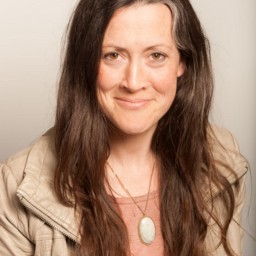
Photo:medium.com
Our Sacred Earth and Mother Nature in Need of More People like Anthea Lawson
A Statement to the Court by a First-Time Lawbreaker
‘Anthea Lawson was arrested for protesting in London with Extinction Rebellion against Government action on climate change. Here she shares the statement that she read in court.’++
But first lest we forget ‘that only 1.5 per cent of accused rapists are now being prosecuted in the UK. Yet one hundred percent of the people who are trying to preserve life for our grandchildren, for our brothers and sisters in other countries who are already struggling with drought and deluge — one hundred percent of us are being prosecuted.’
Earlier this week at City of London Magistrates Court I pleaded guilty to a criminal offence: a breach of Section 14 of the Public Order Act 1986, by sitting on Waterloo Bridge and refusing to move during the Extinction Rebellion protests in London in April this year.
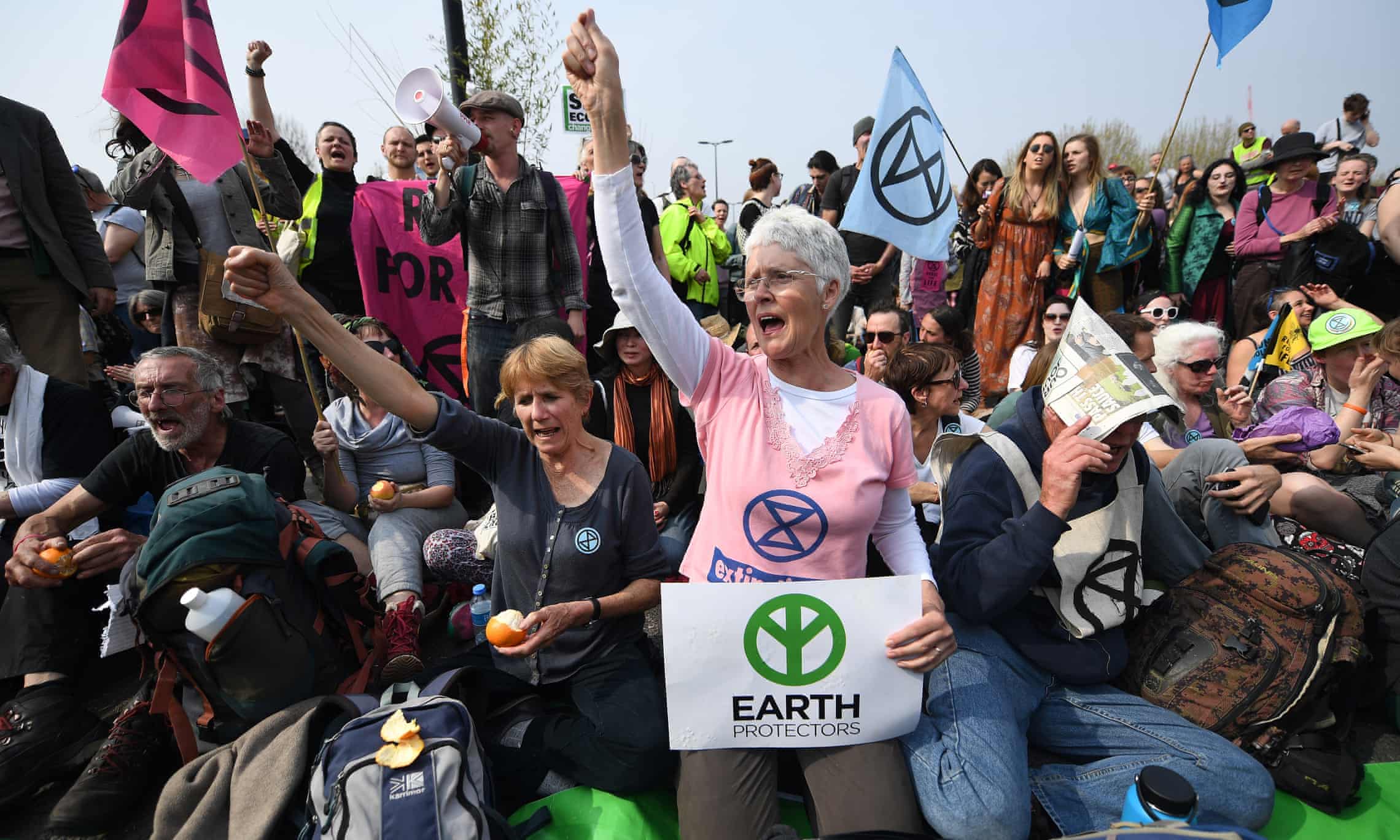
‘Extinction Rebellion climate change protesters occupy Waterloo Bridge in London’
Photo: Battle of Waterloo Bridge: a week of Extinction Rebellion protests
Over 1000 Extinction Rebellion Activists Were Arrested In April – This Is What Happened To Them
This felt like an extraordinary thing to do: both doing it in the first place, and then appearing in a court to be sentenced for it. (The sentence was a six month conditional discharge plus court costs.)
I’m sharing here the statement I made to the court. It seems unlikely to have made any difference to the outcome: there were nine of us in court together, all pleading guilty. Some made statements and some didn’t, and we all received the same sentence, which, with so many of us being prosecuted for the same offence, had no doubt been decided in advance. But still, it was an opportunity to speak my mind, and so I did. Here is what I said:
A Statement to the Court by a First-Time Lawbreaker
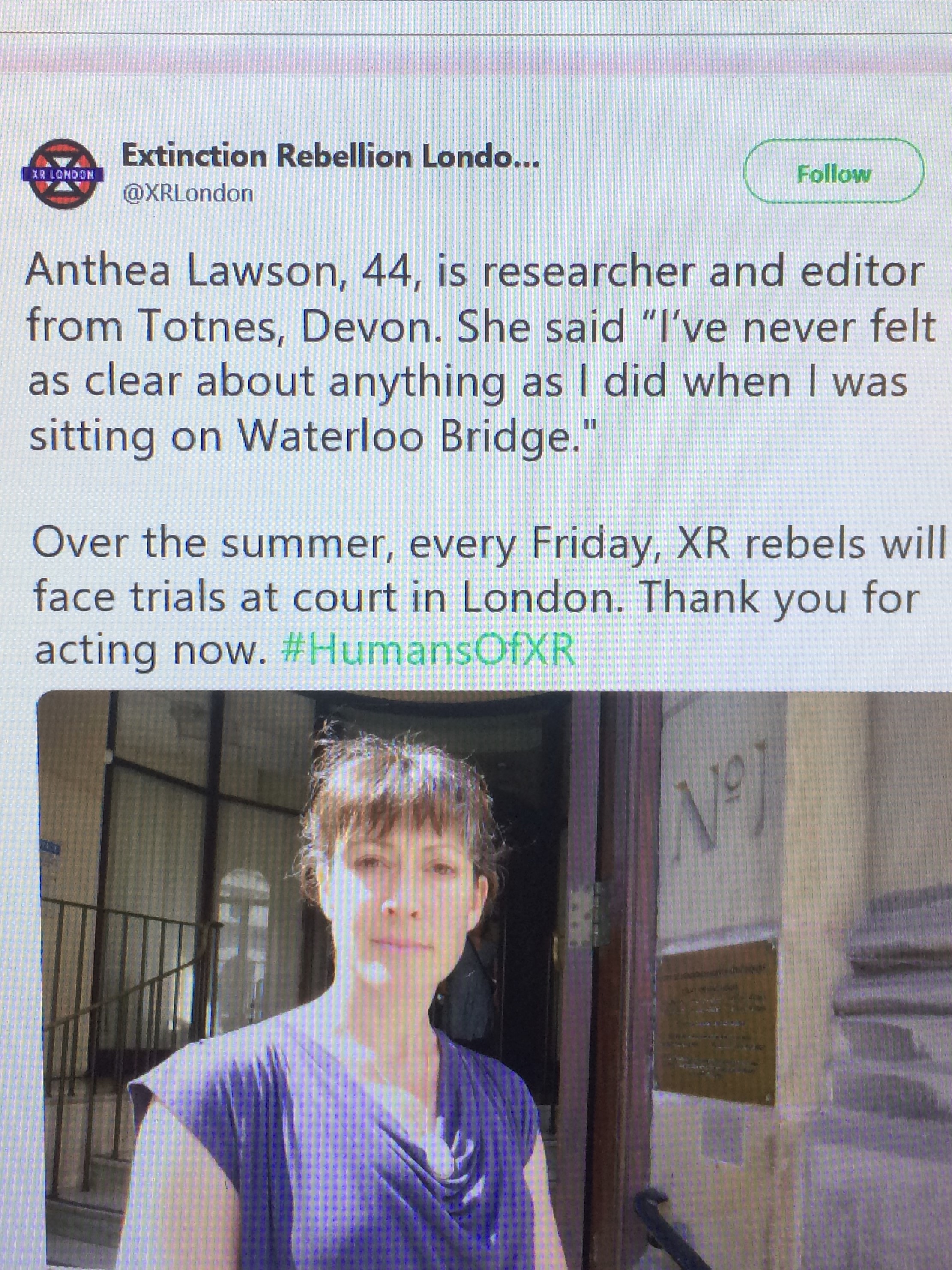
“I am pleading guilty to the offence with which I am charged, for reasons that are to do with not taking up more time, either my own or the court’s. But I would like to say a bit about why I did it.
“I have great respect for the rule of law, and have always lived by it. My mother was a magistrate for twenty years, and I grew up to respect the authority of the state. I trained as a journalist and sat on the reporters’ bench observing court rules in what I wrote for my newspaper. I lived and worked in Sierra Leone shortly after the end of its civil war and saw, first hand, the appalling consequences when the rule of law fails entirely.
In May a World Wildlife Fund report found that nature is being eroded at rates unprecedented in human history.
“My work, for a decade after that, was for an organisation that investigated corruption in the natural resource industries: oil, diamonds, timber. I used my investigations to call for the law to be used against the bankers and company executives who were facilitating corruption — a form of corruption that decimated the health and education budgets of some of the poorest countries in the world. I proposed new laws where there were gaps; I was in and out of the Treasury; I was in years-long conversations with the Economist and the Financial Times lobbying for a new regulation on disclosure of the real beneficial owners of companies, that is now becoming law in, at the latest count, 42 countries.
“So it is a measure of the seriousness of the situation that I have been willing to break the law as part of a protest. I have not done this lightly. I have felt extremely uncomfortable throughout the process of protesting, arrest, custody and now standing here before you. I know that I have caused difficulties for those who encountered the protests, and for the legal system.
“But what I did feels like the only thing left to try. I am talking here about the existential threat posed by climate change and species extinctions to life as we know it. I’m talking about failing harvests, mass deaths, the breakdown of civil order. The conclusions of the Intergovernmental Panel on Climate Change last October are available for anyone to see, and have been widely reported. ‘Limiting global warming to 1.5°C would require rapid, far-reaching and unprecedented changes in all aspects of society,’ said its summary for policymakers last year. This means CO2 emissions need to decline by about 45% from 2010 levels by 2030, to reach net zero by 2050. That’s the figure of 12 years, as a deadline to turn things round, that is being talked about.
We should be mobilising rapidly to change our energy use, change the way we build houses and design cities, change our transport habits, change how we grow and transport food, in ways that go far beyond what individuals or families can do themselves.
“Also widely reported are the rates of wildlife decline. In the same month, October last year, the World Wildlife Fund reported that 60% of the world’s vertebrate animals have been wiped out since 1970 — that’s in my life-time. Professor Robert Watson, an eminent environmental scientist and chair of an intergovernmental panel on biodiversity, said that the destruction of nature is as dangerous as climate change. The panel’s report in May this year found that nature is being eroded at rates unprecedented in human history. One millions species are faced with extinction.
“And yet there is no commensurate action from the government. Faced with information like this, we should be mobilising rapidly, as the IPCC report suggests, to change our energy use, change the way we build houses and design cities, change our transport habits, change how we grow and transport food, in ways that go far beyond what individuals or families can do themselves. But it is not happening. On the contrary, the government continues to subsidise fossil fuel use; to approve a third runway at Heathrow.
“A troubling dimension of these threats is that they are already present for those who have long been on the sharp end of a colonial and then globalised economic system. People in the poorest countries in the world are already experiencing drought, flood and destruction from the climate change that is already happening.
“I have spent twenty years doing lawful campaigning. I have marched, written letters, organised coalitions of hundreds of organisations, lobbied in the corridors of the UN during international negotiations, researched and published reports, run press offices for campaign groups, written op-eds in major newspapers, appeared as a commentator on the BBC, Sky News, Al Jazeera, testified to Parliament here and to a Senate inquiry in the US.
It is now clear that what we need, to ensure the survival of life on earth, is far more than such tweaks; we need a complete overhaul of how we live, how we power our lives.
“I know from this experience, how difficult it is to achieve change. And the change I was trying to achieve, when I was doing all those things, was not as threatening to the fossil fuel-powered status quo as what we now need to do. I was asking, then, for tweaks to our economic system; to make it slightly less abusive in its impacts, to make it play a bit more nicely.
“But it is now clear that what we need, to ensure the survival of life on earth, is far more than such tweaks; we need a complete overhaul of how we live, how we power our lives. And the difficulty of obtaining even those tweaks that I achieved, the resistance from those who benefit financially from the status quo, tells me that we don’t have time to apply these methods to such a greater challenge.
“When I sat down on Waterloo Bridge with Extinction Rebellion, I have never been clearer about what I was doing. I understand that we caused disruption that caused difficulty, and I am sad and sorry for that. I do wish that it was not necessary. I understand that in taking these actions I have taken police and court resources that are needed, pressingly, elsewhere, and I am sorry for that, too.
“But I also note that a decision has been made to prosecute everyone involved for this small offence. It was reported last week that only 1.5 per cent of accused rapists are now being prosecuted in the UK. Yet one hundred percent of the people who are trying to preserve life for our grandchildren, for our brothers and sisters in other countries who are already struggling with drought and deluge — one hundred percent of us are being prosecuted.
Somebody has made that decision. It appears to be a political decision, made to deter protest.
“Somebody has made that decision. It appears to be a political decision, made to deter protest, and I can only speculate about whether it was made by people who have not yet lowered their psychological defences to take on board what we need to do, together, to protect our grandchildren and great-grandchildren.
“But I made a decision, too: to take action in the service of life; to be a good ancestor; to sit on Waterloo Bridge; to be standing here today, however uncomfortable it feels."
***
Big thanks to my friend Mira for putting me up in London the night before the hearing. She quite rightly asked me to explain to her children why I did what I did, and also to explain why their brown-skinned mother is choosing not to protest in the same way as her white-skinned friend: because she can’t be confident that she will be treated reasonably by an institutionally racist police force.
Words by Anthea Lawson
Anthea Lawson is investigating the inner life of activism with Perspectiva. She is writing a book, The Entangled Activist, to be published by Perspectiva Press.
++This statement was published in Emerge
Thank you Extinction Rebellion for being a source of inspiration, a beacon of hope to all those who value life, nature and our sacred Mother Earth. We, too, at the GCGI, share your values and zest for life, beauty and wisdom.
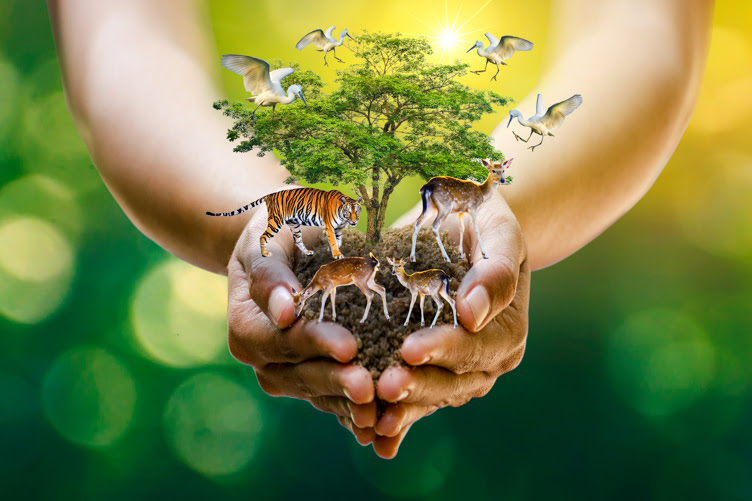
Photo: Stock
At the GCGI we believe every child, young person, students, their teachers, and indeed, everybody, should have regular opportunities and ease of access to connect with nature, so they can learn to value it, appreciate it, enjoy it, prioritise it and take action to save it.
“Be like the sun for grace and mercy.
Be like the night to cover others’ faults.
Be like running water for generosity.
Be like death for rage and anger.
Be like the Earth for modesty.
Appear as you are.
Be as you appear.”-Rumi
Desperately seeking Sophia: The Wisdom of Nature
Nature heals, Nature soothes, Nature restores, Nature connects: Yes, Nature is what makes us Human!
Are you physically and emotionally drained? I know of a good and cost-free solution!
The Message to the World: Time is running out for a world at risk of war with itself, destroying the only collective home we have, Our Sacred Earth
The Time is Now to Take Action.
‘Time is running out for a world at risk…threats that were considered inconceivable, no longer are.’
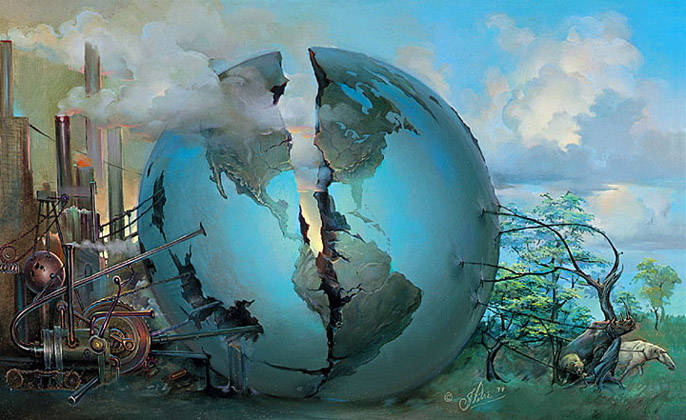
Photo:littlesun.canalblog.com
‘The climate crisis is damaging the ability of the land to sustain humanity, with cascading risks becoming increasingly severe as global temperatures rise, according to a landmark UN report compiled by some of the world’s top scientists.
Global heating is increasing droughts, soil erosion and wildfires while diminishing crop yields in the tropics and thawing permafrost near the poles, says the report by the Intergovernmental Panel on Climate Change…’Climate crisis reducing land’s ability to sustain humanity, says IPCC
A Call to Action from Our Children and Grandchildren.
We Must Not Let Them Down!
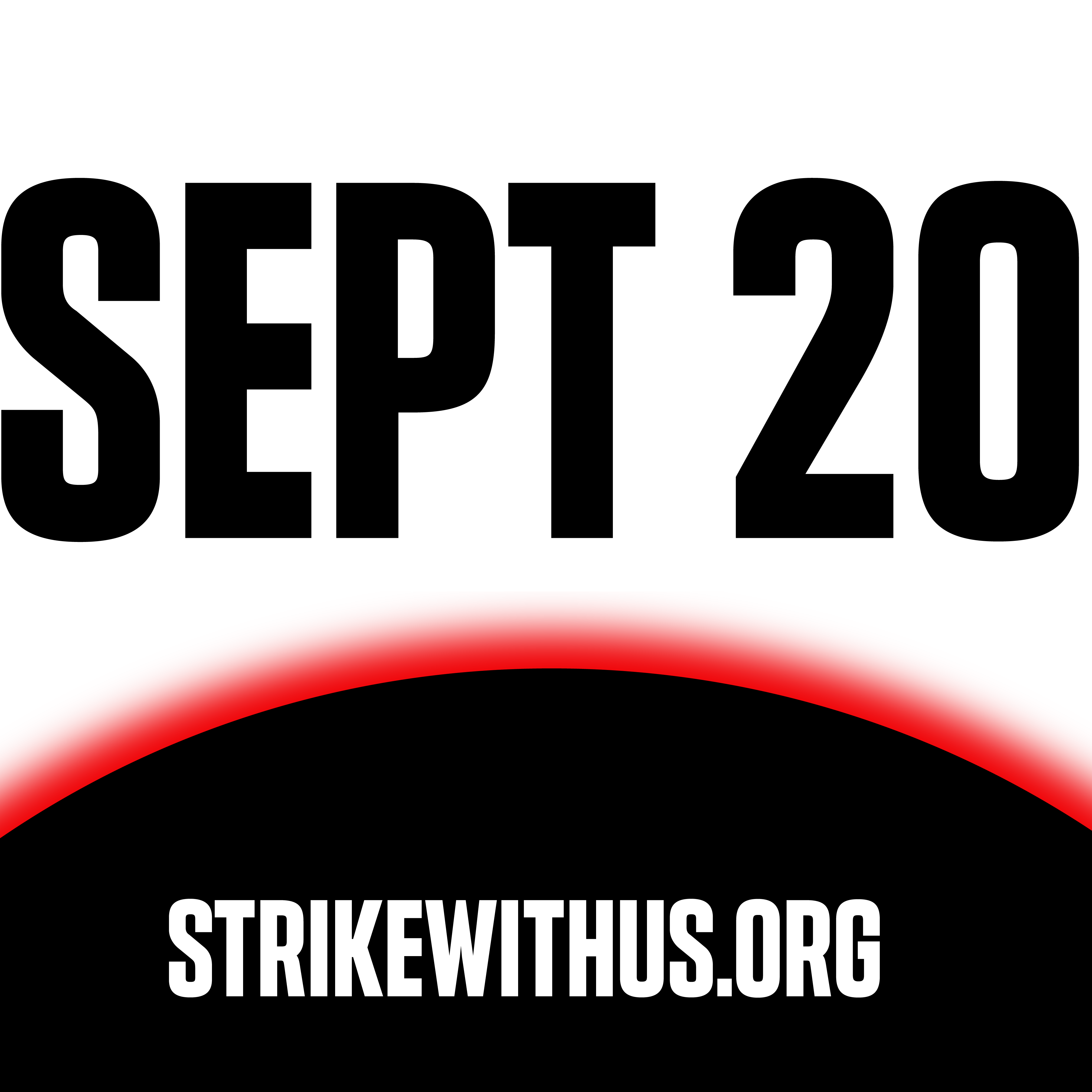
On September 20, three days before the UN Climate Summit in NYC, young people and adults will strike all across the US and the world to demand transformative action be taken to address the climate crisis. To learn more, sign up to host a strike, or receive updates see below:
‘We, as a global society, are at a crossroads. We have a decision to make. Are we going to choose money or power or are we going to choose the future? The September 20 strike is an invitation to everyone to choose us. Choose the kids, choose humanity, choose the future.’...WE, THE FUTURE GENERATION, ASK YOU TO CHOOSE US
- Details
- Written by: Kamran Mofid
- Hits: 3338
Poverty, Destitution, Hunger and Homelessness in the Midst of Plenty
This is nothing, but a manifestation of a cruel and inhumane state of affairs
‘A swathe of public opinion has turned cruel. ‘They just don’t give a shit,’ a woman who’s been living on the streets told me.’-John Harris
'A different world cannot be built by indifferent people.'
“To ignore evil is to become an accomplice to it”- Martin Luther King
“The only thing necessary for the triumph of evil is for good men to do nothing”- Edmund Burke
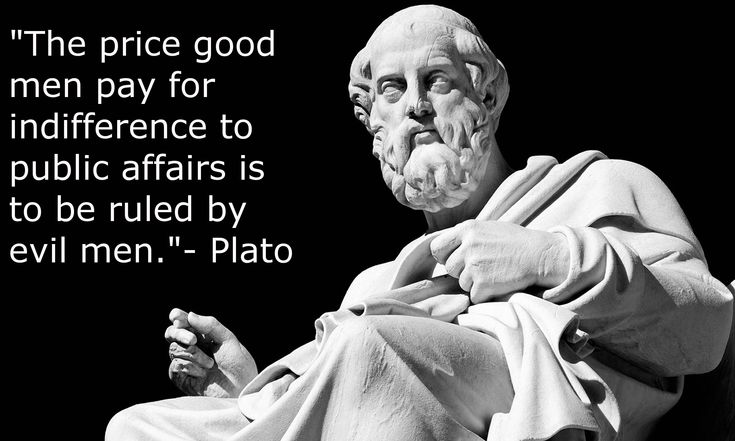
Photo:pintereset.com
‘Using austerity as a cloak, the Westminster Government has overturned any lingering notion of the common good, national solidarity or ethical based politics...The relationship between our politics, our ethics and our public life remain at the heart of this inequality and poverty story.’ -Poverty amid plenty
UK austerity has inflicted 'great misery' on citizens, UN says
- Details
- Written by: Kamran Mofid
- Hits: 1740
N.B. I recently read a very interesting and intriguing article about the Team Human.* I, then, read more about them, and discovered many timeless, beautiful gems, some of which I have noted below. They all reaffirmed what I have been thinking about, believing in and incorporating into what the GCGI has become.
In this troubled world and challenging times, it is reassuring to know that there are teams, like the Team Human, who are manifesting the beauty and wisdom of cooperation, taking actions in the interest of the common good, giving hope for a better world. For that I am most grateful.
A small sample of gems from Team Human
“Working together is what makes us human.”
The economy needn’t be a war; it can be for the common good. To get there, we must retrieve our innate goodwill and rediscover what it means to be human. "We cannot be fully human alone. Anything that brings us together fosters our humanity.”
Economics and the global economy should serve rather than dominate people – and that includes factoring in and optimising for all aspects of human wellbeing too.
And then, happy, healthy, peaceful people, will, in turn, nurture, nourish and value the entire web of life.
We must remember that we only survive and thrive when we work as teams — when we work as an "us."; when we take actions in the interest of the common good.
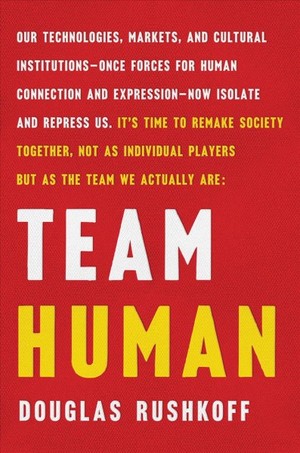
Photo:amazon.com
“A provocative, exciting, and important rallying cry to reassert our human spirit of community and teamwork.”
More than anything else, Team Human’s central theme is that, working together is what makes us human. As is noted early in the book, "We cannot be fully human alone. Anything that brings us together fosters our humanity ... We use our social connections to orient ourselves, to derive meaning and purpose. This is not a mere quaint notion but a biological imperative."
‘Team Human is a manifesto―a fiery distillation of preeminent digital theorist Douglas Rushkoff’s most urgent thoughts on civilization and human nature. In one hundred lean and incisive statements, he argues that we are essentially social creatures, and that we achieve our greatest aspirations when we work together―not as individuals. Yet today's society is threatened by a vast antihuman infrastructure that undermines our ability to connect. Money, once a means of exchange, is now a means of exploitation; education, conceived as a way to elevate the working class, has become another assembly line; and the internet has only further divided us into increasingly atomized and radicalized groups.
Team Human delivers a call to arms. If we are to resist and survive these destructive forces, we must recognize that being human is a team sport. In Rushkoff’s own words: “Being social may be the whole point.” Harnessing wide-ranging research on human evolution, biology, and psychology, Rushkoff shows that when we work together we realize greater happiness, productivity, and peace. If we can find others who understand this fundamental truth and reassert our humanity―together―we can make the world a better place to be human.’
*Optimizing for Human Well-Being
Book Review: 'Team Human' Stresses That The Future Lies In Connection And Cooperation
Further reading:
The enemies of Connection and Cooperation are Selfinterest, Selfishness, Extreme forms of Competition and disregard for the Common Good:
The Destruction of our World and the lies of Milton Friedman
And now the GCGI's suggested Path to a Better World:
An Invitation to Dialogue: Creating a Culture of Collaboration and Cooperation for the Common Good
- The tragedy of India copying the ways of the US and the UK
- World in Chaos and Despair: The Healing Power of Interfaith Spiritual Music
- The Disintegration of this Disunited Kingdom- Canon Dr Paul Oestreicher
- What is religion if less and less people are believing it?
- World in Chaos and Despair: Rediscovering the art of healing ourselves and all that is around us