
- Details
- Written by: Kamran Mofid
- Hits: 2592
The economy needn’t be a war; it can be for the common good. To get there, we must retrieve our innate good will and rediscover what it means to be human.
Economics and the global economy should serve rather than dominate people – and that includes factoring in and optimising for all aspects of human wellbeing too.
'Every story is weak until it’s told and every story is life altering when heard.'
I came to tell this story when I read this report about yet another suicide, another self-harm, destruction of life, families, hope and more in India, a country in the grip of mental illness epidemic. This and other related issues, then, became a topic of conversation between an Indian friend of mine and myself, as noted below.
Neoliberalism and the Destruction of Humanity and What it means to be Human
Neoliberalism and India’s Silent and Devastating Crisis
The Continuing and Deepening Mental illness In India
Nota bene
Although this story concerns India, But, believe me, it is the story of our time the world over.
The other day I met a very dear old Indian friend, whom I had not seen for a long time. He is a wise, inspiring man. A life-long student and teacher. A man of vision, insight, experience and above all, he is a lovely storyteller also.
I, too, love stories, telling and sharing them. Telling stories brings people together for the common good, and it is good for body, mind and soul. That’s for sure.
So, we started telling each other stories on why this, or why that in India or indeed elsewhere.
Why so many continuing and deepening crisis? Why so much hopelessness, fear, anxiety, depression, misery, self-harm and suicides? Why are we hurting and degrading our sacred earth and mother nature? Why so many wars and conflicts? Why so much wealth in the hands of a few, whilst the huge majority of people live in abject poverty and destitution? Why so much xenophobia, racism and intolerance? Why so much corruption and lack of trust? Why the breakdown in traditional, old, trusted, timeless values: families, friends, fun, festivals, time for each other, time to tell and hear stories, grandpa, grandma, uncles and aunties, cousins and nieces? Now, there is no time for anything. We are all living in a virtual life, me, myself and I, lonely and miserable together in the company of our virtual friends on Facebook.
Why populism, ignorance and arrogance are on the rise again? Why the lessons of the 1930s are forgotten? Why the buffoons, jokers, untrustworthy demagogues with big, loud mouths, telling the crowd what they like to hear, get elected to high office the world over, in elections with predictable outcomes, bought by and sold to the highest bidders, the lobbyists in Armani suits and golden, diamond studded rolex watches?
In all, why, despite so much beauty and love all around us, that is, if we care to notice, why then, have we created such a hell on earth?
In short, this was the gist of our dialogue, questions and stories.
You wouldn’t believe the feeling of disbelief when we both came up with the same similar answers to our ‘Why’ questions!
We both, more or less, simultaneously, said: Why? Because India, like many other countries, nations and civilisations, have forgotten who they are, what and why they are, and have become like the US and the UK, with the same values-less education, economy, outlook and spirit. What a tragedy, what a loss to humanity, we both said!
My Indian friend is not an academic. He is a life- teacher. So, he most graciously, asked me to explain the above more fully to those interested to hear it. So there you have it!
Below, for those interested enough, and wish to get more involved in this story, I have noted a few links on the disaster and inhumanity of the US-UK model, the model that so sadly India and others, so falsely believe will bring them prosperity, progress, modernity and development.
Lest we forget, this is the same tragic mistake all asylum seekers and refugees make, taking their lives into their own hands, crossing the oceans and mountains, heading off to these countries, and others like them, believing them to be the land of milk and honey, with payments covered in gold and waiting for them!!
Debunking the Myth of Pseudo Modernity, Progress and Development
The Broken Anglo-Saxon Socioeconomic Model which has Dazzled and Fooled the World
*Homo Economicus Model of selfinterst and selfishness, extreme forms of competition and the outright rejection of Homo Sapiens Model of cooperation and the common good:
The Destruction of our World and the lies of Milton Friedman
Economic Growth: The Index of Misery
Neoliberalism and the rise in global loneliness, depression and suicide
The Decline and fall of America: Social cohesion sacrificed to greed
Mr Trump, we are not what we earn!
The UK’s Broken Economic Model
Britain today and the Bankruptcy of Ideas, Vision and Values-less Education
*Democracy of Choice and the outright rejection of Democracy of Worth
*Values-free, profit making, consumerist education and the outright rejection of education for the common good
*Narcissistic and Egoistic Elites Undermining the Common Good:
The Age Of Perpetual Crisis: What are we to do in a world seemingly spinning out of our control?
Brexit, Trump and the failure of our universities to pursue wisdom
Finally, my friend and I were in total agreement that, yes, India must develop its infrastructure, roads, highways, trains, housing, healthcare, education, ports, airports, cities, sanitation and water resources, social care and more. Yes, India must plan for more employment and create more opportunities for its youth. Yes, India must nurture, nourish and protect its serene environment and natural beauty, as well as its historical monuments and more, etc, etc. And yes, India must make and generate wealth to fund all the above and more.
But progress and wealth generation must not be at the expense of what India is, its civilisation, history, culture, spirit, and people.
To throw away what has made India special, in the hope of becoming a poorer, lesser image and version of the US and the UK, we thought, for sure, will not serve India and the Indians well.
Given the above, in parting, I shared with my Indian friend the story of Iran, the Persian civilisation, honour, dignity, literature, poetry and history. I told him how in the 1960s and in particular in the 1970s, the Shah of Persia, thought to copy America and to build and modernise an ancient civilisation in the image of the US. I told him how this sellout, this Americanisation, became a huge reason for the revolution, a reason lasting to this very moment in time.
We concluded our storytelling by saying that it would be very destructive and tragic if history repeat itself, this time, in India, for the same reasons. Time will come, when all fails and falls apart, when people will stop believing in the myth of “The Biggest Democracy in the World”, lest we forget!
The neoliberal influence on mental health in India
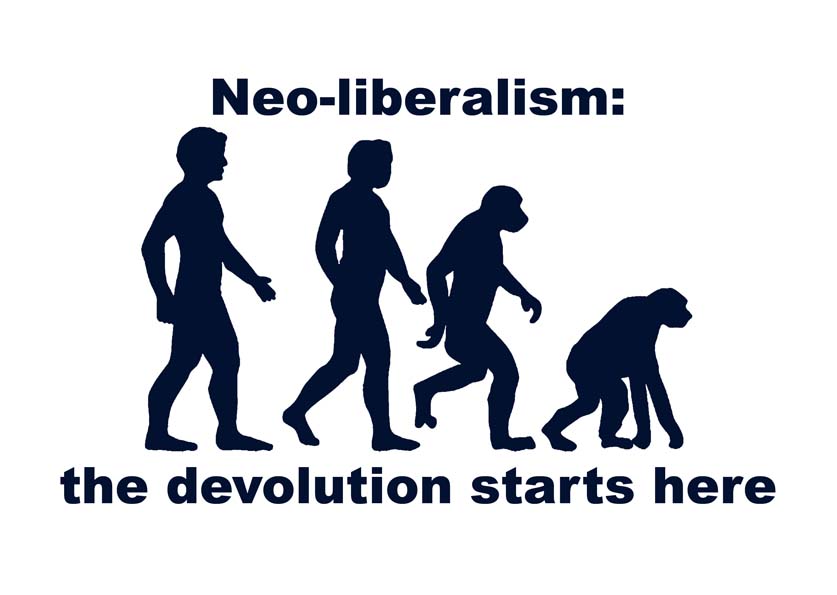
Photo:redandsky.blogspot.co.uk
“The presence of American cultural symbols and practices, the establishment of the IT industry and call centers, and the insertion of cross-cultural psychology, psychotherapy, testing, and personality evaluation through psychological science and new-age psychology is not only impacting the work life of young Indian workers, but it is also reconstituting the very meaning of ‘Indianness.’”
“The emergence of new types of management, capital, technology, and labor on a large scale has brought about transformations in social and psychological life in India. Euro-American cross-cultural psychology and management scholars have specifically emerged on a worldwide scale to give meaning to complex problems of history, culture, power, identity, and conflict through uncomplicated vocabulary of self-fulfillment, flexibility, global best practices, productivity, collectivism vs. individualism, and interdependent vs. independent selves.”
“When corporate cross-cultural psychological science merges with the neoliberal language of enterprise, structural inequality, cross-cultural racism, mental health issues, and ethnocentrism become camouflaged as simple problems of cross-cultural differences and cultural misunderstandings that can be solved through individual effort, self-help, therapy, importation of Western mental health taxonomies, and diversity training.”-Sunil Bhatia and Kumar Ravi Priya, Theory and Psychology, as noted in ‘The Conflicts That Result From Globalizing Euro-American Psychology in India’
See also:
‘There is a widespread perception that mental ill health is on the rise in the West, in tandem with a prolonged decline in collective well-being. The idea that there are social and economic causes behind this perceived decline is increasingly convincing, amid what has been termed the zombie economics and grinding austerity, which have followed the global financial crash.
In particular, there is growing concern that the conditions and effects of neoliberalism – the enervating whirl of relentless privatisation, spiralling inequality, withdrawal of basic state support and benefits, ever-increasing and pointless work demands, fake news, unemployment and precarious work – is partly to blame.’...How neoliberalism is damaging your mental health
(Recently, I gave a lecture at the Todi Conference in Italy. The lecture was about what education is. During my talk I spoke in detail about the consequences of neoliberalism on education, teaching and learning, as well as on health and mental illness. The video of the lecture can be seen here.)
And now two must-read books and a must-watch documentary on the consequences of the Anglo-Saxon Neoliberalism in India
The Must-Read Books
Arundhati Roy, Capitalism: A Ghost Story (Haymarket 2014)
‘India has of late been lauded as a model of the successful neoliberal economy for the developing world, and the growth of its middle class has been presented as a proof of the progressive power of capitalism to improve human life. The reality of the situation is grotesque...The neoliberal success story is a riot of corporate interests in an ‘era of the Privatisation of Everything’ and it is this process which ‘has made the Indian economy one of the fastest growing in the world’.
The eminently modern strategy of privatisation is matched with a form of the strategy of primitive accumulation, which itself marked the rise of capitalism throughout the world; the dispossession of the poor…’ Continue to read
KS Komireddi, Malevolent Republic: A Short History of the New India (Hurst 2019)
‘The New India is culturally arid, intellectually vacant, emotionally bruised, vain, bitter.’
Photo: amazon.co.uk
Read Jason Burke’s review in the Guardian
The Must-Watch Documentary
India: The Republic Of Hunger- Al Jazeera
‘More than 40 per cent of India's 61 million children are malnourished, prompting the prime minister to declare the problem a "national shame".
A recent report reveals that levels are twice that of sub-Saharan Africa, making every third malnourished child in the world an Indian.’
The Republic Of Hunger
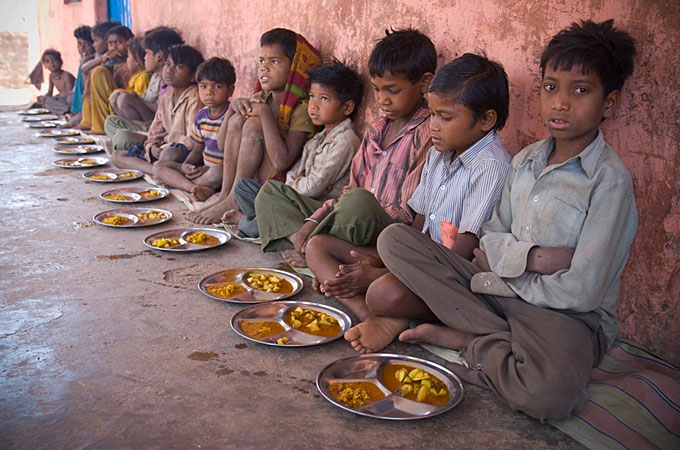
Photo:aljazeera.com
Facts:
“Every third malnourished child in the world is from India.
More than 40 per cent of India's 61 million children are malnourished.
Malnutrition, classroom hunger and school dropout rates continue to be grave, giving rise to extreme poverty and hunger.
47% of those under three years old are undernourished and underweight
Measured by the prevalence of malnutrition, India is doing worse than sub-Saharan Africa.
In recent years the GDP has grown at nearly 10% each year.
By 2011 there were 57 billionaires in India.”
India’s Premier Manmohan Singh called this malnutrition, hunger and poverty “a national shame”. He then noted that “We cannot hope for a healthy future with a large number of malnourished children”.
Dr. Singh’s worries and concerns are noted and appreciated. But, here we need to be more precise, if we wish to move away from hollow words to real action, which is surely needed if countries such as India wish to eradicate poverty, hunger and malnutrition. Dr. Singh’s reputation was forged in his time as finance minister in the 1990s, when following the advice of the International Monetary Fund he pushed through a series of economic liberalisation and reforms (Read neoclassical economics and neoliberalism. KM) which set the stage for India's subsequent boom and entry onto the world stage as a rising economic power.
The Questions:
Given the above, one might, with much justification, ask what have been the fruits of decades of embracing neoliberalism, with is privatisation, liberalisation, deregulation, marketisation and more? What is the use of India boasting the rise of millionaires and billionaires, the high-tech industries and more, when a huge percentage of its children are hungry, malnourished, and underweight? Where is the trickle-down effect? 10% average GDP growth rate for what? What has happened to Indian spirituality, looking after the community and the common good?
Dr. Singh once said: "The greatness of democracy is that we are all birds of passage. We are here today, gone tomorrow. But in the brief time that the people entrust us with this responsibility it is our duty to be honest and sincere in the discharge of these responsibilities."
I very much wonder how he can reconcile the above statement with so much continuing and worsening poverty, hunger, and malnutrition in India. (Reprinted from an earlier Blog)
Now Watch The Republic Of Hunger
What a big shame, you might say, that India and others are becoming more and more like the US and the UK. What a shame that a disgraceful ideology has created such a homogenized world. We are all now like each other and all like the US and to a lesser extent like the UK. Is this something to be proud of?
Now, let us stop and think a bit deeper and wonder what it would be like, if old, historical civilisations, like India, develop and implement a socioeconomic model, based on their own civilisational values of caring, sharing, cooperating, looking after the needy and the neighbours, the old, the weak, vulnerable and disabled? Valuing all that is important, all the web of life. Valuing wealth creation, not as a means to an end, but knowing why they are creating wealth, how and what for? That would be something to be proud of, and hopefully, now that neoliberalism has brought countries like the US and the UK to their knees, they will find it necessary and life-affirming to begin to copy India!
And now please join me in this Call for Action, to address the epidemic rise in Global Mental Illness to clear up the mess, stink, and consequences of Neoliberalism
A GCGI Initiative: Examining mental health issues around the world
This new GCGI Initiative is dedicated to the youth of the world, our children and grand- children, who are the unfolding story of the decades ahead. May they rise to the challenge of leading our troubled world, with hope and wisdom in the interest of the common good to a better future.
'A different world cannot be built by indifferent people.'
- Details
- Written by: Kamran Mofid
- Hits: 3651
A Tribute to the Healing Power of Music: A Music Gala Organised by Prof. Kamran Mofid in Celebration
of the First GCGI Conference, Plater College, Oxford, 2002

Photo: bing.com
I found reasons for joy, happiness, and hope for a better world even amid the bleakness of the world that we have created
“Music is manna for the soul, and nectar for the spirit."
‘The health of the physical body is inextricably tied to our emotional, mental and spiritual health. Music is a powerful catalyst for healing because it touches the very core of humanity... our souls. With music, we can remember our connection to the Creator and the powerful Healer within. We can take control of our health and our lives as we enjoy the healing sound of music.’-Music to Heal the World
Nota bene
In 2002, I organised and convened the first GCGI Conference at Plater College, Oxford, which later became, the Annual GCGI Conference Series in many locations around the world.
An International Conference on
An Interfaith Perspective on Globalisation
Common Goals, Common Crises, Common Call and Common Hope
Plater College, Oxford, July 27 - August 3, 2002
Planning, organising and convening this international conference was one of the most beautiful, memorable moments in my life. As many people, wiser than me have noted, our lives and the world in which we all live, are so unpredictable. Things happen suddenly, unexpectedly. We want to feel we are in control of our own existence. In some ways we are, in some ways we're not ... Life, can bring you so much joy and yet at the same time cause so much pain.
I was so devastated that after this wonderful journey, full of joy and happiness, achievements and success in my academic life, due to some reasons beyond my control, I started to feel unwell, unhappy, depressed, not enjoying what I was doing and teaching, especially when I lost all confidence in the value of moral-free economics that I was teaching my students, and more.
In 1999 I voluntarily resigned from my post at Coventry University. It goes without saying that, I was heartbroken and extremely hurt that I was unable to nurture and develop further what I had envisioned and built there.
After leaving my post at Coventry University, I went through two years of hell, hardship and struggle with everything. I had to rediscover myself again. I had to find a new path to explain who I am, what I am, and why I am.
Thus, I came back to Oxford again. This time to a small Catholic adult education college there in Pullens Lane, Headington, called Plater College. After decades of being a university lecturer, I became a student again, when I registered for the Pastoral Theology course.
I enjoyed my time and studies at Plater very much. It was truly a path to my personal healing. I have explained this in much more detail elsewhere: My Coventry Story and at Oxford Theology Society Lecture, Keble College.
Now, looking back, it seems that I organised this beautiful interfaith music gala, not only for the conference, but, perhaps, unconsciously, I was celebrating my own healing through the healing power of music.
So now, please join me and celebrate the beauty, wonder and the healing power of music, by watching the videos of that evening in Oxford:

Photo:quotesgram.com
Interfaith Music Gala, Oxford 2002. Introductory remarks by Kamran Mofid
Classical and Mystical Persian/Sufi Music
Authentic Persian Folkloric Music (Bhakhitiari and Lori)
Classical and Mystical Syrian/Arabic Music
Folkloric and Spiritual Music of Latin America
Classical and Mystic Hindu Music
Tabla Solo in Contemporary Style
Traditional Sikh Instrumental Recital - Raag Shri
Traditional Indian Classical Vocal Recital - Raag Bhimpalasi
Shabad (Hymn from the Sikh Scripture) - Guru Granth Sahib Ji - in Raag Kirwani
Interfaith Music Gala, Oxford 20002: Thanks and concluding remarks by Kamran Mofid

Photo:youtube.com
- Details
- Written by: Kamran Mofid
- Hits: 3170
Nota bene
Introductory Note from Kamran Mofid
The path of my inspiring and enriching friendship with my dear friend Paul Oestreicher, a disciple of universal compassion and an inspirational peacemaker
It all began in Coventry
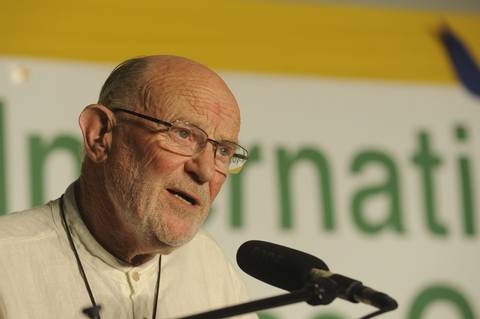
Photo:vaincrelaviolence.org
Canon Paul Oestreicher, a residentiary canon of Coventry Cathedral and director of the Cathedral's Centre for International Reconciliation (1985-1997); a member of the General Synod of the Church of England from 1970-81 and 1995-97. He joined Amnesty International at its inception in 1961 and was Chair of AI UK from 1975-1979; Vice President, Campaign for Nuclear Disarmament (CND); and a lifetime worker for peace and social Justice.
As I have noted elsewhere in My Coventry Story, in 1986 I was awarded my PhD in Economics and soon after I was appointed- full time- senior lecturer at the Department of Economics at Coventry Polytechnic (now University).
Soon after my appointment, a dear friend of mine from New Zealand, Prof. Kevin Clements, visited me at Coventry. It was he who introduced me to Paul.
Paul and I became very good friends. I shared many wonderful and enriching times with him at his office at the cathedral, listening to his stories, learning from his wisdom and insight. A truly wonderful man. We also had many wonderful times, sharing food and drinks at our respective homes, alongside our families.
Paul introduced me to senior figures at the cathedral, including Bishop Barringtomn Ward and Provost John Petty and many others. He also introduced me to many senior people at Coventry City Council, including the Lord Mayor, Councillor Joseph Clifford.
Paul and I also organised a few national and international conferences, mainly on the themes of forgiveness and reconciliation and gave joint lectures and presentations. Paul was also instrumental for me to receive a personal invitation from Sir Richard Branson to accompany the Coventry delegation to Hiroshima for the unveiling of the Statute of Reconciliation at Hiroshima Peace Museum. A replica of this statue was unveiled earlier at the ruins of Coventry Cathedral, in a ceremony which I was honoured to attend also. I am also grateful for his inspiration, support, advice and input, enabling me to instigate and co-found the Centre for the Study of Forgiveness and Reconciliation at Coventry University.
The Disintegration of this Disunited Kingdom
Canon Dr Paul Oestreicher
(This article was initially submitted to the Editor of the Church Times for possible publication on Friday 19 July 2019. However, Canon Oestreicher has agreed for it to be published here today.)
Reading your General Synod report (last week's CT) leaves me close to despair. While England is in a state of social, political and moral disintegration, crying out for healing and reconciliation, our still would-be National Church seems very largely occupied with its own affairs and its own guilt. Oblivious to the mortal dangers, we are busy doing repairs on our leaky vessel, as Britain runs on to the rocks, come Halloween.
Allow me an interpolation from the year of my birth in a small middle class German town in 1931. I know, history never quite repeats itself, but the analogies are frightening. The mainly middle class citizenry felt insecure, disillusioned with self-seeking party politicians at war with each other and drawn towards a charismatic power hungry unconventional leader, promising them whatever they wanted to hear.
In my region, his Brown Shirts were easily elected (think the Brexit Party) by those on right and left and by most churchgoers (the promised new order, a God-send), just as I was born. Two years later, Hitler took absolute power. Dissenters were traitors, (think Daily Mail). Who was to blame for all that was wrong? The Jews of course, bankers or communists, (think immigrants or Islam or Brussels).
Brexit is not, as - with some exceptions - our hierarchy leave us free to think, a matter of personal opinion but a national tragedy. Brazen lies have traduced a (small) majority of citizens into seeking a divorce from the admittedly imperfect peace project that is the European Union. To leave, should from the start have been recognised as an economic, social, political and not least spiritual disaster. See the rise in hate crimes.'Great Britain First' (read England, read Trump) is a surrender of the values we have claimed to cherish, an open and welcoming society, tolerant of difference, committed to human rights, protecting minorities and cherishing the natural environment that sustains us.
To turn our backs on Europe's soul, is to abandon a great part of our own heritage, for everything that is good and bad about Europe is good and bad about us. The self-centred cliques that are in the process of wrecking both of the political parties that have been the mainstay of British tradition, is a calamity for which others cannot be blamed. This coming weekend, concerned citizens, alas without a recognisable church component, will demonstrate against the imposition of an untrustworthy Prime Minister. The German churches failed to warn in time. Could not the small minority that the Church of England now is, still help to turn the tide?
Canon Dr Paul Oestreicher
Brighton
Europe, Britain, Wars, Destruction, Forgiveness & Reconciliation, Peace, EU, Cooperation, Hope, Meaning & Purpose: Timeless Lessons from Coventry
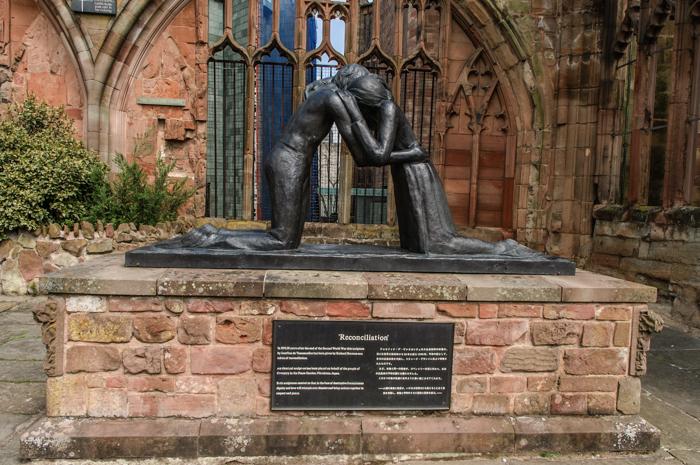
The statue of reconciliation in the ruins of Coventry Cathedral. I was honoured and proud to be present at the unveiling ceremony of the statue in Coventry in 1995 and later on at Hiroshima Peace Garden where a replica was unveiled. Photo: Anne Mofid
14 November 1940: The Destruction and Re-birth of Coventry
Coventry’s Message of Hope to the World on the Armistice centenary and Remembrance Sunday
Eurosceptics should visit Coventry Cathedral: The EU's Higher Purpose
Good Friday Agreement and the Spirit of Forgiveness and Reconciliation
Forgiveness and Reconciliation in Pursuit of the Global Common Good
Forgiveness and Reconciliation: The Path to Conflict Transformation and Peace building
Thank you Coventry for being a Beacon of Hope to the World

Photo:flickr.com
- What is religion if less and less people are believing it?
- World in Chaos and Despair: Rediscovering the art of healing ourselves and all that is around us
- Izaak Walton: Our Stepping Stones to Pastoral Paradise, Serenity and Beauty
- Todi-Week 2019- A Reflection: Where we came to imagine and co-create a better world together
- The Age Of Perpetual Crisis: What are we to do in a world seemingly spinning out of our control?