
- Details
- Written by: Kamran Mofid
- Hits: 3467

Photo: bbc.co.uk
Today, Tuesday 10 April 2018, marks 20 years since the Good Friday Agreement (also known as The Belfast Agreement), which set in place terms that would bring peace to Northern Ireland.
The historic deal has brought Britain and Ireland closer than ever. However, today, Brexit has put the Agreement under a huge amount of stress and uncertainty.
In the words of former US secretary of state, Hillary Clinton, writing in today’s Guardian “We cannot allow Brexit to undermine the peace that people voted, fought and even died for. Reinstating the border would be an enormous setback, returning to the ‘bad old days’ when communities would once again be set apart.”
Clinton adapts a famous Blair quote from the time of the original Belfast agreement to warn: “If short-term interests take precedent over solving the long-term challenges that still exist in Northern Ireland, then, it is clear that the hand of history will be both heavy and unforgiving.”
To neglect the peace process now is a grave mistake
What, then, is the answer?
HOPE, I say
Hope for the region lies in the transformative power of forgiveness and reconciliation, lest we forget
Courage and good-heartedness to take action in the interest of the common good to build a lasting peace
It may sound strange to talk about ‘Hope’ in these challenging times in Northern Ireland. Despite a period of relative stability, peacebuilding and economic development, a sense of hopelessness and despair has taken over people’s life and sentiments about the peace process, togetherness, communities and neighbourly relationships.
At the time of writing, the Northern Ireland Assembly has not sat in Stormont since January 2017, amid a renewable heating scandal, and unionists and nationalists seem unable to resolve issues ranging from same sex marriage to the use of the Irish language in the region. Furthermore, issues related to Brexit and the Conservative Government's power sharing agreement with the Democratic Unionist Party is said to have threatened the peace brought by the Good Friday Agreement those 20 years ago.
To cut a very long and complicated story short, for me, reflecting back, looking at Northern Ireland today, I feel that, a great deal of political hopes have been realised beyond expectations and dreams. However, the current uncertainty calls for an urgent need for a deeper understanding and healing. The boil and the pains of bitterness, hurt and sectarianism has not yet been fully lanced. This has to change if the peace of the last 20 years is to continue.
Paraphrasing many comments that have been made already, it appears that, the underlying issues, affecting the Good Friday Agreement, are constitutional, as well as the need for forgiveness, repentance, truth, justice, as well as the core issues of identity – Irishness and Britishness.
In short, people need to ask of themselves: How do we live well as neighbours, and who is our neighbour?
This relational aspect of reconciliation is necessary for true healing to take place, not only in Northern Ireland, but, also in all places of conflict, wars, injustice and destruction.
No Future Without Forgiveness: ‘Forgive and forget’ will not do. ‘Remember and forgive’ is the Hopeful Path to Reconcile and Build Peace with Justice
The Good Friday Agreement anniversary is a chance to redouble the focus on duty to reach full reconciliation
To suggest a hopeful path for a better understanding of forgiveness, reconciliation, healing the wounds of the past, peace and justice, I can do no better that offer you the excellent and timeless address by former President of Ireland, Mrs. Mary Robinson, given at the launch of the Coventry Centre for the Study of Forgiveness and Reconciliation, delivered at Coventry Cathedral on Monday 11 March 1996.
'Forgiveness & Reconciliation'
Mary Robinson
The President of Ireland
(3 December 1990 – 12 September 1997)

Forgiveness & Reconciliation Mary Robinson
“I am deeply honoured to have been invited to inaugurate your Centre for the Study of Forgiveness and Reconciliation with this lecture, and to act as the Centre’s Patron.” -Mary Robinson, President of Ireland
Related Links:
Coventry and I: The story of a boy from Iran who became a man in Coventry
Former President F.W. de Klerk’s Address at Coventry Cathedral, 2 September 1997
Centre for the Study of Forgiveness and Reconciliation
Forgiveness and Reconciliation in Pursuit of the Global Common Good
‘Father Forgive’: Coventry Cathedral and my life's journey of discovery
What is the Good Friday Agreement that brought peace to Northern Ireland?
Listen to people of all ages reading aloud from the Belfast/Good Friday Agreement
‘The Belfast or Good Friday Agreement is now in its 20th year. We at times forget how important it was that the people of both Northern Ireland and the Republic of Ireland voted for a future together.
In 1998 we witnessed the courage of people who crossed the constitutional divide when seeking accommodation and recognition of the need to build inclusive partnerships and values of tolerance and mutual respect. The Agreement has not been perfect and we have witnessed a range of political fallouts and disagreements but we have also witnessed a sustained decline in violence and new relationships that have formed across the sectarian divide.
We must never forget that the Agreement was the people’s process. It was the people who voted for it and they who sustained it through their commitment to creating a better society that one day will be released from the agonising grip of fear, intimidation and ultimately cultural and political futility.
Our obligation is not to merely remember the Agreement but to remind ourselves of one very central and important question.
What is my civic duty?
Let’s remind ourselves that 20 years after the Agreement that we must strive to build reconciliation, promote trust and most of all dedicate ourselves to a non-sectarian future.’
Prof. Peter Shirlow (FacSS), Director, Institute of Irish Studies, University of Liverpool
Watch the Video:
Listen to people of all ages reading aloud from the Belfast/Good Friday Agreement
- Details
- Written by: Kamran Mofid
- Hits: 4293
Photo: tvokids.com
On 28 October 2014, I had posted an article In Praise of Kindness on the gcgi.info website. Let me quote you the introductory passage from that article, very relevant to what I am going to post below, continuing our thinking, reflection and pondering further on these hugely important questions: ‘What does it mean to be kind? What is Kindness?’
‘The reason we are losing our values is that we are failing to nourish them and hold on to them. It is a collective meanness of spirit.'
‘The Dalai Lama was once asked what surprised him most. He replied: "Man, because he sacrifices his health in order to make money. Then he sacrifices money to recuperate his health. And then he is so anxious about the future that he does not enjoy the present; the result being that he does not live in the present or the future. He lives as if he is never going to die, and then dies having never really lived."
Now let me share with you the words and sentiments of a young executive, a CEO, earning a lot of money, with bonuses, power, and more: “Now it's all about Productivity, Pay, Performance and Profit - the four Ps – which are fuelled by the three Fs: Fear, Frustration and Failure. Just sometimes I wish that in the midst of these Ps (& Fs), there was some time left for another set of four Fs: Families, Friends, Festivals and Fun.”
You see ladies and gentlemen, we need values, we need love, friendship, kindness, generosity, sympathy, empathy, and compassion to be the guiding principles of all we do. Otherwise, no amount of money, capital, technology, IT, theories and policies, can save us from our own mistakes, the crises of our own making.’ Kamran Mofid, “A Better Path”, School of Economic Science, Saturday 8 February 2014
Today, I wish to continue this reflection by sharing with you a very interesting and relevant article that I have recently read about issues related to a better understanding of ‘KINDNESS’. So, let me begin:
The Cult of Being Kind*
By Eve Wiseman, Via The Observer, Sunday 1 April 2018
Photo: lee-lo.co.uk/
“One cold morning in Bristol, a man named Gavyn Emery tied a scarf to a lamppost, and on a cardboard tag wrote: “I am not lost.” It was 2016, and rough sleeping in Bristol had risen by more than 800% in seven years. As temperatures plummeted, more people were inspired to do the same, wrapping trees in coats, sticking hats on bollards, warmth for anybody who needed it. Scarves started appearing in Cornwall, Glasgow, London, Cambridge; across the UK through this very long winter it was possible to see a blossoming compassion, visible in wool.
How a Random Act of Kindness in Bristol Became a National Movement to Help the Homeless
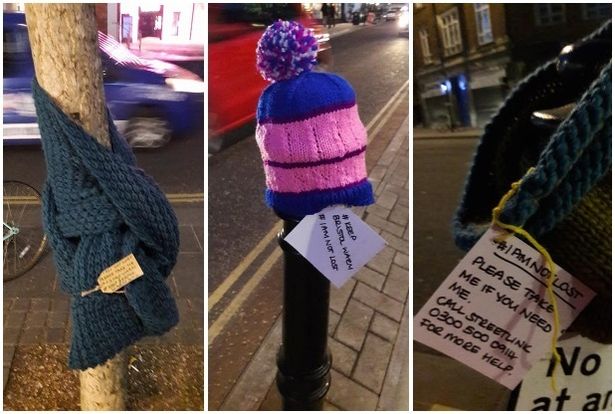
Photo: bristolpost.co.uk
What is Kindness?
Kindness is not new. It’s old, pretty old. Aristotle said: “It is the characteristic of the magnanimous man to ask no favour but to be ready to do kindness to others.” Kindness is mankind’s “greatest delight,” said Roman philosopher-emperor Marcus Aurelius. And yet, for a long time it has been seen as sort of… suspicious. As religion’s hold on our culture has weakened, and with it the insistence upon loving thy neighbour, a certain selfishness has come to be expected. To be kind is also to be weak, unfocused on achievement. Unsuccessful. Kindness is seen as a nostalgic throwback to simpler times, or worse, a con. A man who throws his coat over the puddle is a man who onlookers suspect must be protecting something valuable in the mud. To go out of one’s way to be kind suggests an ulterior motive – who has time to look up from their phone, let alone expose themselves to the discomfort of empathising with a stranger?
When Britain had just voted to leave the EU, the author Rachel Cusk wrote an essay about rudeness which she felt was “rampant”. “People treat one another with a contempt that they do not trouble to conceal,” she said. At the airport, she noticed strangers looking “suspiciously at one another, not sure what to expect of this new, unscripted reality, wondering which side the other person is on”. But as our new “reality” has bedded in, something is changing. Today, kindness is not only fashionable, appearing in a flood of news stories about everyday heroism, but it’s profitable.
Online, hashtags highlight small acts of kindness witnessed in public, and GoFundMe campaigns raise thousands for people in need. The publishing industry is calling the trend for kindness “up lit” – as in, illuminated from below, to expose one’s best angles. After a year of dark thrillers, today they’re investing in feelgood stories of empathy and care. Christie Watson’s The Language of Kindness comes out in May. A memoir about her career as a nurse, it sparked a 14-way bidding war and is being turned into a TV drama by the producers of Poldark. “If the way we treat our most vulnerable is a measure of our society,” she writes, “then the act of nursing itself is a measure of our humanity.” Through stories about her experiences with patients, she reminds readers that we will all, eventually, come to rely on the kindness of strangers.
Ahead of the launch of Jaime Thurston’s book, Kindness: The Little Thing That Matters Most, HarperCollins ran a campaign encouraging acts of kindness because, said Carolyn Thorne, editorial director: “Kindness is not just a book we are publishing but a chance to change cultural attitudes... When kindness is shared, it grows.” It grows. Literary agent Juliet Mushens, whose business partner Robert Caskie just sold debut author Libby Page’s novel The Lido for a fortune, twice – a story about a community, where a young woman befriends an 86-year-old widow to save a swimming pool – welcomes this move towards hopeful stories. “My feeling is that given the constant depressing news cycle, people are looking for a way to escape into fiction, and into more hopeful narratives.” She adds: “I would argue that these stories can be political in their own way. They can inspire the audience to fight for change on a personal level, and remind us that the individual choices we make can have a wider impact.”
‘When we are kind it doesn’t just help that person, it improves our own health’
Doing Good for the Common Good is Good for Us: A Proven Fact Now
Photo:bing.com
When Piers Wenger became the controller of BBC drama commissioning in 2016, he announced his intention to bring a lightness back to entertainment. “I think there is an awful lot of very dark drama across all channels and I’d love to see some more inspiring stories,” he explained. “I would love a Sunday night show which examines heroism and what it means to be a hero.” Note the preface “super” is missing. To be a hero today is simply to be a person who leans into the vulnerability that comes with seeing other people’s problems. It is to tie a scarf around a tree. Being a hero today requires no expert skills, no powers of flying or invisibility – in fact, one of the things that has helped devalue kindness over the past 30 or so years is the fact that we all know how to do it, we have done since we were children, but as a mark of our power and importance, choose not to. Being a hero today is to not look away.
Heroic storytelling extends to the news media, too. Open the New York Times and, since December, you will have found a column called The Week in Good News, right there on page two. A supercolony of penguins found near Antarctica, a SpongeBob musical, drugs that could delay prostate cancer… “The intention,” explains columnist Des Shoe, “is to provide an antidote to what can seem like an endlessly heavy news cycle.” Her column presents a curated selection of good news, including regular stories about “average people doing good work for others”. “I think people are yearning for good news because in the age of push notifications, the crush of stories about tragic things happening in the world can seem overwhelming.” We want a reminder that, despite the swamp of death and poverty we scroll through, all is not lost. This “yearning” means there’s a market for more. “People want good news. They spend time on good news, they seek it out and they look for more. Our readers have asked for much more of this type of coverage.” And stories of kindness lead to clicks.
Build a Better World: The Healing Power of Doing Good
The move towards kindness mirrors the rise of “happiness” pursuits earlier this decade, when a political interest in the value of happiness coincided with academic studies, a self-help movement towards joy, and the relentless counting of one’s blessings. In his book The Happiness Industry, William Davies reported that a growing number of corporations were employing chief happiness officers, while Google had its own “jolly good fellow”. Soon, happiness as a movement began to be questioned. It was pointed out that the political push for happiness grew as cuts in benefits and healthcare deepened. It coincided with a huge rise in prescribed antidepressants. Notions of happiness relied on a fuzzy vagueness: there was the suggestion that this noisy push for happiness was a way to displace attention from the causes of unhappiness itself.
But while happiness and kindness are undoubtedly linked, the difference is that happiness is passive, while kindness is active. At Springwell, for instance, a special school in Barnsley, where many students have suffered abuse, neglect or poverty, teachers have vowed to approach every child with what they call “unconditional positive regard” – or, as the principal Dave Whitaker says, they “batter the children with kindness”, and it seems to be working. Like happiness, kindness is difficult to quantify – we have no way of knowing whether people are becoming kinder, no apps to mine for data, few scarves to photograph – but we can count the stories of kindness that proliferate, often in tandem with those of the effects of austerity. A class of kids singing Happy Birthday to a stranger on the train; the ‘Pay it Forward’ movement; the “book fairies” hiding novels around Cornwall.
In the US this month, in the wake of teachers reporting higher anxiety in the classroom, a survey aimed to discover what children thought about kindness in the era of Trump. Only 14% “strongly agreed” their nation’s leaders “model how to treat people with kindness”. But researchers also noted an upward trend in social and emotional skills. While almost two-thirds said they had been bullied at some time, 8 in 10 said they’d gone out of their way to do something kind for another child, and nearly half said they have done so “many times”. Which is cheering, really, in the same way that Bristol’s scarves are – cheering with the lemon sourness of melancholy. Cheering, in that times have got so dark, with so many people in trouble, that we are finding new reservoirs of kindness and a new appetite for generosity. The concern is that children, with their easy kindness, still wet with lessons about “how to be nice”, soon grow up.
Kindness – “not sexuality, not violence, not money – has become our forbidden pleasure”, historian Barbara Taylor and psychoanalyst Adam Phillips wrote in their 2009 essay On Kindness. “Kindness is not just camouflaged egoism,” they insist. “To this old suspicion, modern post-Freudian society has added two more: that kindness is a disguised form of sexuality, and that kindness is a disguised form of aggression – both of which again reduce kindness to a covert selfishness.” They make the case that, due to these suspicions, we are all battling against our innate kindness.
It was 2013 and Jaime Thurston was scrolling through a second-hand furniture website when she came across a wanted ad: a single mother looking for a rug to cover her broken floor so her children wouldn’t cut their feet. Thurston, sensing desperation, called her and learned more about the situation she’d fled. It led to her starting a charity called 52 Lives, where people nominate “someone in need of kindness”. “We are living in a strange world,” she says, “a virtual world, full of comparison and isolation. We spend so long staring at our phones and avoiding real contact with people, and it ultimately makes us unhappier and lonelier. So I think people are searching for something fulfilling. I think kindness unlocks something deep within people.”
Does reading about kindness perform a similar function? Or, today are we seeking out stories of kindness in order to practise the action in our head before performing it – seeing these people in need, stretching the muscle memory required to offer a hand? By all accounts, we have got to this point through desperation. It was no longer viable to walk on by. “Kindness has so many benefits,” insists Thurston. “When we are kind to someone, it doesn’t just help that person, it is scientifically proven to improve our own physical and mental health as well. So at a time when rates of depression and anxiety seem to be skyrocketing, kindness could be a very simple but powerful antidote.”
In June, psychotherapist Padraig O’Morain publishes Kindfulness. He’s found that: “People who practise self-compassion, which is kindness towards oneself, are good at taking on challenges… It is often our own condemnation that we most fear.” Rather than random acts of kindness to others, O’Morain focuses on an inward-looking kindness. “It’s saying, ‘Look, even though you’ll never run a marathon before you go to work every day, or polish off your entire to-do list to universal applause by 11am, or become a tech billionaire before you’re 25, you’re OK, you’re fine, relax.’” Kindness then, to service the self.
Perhaps this is the key to the new wave of kindness. We perform kindnesses in response to darkness and, in turn, our lives are improved. Which means that rather than old-fashioned or altruistic, kindness is as modern as it gets. Is it rising not just because in cold times we’re compelled to offer scarves to those shivering, but because taking part makes us feel more successful? Well. Small steps, gently.”
*This excellent article by Eva Wiseman was first published in The Observer on Sunday 1 April 2018. See and read the original article.
- Details
- Written by: Kamran Mofid
- Hits: 2926
I offer this in honour of Monet & Architecture: A Special Exhibition, The National Gallery, London And of our forthcoming coming conference in Lucca, Tuscany, 28 August-1 September 2018
(Both in search of Beauty, Wisdom, Inspiration, Vision and Guidance to Build a Better World)
Arguably the most popular and famous Impressionist painter, Claude Monet continues to captivate art audiences around the world
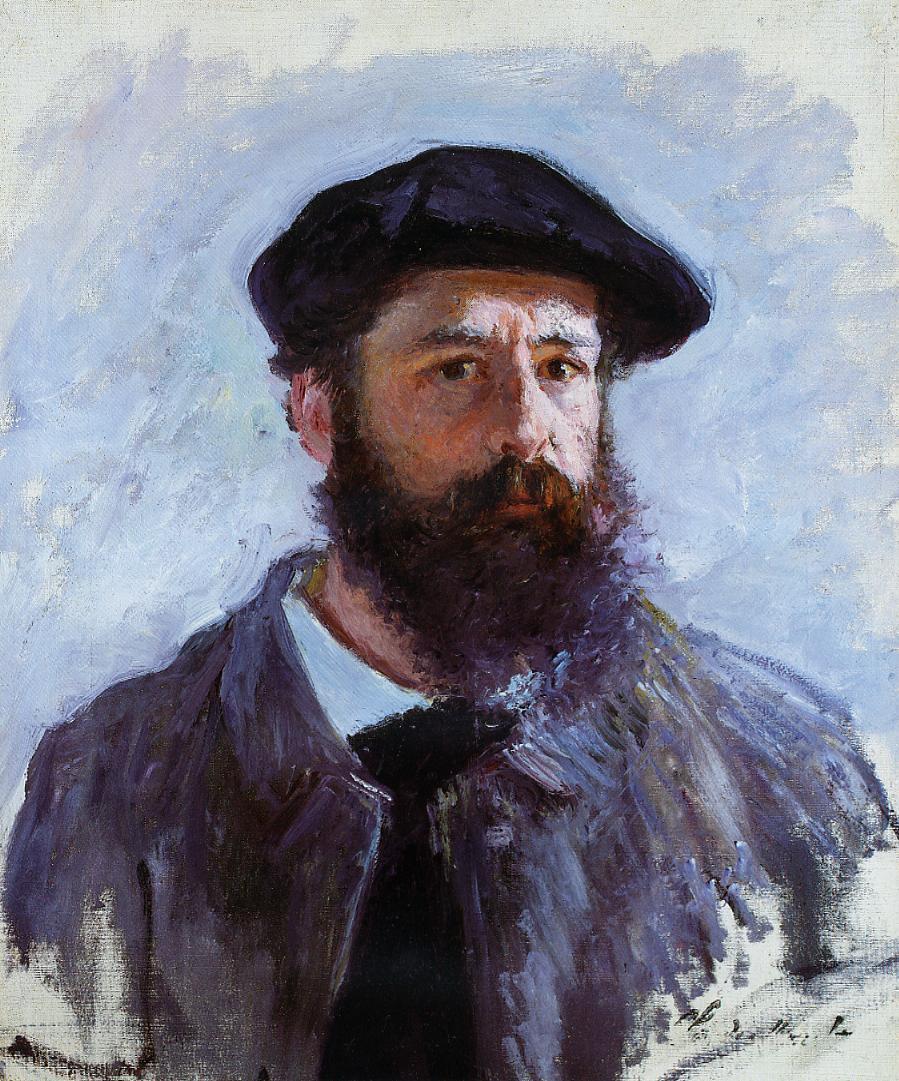
Photo: Claude Monet, Self portrait with beret 1886 | © Art Gallery ErgsArt – by ErgSap / Flickr
'Controversially rebuffing the traditions of realism, Monet sought to capture the essence of nature; the changing light of time and the seasons. He adopted a new way of painting in the 1860s by leaving the confines of the studio and working en plein air – painting directly outdoors. He drew on various inspirations, including the landscapes of J.M.W. Turner and John Constable, whose work he encountered when he moved to London in 1870 during the outbreak of the Franco-Prussian war.'
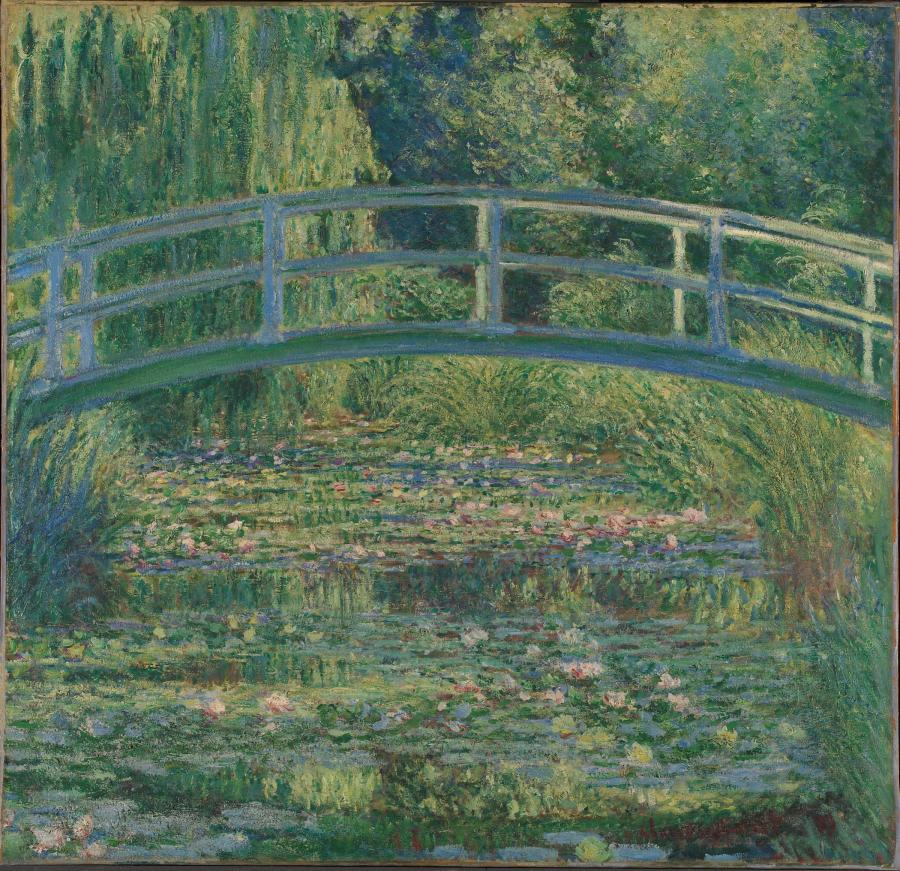
Photo: “Water Lilies” by Claude Monet, The National Gallery, London
Claude Monet:’ a uniquely sensitive eye for nature.’
“He is known as a joyful painter of lilies and picnics. But this thrilling show recasts Monet as an artist aghast as the world hurtled towards calamity"
'This gesture always puzzled me, until I saw the National Gallery’s game-changing exhibition of one of the world’s most joyously accessible artists. It seemed so strange that Monet – the thoughtless painter of fleeting light, the hedonist recorder of bourgeois picnics – should make such a serious public statement. How many visitors to the Orangerie even connect his sensuous lilies with the slaughter of Verdun?'...Jonathan Jones, writing in the Guardian
The Coal Heavers
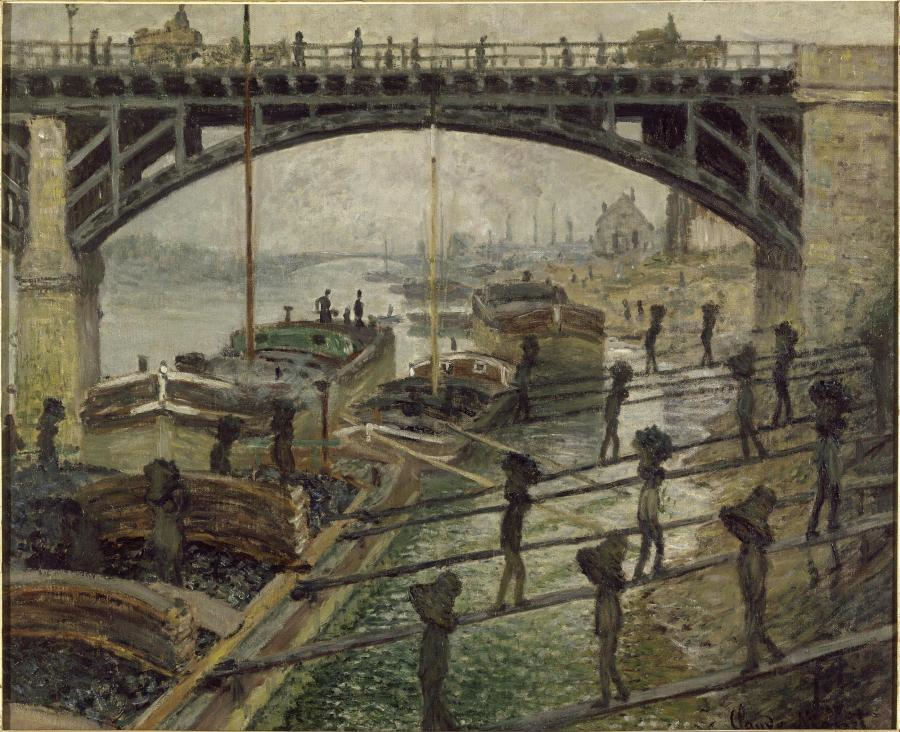
The Coal Heavers, 1875. Photograph: Claude Monet/RMN - Grand Palais (musée d'Orsay)
…’Received wisdom has it that Monet and his fellow impressionists, who held their first exhibition together in 1874, celebrate modern, middle-class city life. Yet this exhibition reveals a very different Monet, one anxious about the industrial world and horrified by its injustices. Far from a glib celebration of big city lights, his 1873 painting Boulevard des Capucines, Paris is nightmarish. It subtly anticipates Edvard Munch. Streets lights cast a blinding inhuman glow over a crowd of black-clothed people who mill about like insects under the coolly watchful eyes of two top-hatted observers on a balcony.
This is not for one second the kind of reassuring scene Monet is sometimes accused of churning out. It is a disillusioned vista of modern emptiness, like an illustration to a devastating novel by Monet’s contemporary Émile Zola. That same grim portrayal of urban reality becomes a harrowing plea for humanity in his 1875 painting The Coal Heavers. With a strange balletic grace that only emphasises the drudgery of their task, workers walk on narrow planks bearing heavy loads of coal from a barge on the Seine. Above, people walk dully over an iron bridge. This is a disenchanted world.
Boulevard des Capucines, Paris
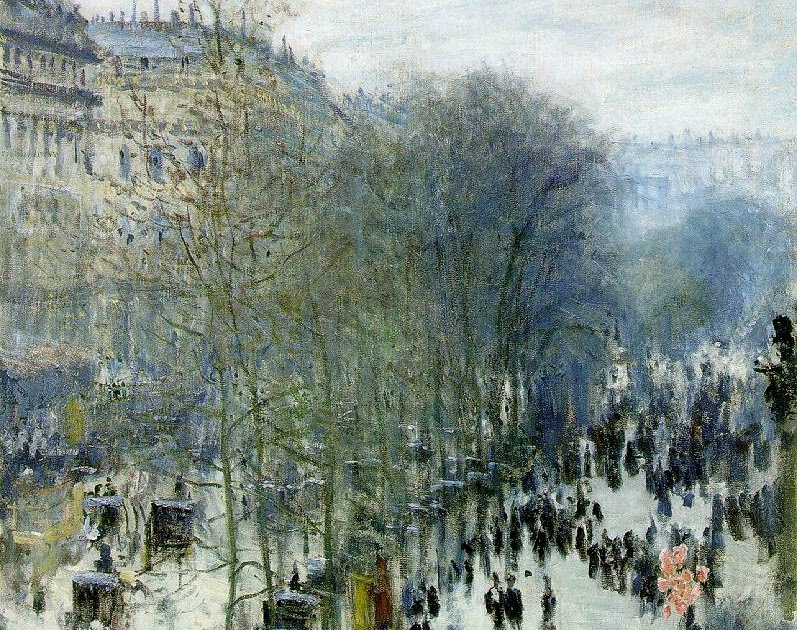
Claude Monet, Boulevard des Capucines,Paris, 1873
Photo: (Nelson-Atkins Museum of Art, Kansas City, Missouri)
This shockingly unexpected encounter with Monet the critic of capitalism prepares you for some of his greatest works. Monet’s paintings of the gothic facade of Rouen Cathedral, painted in the early 1890s, are mind-stretching marvels. From a distance – a considerable distance – they look eerily like Victorian photographs, as if he was inspired by sepia postcards of this venerable monument. Go closer – as close as the guards allow – and the illusion crumbles in a matted, rough, abstract surface of wild colour.
Something strange is happening in these paintings, all right. Each one shows exactly the same view but at a different time of day, in totally contrasting light. The colours vary fantastically: a pink cathedral, a yellow cathedral, a violet cathedral, a gold cathedral. Yet they all represent the same cathedral. In each, Monet explores the crusty, knobbly, shadowed handiwork of the medieval masons who created Rouen Cathedral with a woozy, intoxicated admiration.
General View of Rouen From St. Catherine's Bank
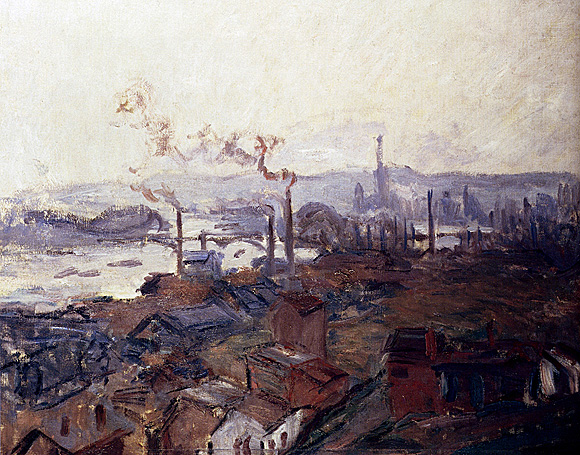
Photo: hoocher.com
They are paintings that capture time itself. The light may change from moment to moment, but the stones of Rouen have lasted centuries. In a world hurtling into the mechanical modern future, Monet keeps coming back to study this ancient survivor. He preserves split seconds. The cathedral preserves centuries.
Only an eye? This exhibition reveals the inner soul of Monet. It shows that his love of nature is not mere escapism. It is a craving for human survival in an age of growing industrial inhumanity. His gift to the French nation makes sense to me now. Decades before the first world war even began, Monet was painting to restore the heart of a heartless world.’
*The above excerpts are taken from Monet & Architecture review – glorious pleas for humanity show Monet in a new light by Jonathan Jones, first published in the Guardian on 5 April 2018
Impression Sunrise
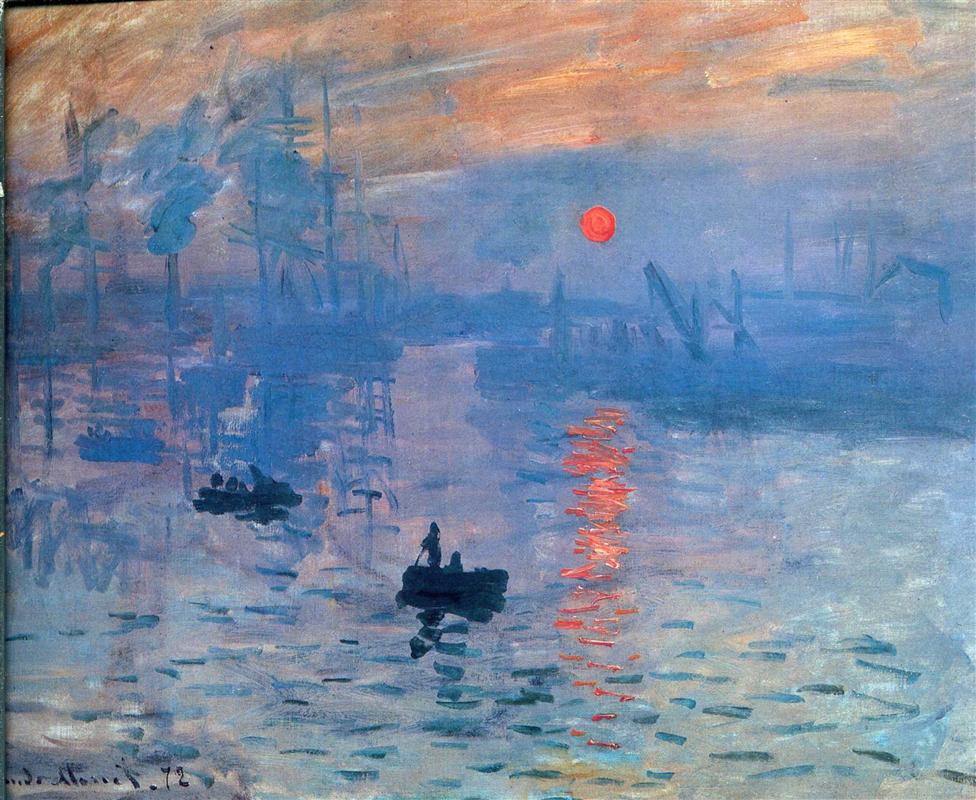
Photo: pinterest.co.uk
- 14th GCGI International Conference and the 4th Joint GCGI-SES Forum, Lucca, 2018: Final Programme
- Book of Abstracts: 4th GCGI-SES Joint Conference 2018
- Easter is a declaration of hope, love, and renewal in a troubled world
- Water is Life and a Global Common Good: The Privatisation and financialisation of Water is a Crime Against Humanity
- Happy International Day of Forests 21 March 2018