
- Details
- Written by: Kamran Mofid
- Hits: 2077
American Bishop Michael Curry has captured the world's attention with a long and powerful address at the wedding of Prince Harry and Meghan Markle on Saturday 19 May 2018
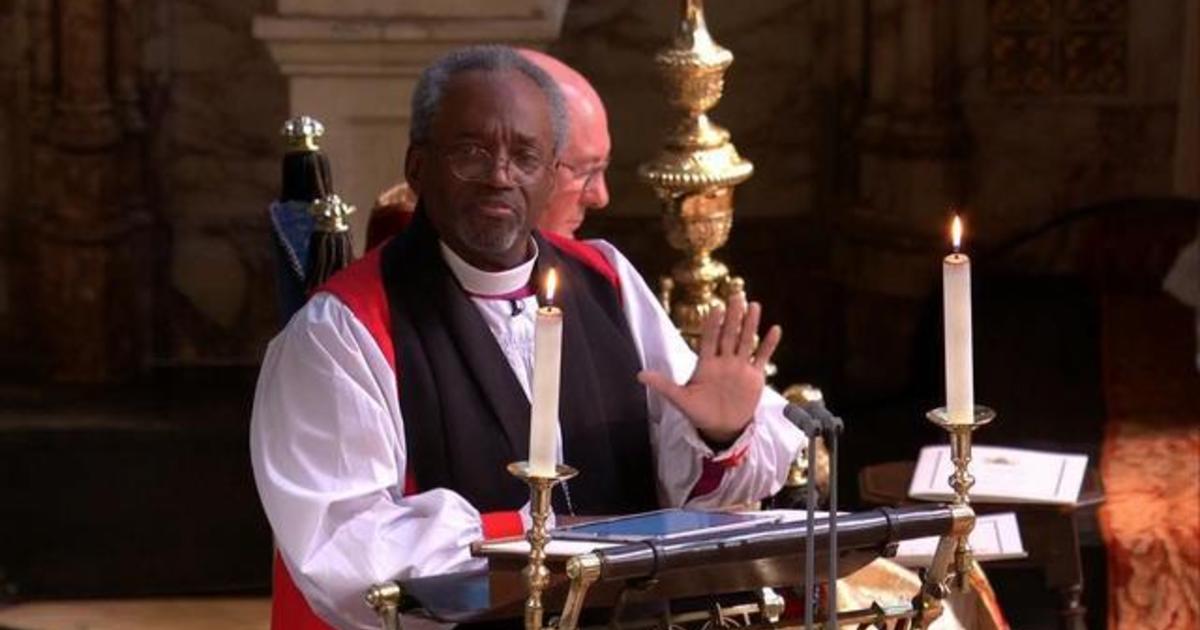
Most Rev. Michael Curry, delivering his powerful sermon at St. George’s Chapel, Windsor Castle
“There’s power in love. Love can help and heal when nothing else can. There’s power in love to lift up and liberate when nothing else will.”
Photo:bbc.co.uk
‘It was a sermon that will go down in history as a moment when the enduring seat of colonialism was brought before the Lord, and questioned in its own house. In the mention of slavery was the inherent accusation of white silver-spoon complicity, and that this union should not go forth without acknowledging it.’
‘Curry’s sermon was one of three moments during the royal wedding when I felt moved. I had not expected to be moved. I had expected to remain full of cold indignation at the pomp and aristocratic indulgence of the day, at the preparatory shooing of the homeless off the streets of Windsor by police officers who should be tending to more important things like knife crime, at the £32m shamelessly spent amid the rising presence of foodbanks and child poverty. The first of these moments was Ragland arriving at the chapel, a black woman quietly alone, being assisted from her car by a representative of an institution that had partaken in her oppression and was now required to respect her. The other was the Kingdom Choir’s beautiful rendition of Stand By Me, in part because it followed the sermon.
Reading from his iPad, gesticulating, swinging his robes, smiling, rocking back and forth on his feet, Curry was in complete contrast to the solemn and stationary ecclesiastical address that preceded his. Where there was stillness, now there was movement. For 14 minutes he preached in the full-throated, uninhibited, theatrical and emotive style of the traditional African-American church. He preached of Moses and Jesus of Nazareth, the Hebrew scriptures and the “old slaves in America’s antebellum South” who recognised in their singing of spirituals, “even in the midst of their captivity”, that there is “a balm in Gilead to make the wounded whole”. Quoting from Martin Luther King to begin and end the speech, this was not something ever witnessed within the lofty walls of the pinnacle of the Anglican establishment at a royal wedding. This was a speech that could have been lifted straight out of the pages of James Baldwin or ZZ Packer.
An ardent campaigner for social justice, particularly on immigration and same-sex marriage, Chicago-born Curry, himself a descendent of slaves, did not tone down his passionate message of the social and political power of love in order to align with the reserve of his pale and stately onlookers. He did not filter. He did it black, with music in his arms, and rhythm in his voice, and a looseness and openness in his face that supposed an almost familial acquaintance with his audience.
In his world, words do not travel alone from the mouth, with just their letters and their grammar for company. Here the body comes too, giving life to the words, lifting them into the air to float and dance into comprehension and human feeling. For Zara Tindall, captured open-mouthed in her pricey, shiny teal in the pews, it was something to behold.
The expressions on the faces of the congregation around the church were also something to behold, ranging from empathy to bemusement to confusion to downright scorn. Four minutes in, Camilla Parker Bowles’s ludicrous hat was trembling as she held down her head: was she laughing? Prince Charles was also bowed, red around the ears, more so than usual: was he?
There was half a smirk at the Duchess of Cambridge’s mouth, and, when Curry exclaimed: “Oh that’s the balm in Gilead!”, throwing up his hands in emphasis, the Queen straightened in her chair, purse-lipped. Meanwhile, Oprah swayed. Ragland looked steadily on, a little sadly, as if aware of something of which others were not, yet also with an innate sweetness; while her daughter sat holding hands with her prince, occasionally conferring in love-soaked whispers.
It was a sermon that will go down in history as a moment when the enduring seat of colonialism was brought before the Lord, and questioned in its own house. In the mention of slavery was the inherent accusation of white silver-spoon complicity, and that this union should not go forth without acknowledging it.
“Love is the way,” Curry chanted, in a rolling, conversational repetition borne of the deep south. “When love is the way, we actually treat each other, well” – he put his hand on his hip and his elbow on the lectern – “like we are actually a family”. A utopia for our time indeed, delivered with a grand humility apparently wasted on some of its listeners, who were not quite expecting such blackness from a black bride.’
*The above excerpts are from an article by Diana Evans which was first published in the Guardian on Sunday 20 May 2018
Read the full text of Bishop Michael Curry's rousing royal wedding sermon
Love is the way | Bishop Michael Curry's captivating sermon - The Royal Wedding - BBC- The Video
Who is Michael Curry? The minister who told royal wedding 'love is the way'
...And now finally a note from me:
In his wonderful sermon, Bishop Michael, shared many beautiful and timeless gems with us. One of those gems that landed right on my heart, was when he told us about the power of ‘ Love and Imagination’ (see below).
‘That’s what love is. Love is not selfish and self-centred. Love can be sacrificial, and in so doing, becomes redemptive. And that way of unselfish, sacrificial, redemptive love changes lives, and it can change this world.
If you don’t believe me, just stop and imagine. Think and imagine a world where love is the way.
Imagine our homes and families where love is the way.
Imagine our neighbourhoods and communities where love is the way.
Imagine our governments and nations where love is the way.
Imagine business and commerce where this love is the way.
Imagine this tired old world where love is the way.’
This very much resonates with me, as I have also came to believe in the awesome power of love and imagination to heal our troubled world.
Let me quote a relevant passage from a lecture I gave at the Oxford Theology Society, Keble College, University of Oxford in 2017:
‘Imagine a political system that puts the public first. Imagine the economy and markets serving people rather than the other way round. Imagine us placing values of respect, fairness, interdependence, and mutuality at the heart of our economy. Imagine an economy that gives everyone their fair share, at least an appropriate living wage, and no zero-hour contracts. Imagine where jobs are accessible and fulfilling, producing useful things rather than games of speculation and casino capitalism. Imagine where wages support lives rather than an ever expanding divisions and separations between the top 1% and the rest. Imagine a society capable of supporting everyone’s needs, and which says no to greed. Imagine unrestricted access to an excellent education, healthcare, housing and social services. Imagine hunger being eliminated, no more food banks and soup kitchens. Imagine each person having a place he/she can call home. Imagine all senior citizens living a dignified and secure life. Imagine all the youth leading their lives with ever-present hope for a better world. Imagine a planet protected from the threat of climate change now and for the generations to come. Imagine no more wars, but dialogue, conversation and non-violent resolution of conflicts.
This is the world I wish to see and I believe we have the means to build it, if we take action in the interest of the common good.
We must begin to seriously think, ponder and reflect together on Life’s Big Questions, questions of meaning, values and purpose:’ Continue to read-Oxford Theology Society Lecture: Values to Make the World Great Again
- Details
- Written by: Kamran Mofid
- Hits: 2679
(Martin Parker has taught at business schools since 1995, including at Warwick, Leicester and Keele Universities. He is currently Professor at the Department of Management, University of Bristol)-Photo: PLUTO PRESS
N.B. This Call is Music to my ears. That is, until such a time that all the business schools around the world, acknowledge and adopt My Economics and Business Educators’ Oath: My Promise to My Students, or produce a similar document, whilst more importantly, atone for their past mistakes, repent and demonstrate how they may form their new moral and spiritual compass and find the path to values-led education in the interest of the common good.
However, sadly, given my own hard-earned experience, I firmly believe this to be highly unlikely. Thus, I am joining with Prof. Martin Parker, by endorsing his noble Call, as I am of the opinion that indeed our universities are not universities anymore.
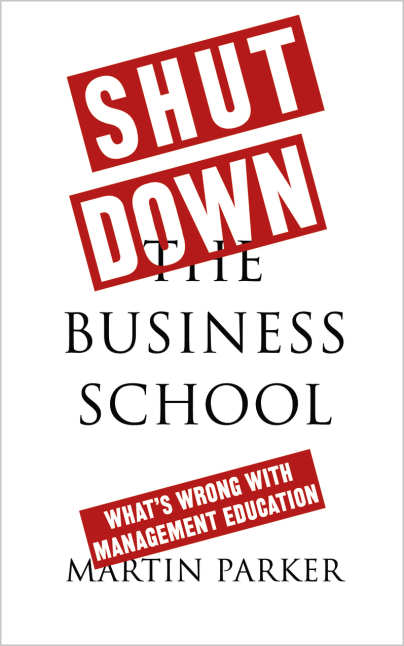
Shut Down the Business School
What's Wrong with Management Education
‘Business schools are institutions which, a decade after the financial crash, continue to act as loudspeakers for neoliberal capitalism with all its injustices and planetary consequences. In this lively and incendiary call to action, Martin Parker offers a simple message: shut down the business school.
Parker argues that business schools are 'cash cows' for the contemporary university that have produced a generation of unreflective managers, primarily interested in their own personal rewards. If we see universities as institutions with responsibilities to the societies they inhabit, then we must challenge the common notion that 'the market' should be the primary determinant of the education they provide.
Shut Down the Business School makes a compelling case for a radical alternative, in the form of a 'School for Organising'. This institution would develop and teach on different forms of organising, instead of reproducing the dominant corporate model, enabling individuals to discover alternative responses to the pressing issues of inequality and sustainability faced by all of us today.’-PLUTO PRESS
Read more:
Why we should bulldoze the business school
By Martin Parker

Photo: chronicle.com
'There are 13,000 business schools on Earth. That’s 13,000 too many. And I should know – I’ve taught in them for 20 years.’
‘Visit the average university campus and it is likely that the newest and most ostentatious building will be occupied by the business school. The business school has the best building because it makes the biggest profits (or, euphemistically, “contribution” or “surplus”) – as you might expect, from a form of knowledge that teaches people how to make profits.
Business schools have huge influence, yet they are also widely regarded to be intellectually fraudulent places, fostering a culture of short-termism and greed. (There is a whole genre of jokes about what MBA – Master of Business Administration – really stands for: “Mediocre But Arrogant”, “Management by Accident”, “More Bad Advice”, “Master Bullshit Artist” and so on.) Critics of business schools come in many shapes and sizes: employers complain that graduates lack practical skills, conservative voices scorn the arriviste MBA, Europeans moan about Americanisation, radicals wail about the concentration of power in the hands of the running dogs of capital. Since 2008, many commentators have also suggested that business schools were complicit in producing the crash.’...Continue to read
- Details
- Written by: Kamran Mofid
- Hits: 1729
Dear Signatories to our Call to Action of 2011 and all other concerned observers,
We, the undersigned, co-authored - A Call to Action- and sought your kind support. We were delighted and honoured for your endorsements. As the current global crises have clearly shown, the whole world is waking up to the value of co-creation and the harnessing of knowledge and wisdom from diverse sources, disciplines, vision, insight, experience and expertise.
We would very much wish to invite you, once again, to revisit A Call to Action 2011 document, so that, we may reignite the spirit in which it was written, relevant and important to what is to follow.
Call for Papers to Mark the 10th Anniversary of the 2008 Global Financial Crisis
(For publication in The GCGI Journal )

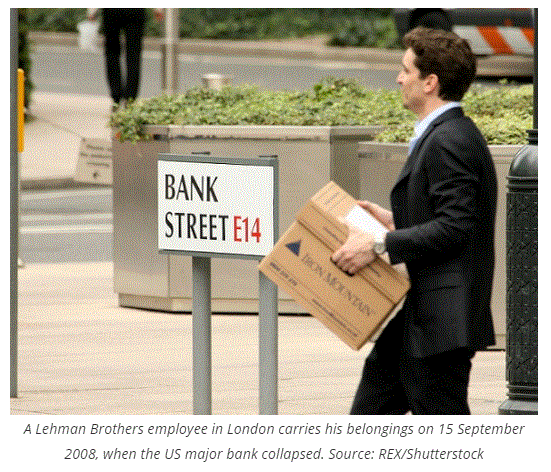
This year marks the 10th anniversary of the 2008 global financial crisis, the most significant financial and economic upheaval since the Great Depression.
It is worth reiterating, however, briefly, the scale of the crisis. ‘The crisis required a write-down of over $2 trillion from financial institutions alone, while the lost growth resulting from the crisis and ensuing recession has been estimated at over $10 trillion (over one-sixth of global GDP in 2008). The year 2009 became the first on record where global GDP contracted in real terms. The process of responding to the crisis, the subsequent deep recession and the impacts on governance of the global financial system – and the eurozone in particular – took the better part of the decade to implement before there was a reliable return to growth across the US and Europe.
‘Many of the direct effects of the crisis still remain active concerns: debt levels across advanced economies, while declining, are still far above where they were before the crisis. (Currently gross debt across advanced economies stands at 106% of GDP as of 2016, compared to 72% in 2007.) Although unemployment in Mediterranean Europe has begun to decline, it still remains incredibly high – over 15% in Spain and 20% in Greece, for example.’
As for political consequences of the crisis, it is suffice to note that, the ensuing austerity measures adopted by many countries, led to the rise of populism, right wing extremism, which in turn has dramatically affected the socio-economic fabric of societies, resulting in Brexit, election of Trump and the rise of extremism across Europe. (For a more comprehensive account of the crisis see a recent comment at CHATHAM HOUSE )
In short, it is safe to assume that, the 2008 economic crisis, which often is appraised only as a “financial crisis”, has in fact, acquired a manifold character involving the socio-economic structures at a worldwide level. To us at Globalisation For the Common Good Initiative (GCGI), it represents an important milestone to take stock of where we were then and where we are now. The problems of rising income inequality, the atrophy of social safety nets, encroaching climate change, and ecological degradation were upon us then and have only intensified since 2008. In addition to these crises, the institutional and structural features that launched the Financial Collapse have not been significantly reformed and repaired, even as reactionary forces have garnered steam in many countries and quarters of the world.
Continuing and deepening the spirit of our Call to Action of 2011, we are calling for a broad array of papers addressing the different aspects of crises. What are the new and worsening problems we face today? How have we not made more progress? Why are we as the people of the globe in an even more desperate situation in many respects? Are there any threads of hope to weave into a sustainable strategy for progress, for social justice, for ecology, and for a firmer financial foundation for the globe?
We are calling on a wide spectrum of scholars, researchers, observers, practitioners, students, storytellers from various disciplines to join us for putting together a series of studies, papers, essays and other form of creative work to mark the tenth anniversary of the international financial that took the world by storm. We want to take this opportunity to put together a body of works that can help us all to see where this storm is taking us. While we would like to put a series of themes for this gathering of ideas and creative works, we welcome other inputs and thematic ideas that can correctly deal with the vision of this call for papers. Here are some of the working themes we have and let us keep the door open for more creative ideas and additional inputs:
- Demographic changes and rise of racial politics,
- The dominance of neoliberalism with its inability and unwillingness to engage with life’s bigger picture: Who am I, where have I come from, where am I going to, what is the purpose of this journey we call life,...
- Ever increasing rise of greed as a strong force giving greater control in governance through strength of plutocracy,
- Rise in incidents of global corruption, money laundering, offshore tax avoidance, with corresponding rise in cynicism and cronyism, leading to a drastic decline in public trust in political and economic institutions,
- Return of cold war without ideological content and drawing boundaries among nations without identifiable dividing economic and social reasons,
- Rise of business-like run educational system as a mere tool of serving labour market as opposed to being a transformative force to create better life on earth,
- Institutionalisation of poverty and inequality,
- The ongoing and inevitable emergence of the next international financial crisis,
- Void of spirituality as a guiding force in dealing with one another,
- Ignoring environment and mother earth and believing that everything should centers on wellbeing of human beings alone,
- The role of education and universities in the fermentation of crises,
- Inflated financial markets, low investment trends and changes in the patterns of production and employment,
- Environmental unsustainability of the current way of production and consumption,
- Increasing unemployment, mainly among the youth, in the context of the adoption of disruptive technological innovations,
- Growing risks in the worldwide geopolitical contexts with a resurgence of massive migrations, xenophobia and armed conflicts,
- Fraud in mortgages,
- Credit agencies' mistakes,
- Regulatory and supervisory failures,
- Accounting, disclosure, and audit failures,
- Flawed expectations about house prices,
- Excessively loose monetary policy.
Submission of Papers
Papers of up to 3000 words should be submitted to Prof. Steve, Editor-in-Chief, GCGI Journal (ISSN 2377-2794) and copied to Professors Damooei and Mofid (see the email addresses respectively below).
The deadline to receive papers is: 1 August 2018
Publication date: October 2018
GCGI Journal
The unique aim of GCGIJ, the journal of the GCGI, in working towards building a better world consistent with the values of social justice, peace and ecology, is to help close the gap between theory and practice, and between theorists and practitioners. The GCGIJ will publish scholarly essays that integrate rigorous thinking about basic principles and theories of the common good and globalization, into discussions of practical issues related to policy developments, social pressures and change, global institutional arrangements and structures, the conduct of important international actors, and other cultural, ecological, economic and systemic patterns and trends: Journal Submission Guidelines
Prof. Jamshid Damooei, PhD (ECON), Professor & Chair, Department of Economics, Finance & Accounting, California Lutheran University, USA and a GCGI Senior Ambassador. Email: damooei@callutheran.edu
Prof. Kamran Mofid, PhD (ECON), Founder, Globalisation for the Common Good Initiative (GCGI). Email: k.mofid@gcgi.info
Prof. Steve Szeghi, PhD (ECON), Department of Economics, Wilmington College, Ohio, USA and a GCGI Senior Ambassador. Email: starsteve90@yahoo.com