
- Details
- Written by: Kamran Mofid
- Hits: 2595
The Time is Now to Rise and Challenge the ‘Gigitisation’ of our World, Our Values and Our Lives!
Nota bene
Debunking the Pandemic of a World ‘Gigitised’
Have you, like me, ever wondered why is it that despite so much beauty and love all around us, the dawn, sunrise, sunset, morning chorus, flowers, blossoms, trees, to name but a few, families, friends, children and grandchildren, lovely books to read, poetry to recite, great, inspiring melodies to listen to, and much much more, we have so tragically built a very troubled world and at times very sad, fearful, anxious and depressing lives? Why are we even in conflict and war with mother nature and our sacred earth?
Is nothing sacred anymore? Are love, kindness, beauty, wisdom, peace and justice not worth fighting for anymore?
I suppose there must be multiple answers to these piercing questions.
However, to my mind, one answer stands out and that is: We all have been ‘GIGGED’ and in the process we have lost the art of knowing what it means to be human, and what it's that we are living for.
This ‘Gigitisation’ of our humanity is closely associated with the ‘Greed’ of a few, which are denying a just living to many.
If you think what I say has some meaning, and if you too, like me, believe that “Education is what makes us fully human”, then, this Blog is for you too.
If there is one thing I have learnt, it is: In Post-COVID-19 We need a Different set of Values and We need to Rediscover
the Value of Values and What it Means to be Human
A Reflection on the Global Pandemic of the Values-free and Inhumane Neolibearl Educational Model:
The World is ‘GIGGED’ Because of It!
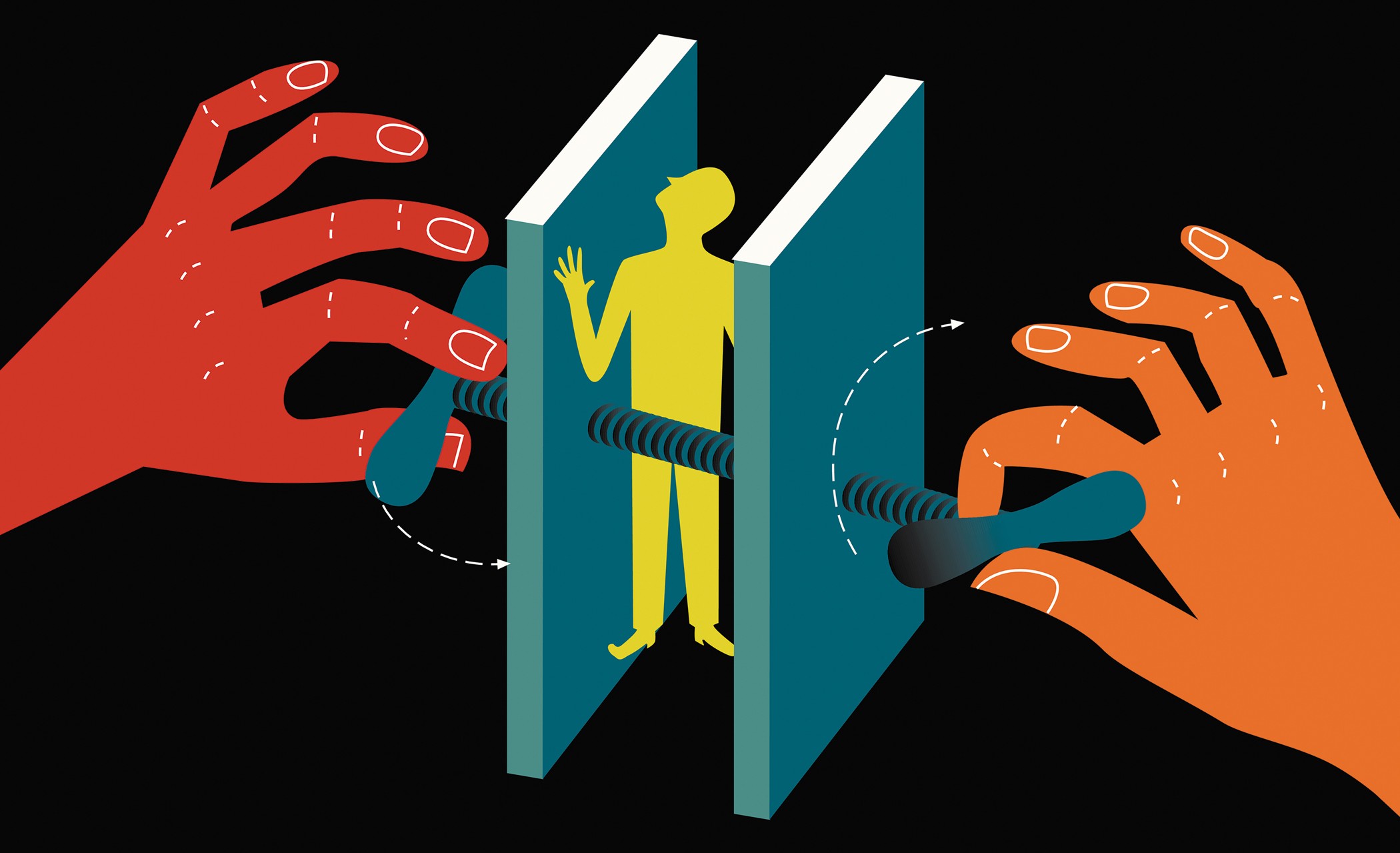
Photo:Nature
If institutions, peoples, communities, societies, values,..., and everything else under the sun is ‘Gigged’, this cannot be for the common good, and people cannot contribute to the common good. No wonder the world is marching for values that give us insight into the world and upholds the common good.
I am prompted to write this Blog today, after reading the articles bellow, and in the process discovering a very relevant book:
‘My gig work as a professor is more precarious than ever in this pandemic.’
‘Professors are selling their plasma to pay bills. Let's hold colleges' feet to the fire.’
‘Facing poverty, academics turn to sex work and sleeping in cars.’
‘The Gig Academy: Mapping Labor in the Neoliberal University (Reforming Higher Education: Innovation and the Public Good) Hardcover – 24 Dec. 2019’
More on these a bit later. First:
Values- free, gig education and gig universities with their gig faculty: No wonder the world has sunk to its nadir of decadance
Knowledge, Wisdom and the Well Rounded Life for Sale: The Neoliberal Hijacking of Education and Universities

Photo: Times Higher Education
‘As more and more tenure lines are replaced with faculty members who are afforded no academic freedom, no benefits, and no long-term contracts, the university becomes more like Wal-Mart, cutting costs with no regard for quality.’
For now let’s consider these:
‘contingent faculty are underpaid, exploited, and exhausted. Sometimes they are homeless or working several jobs and they generally do not have health care.
contingent faculty must teach double or triple the number of courses as tenure-track faculty, usually at multiple schools.
contingent faculty rarely have an office of their own and are not paid to hold office hours, read drafts of student papers, or advise students.
contingent faculty are hired for a course or a semester, often without oversight, mentorship, or access to basic resources (like access to a copy machine) to do their jobs.
contingent faculty generally are not allowed to choose which courses they want to teach, and often don’t have any ability to determine the course content.
contingent faculty are hired and fired irregularly, which makes it impossible for them to mentor students for the duration of the student’s college life, write recommendations, or take a stable role in the student’s life.
contingent faculty are not generally granted citizenship in their departments, which makes them unable to serve on committees or shape policies.
contingent faculty are powerless to affect the terms of their employment, which means they can be given enormous classes with far more students than any one person can handle.’
And moreover, as it has been pointed out: “If you are paying for a college education today, you are paying comparatively more money than previous generations have paid—nearly $70,000 in annual tuition, room and board, and fees at America’s most expensive schools—to be educated by a more poorly-resourced, poorly paid, and potentially poorly-motivated group of educators.” In short, “you want to ensure that the college to which you’ll pay tens of thousands of dollars a year treats its faculty well enough to provide the best possible education for students.”....You can read more on these issues HERE
Now continuing our observation and reflection:
Eight years ago in June 2012, I had posted a Blog: ‘Are Universities still for the Common Good?’ Which I believe is very worthwhile if we can revisit it, however briefly:
‘What is the main role and function of a "good" education? To equip students with marketable skills to help countries compete in a global, information-based workplace? Has this overwhelmed other historically important purposes of education, and thus, short- changing us all and in particular the students?
‘If there is a shared national purpose for education, should it be oriented only toward enhancing the narrow vision of a country's economic success? Should education be answerable only to a narrowly defined economic bottom line, or do we need to discover a more comprehensive, inclusive bottom line, given the catastrophic crises that we are witnessing all around us? Are the interests of the individuals and selective groups overwhelming the common good that the education system is meant to support? Should our cherished educational values be all up for sale to the highest bidder? Should private sector management become the model for our mainly publicly-funded education system? Should the language and terminology of for profit- only business model, such as “downsizing”, “outsourcing”, “restructuring”, ”marketisation”, “privatisation” and “deregulation”, amongst others, be allowed to become the values of education, when teaching and learning is nothing short of a vocation and sacrament?
‘To cut a long story short, it seems that the world of education has been taken over by the soul-less, heartless individuals that see nothing in this world worthy of the common good, but money and in particular, loads of money.’
In short, my conclusion was that: NO,the universities are not still for the common good. They have been taken over by Mamon, and they are now about Money, Money and more Money, regardless of how this Money is obtained!!
See also:
Neoliberalism has Eroded our Ability to Know What it Means to Be Human
Neoliberal Education: From Delusion to Destruction
This is How and Why the Gig Education and the Gig Universities Are Failing Your Children and Grandchildren
Student Suicides at Bristol University: My Open Letter to the Vice-Chancellor, Prof. Hugh Brady
University students are crying out for mental health wellbeing modules
Why Happiness Should be Taught at Our Universities
What if Universities Taught KINDNESS?
To All Striking Academic Colleagues in Britain: Turn the Strike to a Force for the Common Good
Now reverting back to the beginning of this Blog, starting with:
‘My gig work as a professor is more precarious than ever in this pandemic.’
‘Like most of the 1.3 million college faculty members employed off the tenure-track, I work on a contingent basis: I only have a job when the university needs me.’
COVID-19 shows how precarious the positions of contingent faculty members actually are

Photo:Inside Higher Ed
‘One of the most grueling college semesters I’ve ever taught ended on 6 May. The following morning, I woke to nine emails from former students asking for help. Four requested letters of recommendation; two asked for comments on graduate school applications; one wanted advice about what to do now that the summer internship I’d recommended her for had been cancelled; another hoped I could suggest ways to make a 10-page essay on the concept of Enlightenment in modern German philosophy stronger; and the last wanted me to “quickly” read a 12,000-word dissertation chapter before he submitted it to his adviser that afternoon.
Despite my guilt, I told them all, “No.” My first priority was to fill my two kids with waffles, then log them in to their respective online learning platforms. My second was to file an unemployment claim, so I could pay household bills over the summer (I live in Boulder, where the cost of living is not cheap). Not one of these students seemed to realize that I am nothing but a gig worker for their university and my gig is now up – perhaps permanently…’- Continue to read
‘Professors are selling their plasma to pay bills. Let's hold colleges' feet to the fire.’
‘If you like your coffee fair trade, why not your children’s school ‘fair labor’?’
‘Former New York mayor Michael Bloomberg recently gave $1.8bn to his alma mater, Johns Hopkins University in Baltimore, Maryland, for financial aid. The donation, the biggest gift of its kind, will enable Johns Hopkins to ensure permanently need-blind admissions. Bloomberg’s big-ticket donation has received plenty of headlines – and criticism – for simply adding to the coffers of an already elite institution. To me, however, his donation highlights another problem involving money on campus that no philanthropist seems to want to touch: the sheer amount of terribly paid adjuncts now toiling away at American universities.
Over the last few years, I have talked to numerous adjunct professors in extreme situations: homeless, living in their cars, getting their meals from their university’s food bank, taking extra jobs to support their families, even donating plasma.
Top-tier American universities charge tens of thousands of dollars a year in tuition – yet they get away with exploiting legions of adjunct professors, underpaid and economically insecure, who work long hours and typically do not even receive health insurance. Many are living below the poverty line, while the colleges that employ them continue to operate with endowments in the many millions of dollars. A 2015 survey by Pacific Standard found that 62% of adjuncts made less than $20,000 a year.
Knowing this, how can we, as students, parents and alumni, know if the institutions which happily accept our checks provide their staff with even a bare minimum standard of living?’...Continue to read
PS: Not all plasma sellers are Adjunct, even tenured ones have to sell too!
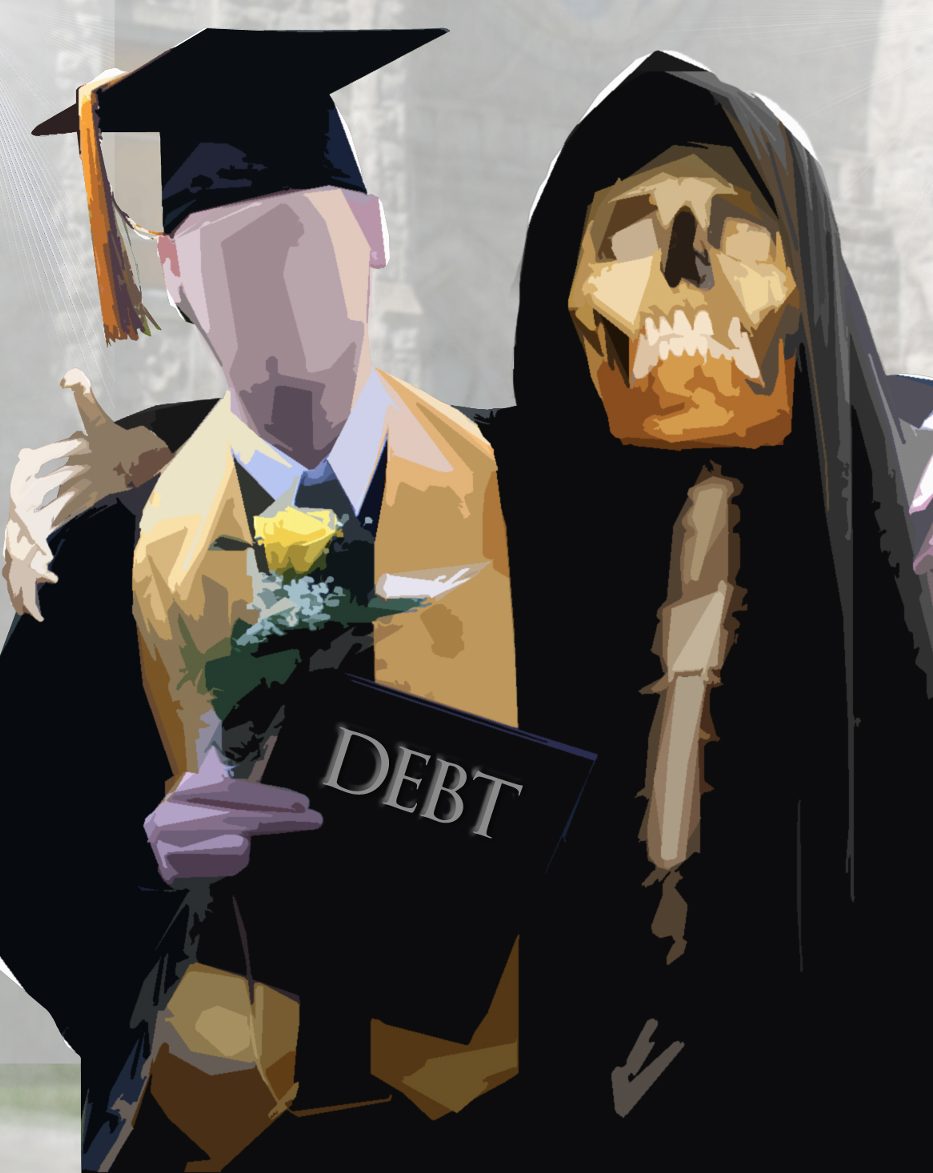
Photo: InsideHook
‘Some Professors Have to Sell Plasma to Make Ends Meet, Even With Tenure.’
‘Over at Longreads, University of Maine tenure track professor Josh Roiland admits to selling plasma for money multiple times last summer. He uses this experience to propose that a career in academia comes at a high cost, and that pursuing it racks up often insurmountable debt for PhDs.
“I have more than $200,000 in student loans and $46,000 in credit card debt,” Roiland says, after summarizing his experiences at the BPL Plasma Center in Lewiston, Maine. “My annual salary translates to a little more than $3,000 in monthly take-home pay,” and his regular expenses include “$800 a month in rent, $1,100 in credit card bills (paying only the monthly minimums), $350 in student loans, and [a] $285 a month car payment.”
The student loans and credit card debt piled up during the course of his undergraduate, graduate, and doctoral studies, and increased when he was finally out of school and looking for a tenure-track job. Three years into his search, he was hired as a visiting professor at the University of Notre Dame, and worked so hard in pursuit of tenure that his marriage fell apart. When he didn’t get tenure, Roiland says he “faced the sudden reality of all the ways that I had mortgaged my future for some elusive—and illusory—present.”...Continue to read
‘Facing poverty, academics turn to sex work and sleeping in cars.’
‘Adjunct professors in America face low pay and long hours without the security of full-time faculty.
Some, on the brink of homelessness, take desperate measures.’

Photo:TaxProfBlog
‘There is nothing she would rather do than teach. But after supplementing her career with tutoring and proofreading, the university lecturer decided to go to remarkable lengths to make her career financially viable.
She first opted for her side gig during a particularly rough patch, several years ago, when her course load was suddenly cut in half and her income plunged, putting her on the brink of eviction. “In my mind I was like, I’ve had one-night stands, how bad can it be?” she said. “And it wasn’t that bad.”
The wry but weary-sounding middle-aged woman, who lives in a large US city and asked to remain anonymous to protect her reputation, is an adjunct instructor, meaning she is not a full-time faculty member at any one institution and strings together a living by teaching individual courses, in her case at multiple colleges.
“I feel committed to being the person who’s there to help millennials, the next generation, go on to become critical thinkers,” she said. “And I’m really good at it, and I really like it. And it’s heartbreaking to me it doesn’t pay what I feel it should.”
Sex work is one of the more unusual ways that adjuncts have avoided living in poverty, and perhaps even homelessness. A quarter of part-time college academics (many of whom are adjuncts, though it’s not uncommon for adjuncts to work 40 hours a week or more) are said to be enrolled in public assistance programs such as Medicaid.
They resort to food banks and Goodwill, and there is even an adjuncts’ cookbook that shows how to turn items like beef scraps, chicken bones and orange peel into meals. And then there are those who are either on the streets or teetering on the edge of losing stable housing. The Guardian has spoken to several such academics, including an adjunct living in a “shack” north of Miami, and another sleeping in her car in Silicon Valley.
The adjunct who turned to sex work makes several thousand dollars per course, and teaches about six per semester. She estimates that she puts in 60 hours a week. But she struggles to make ends meet after paying $1,500 in monthly rent and with student loans that, including interest, amount to a few hundred thousand dollars. Her income from teaching comes to $40,000 a year. That’s significantly more than most adjuncts: a 2014 survey found that the median income for adjuncts is only $22,041 a year, whereas for full-time faculty it is $47,500.’...Continue to read
‘The Gig Academy: Mapping Labor in the Neoliberal University (Reforming Higher Education: Innovation and the Public Good) Hardcover – 24 Dec. 2019’
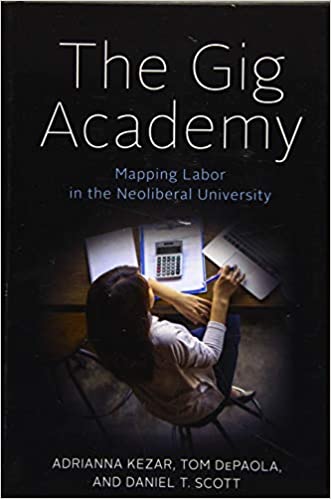
‘Over the past two decades, higher education employment has undergone a radical transformation with faculty becoming contingent, staff being outsourced, and postdocs and graduate students becoming a larger share of the workforce. For example, the faculty has shifted from one composed mostly of tenure-track, full-time employees to one made up of contingent, part-time teachers. Non-tenure-track instructors now make up 70 percent of college faculty. Their pay for teaching eight courses averages $22,400 a year―less than the annual salary of most fast-food workers.
In The Gig Academy, Adrianna Kezar, Tom DePaola, and Daniel T. Scott assess the impact of this disturbing workforce development. Providing an overarching framework that takes the concept of the gig economy and applies it to the university workforce, this book scrutinizes labor restructuring across both academic and nonacademic spheres. By synthesizing these employment trends, the book reveals the magnitude of the problem for individual workers across all institutional types and job categories while illustrating the damaging effects of these changes on student outcomes, campus community, and institutional effectiveness. A pointed critique of contemporary neoliberalism, the book also includes an analysis of the growing divide between employees and administrators.
The authors conclude by examining the strengthening state of unionization among university workers. Advocating a collectivist, action-oriented vision for reversing the tide of exploitation, Kezar, DePaola, and Scott urge readers to use the book as a tool to interrogate the state of working relations on their own campuses and fight for a system that is run democratically for the benefit of all. Ultimately, The Gig Academy is a call to arms, one that encourages non-tenure-track faculty, staff, postdocs, graduate students, and administrative and tenure-track allies to unite in a common struggle against the neoliberal Gig Academy.’- Buy this book
The House of Cards, The Fraudulent Ideology, Is Crashing Down

Photo: The American Prospect
Here are Some Alternatives in the interest of the Common Good from the GCGI Archies:
First and foremost: The Enemy of Values-led Education- The Fraudulent Ideology
And then:
Ten Steps to ‘Degigitise’ and Make the World Great Again for the Common Good
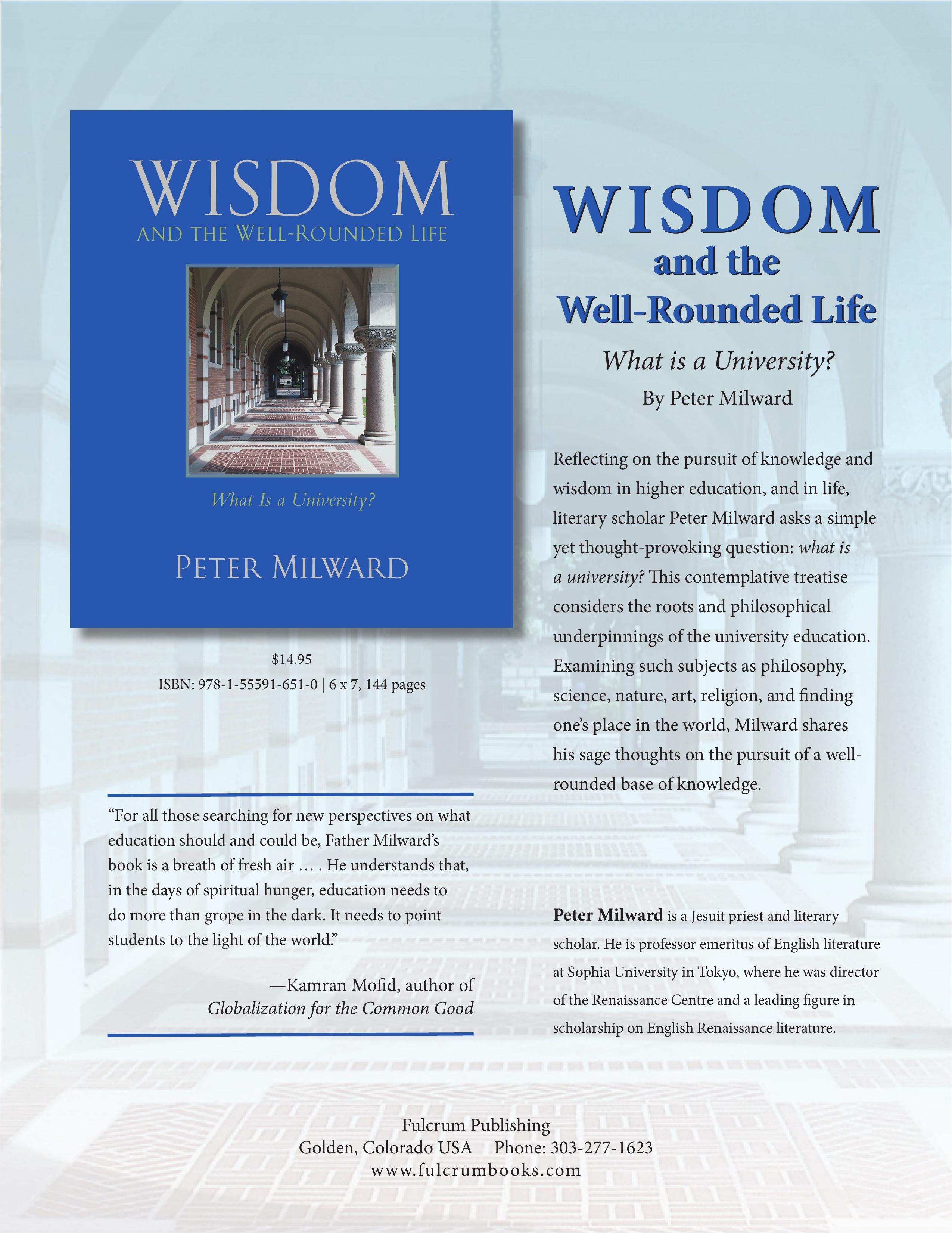
Wisdom and the Well-Rounded Life: What Is a University?
Hustle and Gig: A Must-Read Book on Gig Economy
Struggling and Surviving in the Sharing Economy
by Alexandrea J. Ravenelle (Author)
March 2019
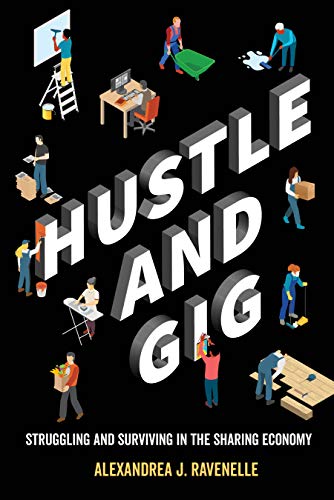
About the Book
‘Choose your hours, choose your work, be your own boss, control your own income. Welcome to the sharing economy, a nebulous collection of online platforms and apps that promise to transcend capitalism. Supporters argue that the gig economy will reverse economic inequality, enhance worker rights, and bring entrepreneurship to the masses. But does it?
In Hustle and Gig, Alexandrea J. Ravenelle shares the personal stories of nearly eighty predominantly millennial workers from Airbnb, Uber, TaskRabbit, and Kitchensurfing. Their stories underline the volatility of working in the gig economy: the autonomy these young workers expected has been usurped by the need to maintain algorithm-approved acceptance and response rates. The sharing economy upends generations of workplace protections such as worker safety; workplace protections around discrimination and sexual harassment; the right to unionize; and the right to redress for injuries. Discerning three types of gig economy workers—Success Stories, who have used the gig economy to create the life they want; Strugglers, who can’t make ends meet; and Strivers, who have stable jobs and use the sharing economy for extra cash—Ravenelle examines the costs, benefits, and societal impact of this new economic movement. Poignant and evocative, Hustle and Gig exposes how the gig economy is the millennial’s version of minimum-wage precarious work.’
Click HERE to read more and purchase the book
......
Ken Loach’s writer attacks ‘dehumanising’ gig economy*
Delivery drivers in Scotland are being forced to urinate into bottles and skip meals due to the “dehumanising” pressure to hit targets, according to one of Scotland’s leading screenwriters.
'Paul Laverty – whose new film with director Ken Loach, Sorry We Missed You, shines a light on the harsh reality of zero-hour contracts and the gig economy – warned that workers were enduring “precarious” existences, and called on the UK government to devolve employment law to end the “exploitative” practices.
Laverty and Loach’s new film follows the story of Ricky, a driver for a parcel-delivery company, and Abbie, a home carer who covers the cost of her own travel between appointments, as they struggle to make ends meet and raise their family.
The Bafta award-winning screenwriter interviewed numerous drivers as part of the project, even joining them on the road as they raced to deliver one Amazon parcel after another.
The experience, he said, revealed “the truth” of their lives.
“You see the photographs of their children stuck to their dashboards, you see them drinking high-energy drinks all day,” he told Scotland on Sunday. “The people I went out with didn’t have time to eat a meal, let alone take toilet breaks – some used plastic bottles to urinate in.
“What I think is really insidious is the language of these workers’ contracts. They’re no longer employees, but ‘owner/driver franchisees’. There’s no healthcare or sickness pay, and if you’re in an accident, you’re on your own.”
Laverty, whose previous collaborations with Loach include award-winning films such as I, Daniel Blake, Sweet Sixteen and My Name Is Joe, said he was under “no illusions” about the influence wielded by corporations and lobbyists on the EU, but warned that Britain’s departure from the union would further imperil ordinary working families.
“Boris Johnson is planning to roll out the red carpet to American business,” he said. “What do you think is going to happen to regulations, holiday pay, the minimum wage and basic health and safety standards as a result?
“If that doesn’t put the fear of God into communities and institutions like the NHS, I don’t know what will. It’ll be a carve-up and that will create an even bigger dichotomy between the rich and the poor. The direction of travel is absolutely clear.”
The film’s release coincides with the publication of a new report by the Scottish Trades Union Congress (STUC) which details how workers on zero-hours and short-term contracts are suffering from a lack of time and control over their own lives.
The report, entitled Time, Control, Trust: Collectivising In Precarious Work, warned that many workers are facing a “double burden” by being both time-poor and financially poor, with their mental health suffering as a consequence...*Continue to read
- Details
- Written by: Kamran Mofid
- Hits: 1905

Dr. Peter Bowman was Science Coordinator on the University Preparatory Certificate at University College London (UCL), tutor
and head of economics at the School of Economic Science, and a GCGI Senior Ambassador.-Photo: UCL
I received the sad news that my dear friend, Dr. Peter Bowman, an outstanding scientist, teacher and educator, had been taken by COVID-19 in the prime of his life.
Peter was diagnosed with an advanced stage of cancer and started chemotherapy at the end of March. Unfortunately, he also contracted the coronavirus and passed away on the 17 April 2020.
Peter joined (UCL) in October 2005 as a Senior Teaching Fellow for Chemistry on the Undergraduate Preparatory Certificate for Science and Engineering (UPCSE). Later, Peter coordinated the science team and became admissions tutor for the UPCSE.
As noted by his colleague, Dr Christine Hoffmann, Director, UCL Centre for Languages & International Education: ‘In his fifteen years with us, Peter made a difference in every area of CLIE and UCL in which he was involved. His dedication to education and teaching was exemplary. Students very often praised his innovative teaching and his commitment to Chemistry. He led our UPCSE science team in a calm, diplomatic and open manner for which all of us knew him so well. With our marketing team, Peter represented CLIE and the UPCSE around the world on many recruitment and marketing trips. He shaped the life of many young international scholars when sharing our educational visions with them at school visits and when testing UPC applicants.’
In 2019 Peter in recognition of his contributions to teaching, supervision, assessment and support of students’ learning was awarded Fellowship of the Higher Education Academy (HEA) with UCL Arena Open.
Social & Economic Justice was Peter’s passion and commitment. Speaking in this ten-minute video Changing Paradigms in Economics: Economics as Relationships, where Peter emphasises that a paradigm shift in economics is well overdue, and the way we deal with money, employment and consumer goods as well as the way the market place operates all is in need of a paradigm shift if things are to improve.
Peter argued for a just economy, which he believed is about relationships in society and how we treat others fairly. 'Justice prevails in an economy that is based on honesty; trust’ loyalty; a sense of service and satisfaction,' Peter noted.
Peter gave the 2015 School of Economic Science Annual Economics Lecture How can the economy work for the benefit of all? The lecture asks how the economy can work for the benefit of all and gives some simple, but timeless propositions.
Peter followed this with his 2016 Lecture Economics for the real world, where he asked some pertinent questions and offered possible solutions to build a better, fairer and kinder world.
I first met Peter at our first GCGI Joint Conference with (SES), which was held at Waterperry House, in September 2012, where he presented an excellent lecture on the theme of: ‘The Path to a just free market economy’.
Given our shared academic and research interests, our commitment to economic and social justice, and our struggles to take steps in the interest of the common good, it was no surprise that we went on to become very good friends.
Peter was instrumental in the close and fruitful relationship that the GCGI formed with the SES, which resulted in four major international Joint Conferences (2012, Waterperry House {WPH}), (2014, WPH), (2016, WPH) and (2018, LUCCA).
Peter also on many different occasions invited me to deliver lectures on different aspects of economic and social justice, as well as the globalisation for the common good at School of Economic Science in London and Leicster, he chaired and moderated the gatherings, which I recall very fondly.
RIP my friend Peter and thank you for the generosity and kindness in friendship, as well as the wonderful times we had in dialoguing and conversing together.
I can only say I have lost a good friend and comrade. I am praying in my own way for my friend, may God grant Peter eternal rest; he was, in the old idiom, a lovely man, who, if required, may still be a peacemaker in heaven.
My wife, Annie, joins me, and together we send our condolences to Peter’s wife, Angela and family.
- Details
- Written by: Kamran Mofid
- Hits: 1230
Our society has lost the instinct for kindness- Julia Unwin*
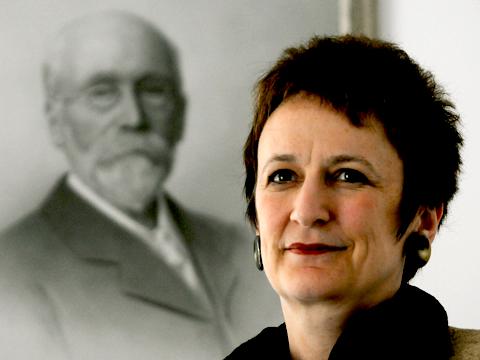
Julia Unwin CBE, Chief Executive of JRF and JRHT from 2007 to 2016.-Photo:The York Press
The Joseph Rowntree Foundation today (11 June 2009) publishes Contemporary Social Evils, which argues that a dangerous erosion of trust and culture of fear now pervades our society. Here foundation head Julia Unwin looks at how we can reclaim our values
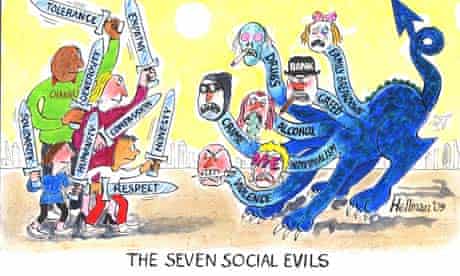
The Joseph Rowntree Foundation says people are fed up with the status quo and are hungry for change.
Illustration: Louis Hellman, Via The Guardian
…’As a society, we appear to have lost the instinct for kindness and the willingness to extend the hand of friendship. Our responses to children, to older people, to strangers, are all conditioned by a concern not to offend and a fear of getting involved.
What does it mean to be kind? What is Kindness?
Today is World Kindness Day: Embracing Kindness to Defeat the Political Economy of Hatred
Our recent public consultation into the social evils of today highlights a real concern for the way in which society increasingly values people for their economic contribution, at the expense of kindness and compassion.
Mr Trump, we are not what we earn!
Memento mori, Memento vivere and the Madness of Black Friday
Some blame the nature of regulation – while providing protection for some, it seems to have intimidated the majority. Others feel there has been a general decline in values: individual advancement is seen as more significant than the ability to care for others.
The Value of Values: Why Values Matter
Crisis in Trust and Perpetual Global Crisis
Can Capitalism Survive Without Trust and Regulation?
Whatever the reasons, we are uncomfortable with the society we have created. The idea of the common good has been lost and Britain today is experiencing a severe social recession – the effects of which are far more devastating and long-lasting than any economic recession.
Why Love, Trust, Respect and Gratitude Trumps Economics: Together for the Common Good
Can there ever be a Compassionate Capitalism?
Why is Trust so Vital to Who we are and How we live our lives?
There is, however, light at the end of this very dark tunnel. Our study has shown that the people are fed up with the status quo and are hungry for change.
So, how can we go about making the changes we need?
We need to rediscover humanity in our communities. Solidarity is a term little used today. Yet across the country, people are taking on the challenge of climate change by working together to reduce their carbon footprints through recycling and growing and selling local produce. The same is true of those who help people in need, or who volunteer in hospitals and schools to make sure people in our communities are cared for and nurtured.
"In Search of the Virtuous Economy: A Plea for Dialogue, Wisdom, and the Common Good"
Ten Steps to Build a Better World
From allotment societies to arts centres, conservation groups to internet cafes, housing co-operatives to car clubs, civic society is showing itself to be adaptive and resilient. It is demonstrating that solidarity is a product of a more serious, more engaged political discourse that is willing and able to respond to the challenges of the 21st century.
Have We lost the Art of Knowing What it Means to Be Human?
In Praise of Generosity, Compassion and Kindness: Lessons of London 2012
Closely associated with this is the notion of hospitality, and the desire to create a world that is genuinely hospitable. A hospitable world is one that is a good steward of the earth, able to ration in the interests of generosity, not plunder in the pursuit of greed. It is a world in which the stranger is welcomed, the weak are supported and the dispossessed are empowered.
We need to come together to stop the plunder of the commons
Do you have an eye for justice and sense of duty? Then, these questions are for you.
The Age Of Perpetual Crisis: What are we to do in a world seemingly spinning out of our control?
Interfaith Spiritual Music to Heal the World, GCGI 1st Conference, Oxford 2002
And finally there is civility. The generosity of spirit which allows for kindness, and politeness, that embraces difference without fear, and that genuinely sees an equality between people. Civility is at the core of an active, vibrant and welcoming society.
Without fear of being nostalgic, it is time to reclaim these values – the future of our society depends on them.’
- Julia Unwin is chief executive (2009) of the Joseph Rowntree Foundation
*This article was first published in The Guardian on 11 June 2009
Contemporary social evils
JOSEPH ROWNTREE FOUNDATION
Distributed for Bristol University Press
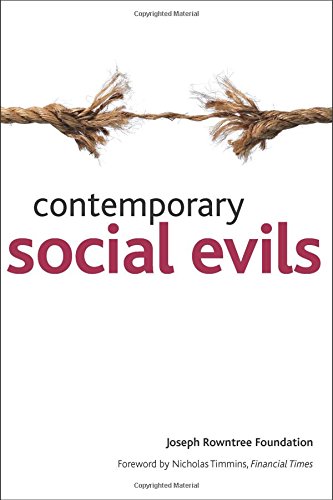
‘Which underlying problems pose the greatest threat to British society in the 21st century? A hundred years after its philanthropist founder identified poverty, alcohol, drugs and gambling among the social evils of his time, the Joseph Rowntree Foundation initiated a major consultation among leading thinkers, activists and commentators, as well as the wider public. The findings have now been brought together in this fascinating book.Individual contributors range across the political spectrum but the book also reports the results from a web survey and consultation with groups whose voices are less often heard. The results suggest that while some evils - like poverty - endure as undisputed causes of social harm, more recent sources of social misery, such as an alleged rise in selfish consumerism and a perceived decline in personal responsibility and family commitment, attract controversy.’
- Good on you Prince Charles, I very much liked what you said
- COVID-19, isolation, reflection, fear, hope, beauty and wisdom: “Feathers of Fire”
- Lockdown lawyers finding solace in poetry to deliver justice in times of COVID-19
- Is this the way to make America great again?
- A look at the biggest casualty of Boris Johnson’s COVID-19 Britain, without which life becomes meaningless