- Details
- Written by: Kamran Mofid
- Hits: 2366
Finding sanctuary in poetry during lockdown
Photo:georgetown.edu
Lawyers' poems deal with trials of delivering lockdown justice*
‘Collection published written by and dedicated to those who have kept the system going.’
‘I need to get a bookcase for the background of my Zoom
I need to get a bookcase for an intellectual room
I can’t appear in court with this background that I’ve got
That washing horse is far too close the Judge will see the lot.
That acute sensitivity about exposing domestic lives through remote working is one of the recurring themes in an anthology of legal lyrics published this week.
The frustrations of our confined lives have inspired a chorus of confessions, drawing on the sense that although lockdown is only 10 weeks old it feels like an eternity.
Some courts have adapted rapidly to remote working or have simply closed, but others still require lawyers, defendants, court staff and witnesses to appear for urgent cases.
The book is written by and dedicated to legal aid practitioners who have kept the justice system going. The verses reflect the predicament of millions who are working from home while coping with childcare, video conferencing and the pandemic.
Jon Whitfield QC of Doughty Street Chambers in London, who co-edited the collection Lockdown Lawyers said the 50-plus poems – including haikus, parodies and extended ballads – cover “falling revenue, falling ceilings, the fear of infection in dirty courts, police stations and prisons with no PPE, the despair of clients in custody or facing huge challenges with cases postponed indefinitely”.
Whitfield, who also sits as a judge in the court of protection and is a trustee of the Winchester poetry festival, said he asked himself: “How has the publicly funded legal system survived this pandemic at all, given it has endured 35 years of cuts whilst saddled with huge increases in expense and workload?
“However, as I pondered and read the contributions, I realised the answer is simple. It is the lawyers that work themselves to a standstill to keep a broken system going … Despite the endless worry of practice, multiplied by the pandemic they still find time to support each other, smile, be creative.”
Emma Trevett, a paralegal at the law firm Irwin Mitchell based in Bristol, came up with the idea after organising virtual events during the Covid-19 crisis that frequently ended with a poem being read.
“I sent out a message on Twitter calling for anonymous poetry from legal aid lawyers,” she said. “I was astounded by the response. Poems flooded in from around the country. I was surprised to find other lawyers that regularly wrote poetry and, that those who did not were excited to have a go.”
Contributors include judges, QCs, the Secret Barrister blogger, other barristers and solicitors and law centre staff. None of the poems are individually signed, allowing writers the freedom to express themselves anonymously. It is published by the Legal Action Group (LAG). Funds raised will be donated to the Law Centres Network.
COVID Limerick No 5
It’s all very well to do Zoom,
but it’s better to be in the room.
One misses the ‘tells’,
the ticks and the smells,
there’s a danger injustice will loom!’
* This article by Owen Bowcott, the Guardian's legal affairs correspondent was first published in The Guardian/Observer on Sunday 31 May 2020.
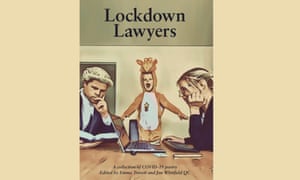
Photo: The Guardian
“Never Forgotten”*
‘Darkness follows the passing of the light,
Emotions peaked to almost eternal night
We persevere our senses heighten,
Gradually the pressure starts to lighten
Pushing through and pressing strong
Where there was one, we are together, an increasing throng.
The devastation, the chaos, it passes
The level of sacrifice not forgotten by the masses.’- *Guernica 37's Carl Buckley contributed to Lockdown Lawyers with a piece entitled "Never Forgotten”
‘Lockdown Lawyers is an anthology of poetry on how the COVID-19 crisis has hit legal aid lawyers and the provision of advice and advocacy. There are over 50 contributions from barristers, solicitors, advisers and some of their family members. The poems range from haiku to multi-page poems and touch upon crime, mental health, the lack of courts and how practitioners are coping working from home (or not).
Edited by Emma Trevett and Jon Whitfield QC, Lockdown Lawyers aims to mark what has been the most unusual and difficult of times, showing how despite the decades of cuts we as a sector have coped. It aims to raise a smile and most importantly, all proceeds to the book will be donated to Law Centres Network to continue their work for the most vulnerable people in society. Visit the website here and order your copy of Lockdown Lawyers.’
Related articles from the GCGI archives:
Finding sanctuary in poetry during lockdown
On the 250th Birthday of William Wordsworth Let Nature be our Wisest Teacher
The Sweetness of Being Human: ‘We have all of us one human heart.’
- Details
- Written by: Kamran Mofid
- Hits: 2112
Is this the way to make America great again?
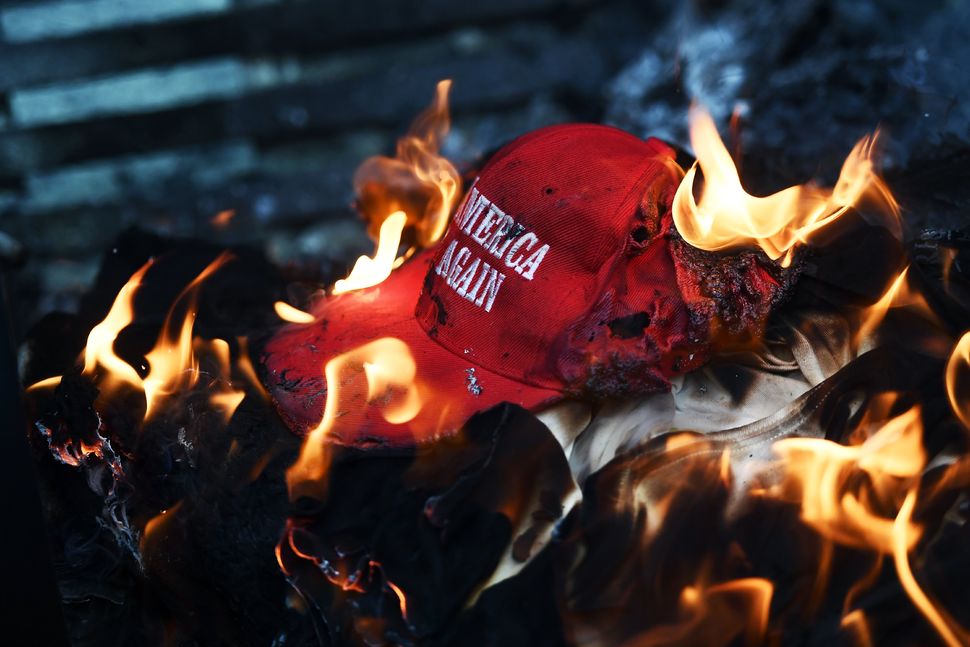
'Burning red "Make America Great Again" hats has become a symbol ofdispleasure with President Donald Trump's politics.'-
Quoted by Megan Trimble, Digital News Editor, U.S. NEWS. Photo:usnews.com
'Fire, pestilence and a country at war with itself'
'A pandemic unabated, an economy in meltdown, cities in chaos over police killings.
All our supposed leader does is tweet.'-Robert Reich
As Trump fled to his bunker in the White House to continue delighting the world with his silly, nonsensical tweets about how beautifully he is Making America Great Again, whilst the country is on fire burning down under the weight of inhumanity, injustice, extreme poverty and inequality, I came across a Blog from the GCGI archives, which I had posted just over 8 years ago on 1 May 2012 which brilliantly and so eloquently speaks volumes on the reasons for the decline of America and the rise of the extreme right wing, racist, xenophic politics and individuals, personified by the man in the bunker himself and his Grand Old Party.
I believe in the interest of the common good and a better understanding of why America has fallen to its nadir of decadence, we should revisit that Blog Again!
..But first a few heart-wrenching photos, depicting the tragedy of America that can never be great.
In yesteryears’ America
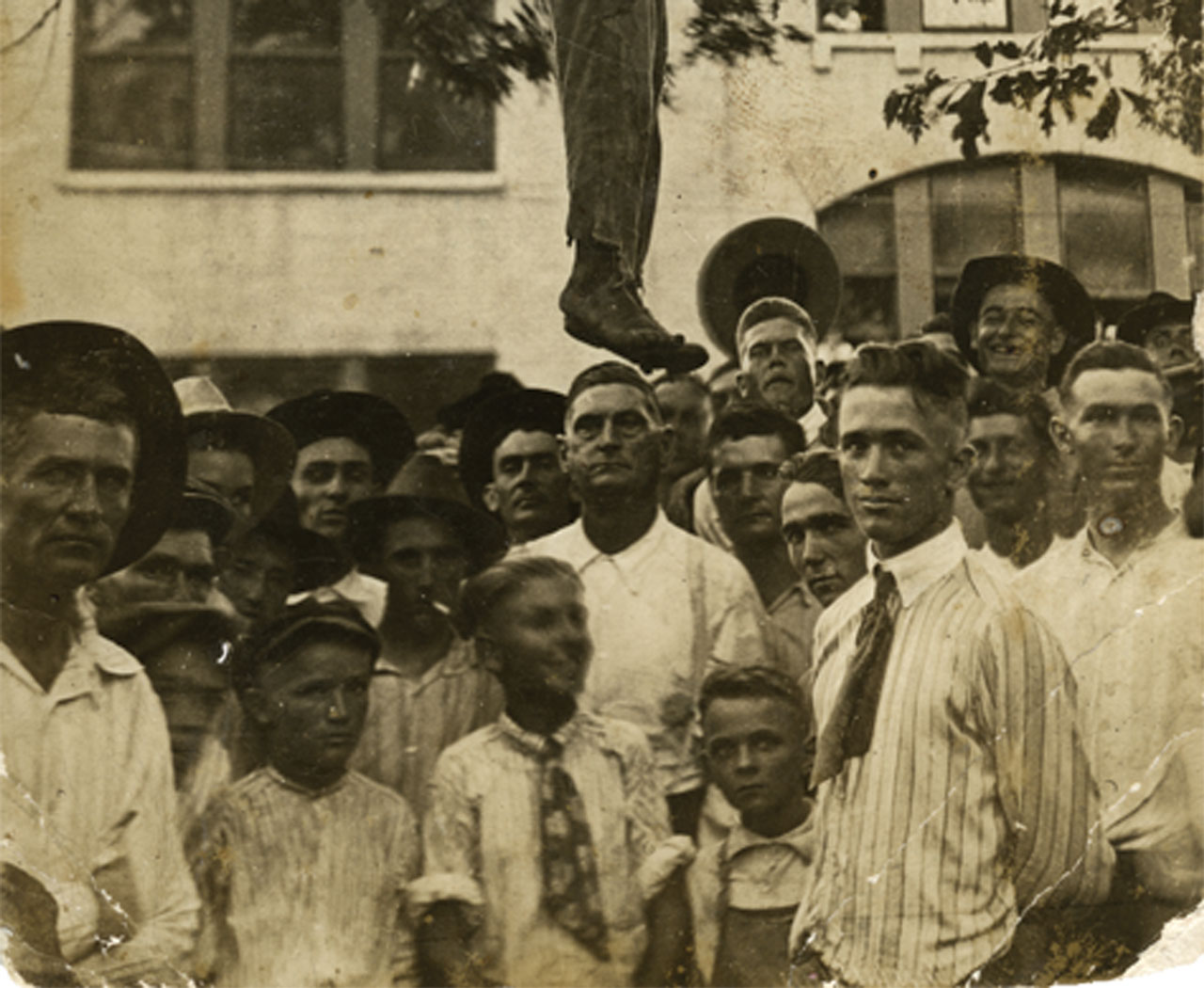
White men and boys pose beneath the body of Lige Daniels shortly after he was lynched
on August 3, 1920, in Center, Texas. Equal Justice Initiative.-
LYNCHING IN AMERICA: CONFRONTING THE LEGACY OF RACIAL TERROR
In 1919, the state failed to protect black Americans. A century later, it's still failing
How the USA's history has shaped today's police brutality The BBC
(George Floyd's name is the latest in a long list of African Americans to die as a result of racism and police brutality throughout the history of the United States.
The BBC's Clive Myrie, who has reported from the US for nearly 25 years, looks at how a toxic mix of racism and bad policing has led to the most serious racial unrest in the US for many years.)
In today’s America: 'I can't breathe'
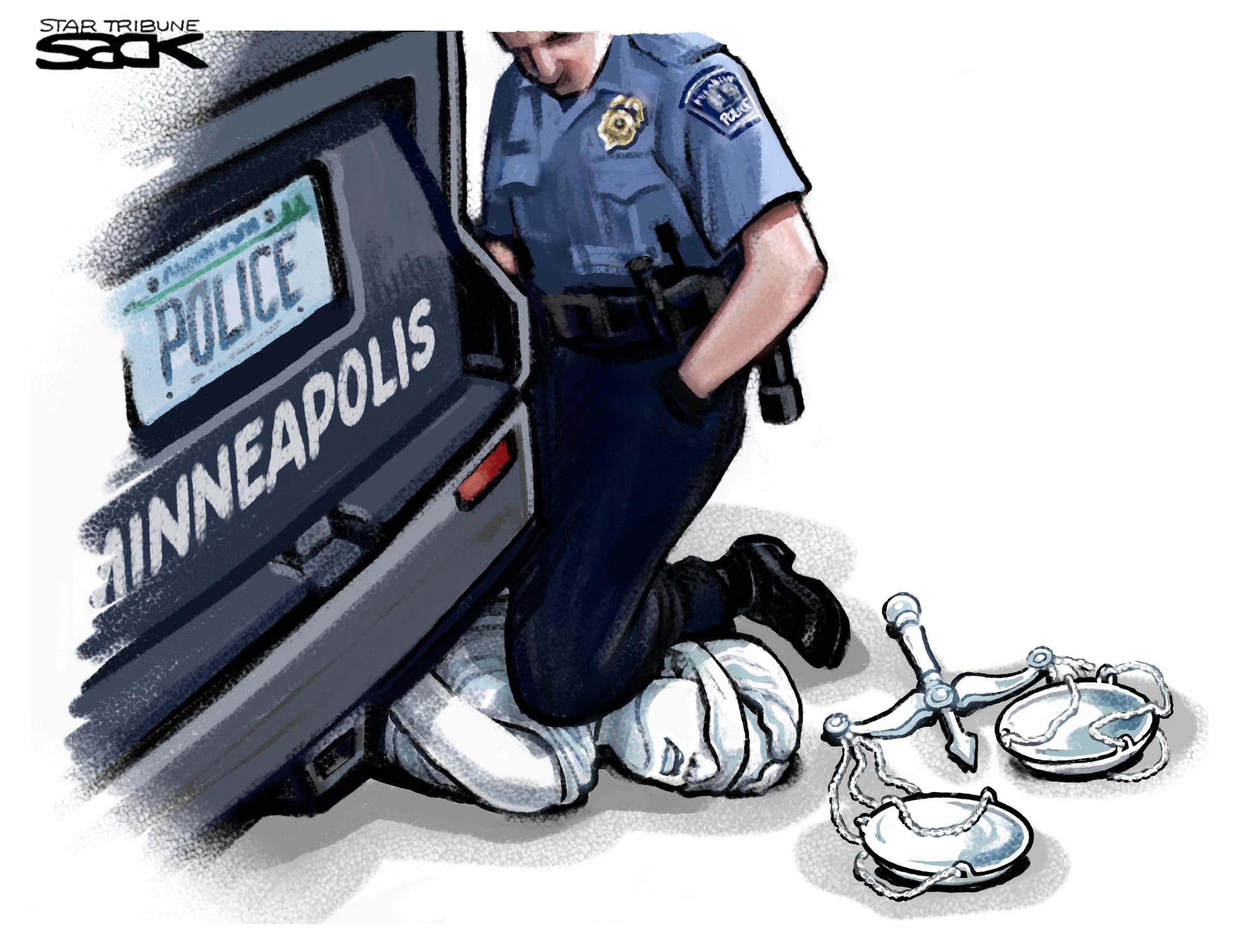
Drawing by Steve Sac, Star Tribune
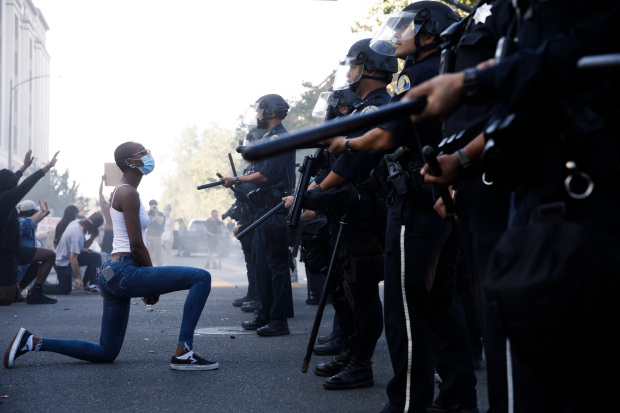
A protester takes a knee during at SanJose protest on Friday after GeorgeFloyd's death in Minneapolis.-
Photo: The Mercury News, Minneapolis
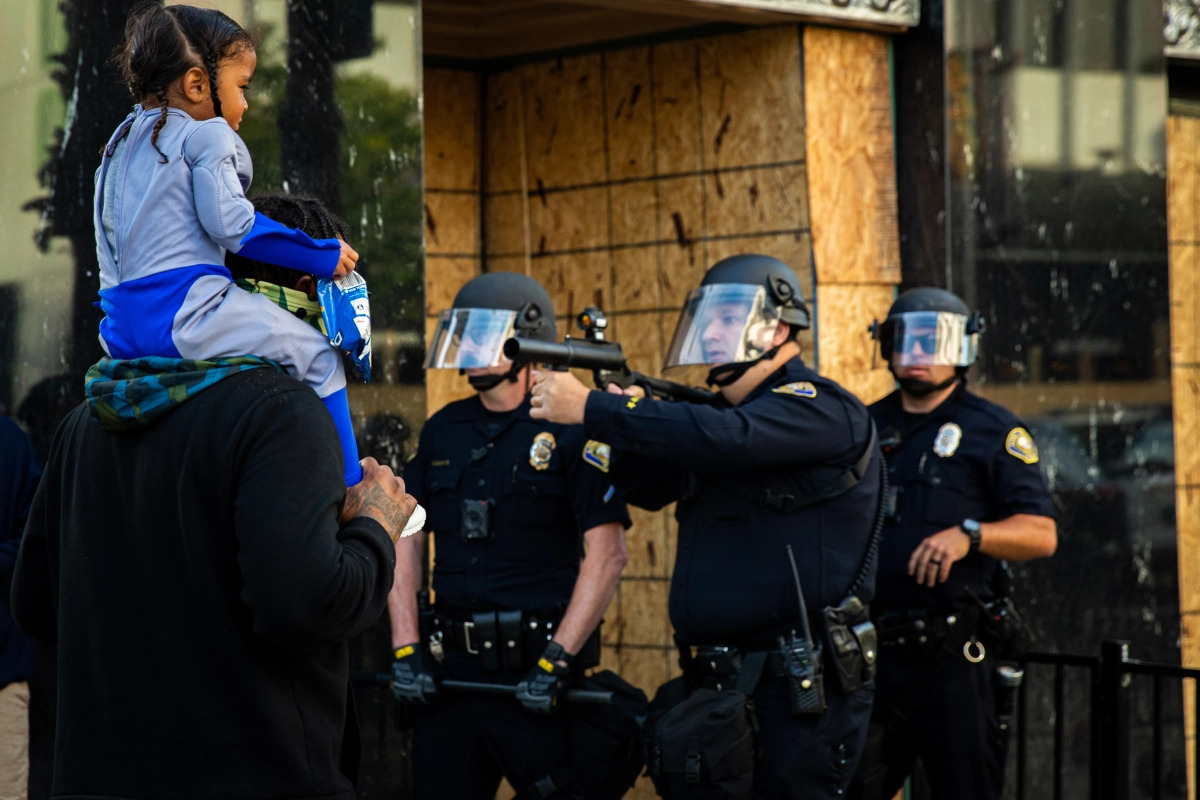
This photo was captured by freelance photographer Richard Grant on 1 June 2020 during a protest in
Long Beach, California against police violence and racial injustice in the days following the death of George Floyd.
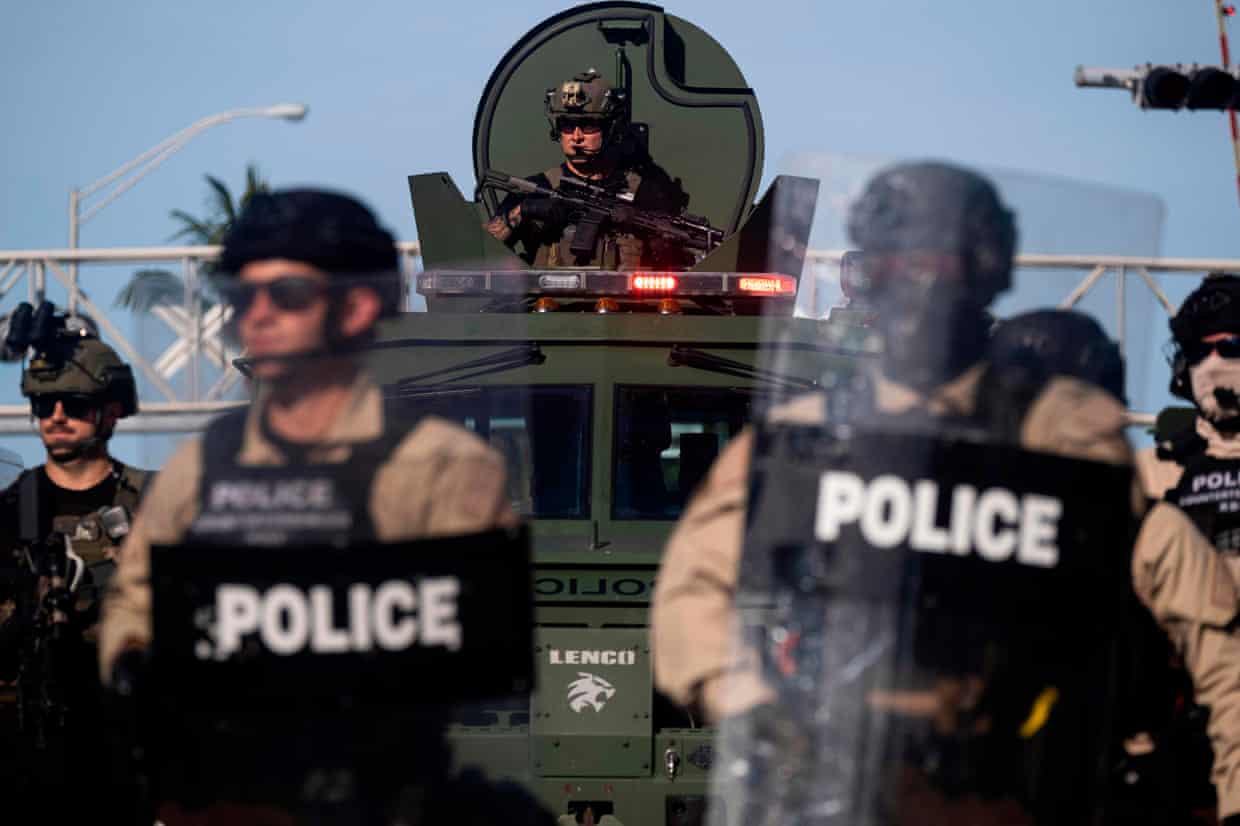
A Miami Police officer watches protesters from an armoured vehicle. Photo: Ricardo Arduengo/AFP/Getty Images
Why are some US police forces equipped like military units?
(Controversial programme allows access to military gear including armoured vehicles, helicopters and grenade launchers)
If you’re surprised by how the police are acting, you don’t understand US history
(Policing in America was never created to protect and serve the masses. It can’t be reformed because it is designed for violence)
America’s Raging Fire Against Racism, Inhumanity, Poverty and Injustice
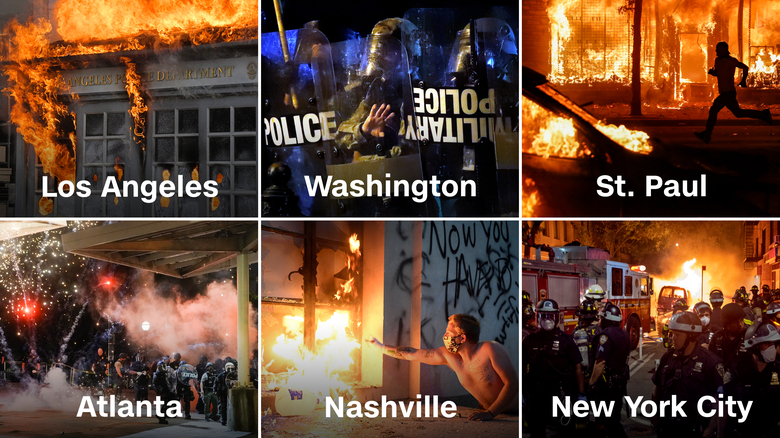
Photo:CNN.com
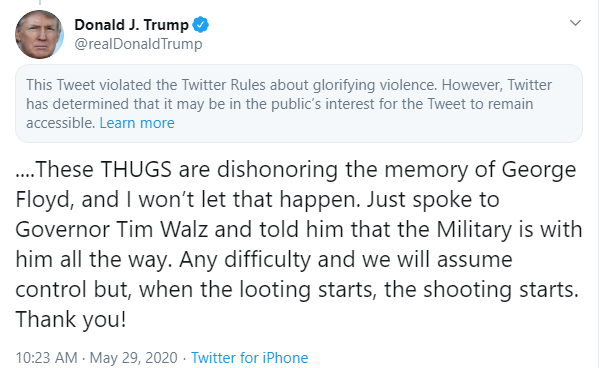
Trump Calls the US Protestors seeking Justice 'THUGS', ' and then sheds crocodile tears for protestors
in Hong Kong or Iran,for example. What a hypocrite!!
And Now: Why so much injustice, inhumanity, poverty, inequality, racism, conflicts, wars and ecological destruction, to name but a few?
The killing has highlighted links between racial injustice and economic inequality
Racism in the US is a 400-year old virus infecting the masses, and they have got no vaccine against it yet!!
America's 'shaky foundations'
"The land was stolen from native people, genocide was committed against the native people, and ancestors were stolen from Africa and brought here to work,"...
"So the foundation of the United States of America is genocide, stealing land and slavery.
"Any architect will tell you that if you don't have a strong foundation, the building's going to be shaky, and shaky from day one... This original sin has not been dealt with since the birth of this country."- Spike Lee, The BBC, 2 June 2020
And now to my mind, this historical inhumanity, namely, genocide, stealing (as well as abusing land) and slavery, is now being continued, augmented and enlarged by the racism and slavery of the so-called modern economics of neoliberalism.
It is all down to the cheating, lying, ignorance and arrogance of modern economics and the equally no good economists!
The Destruction of our World and the lies of Milton Friedman
The continuing and deepening tragedy of our world: Socialism & Freedom to Choose for the 1% , Capitalism, Slavery, Serfdom & Capitulation for the 99%, All thanks to the Lies of Milton Friendman and his likes
If, you, too, like me, are imagining a better life, a better world, a world of peace, harmony, fairness, kindness, generosity and the common good, then, we must expose and demolish Milton Friedman's Lies
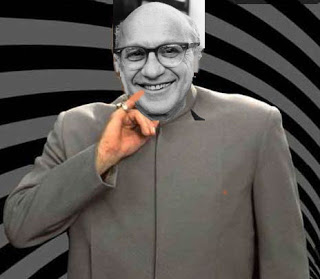
This is ‘Milton Friedman, The Liar’- 'Infamous Economic Dogmatist'-Photo: hubpages.com
The entire Blog can be read HERE
However, for the purpose of today’s reflection, I wish to recall excerpts on Milton Friendman’s ‘Economics Racism’.
The godfather of neoclassical economics ignored the market forces of discrimination and slavery.
'In a most illuminating article and discussion, ‘The White Ignorance of Milton Friedman’, the writer and historian, John Jackson, eloquently highlights Friedman’s economic racism, ignorance and bias for all to see.
Jackson has reminded us that Friedman, the so-called, a giant of economics, wrote a misguided history of capitalism’s relationship with racism and slavery. Friedman’s entire essay contained only one reference and that reference did not support anything Friedman claimed about how increasing property rights led to a decrease in racism and discrimination. I argued that Friedman was an example of an “imperial scholar” because he ignored the work of pioneering African-American scholars who offered better-documented and more insightful accounts of the relationship among property rights, race, and slavery.
Let Jackson to enlighten us a bit more:
‘Imperial Scholars and White Ignorance’
'White people have the luxury of not thinking about race if they don’t want to. Marginalized people, on the other hand, are forced to think about their own oppression all the time if they want to get by in the world. One way to think about this luxury is what philosopher Charles Mills calls “white ignorance.” In scholarship, one way the white ignorance is displayed is by white scholars, whom Critical Race Theorist Richard Delgado called “imperial scholars,” who ignore the scholarship of people of color. The poster child for white ignorance may well be Milton Friedman.
Milton Friedman was one of the most famous economists of the twentieth century. The leading light of the “Chicago School of Economics,” the most influential economics department in the world, Nobel prize-winner in Economics in 1976. If there were an All-Star team of economists, Friedman would be in the starting line-up. My view of him was nicely summarized by Murray Rothbard in 1964: “I am getting pretty p.o.’ed at the influence of that little bastard anyway; he is the No.1 respectable right-wing economist in Newsweek and Business Week, and Goldwater’s chief economic theoretician.” (Rothbard to James Martin, Martin Papers, University of Wyoming).
My focus is on Friedman’s chapter on “Capitalism and Discrimination” in his 1962 book, Capitalism and Freedom a book that has gone through several editions and is still in print. (How much would you pay for the first edition? Wrong! It is way more than that!). Friedman’s views on racial discrimination reflect a profound ignorance of how race operates in the world. This ignorance was inexcusable in 1962 and the fact that Friedman did not revise these views in the 1982 or 2002 editions show the pernicious power of his ideology which blinded him to the racial reality of the world.
Friedman’s description of race relations rests on two assumptions. The first is that racial animosity is simply a “taste,” not unlike my love of pizza topped with Canadian bacon and sauerkraut (it is awesome, try it!). Here he states his position:
How the Myth of Self-interest & Selfishness Caused the Global Crisis
...‘The financial crisis should teach us some important lessons about the way economies work and the way we design our organizations. In essence, we have simply made the wrong assumptions about human nature. The leading model in economic theory is that of Homo Economicus, a person who makes decisions based on their rational self-interest. Led by an invisible hand, that of the market, the pursuit of self-interest automatically produces the best outcomes for everyone. Looking at the financial crisis today this idea is no longer tenable. When individual greed dominates, everyone suffers. We could have known this all along had we looked more closely at human evolution.’
However, given the disastrous and tragic consequences of Homo Economicus Model of selfinterst, which leads to severe forms of competition between individuals and firms, which will in due course, leads to severe forms of anxiety, fear, worthlessness and hopelessness for all the practitioners, ‘A team of evolutionary minded psychologists, biologists and economists led by biologist David Sloan Wilson and economist John Gowdy have come together over the past few years to come up with a more accurate model for how businesses and economies operate. It is based on Homo Sapiens rather than Homo Economics.
These scientists assert that humans have truly cooperative instincts which they developed over hundreds of thousands of years living and working in highly cohesive groups. The best survival strategy for our ancestors was to cooperate with each other and to suppress individual greed and selfishness that was good for the individual but harmful to the group. All the empirical evidence shows if the conditions are right, individuals happily work together to create highly effective organizations that look after the common good.
Homo Sapiens is the only viable model of organizational life and to deny this, is to deny human nature.
‘Unfortunately, the way many firms operated in the early 21st century was to deny these cooperative instincts. People who were recruited to the top jobs in banks and utility companies were selected for their ambition and lust for money. As if led by an invisible hand, they would do things that were good for the company or society as a whole. We have seen all too well where this ended.
For instance, inspired by neo-economic theory (neoclassical economics) and persuaded by leading consultancy firms such as McKinsey, Enron organized their famous Talent days where they would recruit the sharpest and most competitive students from prestigious MBA programs without any regard for their cooperative skills and moral standards (this is sadly not generally taught in MBA programs). No surprise that there was a culture of competition, deception, and greed at Enron and no surprise the firm went down in a spectacular way. Banks, firms, and even entire nations have gone bankrupt because they perpetuated the myth of self-interest, while denying human social instincts. It is time for a paradigm shift in economics, and business science and policy.’...Read more
The Inhumanity & Immorality of Neoclassical Economics as depicted in Neoliberalism
Was the Rise of Neoliberalism the Root Cause of Extreme Inequality?
Neoliberalism: do you know what it is? This is the Question!
'Neoliberalism: ‘It has played a major role in a remarkable variety of crises: the financial meltdown of 2007‑8, the offshoring of wealth and power, of which the Panama Papers offer us merely a glimpse, the slow collapse of public health and education, resurgent child poverty, the epidemic of loneliness, the collapse of ecosystems, the rise of Donald Trump. But we respond to these crises as if they emerge in isolation, apparently unaware that they have all been either catalysed or exacerbated by the same coherent philosophy; a philosophy that has – or had – a name. What greater power can there be than to operate namelessly?
...‘Neoliberalism sees competition as the defining characteristic of human relations. It redefines citizens as consumers, whose democratic choices are best exercised by buying and selling, a process that rewards merit and punishes inefficiency. It maintains that “the market” delivers benefits that could never be achieved by planning.
Attempts to limit competition are treated as inimical to liberty. Tax and regulation should be minimised, public services should be privatised. The organisation of labour and collective bargaining by trade unions are portrayed as market distortions that impede the formation of a natural hierarchy of winners and losers. Inequality is recast as virtuous: a reward for utility and a generator of wealth, which trickles down to enrich everyone. Efforts to create a more equal society are both counterproductive and morally corrosive. The market ensures that everyone gets what they deserve.
We internalise and reproduce its creeds. The rich persuade themselves that they acquired their wealth through merit, ignoring the advantages – such as education, inheritance and class – that may have helped to secure it. The poor begin to blame themselves for their failures, even when they can do little to change their circumstances.
Never mind structural unemployment: if you don’t have a job it’s because you are unenterprising. Never mind the impossible costs of housing: if your credit card is maxed out, you’re feckless and improvident. Never mind that your children no longer have a school playing field: if they get fat, it’s your fault. In a world governed by competition, those who fall behind become defined and self-defined as losers.
Among the results, as Paul Verhaeghe documents in his book What About Me? are epidemics of self-harm, eating disorders, depression, loneliness, performance anxiety and social phobia. Perhaps it’s unsurprising that Britain, in which neoliberal ideology has been most rigorously applied, is the loneliness capital of Europe. We are all neoliberals now.
The term neoliberalism was coined at a meeting in Paris in 1938. Among the delegates were two men who came to define the ideology, Ludwig von Mises and Friedrich Hayek. Both exiles from Austria, they saw social democracy, exemplified by Franklin Roosevelt’s New Deal and the gradual development of Britain’s welfare state, as manifestations of a collectivism that occupied the same spectrum as nazism and communism.
In The Road to Serfdom, published in 1944, Hayek argued that government planning, by crushing individualism, would lead inexorably to totalitarian control. Like Mises’s book Bureaucracy, The Road to Serfdom was widely read. It came to the attention of some very wealthy people, who saw in the philosophy an opportunity to free themselves from regulation and tax. When, in 1947, Hayek founded the first organisation that would spread the doctrine of neoliberalism – the Mont Pelerin Society – it was supported financially by millionaires and their foundations.
With their help, he began to create what Daniel Stedman Jones describes inMasters of the Universe as “a kind of neoliberal international”: a transatlantic network of academics, businessmen, journalists and activists. The movement’s rich backers funded a series of think tanks which would refine and promote the ideology. Among them were the American Enterprise Institute, the Heritage Foundation, the Cato Institute, the Institute of Economic Affairs, the Centre for Policy Studies and the Adam Smith Institute. They also financed academic positions and departments, particularly at the universities of Chicago and Virginia.
As it evolved, neoliberalism became more strident. Hayek’s view that governments should regulate competition to prevent monopolies from forming gave way – among American apostles such as Milton Friedman– to the belief that monopoly power could be seen as a reward for efficiency.
Something else happened during this transition: the movement lost its name. In 1951, Friedman was happy to describe himself as a neoliberal. But soon after that, the term began to disappear. Stranger still, even as the ideology became crisper and the movement more coherent, the lost name was not replaced by any common alternative.
At first, despite its lavish funding, neoliberalism remained at the margins. The postwar consensus was almost universal: John Maynard Keynes’s economic prescriptions were widely applied, full employment and the relief of poverty were common goals in the US and much of western Europe, top rates of tax were high and governments sought social outcomes without embarrassment, developing new public services and safety nets.
But in the 1970s, when Keynesian policies began to fall apart and economic crises struck on both sides of the Atlantic, neoliberal ideas began to enter the mainstream. As Friedman remarked, “when the time came that you had to change … there was an alternative ready there to be picked up”. With the help of sympathetic journalists and political advisers, elements of neoliberalism, especially its prescriptions for monetary policy, were adopted by Jimmy Carter’s administration in the US and Jim Callaghan’s government in Britain.
After Margaret Thatcher and Ronald Reagan took power, the rest of the package soon followed: massive tax cuts for the rich, the crushing of trade unions, deregulation, privatisation, outsourcing and competition in public services. Through the IMF, the World Bank, the Maastricht treaty and the World Trade Organisation, neoliberal policies were imposed – often without democratic consent – on much of the world. Most remarkable was its adoption among parties that once belonged to the left: Labour and the Democrats, for example. As Stedman Jones notes, “it is hard to think of another utopia to have been as fully realised.”
It may seem strange that a doctrine promising choice and freedom should have been promoted with the slogan “there is no alternative”. But, as Hayek remarked on a visit to Pinochet’s Chile – one of the first nations in which the programme was comprehensively applied – “my personal preference leans toward a liberal dictatorship rather than toward a democratic government devoid of liberalism”. The freedom that neoliberalism offers, which sounds so beguiling when expressed in general terms, turns out to mean freedom for the pike, not for the minnows.
Freedom from trade unions and collective bargaining means the freedom to suppress wages. Freedom from regulation means the freedom to poison rivers, endanger workers, charge iniquitous rates of interest and design exotic financial instruments. Freedom from tax means freedom from the distribution of wealth that lifts people out of poverty.
As Naomi Klein documents in The Shock Doctrine, neoliberal theorists advocated the use of crises to impose unpopular policies while people were distracted: for example, in the aftermath of Pinochet’s coup, the Iraq war and Hurricane Katrina, which Friedman described as “an opportunity to radically reform the educational system” in New Orleans.
Where neoliberal policies cannot be imposed domestically, they are imposed internationally, through trade treaties incorporating “investor-state dispute settlement”: offshore tribunals in which corporations can press for the removal of social and environmental protections. When parliaments have voted to restrict sales of cigarettes, protect water supplies from mining companies, freeze energy bills or prevent pharmaceutical firms from ripping off the state, corporations have sued, often successfully. Democracy is reduced to theatre.
Another paradox of neoliberalism is that universal competition relies upon universal quantification and comparison. The result is that workers, job-seekers and public services of every kind are subject to a pettifogging, stifling regime of assessment and monitoring, designed to identify the winners and punish the losers. The doctrine that Von Mises proposed would free us from the bureaucratic nightmare of central planning has instead created one.
Neoliberalism was not conceived as a self-serving racket, but it rapidly became one. Economic growth has been markedly slower in the neoliberal era (since 1980 in Britain and the US) than it was in the preceding decades; but not for the very rich. Inequality in the distribution of both income and wealth, after 60 years of decline, rose rapidly in this era, due to the smashing of trade unions, tax reductions, rising rents, privatisation and deregulation.
The privatisation or marketisation of public services such as energy, water, trains, health, education, roads and prisons has enabled corporations to set up toll booths in front of essential assets and charge rent, either to citizens or to the government, for their use. Rent is another term for unearned income. When you pay an inflated price for a train ticket, only part of the fare compensates the operators for the money they spend on fuel, wages, rolling stock and other outlays. The rest reflects the fact that they have you over a barrel.
Those who own and run the UK’s privatised or semi-privatised services make stupendous fortunes by investing little and charging much. In Russia and India, oligarchs acquired state assets through firesales. In Mexico, Carlos Slim was granted control of almost all landline and mobile phone services and soon became the world’s richest man.
Financialisation, as Andrew Sayer notes in Why We Can’t Afford the Rich, has had a similar impact. “Like rent,” he argues, “interest is … unearned income that accrues without any effort”. As the poor become poorer and the rich become richer, the rich acquire increasing control over another crucial asset: money. Interest payments, overwhelmingly, are a transfer of money from the poor to the rich. As property prices and the withdrawal of state funding load people with debt (think of the switch from student grants to student loans), the banks and their executives clean up.
Sayer argues that the past four decades have been characterised by a transfer of wealth not only from the poor to the rich, but within the ranks of the wealthy: from those who make their money by producing new goods or services to those who make their money by controlling existing assets and harvesting rent, interest or capital gains. Earned income has been supplanted by unearned income.
Neoliberal policies are everywhere beset by market failures. Not only are the banks too big to fail, but so are the corporations now charged with delivering public services. As Tony Judt pointed out in Ill Fares the Land, Hayek forgot that vital national services cannot be allowed to collapse, which means that competition cannot run its course. Business takes the profits, the state keeps the risk.
The greater the failure, the more extreme the ideology becomes. Governments use neoliberal crises as both excuse and opportunity to cut taxes, privatise remaining public services, rip holes in the social safety net, deregulate corporations and re-regulate citizens. The self-hating state now sinks its teeth into every organ of the public sector.
Perhaps the most dangerous impact of neoliberalism is not the economic crises it has caused, but the political crisis. As the domain of the state is reduced, our ability to change the course of our lives through voting also contracts. Instead, neoliberal theory asserts, people can exercise choice through spending. But some have more to spend than others: in the great consumer or shareholder democracy, votes are not equally distributed. The result is a disempowerment of the poor and middle. As parties of the right and former left adopt similar neoliberal policies, disempowerment turns to disenfranchisement. Large numbers of people have been shed from politics.
Chris Hedges remarks that “fascist movements build their base not from the politically active but the politically inactive, the ‘losers’ who feel, often correctly, they have no voice or role to play in the political establishment”. When political debate no longer speaks to us, people become responsive instead to slogans, symbols and sensation. To the admirers of Trump, for example, facts and arguments appear irrelevant.
Judt explained that when the thick mesh of interactions between people and the state has been reduced to nothing but authority and obedience, the only remaining force that binds us is state power. The totalitarianism Hayek feared is more likely to emerge when governments, having lost the moral authority that arises from the delivery of public services, are reduced to “cajoling, threatening and ultimately coercing people to obey them”.
Like communism, neoliberalism is the God that failed. But the zombie doctrine staggers on, and one of the reasons is its anonymity. Or rather, a cluster of anonymities.
The invisible doctrine of the invisible hand is promoted by invisible backers. Slowly, very slowly, we have begun to discover the names of a few of them. We find that the Institute of Economic Affairs, which has argued forcefully in the media against the further regulation of the tobacco industry, has been secretly funded by British American Tobacco since 1963. We discover that Charles and David Koch, two of the richest men in the world, founded the institute that set up the Tea Party movement. We find that Charles Koch, in establishing one of his think-tanks, noted that “in order to avoid undesirable criticism, how the organisation is controlled and directed should not be widely advertised”.
The words used by neoliberalism often conceal more than they elucidate. “The market” sounds like a natural system that might bear upon us equally, like gravity or atmospheric pressure. But it is fraught with power relations. What “the market wants” tends to mean what corporations and their bosses want. “Investment”, as Sayer notes, means two quite different things. One is the funding of productive and socially useful activities, the other is the purchase of existing assets to milk them for rent, interest, dividends and capital gains. Using the same word for different activities “camouflages the sources of wealth”, leading us to confuse wealth extraction with wealth creation.
A century ago, the nouveau riche were disparaged by those who had inherited their money. Entrepreneurs sought social acceptance by passing themselves off as rentiers. Today, the relationship has been reversed: the rentiers and inheritors style themselves entrepreneurs. They claim to have earned their unearned income.
These anonymities and confusions mesh with the namelessness and placelessness of modern capitalism: the franchise model which ensures that workers do not know for whom they toil; the companies registered through a network of offshore secrecy regimes so complex that even the police cannot discover the beneficial owners; the tax arrangements that bamboozle governments; the financial products no one understands.
The anonymity of neoliberalism is fiercely guarded. Those who are influenced by Hayek, Mises and Friedman tend to reject the term, maintaining – with some justice – that it is used today only pejoratively. But they offer us no substitute. Some describe themselves as classical liberals or libertarians, but these descriptions are both misleading and curiously self-effacing, as they suggest that there is nothing novel about The Road to Serfdom, Bureaucracy or Friedman’s classic work, Capitalism and Freedom.
For all that, there is something admirable about the neoliberal project, at least in its early stages. It was a distinctive, innovative philosophy promoted by a coherent network of thinkers and activists with a clear plan of action. It was patient and persistent. The Road to Serfdom became the path to power.
Neoliberalism’s triumph also reflects the failure of the left. When laissez-faire economics led to catastrophe in 1929, Keynes devised a comprehensive economic theory to replace it. When Keynesian demand management hit the buffers in the 70s, there was an alternative ready. But when neoliberalism fell apart in 2008 there was … nothing. This is why the zombie walks. The left and centre have produced no new general framework of economic thought for 80 years.
Every invocation of Lord Keynes is an admission of failure. To propose Keynesian solutions to the crises of the 21st century is to ignore three obvious problems. It is hard to mobilise people around old ideas; the flaws exposed in the 70s have not gone away; and, most importantly, they have nothing to say about our gravest predicament: the environmental crisis. Keynesianism works by stimulating consumer demand to promote economic growth. Consumer demand and economic growth are the motors of environmental destruction.
What the history of both Keynesianism and neoliberalism show is that it’s not enough to oppose a broken system. A coherent alternative has to be proposed. For Labour, the Democrats and the wider left, the central task should be to develop an economic Apollo programme, a conscious attempt to design a new system, tailored to the demands of the 21st century.’ -George Monbiot, Neoliberalism – the ideology at the root of all our problems
The above excerpts are taken from: The Destruction of our World and the lies of Milton Friedman
...And finally, the fundamental question at this moment is: can the United States be reformed?
The answer to my mind is an emphatic NO, unless the following is understood and addressed accordingly:
To reverse this destructive path we need a different model of education and we need a different economic value and economy. However, these are not possible to achieve so long as The Fraudulent Ideology reins supreme. Full stop. Carpe Diem!
Why Love, Trust, Respect and Gratitude Trumps Economics
See also:
"Sharing the Wisdom, Shaping the Dream:
Reclaiming the Moral and Spiritual Roots of Economics and Capitalism"
By The Reverend Canon Dr. Vincent Strudwick
And
Wisdom and the Well-Rounded Life: What Is a University?
- Details
- Written by: Kamran Mofid
- Hits: 2108
Trust is the essence of life and leadership to build a better world for all
...and when that trust is broken all is lost it's all over
Life loses its meaning and purpose
Dominic Cummings’ actions damage public trust
‘We are in a public health crisis unprecedented in living memory. We have written to the prime minister because we are very concerned for the safety and wellbeing of the public. There is ample evidence that effective epidemic control requires the public to trust and respect both the messages and the messengers who are advocating action. This trust has been badly damaged by the actions of Dominic Cummings, including his failure to stand down or resign in the public interest, and Boris Johnson’s subsequent unwillingness to remove him.
As lockdown is eased, public trust and high compliance is essential to reduce the risk of a second spike in infections and deaths. It is vital for all people in positions of power to follow the rules with the same discipline as the rest of the population. The public also needs to see that the necessary infrastructure and effective systems are put in place rapidly and effectively…’-Excerpts from The Letter to the Observer (Sunday 31 May 2020) and signed by 26 senior UK academics and health administrators. Read the full letter and see the signatories HERE
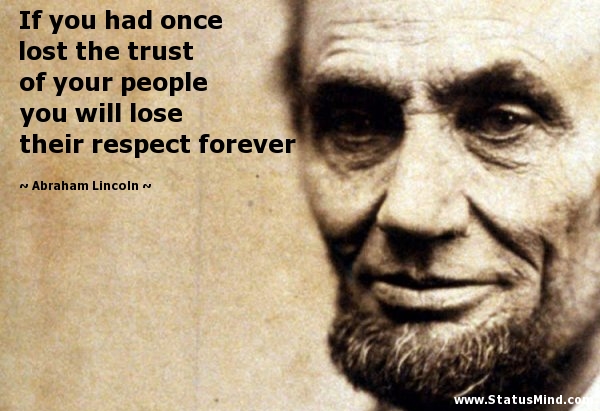
How can we live and lead a good life when we can trust no one and no one trusts us? Or, is life possible or meaningful without trust? Let me explain a bit more:
As it has been observed time and again, “Trust is the treasure of our daily lives. However, we do not understand its value. It is generally seen that trust in our daily lives is disappearing fast.
"Trust in each other gives strength and vitality to our relationships. It gives us inner happiness, which is priceless. It brings joy all around and life appears brighter and brighter. Its fragrance spreads far and wide. Trust keeps us in a positive mental framework. When you trust each other you feel self-confident. The feeling of believing others is electrifying. It not only provides a sense of security, but provides new zeal to fight the vagaries of life. Trusting each other gives us a sense of deep bonding. It signifies that we are united to fight the battles ahead. Trust is a synonym for warmth in our relationships.
"With so many advantages of trusting each other, how do we feel when germs of mistrust appear?"...Crisis in Trust and Perpetual Global Crisis
The Covid-19 outbreak has exposed deep-rooted weaknesses in the UK’s institutions and most tragically, once again, it has highlighted the collapse in trust between the rulers and the ruled.
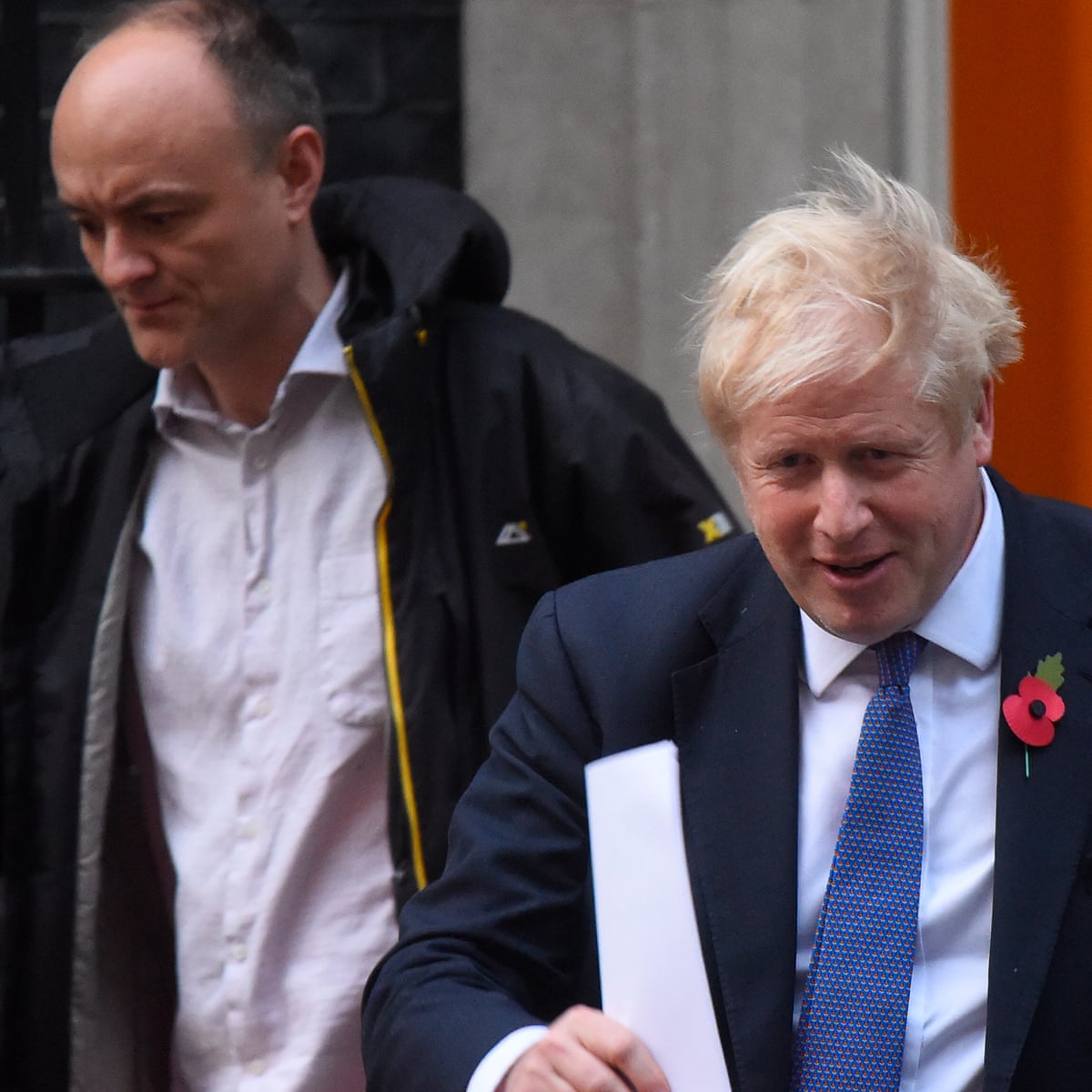
Photo: The Guardian
‘The Irish Times columnist Fintan O'Toole nailed it this week when he observed that Johnson and Cummings made the people who placed trust in them feel like fools: "As the Catholic Church found in Ireland, people don't forgive violation of the sense of meaning that gives dignity to their own sufferings."- Quoted by Paola Totaro, The Sunday Morning Herald
‘’The great populist fallacy is that all a leader needs to claim consent is to win an occasional election. Then anything goes. Philosophers from John Locke to John Stuart Mill have stressed that democracy also requires a continuing contract, in which the state receives the trust of the people by trusting them in turn, rather than enslaving them.’- Simon Jenkins, ‘Britain's double shame: coronavirus deaths and economic collapse.’
‘Trust is the most precious commodity in any walk of life. The baleful fact is that the British government, in the midst of a profound and unprecedented crisis, is led by a man, and the party faction he represents, who cannot be trusted.
The atmosphere in No 10 is reported to be rancorous. Ministers, officials and special advisers are mutually suspicious. The prime minister, never a man for detail, habitually relies on foppish charm, wordplay and a ruthless readiness to make or drop any promise if it serves his interest. Whatever else this gang inspires, it’s neither loyalty nor trust…
In short, we need good government by politicians who believe in it and understand the profundity of that responsibility. Good government is not achieved by half-truths, dissimulation and jokes. Johnson and his flyblown Brexity Tories are demonstrating, as Britain’s death rate begins to exceed Italy’s, that they are not the people for the task. The question is not if, but when the government accepts that its old faiths have died – and not if, but when it is forced aside by those who understand we need to trust our rulers.’- Will Hutton, ‘Trust is essential in these times. But Boris Johnson is not a man to be trusted’
‘The taint of Cummings’ behaviour has spread to every cabinet minister who defended him, telling the nation that Dom’s only crime was loving his family too much – and so implicitly telling every Briton who obeyed the rules that they loved their family too little. Each one of them is shrunk by this.
Naturally, the politician most wounded is Johnson. He has insulted the very people who voted for him last December, whether one-time Labour voters or lifelong Tories. Anyone who followed the rules has reason to be livid. No wonder one Tory MP, a former minister, told me in despair this week: “This is a cabinet of fools led by a hollow narcissist who is nothing without his svengali.”...
…’Which brings us to the real victims of Cummings’ actions. Not him or his bosses and their political careers – but the British people. What Cummings did wrecked public trust, turning us cynical about instructions from those in charge. Public trust is not merely a political commodity: in a pandemic, it is an essential public health resource. And now it has been badly depleted.
So when the health secretary, Matt Hancock, tells Britons it is their “civic duty” to isolate if they’re identified as a contact of someone who’s tested positive, the natural impulse will be to laugh in his face. Civic duty indeed. Tell that to Cummings. Now an essential public health message has to be qualified and caveated to accommodate Cummings’ behaviour. Isolate – unless your “instincts” say otherwise. Isolate – unless childcare gets a bit tricky. It doesn’t quite carry the same force, does it?’...Jonathan Freedland, ‘Dominic Cummings and Boris Johnson have wrecked something precious’
The pertinent question in everybody’s mind surely must be: How will we ever recover from the coronavirus crisis if we can’t trust Boris Johnson and his equally untrustworthy front team to do the right thing for us?
‘Trust in government is crucial if we expect citizens and businesses to respond to public policies that aim to lift us out of the lockdown and put us on the road to recovery.
If we don’t trust the Government to do the right thing, we won’t have the confidence to return to work, school or the high street.
Trust and confidence matters. It matters because it saves lives in the middle of a public health emergency. It matters because we all have to work together as we lift the restrictions and try to get back to normal.
A lack of trust and confidence in the Government costs jobs, profits and growth – causing deep economic scarring beyond the public health crisis that need not have been the case.’...- Darren Jones is the Labour MP for Bristol North West and the Chair of the Business, Energy and Industrial Strategy Select Committee, Continue to read
The end of trust in our political class and their brand of populism

Photo:trusttour.org
The erosion of trust is not an illusion.
‘We all depend on our social, business, financial, and political affairs, on a shared currency of trust. But we have somehow devalued this currency and breaches of public trust have recently grown to epidemic proportions.’+
Yes. This is very true: The more I read, the more I investigate and research, the more I discover that, all over the world, there is no trust in anything or anybody any more. No trust in politics and politicians, no trust in the media, education, lawyers, police, army and the judiciary, medicine and the medical profession, business and finance, banks and insurance, food, food-processing, supermarkets and agriculture, as well as all sorts of tradesmen and traders, and God forbid, even religion and charities. Do I need to mention more! This, I am sure, resonates with so many people around the world.
Brand trust is disappearing fast as ‘We no longer enjoy high levels of confidence in fellow citizens, much less social institutions, and are increasingly skeptical of those holding positions of authority.’
‘Trust is a public virtue in that it is a property or characteristic that communities need to possess in order to function well. Trust among members of a community facilitates exchange among individuals and social interaction. In this sense, trust can be understood as an aretaic (“virtuous”) property that contributes to the well-being or excellence of a community in the same way that virtues are understood as properties or character traits that contribute to individual flourishing.’
‘Simply put, to live in a community where people render aid to strangers without fear of suffering harm requires us not only to condemn violations of this norm but to offer assistance when we can, even in the face of uncertainty. If we do not engage one another in a trusting and trustworthy manner, we fail to maintain a community that reflects these values, and we diminish our ability to flourish both individually and collectively.’- To read more and note the original source/s of the quotes above see: Crisis in Trust and Perpetual Global Crisis
The pertinent question at this point is: How can we reverse the current trends and have trust again?
To reverse this destructive path we need a different model of education and we need a different economic value and economy. However, these are not possible to achieve so long as The Fraudulent Ideology reins supreme. Full stop. Carpe Diem!
Why Love, Trust, Respect and Gratitude Trumps Economics
See also:
"Sharing the Wisdom, Shaping the Dream:
Reclaiming the Moral and Spiritual Roots of Economics and Capitalism"
By The Reverend Canon Dr. Vincent Strudwick
And
Wisdom and the Well-Rounded Life: What Is a University?
...And in conclusion, given what has been written about TRUST in this Blog, we should see the article below which was first noted in a GCGI Blog on 12 June 2019: Britain today and the Bankruptcy of Ideas, Vision and Values-less Education
I was Boris Johnson’s boss: he is utterly unfit to be prime minister
An article by Max Hastings*
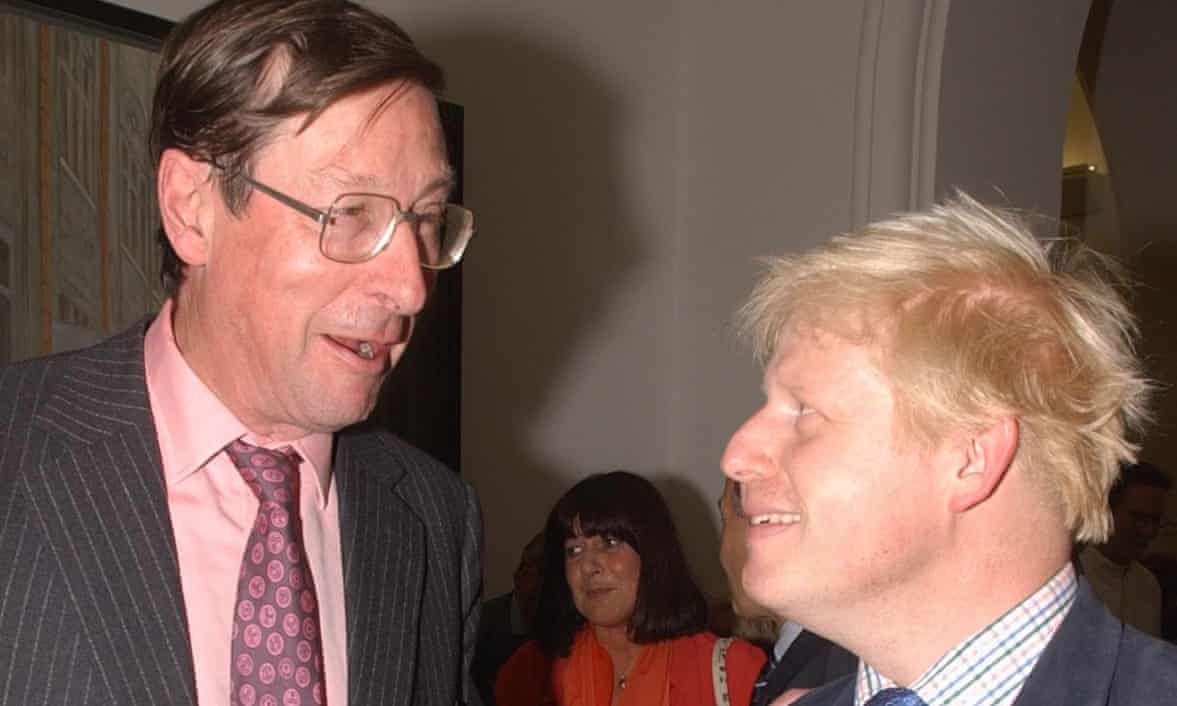
Boris Johnson with Max Hastings in 2002. Photo: Nigel Howard/ANL/Rex Features, via The Guardian
‘The Tory party is about to foist a tasteless joke upon the British people. He cares for nothing but his own fame and gratification’
‘He would not recognise the truth, whether about his private or political life, if confronted by it in an identity parade.’
‘Six years ago, the Cambridge historian Christopher Clark published a study of the outbreak of the first world war, titled The Sleepwalkers. Though Clark is a fine scholar, I was unconvinced by his title, which suggested that the great powers stumbled mindlessly to disaster. On the contrary, the maddest aspect of 1914 was that each belligerent government convinced itself that it was acting rationally.
It would be fanciful to liken the ascent of Boris Johnson to the outbreak of global war, but similar forces are in play. There is room for debate about whether he is a scoundrel or mere rogue, but not much about his moral bankruptcy, rooted in a contempt for truth. Nonetheless, even before the Conservative national membership cheers him in as our prime minister – denied the option of Nigel Farage, whom some polls suggest they would prefer – Tory MPs have thronged to do just that.
I have known Johnson since the 1980s, when I edited the Daily Telegraph and he was our flamboyant Brussels correspondent. I have argued for a decade that, while he is a brilliant entertainer who made a popular maître d’ for London as its mayor, he is unfit for national office, because it seems he cares for no interest save his own fame and gratification.
Tory MPs have launched this country upon an experiment in celebrity government, matching that taking place in Ukraine and the US, and it is unlikely to be derailed by the latest headlines. The Washington Post columnist George Will observes that Donald Trump does what his political base wants “by breaking all the china”. We can’t predict what a Johnson government will do, because its prospective leader has not got around to thinking about this. But his premiership will almost certainly reveal a contempt for rules, precedent, order and stability.
A few admirers assert that, in office, Johnson will reveal an accession of wisdom and responsibility that have hitherto eluded him, not least as foreign secretary. This seems unlikely, as the weekend’s stories emphasised. Dignity still matters in public office, and Johnson will never have it. Yet his graver vice is cowardice, reflected in a willingness to tell any audience, whatever he thinks most likely to please, heedless of the inevitability of its contradiction an hour later.
Like many showy personalities, he is of weak character. I recently suggested to a radio audience that he supposes himself to be Winston Churchill, while in reality being closer to Alan Partridge. Churchill, for all his wit, was a profoundly serious human being. Far from perceiving anything glorious about standing alone in 1940, he knew that all difficult issues must be addressed with allies and partners.
Churchill’s self-obsession was tempered by a huge compassion for humanity, or at least white humanity, which Johnson confines to himself. He has long been considered a bully, prone to making cheap threats. My old friend Christopher Bland, when chairman of the BBC, once described to me how he received an angry phone call from Johnson, denouncing the corporation’s “gross intrusion upon my personal life” for its coverage of one of his love affairs.
“We know plenty about your personal life that you would not like to read in the Spectator,” the then editor of the magazine told the BBC’s chairman, while demanding he order the broadcaster to lay off his own dalliances.
Bland told me he replied: “Boris, think about what you have just said. There is a word for it, and it is not a pretty one.”
He said Johnson blustered into retreat, but in my own files I have handwritten notes from our possible next prime minister, threatening dire consequences in print if I continued to criticise him.
Johnson would not recognise truth, whether about his private or political life, if confronted by it in an identity parade. In a commonplace book the other day, I came across an observation made in 1750 by a contemporary savant, Bishop Berkeley: “It is impossible that a man who is false to his friends and neighbours should be true to the public.” Almost the only people who think Johnson a nice guy are those who do not know him.
There is, of course, a symmetry between himself and Jeremy Corbyn. Corbyn is far more honest, but harbours his own extravagant delusions. He may yet prove to be the only possible Labour leader whom Johnson can defeat in a general election. If the opposition was led by anybody else, the Tories would be deservedly doomed, because we would all vote for it. As it is, the Johnson premiership could survive for three or four years, shambling from one embarrassment and debacle to another, of which Brexit may prove the least.
For many of us, his elevation will signal Britain’s abandonment of any claim to be a serious country. It can be claimed that few people realised what a poor prime minister Theresa May would prove until they saw her in Downing Street. With Boris, however, what you see now is almost assuredly what we shall get from him as ruler of Britain.
We can scarcely strip the emperor’s clothes from a man who has built a career, or at least a lurid love life, out of strutting without them. The weekend stories of his domestic affairs are only an aperitif for his future as Britain’s leader. I have a hunch that Johnson will come to regret securing the prize for which he has struggled so long, because the experience of the premiership will lay bare his absolute unfitness for it.
If the Johnson family had stuck to showbusiness like the Osmonds, Marx Brothers or von Trapp family, the world would be a better place. Yet the Tories, in their terror, have elevated a cavorting charlatan to the steps of Downing Street, and they should expect to pay a full forfeit when voters get the message. If the price of Johnson proves to be Corbyn, blame will rest with the Conservative party, which is about to foist a tasteless joke upon the British people – who will not find it funny for long.’
*Max Hastings is a former editor of the Daily Telegraph and the London Evening Standard
This article by Max Hastings was first published in the Guardian on Monday 24 June 2019
- The Tragedy of Health and Social Care Failings in our Privatised and Monetised World
- The Global Tragedy of Care for the Elderly: When Caring and Empathy becomes a Business for Profit, then, even a Caring Country Fails Miserably
- Way before there was Canada, there was Tahltan People. We need their wisdom now more than ever before
- This resonates with me, it is my blueprint too, hope it is yours also
- Sermon of Hope This Sunday: ‘This pandemic sends me back in time, and I learn a fine lesson from my father.’