The country star best known for his many great songs, such as I Believe In You, My Best Friend, Good Ole Boys Like Me, Tulsa Time and many more, as well as his laid-back demeanor died on Friday following a short illness at his home in Alabama.
I was very sad to hear of the passing of Don Williams. I must admit, I very much liked his voice, music, songs, the lyrics, as well as the way he projected peacefulness, contentment, and being at ease with oneself.
Before I share more about Don Williams, I wish to share a personal story.
I few year back, I wanted to get something speacil for my wife’s birthday. I was wondering what? I was looking for a meaningful gift, not just a dinner and wine and the red rose! I wanted to tell her she is MY Best Friend!
Then, I heard that Don Williams was touring England and very close to Annie's Birthday he was going to be at Birmingham Symphony Hall. The rest is history. I got the tickets. We went to the concert and Don so beautifully sang my favorite song: You're My Best Friend
Music is manna for the soul, and nectar for the spirit."
‘The health of the physical body is inextricably tied to our emotional, mental and spiritual health. Music is a powerful catalyst for healing because it touches the very core of humanity... our souls. With music, we can remember our connection to the Creator and the powerful Healer within. We can take control of our health and our lives as we enjoy the healing sound of music.’-A Path with Heart
On Friday his publicist confirmed Williams, who was known as “the Gentle Giant” because of his easygoing temperament, died after a short illness.
Williams had 17 No 1 hits in the US and was inducted into theCountry Music Hall of Fame in 2010, before he retired in 2016. Williams was known for his rich voice, gentle delivery and storytelling style. He toured sparingly, did few media interviews and spent much of his time on his farm west of Nashville.
His career started as a musician in Portland, a city he moved to from his native Texas, where he was born in 1939. He moved to Nashville in the late 60s and wrote songs for some of country’s biggest names, including “Cowboy” Jack Clement.
“It’s one of those blessings and curses kind of things,” Williams said in an interview with the Associated Press in 1994. “There’s very few things in my life that I’ve done that come anywhere close to making you feel exhilarated and humbled and fulfilled and challenged and all that, all at the same time.”
His hits included I Believe in You, Lord, I Hope This Day Is Good, You’re My Best Friend, Some Broken Hearts Never Mend, and Till the Rivers All Run Dry. Eric Clapton recorded his We’re More Than Friends and Pete Townshend redid his Til the Rivers All Run Dry.
“Don Williams offered calm, beauty, and a sense of wistful peace that is in short supply these days,” said Kyle Young, CEO of the Country Music Hall of Fame in a statement on Friday. “His music will forever be a balm in troublesome times.”*
*Excerpts above are from The Guardian, Saturday 9 September 2017
A brief introductory remarks by Prof. Kamran Mofid, Founder, Globalisation for the Common Good Initiative (GCGI) and Co-founder and Associate Director (1996-1999), Centre for the Study of Forgiveness and Reconciliation at Coventry University
Forgiveness and Reconciliation: The Keystones of Human Values
"We cannot change the past, but we can change our attitude toward it. Uproot guilt and plant forgiveness. Tear out arrogance and seed humility. Exchange love for hate --- thereby, making the present comfortable and the future promising."- Maya Angelou
Ambassadors’ Lecture Series: A bird’s eye view
In 1986 I was awarded my PhD in Economics at University of Birmingham and soon after I was appointed full-time senior lecturer at the Department of Economics at Coventry Polytechnic (now University).
At an international conference in London in 1986, I met the then director of the Anglo-Japanese Economic Institute, Mr. George Bull. We became very good friends. Indeed, George was like a father figure to me- a source of wisdon and inspiration. He introduced me to Japan and to many Japanese friends and facilitated some of my trips to Japan. We did many national and international conferences together, including: Japan and the U.K. Economy; Forgiveness and Reconciliation; NAFTA and the EU; Japan and the Global Economy; and Iran and the Emerging Global Order, all held at Coventry University.
We also together - in association with and supported by the University, the Cathedral and the City Council - instigated and co-founded the Centre for the Study of Forgiveness and Reconciliation at Coventry University and as part of its work, in association with the Ambassadors’ Lecture Series, which we had co- founded already, invited international speakers including the former presidents of Ireland and South Africa, namely, Mrs. Mary Robinson, and F.W. de Klerk to deliver lectures at Coventry Cathedral. Moreover, we also invited other international speakers including Ambassadors of Japan, Germany, Italy, Egypt, Mexico and the High Commissioner of Canada to deliver lectures on the need for dialogue and mutual respect amongst different cultures and civilisations at Coventry’s St. Mary’s Guildhall.
The Ambassadors’ Lecture Series aimed at enabling the ambassadors a frank exposition of their respective countries’ policies to a far wider audience in search of better understanding of why particular nations and peoples have acted in certain ways and what changes are desirable and feasible in different nations’ aims and attitudes.
The anniversary of the end of the Second World War, the Pacific War, made the decision of the Ambassador of Japan to accept our invitation to give the very first Ambassador’s Lecture especially significant and timely.
Remembering an extraordinary and inspiring day, 11 March 1996, when President Mary Robinson came to Coventry, the first visit to Coventry by an Irish President
“I am deeply honoured to have been invited to inaugurate your Centre for the Study of Forgiveness and Reconciliation with this lecture, and to act as the Centre’s Patron.” -Mary Robinson, President of Ireland
I remember this day very affectionately, with pride and honour. A few months earlier, George Bull and I had sent a letter, if my memory serves me right, through the Irish Ambassador in London (a close personal friend of George) to President Robinson, inviting her to deliver the inaugural lecture of the Centre for the Study of Forgiveness and Reconciliation, and to act as the Centre’s Patron.
Then, on 12 January 1996 I received a fax from the Irish Embassy in London with the most pleasing and wonderful news, that President Mary Robinson has most graciously accepted our invitation to come to Coventry, to deliver the inaugural lecture of the Centre for the Study of Forgiveness and Reconciliation, and to act as the Centre’s Patron.
In early 1997, George and I submitted a letter of invitation to former President F. W. de Klerk of South Africa, to give the Second Lecture of the Centre at Coventry Cathedral.
was delighted and honoured when a few weeks later I received a fax that he had graciously accepted our invitation, and on 2 September 1997 Mr de Klerk came to Coventry, delivering his timely lecture “Principles of Forgiveness and Reconciliation” at the Cathedral.
Life is so full of unpredictable beauty and strange surprises
As many people, wiser than me have noted, our lives and the world in which we all live, are so unpredictable. Things happen suddenly, unexpectedly. We want to feel we are in control of our own existence. In some ways we are, in some ways we're not ... Life, it can bring you so much joy and yet at the same time cause so much pain.
I was so devastated that after this wonderful journey, full of joy and happiness, achievements and success, due to some reasons beyond my control, I started to feel unwell, unhappy, not enjoying what I was doing and teaching, especially when I lost all confidence in the value of moral-free economics that I was teaching my students, and more.
In 1999 I voluntarily resigned from my post at Coventry University. It goes without saying that, I was heartbroken and extremely hurt that I was unable to nurture and develop further what I had envisioned and built.
Looking back, reflecting on what has happened, I think, somehow, somebody, somewhere, had planned it so that I, too, should have a life, similar to the life of Coventry itself: fall and rise again, a topic to which I will return in the second part of "My Coventry Story", covering 2000-2017.
Once again, thank you Coventry, my Coventrian friends, the sources of my inspiration and strength. I cannot tell you how grateful I am to you all.
For a fuller and more detailed explanation of the story behind the establishment of the Centre for the Study of Forgiveness and Reconciliation see:
Coventry City of Peace, Forgiveness and Reconciliation
'Father Forgive’: Coventry Cathedral and my life’s journey of discovery
This is the Story of a Boy from Iran who became a Man in Coventry
Text of a presentation given in St Michael’s House, Coventry Cathedral on 26 July 2017 by Professor Kamran Mofid
“To be a person is to have a story to tell.” — Isak Dinesen
“So, you’re a Silicon Valley billionaire and you’ve already got the private plane. What you need next is a philosophy, something to live by, and to help finance, and—most important—to use to explain or justify yourself. Don’t just grab the next philosophy to come along. Chances are that will be Ayn Rand and her extreme form of capitalism, which she called objectivism.”
'The Obscure Economist Silicon Valley Billionaires Should Dump Ayn Rand For'
'He lived almost 200 years ago, but Henry George’s theories might have something to offer people who want to put their money to good use today.'
argues Vanity Fair columnist Michael Kinsley
Before sharing this interesting article with you, I would very much like to briefly share a bit of my own story of when and how I got to know Henry George.
For knowing George, I owe a debt of gratitude to my friend, editor and publisher, Anthony Werner, Editor-in-Chief, Shepheard-Walwyn. I think the best I can do to say more about this, is to quote a passage or two, from a Blog I had written a few years back:
“In my journey and search for wisdom, I have been extremely blessed with finding some wonderful friends, friends that have inspired me and have made me a happier, and I hope, a better person. I thank them all for who I am and what I do. One of those friends is Anthony Werner, Editor-in-Chief, Shepheard-Walwyn Publishers (SWP), London.
Whilst at Plater College, in Oxford in early 2000s studying for a diploma in pastoral theology in my quest and search for life’s bigger picture, I happened to see an advertisement for one of SWP’s titles, The Natural Economy in The Tablet. Anthony had quoted a remarkable statement from the book:
‘A true grasp of how the economyshould be constituted shows it to be a thing of harmony and beauty, all its parts cooperating for the common good, and its inbuilt laws distributing benefits equitably.’
This must have struck a chord with me, because I immediately ordered a copy. Having read it, I ordered two or three more different titles and then, some months, later I went to London to see Anthony. I opened my heart to him. I told Anthony that, despite having taught economics for over twenty years, I was unaware that such a body of knowledge existed.
We chatted and chatted for a long time. I left his office a different man and a different economist. I then sent Anthony a manuscript, the fruit of my new thinking about economics. Anthony published it in 2002 as Globalisation for the Common Good.”...Continue to read
Anyhow, Anthony and I had many discussions about many engaging topics. Economic freedom, social justice, welfare of humanity, Land Value Tax (LVT), Henry George and his life journey and story, as I recall, were amongst the most interesting subjects we talked about.
Having told my Henry George story, I am now pleased to share with you, Michael Kinsley’s reflection on George and the Silicon Valley:
Photo:hgchicago.org
“So, you’re a Silicon Valley billionaire and you’ve already got the private plane. What you need next is a philosophy, something to live by, and to help finance, and—most important—to use to explain or justify yourself. Don’t just grab the next philosophy to come along. Chances are that will be Ayn Rand and her extreme form of capitalism, which she called objectivism.
Rand has a lot going for her, to be sure. First, you may have actually read her in high school and may have been genuinely influenced. Second, in a nutshell, she rationalizes greed, which you have nothing against. Third, she was into mildly kinky sex—something else you may have in common. Fourth, she was associated in some way you don’t quite follow with Alan Greenspan, who is respectability itself, whatever other Rand enthusiasts may have been up to.
But you’re too late. Ayn Rand, who never was really undiscovered (The Fountainhead became a movie, starring Gary Cooper as a heroic architect, a few years after it was published), has by now been thoroughly re-discovered. According to James Stewart (the prominent business journalist, not the even more prominent actor), writing in The New York Times, PresidentTrump says Ayn Rand is his favorite writer and that The Fountainhead, her pulmonary embolism of a book, is his favorite novel. Travis Kalanick, the onetime Übermensch ofUber, is on board, as is (liberal foodies, please note) John Mackey, co-founder and C.E.O. of Whole Foods.
My dear billionaire, you need an economist almost no one has heard of. One who addressed the most pressing problems of today, which do not include the insufficient greed of rich people. But one who was not completely out of sympathy with rich people, either.
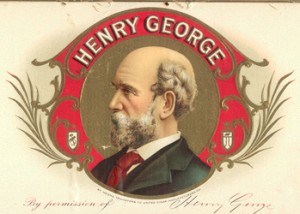
May I nominate Henry George (1839–97)—economist, pamphleteer, journalist? Once famous, he is now widely forgotten. He described himself as a man who came out of the great American West, which he did—but only after he got there via Philadelphia, where he was born. He later moved to New York City, ran for mayor, and attracted 10,000 people to a political rally (but lost nonetheless). He made the best-ever short defense of free trade: You wouldn’t fill your harbor with rocks to keep out goods your citizens want to buy, would you? Well, that’s what you’re doing when you slap tariffs on imports.
"One cannot imagine a more beautiful combination of intellectual keenness, artistic form and fervent love of justice. Every line is written as if for our generation."- Albert Einstein on Henry George
George’s masterwork, published in 1879, was Progress and Poverty, which set forth to explain how “increase of want” could go hand in hand with “increase of wealth.” Thus George took on precisely the question we face today: not the general question of poverty or inequity, but why specifically are middle-class incomes stagnating, and incomes of people at the bottom falling, while those at the top continue to rise?
George was no vulgar Marxist. You might call him a “supply-side socialist.” All products of the economy, he reasoned, are ultimately derived from three sources: labor, capital, and land. What else is there? Labor and capital are both productive. Put them to work and you end up with more. But land is different. As the man said, “They aren’t making any more of it.” When you work for an hour, you increase society’s wealth (and your own) by an hour’s worth of wages. When you save a dollar rather than spending it, you increase society’s (and your own) wealth by a dollar. But when you buy a piece of land for $10,000 and sell it for $20,000, you haven’t increased the total wealth of society by a nickel. Yet the price of land keeps going up, up, up, as the population increases and society grows richer. Where does that money come from? It comes from the pockets of the other two factors of production, labor and capital.
George distinguished, in other words, between the capitalist who is truly productive and the capitalist who is simply a “landlord.” If you’re a landlord, he wrote, “you need do nothing more. You may sit down and smoke your pipe; you may lie around like the lazzaroni of Naples or the leperos of Mexico; you may go up in a balloon or down a hole in the ground; and without doing one stroke of work, without adding one iota to the wealth of the community, in ten years you will be rich! In the new city you may have a luxurious mansion; but among its public buildings will be an almshouse.”
And how is all this talk of leperos and almshouses relevant today? You’ve got to think of “land” as a metaphor for all unproductive forms of capitalism. Much of the financial industry, for example: hedge funds, private equity, I.P.O.’s and I.R.A.’s. Some might defend finance as an industry that makes the making of what other industries make more efficient. But when you read that Goldman Sachs is getting some enormous fee for fuck-all or that two companies are merging that unmerged a few years ago and will unmerge again in a few years, you gotta wonder.
Take a look at the Forbes 400 list. The No. 1 slot has been occupied for many years by Bill Gates, co-founder of Microsoft. As it happens, Microsoft and Gates are a notable exception: Gates grew rich the traditional way, producing real products that people were willing to pay for. But, as Forbes admits, 93 of the Forbes 400 made their money by just playing with money: “All together this group is worth a combined $491 billion—20% of the Forbes 400’s total $2.4 trillion net worth.”
Government licenses confer monopolies all over the economy, but no place more than in the media. Start with Comcast, the beloved cable company. Real estate itself—which, remember, they’re not making any more of—represents $129 billion of the wealth in the Forbes 400. Simple inheritance (the most efficient method of becoming rich) is a non-trivial source of wealth. The members of the Walton family on the list—heirs of Walmart’s founders—are by themselves worth $123 billion.
Henry George believed that the landlord’s share of wealth that all of us have helped to accumulate is inherently illegitimate and should be confiscated. He wouldn’t send in the National Guard to seize people’s property. He would instead confiscate the value of unimproved land—that is, land that had not been improved by, say, building on it—by taxing its annual value at a rate of 100 percent.
“But,” you’re thinking, “that would make the property itself worthless.” (“That’s not what I’m thinking,” says Arianna, mysteriously.) Well, you’re right. Making the property worthless is the whole idea. Society gets the value of the property. Taxes on the other factors of production—labor and capital—can be reduced, or even eliminated. This is why people who are dedicated to promoting George’s ideas are known as “single-taxers.”
The landlord will have little choice but to put the property to its “highest and best use.” This raises another difficulty with George’s idea: we no longer believe—or at least we no longer assume—that the “highest and best use” of a piece of land is to throw up another reflective-glass skyscraper. “Highest and best use” is a legal term that doesn’t distinguish between “use” that is the most profitable and “use” that is best for society. Jane Jacobs won that battle. And, anyway, today’s landlords probably paid full price for their monopolies. The people who originally benefited from the monopoly have long since disappeared with their ill-gotten gain. So there would be practical problems figuring out what is taxed, and by how much.
But George got the main things right. Free markets are best (provided they are really free). A lot of markets that masquerade as free really aren’t. And we often tax the wrong things—ignoring wealth that accomplishes nothing while taxing labor and capital that are actually productive. After his book came out, Henry George was the most famous economist in the world for a while. The Thomas Piketty or John Kenneth Galbraith of his time. An intellectual with star quality, and total conviction of the rightness of his argument. He probably thought he would be famous forever. He was wrong about that.
This article was first published in VANITY FAIR, 1 September 2017
GCGI is our journey of hope and the sweet fruit of a labour of love. It is free to access, and it is ad-free too. We spend hundreds of hours, volunteering our labour and time, spreading the word about what is good and what matters most. If you think that's a worthy mission, as we do—one with powerful leverage to make the world a better place—then, please consider offering your moral and spiritual support by joining our circle of friends, spreading the word about the GCGI and forwarding the website to all those who maybe interested.