
- Details
- Written by: Kamran Mofid
- Hits: 3983
*(A note from Kamran Mofid: Recently I posted a Blog about the Silicon Valley and Henry George-This is how Silicon Valley may become a force for good: Dump Ayn Rand and embrace Henry George
Anthony Werner told me that he really liked the article. So, I then, asked him to consider writing a follow up. I am delighted that he agreed.)
Would Henry George’s ‘Remedy’ help us combat today’s global crises?
Anthony Werner, Editor-in-Chief, Shepheard-Walwyn Publishers, London, UK
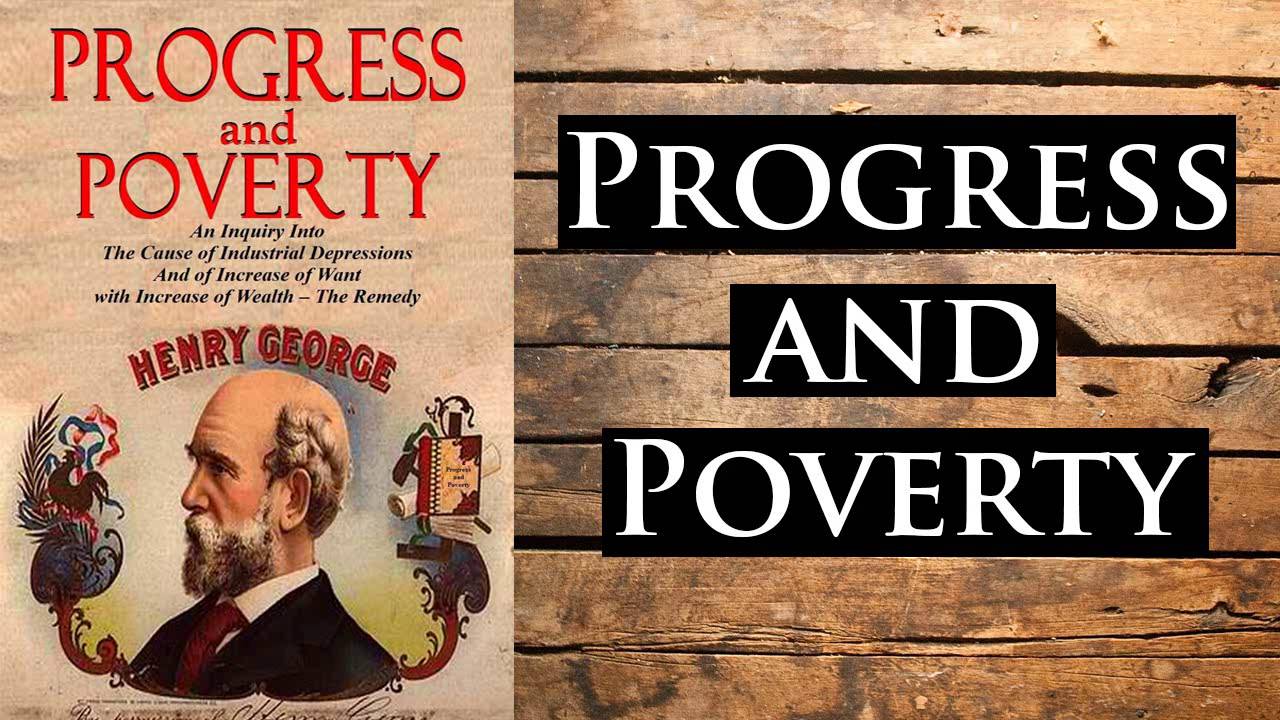
Photo:bing.com
In Progress and Poverty[1] Henry George sought the ‘cause of industrial depressions and the increase of want with the increase of wealth’ and offered a ‘remedy’ which remains as relevant to the problems of poverty and inequality we face today, as when he first wrote, but it also opens a new way of dealing with environmental pollution.
To understand the relevance of the ‘remedy’ we need to understand what causes poverty and inequality. The cause is institutionalised, just as slavery once was. As Mandela pointed out in his Trafalgar Square speech in 2005: 'Like slavery and apartheid, poverty is not natural. It is man-made and it can be overcome and eradicated by the actions of human beings.'
What is the institution that makes poverty inevitable? Adam Smith described it very succinctly in The Wealth of Nations:
‘As soon as land becomes private property, the landlord demands a share of almost all the produce which the labourer can either raise, or collect from it. His rent makes the first deduction from the produce of the labour which is employed upon land.’[2]
More recently (27th Dec 2009) in the Financial Times John Kay wrote:
‘You can become wealthy by creating wealth or by appropriating the wealth created by other people. When the appropriation of the wealth is illegal it is called theft or fraud. When it is legal economists call it rent-seeking.’
But, economists will say, private property in land is essential for economic development. Without security of tenure, nobody is going to invest in sowing crops or building a business. As Hernando de Soto pointed out in The Mystery of Capital[3] economic success has everything to do with the legal structure of property and property rights.
At the end of the 19th century there was growing friction between industrialists and workers over pay, and the appalling conditions under which so many workers lived was troubling the conscience of society. This prompted Pope Leo XIII in 1891 to issue his encyclical Rerum Novarum, ‘to refute false teaching ... in the interest of the Church and the commonweal ... [He] thought it useful to speak on the condition of labour ... [and] to treat expressly and at length, in order that there may be no mistake as to the principles which truth and justice dictate[4] for its settlement.’
He acknowledged that it is not easy ‘to define the relative rights and the mutual duties of the wealthy and the poor, of capital and labour’, but notes that ‘by degrees it has come to pass that working men have been given over, isolated and defenceless, to the callousness of employers, and the greed of unrestrained competition ... so that a small number of very rich men have been able to lay upon the masses of the poor a yoke little better than slavery itself.’
‘To remedy these evils the Socialists[5], working on the poor man’s envy of the rich, endeavour to destroy private property, and maintain that individual possessions should become the property of all, to be administered by the State or by municipal bodies. They hold that, by thus transferring property from private persons to the community, the present evil state of things will be set to rights’. The Pope argued that these proposals are ‘unjust, because they would rob the lawful possessor, bring the State into a sphere that is not its own, and cause complete confusion.’ History has demonstrated the shortcomings of the Communist experiment in the Soviet Union.
He goes on: ‘It is surely undeniable that, when a man engages in remunerative labour, the very reason and motive of his work is to obtain property, and to hold it as his own private possession. If a man hires out his strength or industry, he does this for the purpose of receiving in return what is necessary for food and living ...Thus, if he lives sparingly, saves money, and invests his savings, for greater security, in land, the land in such a case is only his wages in another form; and, consequently, a workingman’s little estate thus purchased should be as completely at his own disposal as the wages he receives for his labour. But it is precisely in this power of disposal that ownership consists, whether the property be land or movables.’ A bit further on the Pope repeats: ‘Hence man not only can possess the fruits of the earth, but also the earth itself’.
While George agreed that the fruit of a person’s labour belongs to them, he takes issue with the Pope over the morality of land ownership in an open letter.[6] He begins: ‘Your Holiness: I have read with care your Encyclical letter on the condition of labour, addressed ... to the Christian World.
‘Since the most strikingly pronounced condemnations are directed at a theory that we, who hold it, know to be worthy of your support, I ask permission to lay before your Holiness the grounds of our belief and to set forth some considerations you have unfortunately overlooked.
The momentous seriousness of the facts you refer to, the poverty, suffering and seething discontent that pervade the Christian world, the danger that passion may lead ignorance in a blind struggle against social conditions rapidly becoming intolerable, are my justification.
‘Our postulates are all implied in your Encyclical. They are the primary perceptions of human reason, the fundamental teachings of the Christian Faith: We hold that:
‘This world is the creation of God. The men brought into it for the brief period of their earthly lives are the equal creatures of His bounty, the equal subjects of His provident care.
By his constitution man is beset by physical wants, on the satisfaction of which depend not only the maintenance of his physical life but also the development of his intellectual and spiritual life.
God made the satisfaction of these wants dependent on man’s own exertions, giving him the power and laying on him the injunction to labour – a power that of itself raises him far above the brute, since we may reverently say that it enables him to become, as it were, a helper in the creative work.
God has not put on man the task of making bricks without straw. With the need for labour and the power to labour, He has also given man the material for labour. This material is land – man physically being a land animal, who can live only on and from land, and can use other elements, such as air, sunshine and water, only by the use of land.
Being the equal creatures of the Creator, equally entitled under His providence to live their lives and satisfy their needs, men are equally entitled to the use of the land, and any adjustment that denies this equal use of land is morally wrong.
Being created individuals, with individual wants and powers, men are individually entitled ... to the use of their own powers and the enjoyment of the results.
There thus arises, anterior to human law, and deriving its validity from the law of God, a right of private ownership in things produced by labour – a right that the possessor may transfer, but of which to deprive him without his will is theft.
This right of property, originating in the right of the individual to himself, is the only full and complete right of property. It attaches to things produced by labour, but cannot attach to things produced by God.’
Unfortunately, the encyclical remains the basis of Catholic social teaching to this day, thus supporting the status quo, but it is at odds with St Gregory the Great (Pope 590-604):
‘Those who make private property of the gift of God pretend in vain to be innocent, for in thus retaining the subsistence of the poor they are the murderers of those who die every day for want of it.’[7]
In 1881, a contemporary of Henry George, Dr Thomas Nulty, Bishop of Meath in Ireland, came independently to recognise the injustice of the private ownership of land and called in a pastoral letter for a radical reform of the Irish land tenure system. He acknowledged that evil social institutions had long endured - the slave owner's right of property was regarded as sacred as any other property right - but the world’s approval, the bishop argued, could not justify injustice. The death knell of slavery was only sounded when public attention was fixed on the intrinsic nature of slavery. Then it was no longer acceptable.
History has shown that land enclosure creates two classes in society, the landowners and the landless. The latter can only live by paying a rent to the former for the right to use land which is God’s gift to all humanity. The landowner is thus in receipt of an unearned income simply because society permits land to be owned, just as it once permitted slaves to be owned. Adam Smith was in no doubt about the effect: the landowner ‘acts always as a monopolist, and extracts the greatest rent which can be got for the use of his ground’.[8] Winston Churchill was even more explicit:
‘No matter where you look or what examples you select, you will see every form of enterprise, every step in material progress, is only undertaken after the land monopolist has skimmed the cream for himself, and everywhere today the man or the public body that wishes to put land to its highest use is forced to pay a preliminary fine in land values to the man who is putting it to an inferior one, and in some cases to no use at all.
All comes back to land value, and its owner is able to levy a toll upon all other forms of wealth and every form of industry. A portion, in some cases the whole, of every benefit which is laboriously acquired by the community increases the land value and finds its way automatically into the landlord's pocket. If there is a rise in wages, rents are able to move forward, because the workers can afford to pay a little more. If the opening of a new railway or new tramway, or the institution of improved services, of a lowering of fares, or of a new invention, or any other public convenience affords a benefit to workers in any particular district, it becomes easier for them to live, and therefore the ground landlord is able to charge them more for the privilege of living there.’
He then gave an example which illustrates why the welfare state is no solution to poverty and the widening gap between rich and poor:
‘Some years ago in London there was a toll bar on a bridge across the Thames, and all the working people who lived on the south side of the river had to pay a daily toll of one penny for going and returning from their work. The spectacle of these poor people thus mulcted of so large a proportion of their earnings offended the public conscience, and agitation was set on foot, municipal authorities were roused, and at the cost of the taxpayers, the bridge was freed and the toll removed. All those people who used the bridge were saved sixpence a week, but within a very short time rents on the south side of the river were found to have risen about sixpence a week, or the amount of the toll which had been remitted![9]
Today, Housing Benefits and other welfare payments have the same effect. Churchill concluded: ‘We do not want to punish the landlord. We want to alter the law.’
Churchill was one of the most outspoken supporters of Henry George who had realised that the injustice of land ownership could be ended by reforming taxation. It did not require the redistribution of land and could be introduced in stages so that it did not disrupt the economy.
Currently the rent of land goes to the landowner. George proposed that the rent be paid to the state, not as the landowner, which would amount to land nationalisation, but as the natural way to fund government without distorting the economy. The corollary was the abolition of all economy distorting taxes, which is why his proposal became known as the ‘single tax’.
Title to land and security of tenure would remain undisturbed but would carry with it an obligation to pay the market ground rent to the government in lieu of tax. All improvements, such as buildings, would not be included in the valuation, unlike today where improvements are taxed with VAT and property taxes, making some improvements unaffordable to the detriment of society. In a dynamic economy, rent would vary from time to time and from place to place and should therefore ideally be assessed on a yearly basis.
George called this payment a land-value tax to make clear that it was based on the market value, not on the acreage, of land, but it is not really a tax. It is a ground rent, reflecting the market valuation of the benefits accruing to the site. These benefits can be natural such as fertility and rainfall for agricultural land, but in an advanced economy location becomes the dominant factor – location, location, location as the estate agents say. For example in London, a good state school in the neighbourhood can add £100,000 to the value of a property. This extra value has nothing to do with the house, which may need renovation, but everything to do with the value parents place on being able to send their children to a good school, in other words, the location.
Currently the existing owner reaps the benefit of the uplift in location value. Were George’s proposal implemented, the government would be the beneficiary of an annual ground rent of about £5000 pa. The parents would also benefit: instead of having to borrow an extra £100,000, they would only have to pay £5000 in monthly instalments over the course of the year. The remaining £95,000, or part of it, would be available for renovating the house, if needed, benefitting local trades people and the economy generally. A win/win situation.
Much the greatest benefit of George’s reform is the removal of the injustice that causes poverty. There would be no landowner demanding the lion’s share of the produce or taxman seeking a cut, so the worker would keep the full reward of his efforts. The payment he makes to the government would be for the benefits he derives from society where he lives or works, and he would know how much he would have to pay by choosing where to live and work. To maximise its receipts, government would be incentivised to maximise the benefits they provide to society. Funded out of rent rather than arbitrary taxes, government income would be more predictable year on year and tax avoidance be almost impossible - and unnecessary.
If government were to receive a market-determined ground rent from all occupied properties in the country, public services could be funded without taxation. The replacement of taxation would in itself be a huge benefit to society. As Lord Soames pointed out: ‘If one were to set out with a specific, stated objective of designing a tax system which would penalise and deter thrift, energy and success, it would be almost impossible to do better than the one which we have in this country today.’ (House of Lords, 3rd July 1978)
George’s reform would also restore a right relationship between humanity and the earth. As Mrs Thatcher put it at the Conservative Party Conference in 1988: ‘No generation has a freehold on this earth. All we have is a life tenancy – with a full repairing lease.’[10] It is not suggested that Mrs Thatcher fully understood the implications of her statement, but it neatly sums up Henry George’s argument and reminds us that the leaseholder, in addition to paying the rent, owes a duty of care to keep the land in good condition, thus taking care of the environment.
It would be too disruptive of the economy and banking system to introduce George’s ‘reform at a stroke. Existing taxes would need to be abolished, a few at time, while a proportion of the ground rent were collected on a revenue neutral basis. At each stage, as more taxes were abolished, a higher percentage of the rent would be payable until all taxes were abolished and government was funded entirely out of ground rents. A description of how a start could be made to replace the existing tax system with an annual ground rent is described in Public Revenue without Taxation.[11]
[1] Henry George, Progress and Poverty , (1879), Robert Schalkenbach Foundation, 1992.
[2] Adam Smith, The Wealth of Nations, Bk 1, ch 8
[3] Hernando de Soto, The Mystery of Capital, Basic Books, 2003.
[4] Emphasis added
[5] Today we would use the term ‘Communist’ rather than ‘Socialist’
[6] Henry George, ‘The Condition of Labour’ (1891) in The Land Question, Robert Schalkenbach Foundation, 2009.
[7] Quoted in Roy Douglas, ‘Single Tax 1896’, in Land, People and Politics: a History of the Land Question in the UK 1878-1952, Allison & Busby, 1976, p.11.
[8] Adam Smith, The Wealth of Nations, Bk 5, ch 2, Article 1.
[9] Winston Churchill, The People’s Rights, Hodder and Stoughton 1909, originally delivered as a speech in Edinburgh on 17th July 1909.
[10] The Greening of Mrs Thatcher, The Economist, March 11 1989
[11] Ronald Burgess, Public Revenue without Taxation, Shepheard-Walwyn, 1993.
- Details
- Written by: Kamran Mofid
- Hits: 2444
Economyths: The Five Stages of Economic Grief
A healthy healing process for the economics profession to slowly come to terms with its role in the Great Financial Crisis.
By David Orrell, author of: Economyths: 11 Ways That Economics Gets it Wrong
This article was first posted in Evonomics on 17 September 2017
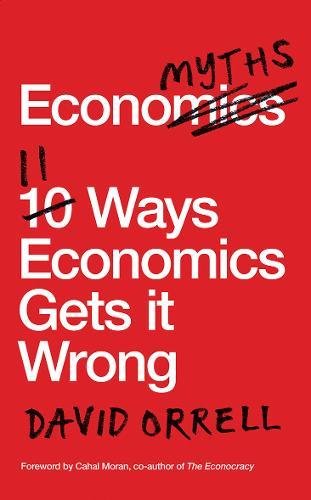
A short note about Economyths: ‘When Economyths was first published by Wiley in 2010, David Orrell showed how mainstream economics is based on key myths such as fair competition, rational behaviour, stability and eternal growth – and how these myths lead paradoxically to their opposites: inequality, an irrational economy, financial instability and a collision with nature’s limits.
Since then, we’ve had Occupy, political upheaval, flash crashes in financial markets, the warmest few years in recorded history – and a growing chorus demanding fundamental reform. So how has economics responded?
Orrell shows how the ten myths still dominate economics. He reveals their roots in thought that goes back to the ancient Greeks, making them hard to dislodge. And he uncovers, demolishes and develops an alternative to the greatest economyth of all – the one that will lead to the collapse of orthodox economics.’
‘Swiss psychiatrist Elisabeth Kübler-Ross, a pioneer in the field of grief counselling, identified the five stages of grief as denial, anger, bargaining, depression, and acceptance. This extract from Economyths draws on her model of grief as inspiration to chart the long, arduous, but ultimately healthy and healing (we hope, it’s not over yet) process as the economics profession slowly comes to terms with its role in the Great Financial Crisis.’
The ten years since the first tremors of the crisis began in 2007 have been a difficult journey, not just for the world economy, but also for the economics profession. The status of the field had never been higher than in the two decades preceding the crisis, during what Ben Bernanke and others called the Great Moderation. Inflation and macroeconomic volatility seemed to be under control, and total national income was growing at an almost steady rate (the fact that total debt was growing even faster was less remarked upon). In 2002, Alan Greenspan received an honorary knighthood from the Queen for ‘his outstanding contribution to global economic stability’. The following year, Nobel laureate Robert Lucas, famous for his theory of ‘rational expectations’, told his audience: ‘My thesis in this lecture is that macroeconomics in this original sense has succeeded: Its central problem of depression prevention has been solved, for all practical purposes, and has in fact been solved for many decades.’With its firm grounding in mathematical rigour, economics was the undisputed queen of the social sciences.
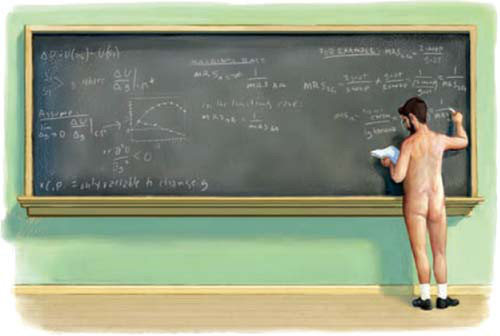
‘Assume A, assume B, … blah blah blah … And so we have proven that P is true.’!!
Economics and the Economist- A Pseudo Science and Scientist:Emperors with no clothes
"Today's neoclassical economist is an emperor with no clothes who's fooled us all long enough."Photo: transitionvoice.com
Economists were therefore more than a little surprised by what jurist and economist Richard Posner – author of books including the aptly-named A Failure of Capitalism: The Crisis of ’08 and the Descent into Depression – inventories as ‘the bursting of the housing bubble (they didn’t know it was a bubble), the ensuing banking collapse, the stock market crash, the sharp decline in output and employment, the global scope of the crisis, and the onset of deflation in the late fall of 2008 that created fears of a depression comparable to the Great Depression of the 1930s’. According to James Heckman from the University of Chicago, ‘Everybody here was blindsided by the magnitude of what happened. But it wasn’t just here. The entire profession was blindsided.’
Indeed, the crisis came as a traumatic event that left mainstream economists in what Greenspan called ‘a state of shocked disbelief’. Models which were based on assumptions of stability, equilibrium and efficiency were of little use when markets were cratering, real estate was sinking into the mud, and oil and food were spiking. And since that time, economists have been working their way slowly and painfully through the different stages or aspects of the grief process, as they realise that their elegant models not only failed to predict the crisis, but also helped to create it.
When Economyths first came out, most economists were in a state of denial – especially those at the top of the profession. Future laureate Tom Sargent said in a 2010 interview “It is just wrong to say that this financial crisis caught modern macroeconomists by surprise.” (No mention of whether the non-modern macroeconomists saw it coming too.) Laureate Robert Lucas preferred to see the unpredictability as a natural result of future laureate Eugene Fama’s efficient market hypothesis (though as Posner notes, that didn’t stop him from predicting, shortly after Lehman’s collapse, that the crisis would soon go away).Fama agreed that the efficient market hypothesis ‘did quite well in this episode’. The Nobel committee apparently agreed too.
As reality sank in, economists soon began lashing out in anger at anyone who dared criticise their field, including yours truly (I’m going to talk about this because it seems to be quite a general problem). At Canada’s top-ranked economics blog Worthwhile Canadian Initiative, for example, a group of prominent academics, including regular contributors to national publications (Globe and Mail, National Post, Maclean’s, Literary Review of Canada, etc.),shared their professional thoughts about the book online. Descriptors used included idiotic, ignorant, intellectually lazy, juvenile, random, rubbish, semi-articulated, and ‘sort of like Malcolm Gladwell without the insight’ – ouch. Someone even compared me to a climate change denier (not uncommon, as it turns out).
One commenter described the online book burning as part of a widely-deployed ‘shoot the messenger’ strategy against critics. Which is fine – we give as good as we get, and at least they don’t grade us. But what was interesting about their discussion was the way these academics, who hailed from top universities such as British Columbia, Carleton, Laval, and so on, managed to maintain the illusion that they were being incredibly tolerant and open to criticism. As one put it, ‘Economists welcome criticism. In the academy, we are well-known, if not infamous, for being direct, abrupt, and rude in criticizing each other (and others). There is a very healthy discussion about methodology. Bring it on.’ But they confused academic bickering with genuine criticism from people who share none of their biases.
The site linked to an even more vituperative blog review by an economics professor at the University of Victoria who of course took pains to say that economics ‘benefits from criticism’, as long as it’s the right type, a topic we discuss further below. (Fortunately I was spared the electronic ‘viruses and hate mail’ which have apparently afflicted other critics of mainstream economics.) And that was about it for thoughtful response from the country’s economics establishment, at least until former Deputy Governor of the Bank of Canada William White (now at OECD) – one of the few people who warned of the financial crisis – cited the paperback edition as a Bloomberg Best Book of 2013, perhaps out of sympathy.
Let’s make a deal
As anger started to burn out, the next stage of the drawn-out and generally exhausting grief process involved bargaining: both with the future – perhaps we can put things right – and in a kind of retroactive bargaining with the past, saying that the event would not have occurred if only something had been done differently. One common argument, anticipated in the book’s introductory chapter, was that there is nothing wrong with economics per se, the problem is one of poor communication: the field’s critics just don’t understand the full rich diversity of economic thought, and are attacking a simplified caricature.
A good illustration of this approach was the 2015 book Economics Rules by Dani Rodrik from Harvard. Echoing Lionel Robbins – who called economic man an ‘expository device’ in 1932 – Rodrick explains that the reason student groups such as the Post-Crash Economics Society are frustrated is that introductory economics courses offer only a pared down version of the theory and give ‘little sense of the diversity of conclusions in economics’. Also most economists are poor at presenting their arguments to the public, because they ‘see themselves as scientists and researchers whose job it is to write academic papers’. Rodrik does note the existence of a ‘guild mentality’ in economics which ‘renders the profession insular and immune to outside criticism’, and observes in a couple of places that ‘Only card-carrying members of the profession are viewed as legitimate participants in economic debates’. Yet later he cites the influence of behavioural psychologists and so on to conclude that ‘the view of economics as an insular, inbred discipline closed to outside influence is more caricature than reality’. (Pardon?) The overall impression is one of bemusement at all the fuss.
After making a number of good points about models, the book concludes with ‘Ten Commandments’ (aka ‘bargaining points’) for economists, and ten for non-economists. Some of these are very sensible – #3 from the latter list, for example, says: ‘Analysis requires simplicity; beware of incoherence that passes itself off as complexity.’ Others are versions of common defences against critics, e.g. #9: ‘If you think all economists think alike, attend one of their seminars’, and #10: ‘If you think economists are especially rude to noneconomists, attend one of their seminars.’ These are surely well-meant and sound fairly innocuous, unless you’re afraid of economics seminars, but they come up all the time in different guises and it’s worth inspecting them a little more closely.
The first is a polite variation of the ‘caricature’ or ‘straw man’ argument, implying that economics is far more diverse and complicated than it appears to an outsider. However, the fact that economists do not agree on every point does not somehow innoculate the field against criticism; and the claim or implication that non-economists don’t fully understand the subject, and need to attend a seminar or take a course to appreciate its mysteries, often boils down to a debating or avoidance tactic (and obviously doesn’t apply to the increasing number of critics from within the field’s own ranks). It also leads to the catch-22, perfectly expressed in a generally glowing 2017 review of Rodrik’s ‘marvelous book’ by economist and game theory expert Ariel Rubinstein, published in the Journal of Economic Literature, that ‘One needs to be an outsider to criticize Economics but one needs to be an economist to do it sufficiently well so as not to be drawn astray by stereotypes’, which doesn’t seem to leave many people. Apparently Rodrik qualifies, despite or because of the fact that he ‘belongs to the elite of the Economics academic establishment’.
Commandment/bargaining point #10, meanwhile, echoes the idea, also expressed above, that rudeness between economists is evidence of a ‘very healthy discussion about methodology’. I’m assuming this doesn’t include hate mail. Five things … First, the main objection to the arguments made by economists concerns not the style, but the content. Second: as seen below, economists are not rude at all when it comes to questioning their leaders – in fact obsequious deference would seem to be a better description. Third: lack of civility (at least in itself) is not an indicator of healthy scientific debate, in the academy or in the playground. I’d say that advertising it probably reflects more an anxiety about appearing robustly scientific.
Fourth: in his 2006 book The Trouble With Physics, physicist Lee Smolin notes that string theorists cultivate a ‘brash, aggressive, and competitive atmosphere’, though he doesn’t see it as an advantage. He also detects a ‘blatant prejudice’ against hiring women. Could these be related – and could macho posturing be a similar problem in economics? According to one article, by economist Miles Kimball and an untenured female economist who didn’t want to be identified in case it hurt her career, some male economists ‘may not even realize all the ways they routinely put others down – especially those in vulnerable positions who dare not strike back’.
Finally, and related, rudeness might be fine between equals, but one of the functions of social graces is to help deal with asymmetrical power relationships, of the sort encountered in economics departments. A 2015 investigation at the University of Manitoba, for example, concluded that while the department head, an orthodox economist, had insisted ‘that he was committed to maintaining diversity’, his subsequent actions resulted in a change of climate that had the opposite effect. This ultimately led among other things to ‘a violation of academic freedom when orthodox members of the department behaved in ways that discriminated against doctoral students being supervised by heterodox economists’. According to one professor there was ‘serious bullying going on’ including threats to interfere with the tenure process. No wonder the students are calling for revolt (they’re so rude).
Economic depression
It therefore comes as something of a relief to us critics that some economists at least may be proceeding to the penultimate, more passive stage of the grief process, depression. Evidence is provided by a paper by Paul Romer, ‘The Trouble With Macroeconomics’ (he had also been reading Smolin’s book, hence the title), a 2016 preprint of which caused a considerable stir in economics circles. Sounding almost Economyths-like in style, the first sentence of the abstract announces that ‘For more than three decades, macroeconomics has gone backwards’. It goes on to describe the author’s ‘pessimistic assessment of regression into pseudoscience’ and mention the ‘serious failure’ of top economists. Decidedly non-upbeat section titles include ‘Post-Real Models’, ‘Loyalty Can Corrode The Norms of Science’, ‘Back to Square One’, and ‘The Trouble Ahead For All of Economics’. No concrete solutions are proposed for what sounds, to an outsider, like a rather dysfunctional state of affairs.
In the same way that elegant but unfalsifiable string theory has, as Smolin showed, taken over high-energy physics, so mainstream economics has increasingly emphasised elegant but unfalsifiable mathematical models over experimental reality. Most of the parameters in the models cannot be determined from observations, but are simply made up to give the desired answers. Events such as crashes are assumed to be caused by external shocks, rather than internal dynamics. The models can’t make sense out of even basic things like monetary policy, which according to theory – since money plays no significant role in these models – should have little or no effect.
However, the problems are as much sociological as they are mathematical. Just as string theory is characterised by what Smolin described as ‘groupthink’ about the correct way to approach problems, so some economists see it as ‘an extremely serious violation of some honor code for anyone to criticize openly a revered authority figure … neither facts that are false, nor predictions that are wrong, nor models that make no sense matter enough to worry about’.
Romer, who is now chief economist at the World Bank, notes that he sees himself more as a practitioner rather than an academic, so feels free to speak out and tell it like it is, but many people are afraid to criticise a ‘revered leader’ because of the ‘unpleasant reaction’ that it may evoke. He relates a story of running into a colleague who was so angry with him for criticising a paper by Robert Lucas that ‘at first he could not speak. Eventually, he told me, “You are killing Bob.”’ Yikes. So much for that self-image of economists being open to criticism. In fact Romer says he was inspired to write the paper after seeing a documentary about the Church of Scientology.
Paul Mason observed in The Guardian that Romer’s paper is important because he is not an outsider or a rebel, but ‘a doyen of the profession, and from the heart of the US academic mainstream’. As Bloomberg commented, ‘along came one of the leading practitioners of his generation, to say that the skeptics were onto something’. Which, speaking as one such sceptic, is certainly appreciated. In fact in some respects Romer probably goes further – even I didn’t sum an economic argument up as: ‘Assume A, assume B, … blah blah blah … And so we have proven that P is true.’
However, while it is refreshing that some in the mainstream are facing up to these problems, and Romer’s paper is written with great courage, a dose of dark humour, and an obvious concern for the state of economics, there is in fact little acknowledgement that these issues have long been debated and solutions proposed outside of the mainstream; and as argued in this book, it is exactly this deafness to other voices which is at the root of the ‘trouble with economics’, and the reason it has taken so long to confront the fact that there might be a serious problem, let alone actually do something about it.
The path to acceptance
Of course, depression is a state of mind that involves turning inwards. But for an area as insular as mainstream economics, the final stage of the grief process – acceptance – will only come when the field finally gets over itself and opens up to new ideas – or even the old ideas that have been there all along. This may be beginning to happen. In 2017 for example the UK’s Economic and Social Research Council announced that it intended to set up a network with its remit being to ‘revolutionise’ the field of economics: ‘It will be led by a team of 25 world leading experts taken not only from different branches of economics, but also from psychology, anthropology, sociology, neuroscience, economic history, political science, biology and physics.’
Perhaps those experts can answer some of the questions we posed for them back in the original 2010 edition of Economyths. As seen in the revised edition, ideas from areas such as complexity science and data analysis are starting to sink in and have an effect. And some high-profile economists are having a go at new approaches. Joseph Stiglitz, for example, recently contributed to a paper that uses an agent-based model to account for ‘the complex adaptive nature of economic systems, and the implications of money endogeneity’ (i.e. the fact that money is produced by banks).
But one thing that mainstream economists won’t go near – it doesn’t fit with the models – is the idea that economists might not be quite so impartial, objective and unbiased as they appear. Rodrik, for example, notes that leading economists had bought into the dominant efficient market paradigm which saw markets ‘not only as inherently efficient and stable, but also as self-disciplining’, and that this ‘legitimized and enabled a great wave of financial deregulation that set the stage for the crisis’. He describes it as ‘curious’ that other models were not used. But why would they make that particular choice? Why were other models, such as Minsky’s model of the credit cycle, repressed? And did economists buy in or sell out? The field of economics has an unhealthily close dependency relationship with the financial sector, which may just have clouded its judgement.
Instead of acting out against critics in a way that embarrasses the profession, or ignoring those who want to help, it’s time for mainstream economists to relax the defences and open up a little. A first step is to untangle those institutional effects and other motivations that have shaped their field and which continue to resist change. I’m sure there are plenty of sociologists and psychologists (even grief counsellors probably) who can help. Of course the process can’t be rushed, so here is, not a commandment, but a gentle suggestion to economists in this difficult time: ten years is enough. Time to open the windows and let in the fresh air.
See the original article: Economyths: The Five Stages of Economic Grief
Read more:
Economics and Economists Engulfed By Crises: What Do We Tell the Students?
Economics, Globalisation and the Common Good: A Lecture at London School of Economics
My Economics and Business Educators’ Oath: My Promise to My Students
A New Nobel Prize: Economics in the Interest of the Common Good
- Details
- Written by: Kamran Mofid
- Hits: 2615
'The Power of Thank You... Mastering the Art of Gratitude'*
A Sure Path to Healing and Happiness

Photo: bing.com
Expressing feelings of despair and dissatisfaction are useful for one's personal growth as long as it is part of a constructive process. There is limited value in beating the drum of 'how bad everything is' and 'how if it were not for this or that our lives would be so much better'. All we really achieve from this kind of activity is pollution and stagnation, which prevents growth. This way of being also means we do not see solutions because we spend too much time living in the problem, which magnifies the problem and extends its influence, which disempowers us in the process.
Expressing what it is we are unhappy with is valuable in order that we can see what needs to be done, but if all we do is complain we create a self-limiting prison for ourselves. It is within this prison that negative beliefs are born. A common sub-conscious belief that limits so many of us is that life seems to punish us and reward others, and there is very little we can do about it. This creates a victim consciousness which can be described as 'poor me' but this consciousness is only really useful if it motivates change. If on the other hand we make this mind-set our home, never daring to venture beyond its walls then we slowly die under its influence.
The power of thank you is limitless, the more we find things to be thankful about, great and particularly small then the more growth and well-being floods into our lives. The 'poor me' consciousness simply creates a culture of pessimism and negativity, a culture that overshadows our positive state of being. Whereas the vast vocabulary and the colourful language of thank you creates positivity and a real appreciation of things that are so easily overlooked. Thank you helps us to savour life and find beauty and truth, it helps us discover our true nature, abilities and talents. Thank you stokes the fire of creativity and introduces us to higher levels of awareness and consciousness. The thank you process motivates us to act because the appreciation that it produces gives us real power. It is a power that inspires, a power that rejoices more and complains less, a power that realises our lives are dictated most of all by what thoughts we generate in our minds.
The power of thank you is not an attack on the self pitying consciousness because self pity does have a place in our lives. The power of thank you is about understanding one way to move out of self pity and victim-hood. It is about realising that whatever the state of our lives we do have the power and ability to influence things positively. We do not have to wait for chance, or some miracle to bring change to our circumstances, we can create our own miracles by being more thankful.
Starting from today create some thank you statements. Take a close look at your life and find at least half a dozen things you take for granted, or overlook and never really consider the value and importance of. Then make these thank you statements into affirmations that you can recite throughout the day, particularly before you go to sleep at night and before you get out of bed in the morning. By reciting these thank you's at least twice a day there will be meaningful growth that starts appearing in your life and that growth will eventually bear good fruit. The power of thank you is particularly valuable in the face of life's challenges and if we can find something to be grateful for, something that can be celebrated, we can and do move forward more quickly taking necessary lessons and truth with us. Remember practice, patience and perseverance guarantee success. So try saying thank you more and watch a different perspective, attitude and set of values and beliefs begin to unfold which will serve to free you from your self limiting prison. It is time to free yourself with the power of thank you.
POWER OF THANK YOU 2
Try out this thought for size; ‘My life is perfect. I have everything that I need and I am truly grateful’. Spend a day reciting this thought in your mind over and over again. If it helps, write it down again and again. Just try for twenty-four hours to truly embrace this thought and see what happens. If there’s even the slightest improvement in your day or how you feel, make a deal with yourself to do it for another day. And why not keep doing this whilst it continues to work for you?
Photo: bing.com
Those of you who are familiar with the Reach Approach will understand that we passionately believe wellbeing is a healthy marriage between mind, body, spirit and environment. It’s a beautiful dance between all four, where each performs its role gracefully and harmoniously. It’s a wonderful contract of interdependence where each aspect performs its function with respect for itself and the whole organism. In other words, health is a state of non- rivalry. So therefore, anything we do that spoils the dance, corrupts the contract or contaminates the relationship, denies us health and wellbeing. Complaining does just that. The more we complain, the more we have to complain about. The more we give thanks, the more we will have to be grateful for. This is so simple and in many ways obvious and yet its depth and power is still not fully understood.
Complaining has many forms. It is not simply the act of ‘wittering on’ or grumbling to yourself and others. That’s the obvious expression of complaint. To complain means being frustrated with your life, being dissatisfied with your relationships, doubting yourself, your talents and abilities. It’s a life of comparing and competing, striving to mask your deficiencies and shortcomings; a life of overcompensating in order to be liked and to fit in. It’s a turbulent river of dissatisfaction that runs through the landscape of your life. It eats away at you, telling you you’re not good enough, what you have is not good enough and propels you to pursue things you don’t need to make you feel better about yourself and your reality. Can you relate to this? Are you complaining and haven’t even realised? Our research and clinical experience clearly shows that the majority of people are complaining in some form. They simply aren’t aware of it. Why not take a closer look at your life and note how much you pretend, defend, justify and deny (these are just some of the offspring of complaining)........ Why not do that now?
Take up our challenge. Develop the habit of ‘thank you’. An attitude of gratitude will completely change your perception and perspective. Just as a culture of complaint has bent you out of shape (distorted your true nature), the practice of ‘thank you’ will not only restore your beauty, it will attract everything you need into your life. Complaining takes you further away from yourself and the truth, whilst ‘thank you’ brings you into a loving embrace with your purpose and potential. In other words, you stop living as a passenger in your own life, wondering which way the vehicle will take you next. Instead you move into the driver’s seat with a confidence in what you need to do and where you need to go. It’s so satisfying. Try this thought; ‘My life is perfect, I have exactly what I need and for that I am truly grateful’. Even though your life may not be perfect and may not be exactly as you wish it to be right now, by daring to think in this way, both your psychology and biology are positively affected. You are what you think you are. Your perceptions and your beliefs do shape your reality. Find things to be grateful for every day and things to be grateful for will come and find you! The laws of cause and effect relate to everything in our
world so try sending out the right signals and watch the inevitable return of your preferred outcomes (your dreams). This one act will save your life if you let it. Practice the power of thank you faithfully. It has untold depths and it never disappoints.
THANK YOU FOR THE GIFT OF.....
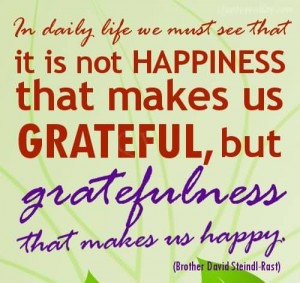
The more you complain the more you will have to complain about. The more you give thanks the more you will have to be grateful for. The more that you walk a path of appreciation and gratitude, the richer your life will be. This is real wealth, the wealth of peace and contentment, a life that lacks nothing. So our invitation to you is to play the game of saying thank you for the gift of.... The more of these you can generate for yourself, the better. Below are some that we believe are universally applicable.
Thank you for the gift of my enemies and for the opportunities to develop forgiveness and kindness.
Thank you for the gift of this moment, as it allows me to fully blossom into ‘me’.
Thank you for the gift of my friendships and for the love and the support that they bring.
Thank you for the gift of my challenges, for the insight, growth and wisdom that they offer. Thank you for the gift of each day and the opportunity for greater peace, joy and happiness.
Thank you for the gift of my body and the countless wonders it performs each day.
Thank you for the gift of a life in which I can serve and benefit others with no desire for myself.
Thank you for the gift of sleep and for the renovation and repair that takes place each night.
Thank you for the gift of tomorrow which, when I allow, always adds value and meaning to my life.
Thank you for the gift of silent reflection that offers the unravelling of the mind’s many mysteries.
Thank you for the gift of the inner wisdom that lives deep within my heart.
Thank you for the gift of nature in all her wonderful guises and magnificent forms, she’s amazing!
Thank you for the gift of my life and the opportunity that each day brings for positive change.
Thank you for the gift of my family, who offer me the chance to develop patience and unconditional love.
A life of thank you is a rich and full life. It’s kind to you and those around you. It’s full of smiles and laughter where a gentle river of insight flows continuously through the mind, touching every cell and sinew. A life of gratitude soothes hurts and pain, evaporates anger and reframes your perspective. Why drown in the ‘cesspit of complaint’. Has it ever served you well? Try immersing your mind in the ‘gift of thank you’. It’s power is truly breathtaking. It will undoubtedly redefine your life. If you do anything today, say THANK YOU with all your heart.
*See the originalarticle which was first published in The Reach Approach: The Power of Thank You... Mastering the Art of Gratitude
...And now for more reflection on what was noted above, visit 'My Wisdom Corner', a few examples of the many gems I have discovered in my life journey from the wisdom of others. They have opened new horizons in my life. For that I cannot be grateful enough: 'My Wisdom Corner'

"Passing of Knowledge" by Victor Tan Wee Tar
What is this life all about?
Why am I here? What’s my Life’s purpose? How can I make the most of my Life?
- The ‘Gentle Giant’ of country music, Don Williams, dies at 78
- Ambassadors’ Lecture Series: The Prelude to the Establishment of the Centre for the Study of Forgiveness and Reconciliation at Coventry University in 1996
- This is how Silicon Valley may become a force for good: Dump Ayn Rand and embrace Henry George
- UK’s Broken Economic Model: A New Path is Called for- I offer you the Common Good
- A bit of Good News: Economists are Having Second Thoughts, Values and Virtues Matter