
- Details
- Written by: Kamran Mofid
- Hits: 16911
“Don’t just teach your students how to count. Teach them what counts most.”
‘In spite of the utter failure of academic and professional economists to predict, explain or find solutions to the financial and economic crises sweeping the globalised, marketised world they have created, there is still little challenge to the narrow and one-sided way that economics is taught in our universities. In spite of the fact that economics is about complex human relationships, and is therefore bound to be the subject of debate and disagreement, there is no problem with university courses that only teach the neoclassical pro-market approach.’- Gaian Economics

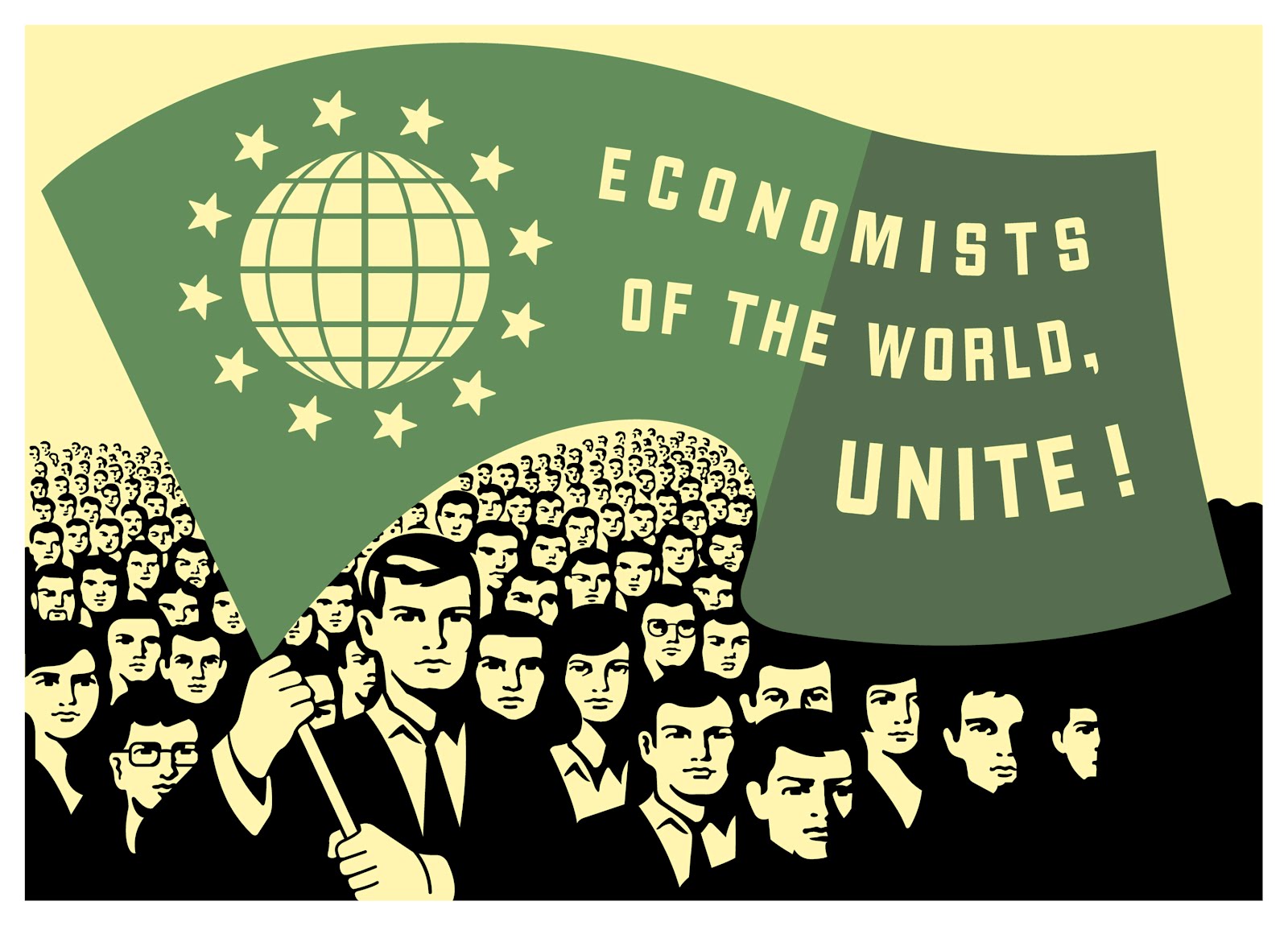
“Economics is only dismal because there are not enough of us making it our own.”
Photo: gaianeconomics.co.uk
ECONOMICS is “not a ‘gay science,” wrote Thomas Carlyle in 1849. No, it is “a dreary, desolate, and indeed quite abject and distressing one; what we might call, by way of eminence, the dismal science.”
But, happily today, some academic economists are discovering that their discipline is not really a “dismal science”, but a subject of beauty, elegance and relevance, if it was to return to its original roots, moral philosophy amid issues and questions of broad significance involving the fullness of human existence.
More economists are now realising that the focus of economics should be on the benefit and the bounty that the economy produces, on how to let this bounty increase, and how to share the benefits justly among the people for the common good, removing the evils that hinder this process. Moreover, they are noticing that economic investigation should be accompanied by research into subjects such as anthropology, psychology, philosophy, politics, ethics and spirituality, to give insight into our own mystery, as no economic theory or no economist can say who we are, where have we come from or where we are going. Humankind must be respected as the centre of creation and not relegated by more short term economic interests.
My question to my fellow academic economists is: Are you one of those "Recovering" economists, and if not, why not?
Students everywhere are calling for pluralism in economics. See below:
So what is economics? What has gone wrong? What is to be done?
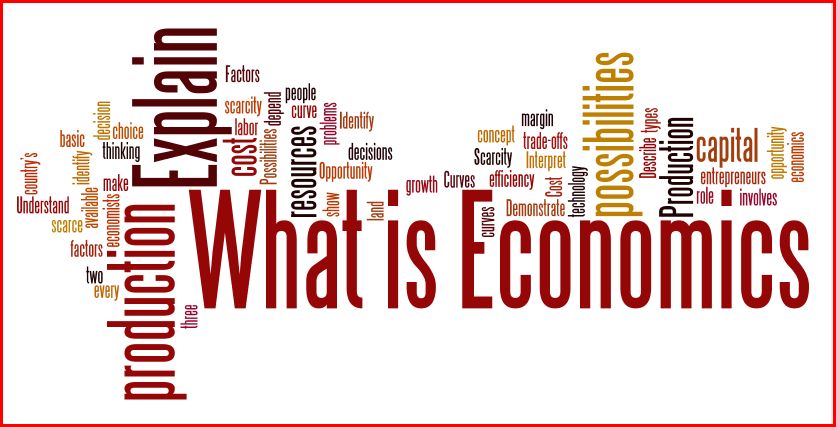
Photo: thestash.co
2000- France, the Sorbonne and other universities
“In the spring of 2000 an interesting dichotomy between theory and reality in economics teaching appeared in France when economics students from some of the most prestigious universities, including the Sorbonne, published a petition on the internet urging fellow students to protest against the way economics was being taught. They were against the domination of rationalist theories, the marginalization of critical and reflective thought and the use of increasingly complex mathematical models. Some argued that the drive to make economics more like physics was flawed and that it should be wrenched back in line with its more social aspects”:
In Praise of the Economic Students at the Sorbonne: The Class of 2000
2008- London, Her Majesty Queen Elizabeth II asking the economists at London School of Economics: “Why did nobody notice?”
Your Majesty,
“I note, with much interest, Your Majesty’s recent visit to the London School of Economics. Given the current financial calamity, Your Majesty asked a very pertinent and important question: “Why did nobody notice?”
I firmly believe that the director of research and his colleagues present there, should have provided Your Majesty with truthful and honest answers. However, given what I have read in the press, I do not believe this was the case. Their failure to do so, clearly goes a long way to prove the detachment of economists and the modern neo-liberal economics from the real world. They have turned our profession and subject into a comedy of errors, a dismal science of irrelevance.
This is very sad indeed Your Majesty. An entire profession now appears to have suffered a collapse. Trust and confidence in my profession has all but been demolished, the “dismal science” at its worst.
Many mistakes have been made. Many economists have compromised themselves and their profession by remaining silent, not criticising the extremism and the neo-liberal fundamentalism present in their profession. Lessons should be learnt, someone should be held accountable. Otherwise the same mistakes will be repeated and nobody will believe what an economist says again. In other words, Your Majesty deserves a proper and honest answer…”
2011- London- “There is no correlation between ethics and economics”- Lord Kalms’ letter to the Times (08/03/2011):
Ethics boys
Sir, Around 1991 I offered the London School of Economics a grant of £1 million to set up a Chair in Business Ethics. John Ashworth, at that time the Director of the LSE, encouraged the idea but had to write to me to say, regretfully, that the faculty had rejected the offer as it saw no correlation between ethics and economics. Quite. Lord Kalms, House of Lords
Economics, Globalisation and the Common Good: A Lecture at LondonSchool of Economics
2011- USA, Harvard University, Students of economics revolting against their professor at Harvard
“There is a growing student protest movement against orthodox economics that could change the field as we know it.” On 2nd November 2011 at HarvardUniversity, students of Prof. N. Gregory Mankiw walked out of his class.
“Mankiw is the former head of the Council of Economic Advisers for President George W. Bush and an advisor to Republican presidential candidate Mitt Romney. He is also the author of "Principles of Economics," the predominant textbook used in introductory economics classes worldwide. Not surprisingly, he has an extremely traditional, market-oriented view of the discipline.
The students who walked out of Mankiw's class explained their reasoning in an open letter printed in the Harvard Political Review. It began with this declaration: "Today, we are walking out of your class, Economics 10, in order to express our discontent with the bias inherent in this introductory economics course. We are deeply concerned about the way that this bias affects students, the University, and our greater society.
They went on to explain that instead of presenting a broad introduction to economics, Mankiw's teaching was narrowly focused, did not offer alternative approaches to orthodox economic models and ultimately was complicit in perpetuating systemic global inequality…
These students are frustrated by a field that they believe could provide so much to society but instead is mired in outmoded thinking. Today's economics is dominated by ideas, like the efficient market hypothesis, making such sweeping generalizations that they render human beings practically unrecognizable”…
Goodbye, St Paul's. Hello, St Mary's
2013- Manchester University Economics Students, Post-Crash Economic Society
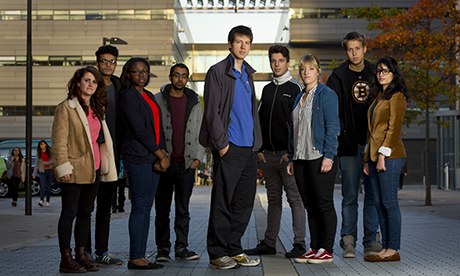
The Post-Crash Economics Society at ManchesterUniversity
Photo: thegusrdian.com
“What wonderfully good news! Once again, another group of brave students of economics at a university have risen against the “dismal science” and the madness of the neo-clasical economics, its ways and its teachings. I am delighted to hear that the Manchester students have seen the light, like their fellow students at other universities, such as the class of 2000 at the Sorbonne”:
2014- International Student Initiative for Pluralism in Economics (ISIPE) was founded

It is not only the world economy that is in crisis. The teaching of economics is in crisis too, and this crisis has consequences far beyond the university walls. What is taught shapes the minds of the next generation of policymakers, and therefore shapes the societies we live in. We, 42 associations of economics students from 19 different countries, believe it is time to reconsider the way economics is taught. We are dissatisfied with the dramatic narrowing of the curriculum that has taken place over the last couple of decades. This lack of intellectual diversity does not only restrain education and research. It limits our ability to contend with the multidimensional challenges of the 21st century – from financial stability, to food security and climate change. The real world should be brought back into the classroom, as well as debate and a pluralism of theories and methods. This will help renew the discipline and ultimately create a space in which solutions to society’s problems can be generated.
United across borders, we call for a change of course. We do not claim to have the perfect answer, but we have no doubt that economics students will profit from exposure to different perspectives and ideas. Pluralism could not only help to fertilize teaching and research and reinvigorate the discipline. Rather, pluralism carries the promise to bring economics back into the service of society. Three forms of pluralism must be at the core of curricula: theoretical, methodological and interdisciplinary.
International Students call for pluralism in economics
GCGI supports the International Student Initiative for Pluralism in Economics
5 May 2014- An international student call for pluralism in economics
“It is not only the world economy that is in crisis.The teaching of economics is in crisis too, and this crisis has consequences far beyond the university walls. What is taught shapes the minds of the next generation of policymakers, and therefore shapes the societies we live in. We, over 65 associations of economics students from over 30 different countries, believe it is time to reconsider the way economics is taught. We are dissatisfied with the dramatic narrowing of the curriculum that has taken place over the last couple of decades. This lack of intellectual diversity does not only restrain education and research. It limits our ability to contend with the multidimensional challenges of the 21st century - from financial stability, to food security and climate change. The real world should be brought back into the classroom, as well as debate and a pluralism of theories and methods. Such change will help renew the discipline and ultimately create a space in which solutions to society’s problems can be generated.
United across borders, we call for a change of course. We do not claim to have the perfect answer, but we have no doubt that economics students will profit from exposure to different perspectives and ideas. Pluralism will not only help to enrich teaching and research and reinvigorate the discipline. More than this, pluralism carries the promise of bringing economics back into the service of society. Three forms of pluralism must be at the core of curricula: theoretical, methodological and interdisciplinary.
Theoretical pluralism emphasizes the need to broaden the range of schools of thought represented in the curricula. It is not the particulars of any economic tradition we object to. Pluralism is not about choosing sides, but about encouraging intellectually rich debate and learning to critically contrast ideas. Where other disciplines embrace diversity and teach competing theories even when they are mutually incompatible, economics is often presented as a unified body of knowledge. Admittedly, the dominant tradition has internal variations. Yet, it is only one way of doing economics and of looking at the real world. Such uniformity is unheard of in other fields; nobody would take seriously a degree program in psychology that focuses only on Freudianism, or a politics program that focuses only on state socialism. An inclusive and comprehensive economics education should promote balanced exposure to a variety of theoretical perspectives, from the commonly taught neoclassically-based approaches to the largely excluded classical, post-Keynesian, institutional, ecological, feminist, Marxist and Austrian traditions - among others. Most economics students graduate without ever encountering such diverse perspectives in the classroom.
Furthermore, it is essential that core curricula include courses that provide context and foster reflexive thinking about economics and its methods per se, including philosophy of economics and the theory of knowledge. Also, because theories cannot be fully understood independently of the historical context in which they were formulated, students should be systematically exposed to the history of economic thought and to the classical literature on economics as well as to economic history. Currently, such courses are either non-existent or marginalized to the fringes of economics curricula.”…
Continue to read the rest of the statement:
Open Letter — International Student Initiative for Pluralism in Economics
I firmly believe that the academic economists should show true leadership, wisdom and humility by supporting their students’ call for pluralism in economics.
“It is clear that some serious reflection is in order. Not to stand back and question what has happened and why, would be to compound failure with failure: failure of vision with failure of responsibility. If nothing else these current crises of finance, social injustice and environmental devastation present us with a unique opportunity to address the shortcomings of our profession with total honesty and humility while returning the “dismal science” to its true position: a subject of beauty, wisdom and virtue.”…
Economics and Economists Engulfed By Crises: What Do We Tell the Students?
Now, the pertinent question is: Are the students being listened to? The short answer is: NO. Dogmatism and conservatism at departments of economics have won again. Academic economists are not prepared to show leadership, humility and wisdom.
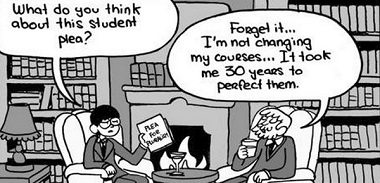
Photo: econintersect.com
As Aditya Chakrabortty writing in the Guardian has noted: “To see how fiercely the academics fight back, take a look at the University of Manchester.”
“Since last autumn, members of the university's Post-Crash Economics Society have been campaigning for reform of their narrow syllabus. They've put on their own lectures from non-mainstream, heterodox economists, even organising evening classes on bubbles, panics and crashes. You might think academics would be delighted to see such undergraduate engagement, or that economists would be swift to respond to the market.
Not a bit of it. Manchester's economics faculty recently announced that it wouldn't renew the contract of the temporary lecturer of the bubbles course, and that students who wanted to learn about the crash would have to go to the business school. The most significant economics event of our lifetime isn't being taught in any depth at one of the largest economics faculties in the country. So what exactly is a Russell Group university teaching our future economists? Last month the Post-Crash members published a report on the deficiencies of the teaching they receive. It is thorough and thoughtful, and reports: "Tutorials consist of copying problem sets off the board rather than discussing economic ideas, and 18 out of 48 modules have 50% or more marks given by multiple choice." Students point out that they are trained to digest economic theory and regurgitate it in exams, but never to question the assumptions that underpin it. This isn't an education: it's a nine-grand lobotomy.
The Manchester example is part of a much broader trend in which non-mainstream economists have been evicted from economics faculties and now hole up in geography departments or business schools. "Intellectual talibanisation" is how one renowned economist describes it in private. This isn't just bad for academia: the logical extension of the argument that you can only study economics in one way is that you can only run the economy in one way.
Mainstream economics still has debates, but they tend to be technical in nature. The Nobel prize winner Paul Krugman has pointed to the recent work of Thomas Piketty as proof that mainstream economics is plenty wide-ranging enough. Yet when Piketty visited the Guardian last week, he complained that economists generate "sophisticated models with very little or no empirical basis … there's a lot of ideology and self-interest".
Like so many other parts of the post-crash order, mainstream economists are liberal in theory but can be authoritarian in practice. The reason for that is brilliantly summed up by that non-economist Upton Sinclair: "It is difficult to get a man to understand something when his salary depends on his not understanding it."
I must say what a great pity. Can’t they see the magnitude of their failure? Read more below:
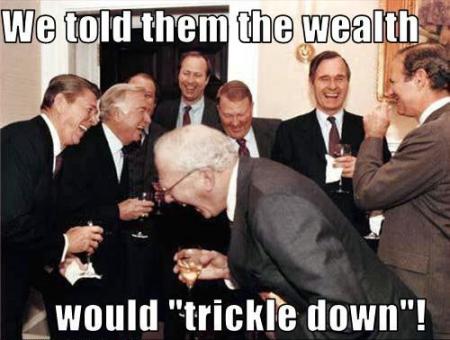
Photo: miamiautonomyandsolidarity
Open Letter to Mark Carney, Governor of the Bank of England
Corruption, Corruption,... Corruption, Everywhere
Values, Ethics, and the Common Good in MBA rankings: Where are they?
Our grandparents were wiser about markets than today’s economists and regulators
Economists Stop teaching 'The World's Dumbest Idea'!
Gaian Economics: Economics in University: Teaching or Propaganda?
What is Economics? A pictorial look:
what is economics - Google Search
If you are not a "Recovered" or "Recovering" academic economist yet, but have been inspired by this Blog to begin your own journey of “Recovery”, I wish to offer you the following as you prepare for your journey:
In February 2012 an international conference: "Economics education after the crisis: Are the graduate economists fit for purpose?" was organised by the UK Government Economic Service, the Bank of England and Royal Economic Society.
In her conference report, Diane Coyle (Chair) - Enlightenment Economics and ESRC Research Committee Member notes the following:
"One of the consequences of the financial and economic crisis since 2008 has been a re-evaluation of economics itself by at least some of its practitioners. This includes looking again at the teaching of economics in universities, the subject of a recent conference supported by the Government Economic Service, the Bank of England and the Royal Economic Society. As a speaker in the opening session of the conference noted ‘The crisis was a large intellectual failure. We all got it largely wrong and have been using the wrong intellectual apparatus.’
The question of whether the teaching of economics in universities needs reform is linked to the underlying question about the intellectual status of economics itself, post-crisis. A number of speakers noted that there had been huge progress in recent decades in some areas of economics, such as auction theory, or development economics, for instance. However, there was a degree of consensus among participants that economists need to acknowledge the limitations of what has been the standard paradigm in the subject for 50 years. Ideally, we now need to combine a greater modesty about the state of knowledge, an insistence on dogged empirical work to the highest scientific standards, and a new eclecticism about what explanation is needed to understand economic phenomena."…
Read the full report:
Teaching Economics After the Crisis
BBC Radio 4 - Teaching Economics After the Crash
One outcome of the Conference was the formation of a steering group, including both academics and employers of graduate economists, to discuss recommendations for reforms to the teaching of economics students in the UK, In this article, Diane summarises the issues discussed and sets out the group's recommendations. I very much recommend this as a very good starting point to all those wishing to begin their "Recovery" journey:
And then in 2012 a selection of papers presented at the conference was published in a very highly recommended book: “What’s the Use of Economics? Teaching the Dismal Science after the Crisis”, Edited by Diane Coyle, London Publishing Partnership, September 2012
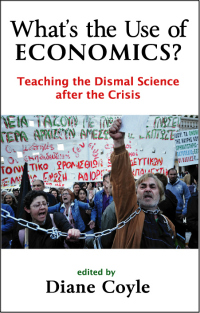
“With the financial crisis continuing after five years, people are questioning why economics failed either to send an adequate early warning ahead of the crisis or to resolve it quickly. The gap between important real-world problems and the workhorse mathematical model-based economics being taught to students has become a chasm. Students continue to be taught as if not much has changed since the crisis, as there is no consensus about how to change the curriculum. Meanwhile, employer discontent with the knowledge and skills of their graduate economist recruits has been growing. This book examines what economists need to bring to their jobs, and the way in which education in universities could be improved to fit graduates better for the real world. It is based on an international conference in February 2012, sponsored by the UK Government Economic Service and the Bank of England, which brought employers and academics together. Three themes emerged: the narrow range of skills and knowledge demonstrated by graduates; the need for reform of the content of the courses they are taught; and the barriers to curriculum reform. While some issues remain unresolved, there was strong agreement on such key issues as the strengthening of economic history, the teaching of inductive as well as deductive reasoning, critical evaluation and communication skills, and a better alignment of lecturers' incentives with the needs of their students.”
Read more: What’s the Use of Economics? Teaching the Dismal Science after the Crisis
Why Economics, Economists and Economy Fail?
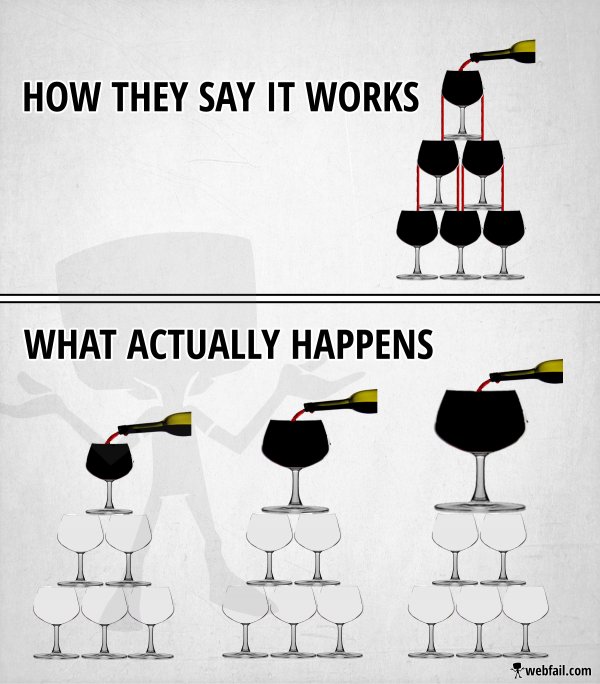
To all those imagining a real economics, a wise economist and a just economy: Why Economists Fail?
Why Economics, Economists and Economy Fail?
Values to Build a Better World
‘We have to build a better man before we can build a better society.’-Paul Tillich
‘Try not to become a man of success, but a man of value.’ - Albert Einstein
Values: To guard the hope, faith, love, courage, integrity, honesty, peace, justice, ecology, responsible leadership and humanity for the common good that can lead us forward, because they are the foundation for our greatest thoughts, actions, and the hope for our individual/collective sustainability and can never be cast asunder.
Values to Build a Better World
‘Saving economics from the economists’
ECON 101
A suggested first year module for all students majoring in economics
Ubuntu Economics: Economics for Meaning, Social Justice and the Common Good- Where we connect our intellect with our humanity
Prof. Kamran Mofid
Ronald Coase, professor of economics at the University of Chicago Law School and winner of the Nobel Prize in Economics, shortly before his death on September 2, 2013, published an article in the Harvard Business Review, ‘Saving economics from the economists’ (Coase & Wang, 2012). He argued that ‘the degree to which economics is isolated from the ordinary business of life is extraordinary and unfortunate’. ‘In the 20th century, economics identified itself as a theoretical approach of economization and gave up the real-world economy as its subject matter. It thus is not a tool the public turns to for enlightenment about how the economy operates…. It is time to reengage with the economy. Market economies springing up in China, India, Africa, and elsewhere herald unprecedented opportunities for economists to study how the market economy gains its resilience in societies with cultural, institutional, and organizational diversity. But knowledge will come only if economics can be reoriented to the study of man as he is and the economic system as it actually exists’.
There are many heterodox economists who reject the dominant model of rational choice in ‘free’ markets, and want to reconnect the study of the economy to the real world; to make its findings more accessible to the public; and to place economic analysis within a framework that embraces humanity as a whole, the world we live in.
This course, “Ubuntu Economics: Economics for Meaning, Social Justice and the Common Good” with its ‘human economy’ approach shares all these priorities. We believe that economic investigation should be accompanied by research into subjects such as anthropology, psychology, philosophy, politics, ethics and spirituality, to give insight into our own mystery, as no economic theory or no economist can say who we are, where have we come from or where we are going. Humankind must be respected as the centre of creation and not relegated by more short term economic interests.
Reverting to Ubuntu Economics:
As it has been said, “Africa, the birthplace of the first human, may just hold the key to the survival of humanity. How fitting and appropriate that the country where homo erectus was first identified is also the birthplace of the philosophy that points the way toward a sustainable future for us, its offspring.
No, I'm not talking about a new technology that will solve our dependence on non-renewable energy resources or that will stop climate change. Not directly at least. But I am talking about a way of seeing the world and all its inhabitants that, if adopted by a critical mass of human beings, would have a major impact in our ability to work together and ultimately shift the context of what it means to be a human being living on Planet Earth in the 21st century.
The philosophy is simple enough. It does however require a massive shift in how we think about ourselves, how we see each other, and how we view every other living thing on the planet.
I'm talking about the philosophy called "Ubuntu," which translated means "I am what I am, because of who we all are." The word "ubuntu" has its origins in the Bantu languages of southern Africa.”
In all, when we speak about the Ubuntu Spirit, we’re referring to the spirit of oneness, unity, love, peace and compassion, which expresses itself in a desire to help others and includes everyone. As Nelson Mandela explains, “The spirit of ubuntu – that profound African sense that we are human only through the humanity of other human beings – is not a parochial phenomenon, but has added globally to our common search for a better world.”
Moreover, as it has been observed by many, people are not individuals, living in a state of independence. They are part of a community, living in relationships and interdependence. This is in stark contrast to neo-classicals who emphasise the individual and its egoism as the engine of economics and business.
Course outline:
What is Ubuntu?
Ubuntu: The philosophical, theological, and spiritual underpinnings
Ubuntu: The economic values. How do they differ from the neo-classical values?
Ubuntu in Africa
What can the West learn from African spirituality and ubuntu?
Ubuntu’s role in community cohesion and transformation
Ubuntu’s role in health-care provision and allocation of resources
Ubuntu business: What is it?
Examples of ubuntu transforming the CEOs and their businesses
The spirit of ubuntu and philanthropy
Ubuntu and the Bottom Line
What does Ubuntu tell us about?
Empathy, cooperation, and sharing over retribution and competition, and inclusivity over exclusivity
Read more:
Ubuntu Education: Nelson Mandela’s Lasting Legacy
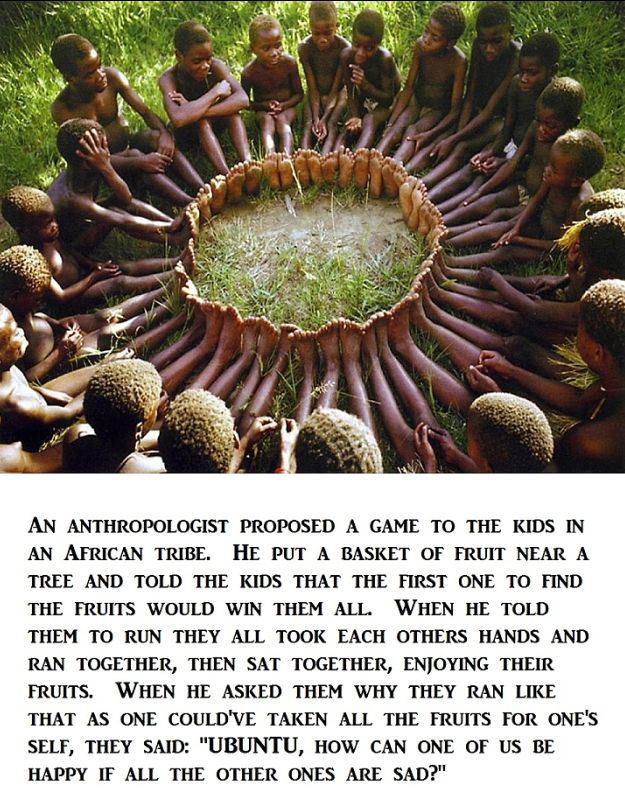
Photo: globalelite.tv
- Details
- Written by: Kamran Mofid
- Hits: 3385
Press Release
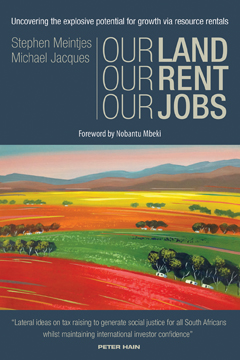
Our Land, Our Rent, Our Jobs
Uncovering the explosive potential for growth via resource rentals
Stephen Meintjes & Michael Jacques
Publication: 2nd July 2015
Publisher: Shepheard-Walwyn
www.shepheard-walwyn.co.uk
ISBN 9780856835049 £19.95 paperback
South Africa may seem far away but it is strategically important to the West. Out of frustration at the slow progress with land apportionment and high unemployment, a radical party with Marxist leanings has emerged which could turn to China and Russia. To take the heat out of the situation the authors show how a reform of taxation can lead to a more equitable distribution of land and wealth, while at the same time stimulating the economy and job growth. They illustrate how the current tax regime makes 50% of the country economically unviable and recommend a return to the tried and tested system that served Johannesburg so well as a local tax and still serves the gold mining industry well.
Mugabe's policy of violent expropriation has ruined the economy in Zimbabwe and, unchecked, the same could happen in South Africa. In an open letter to Richard Branson, published in the Mail and Guardian last year, Andile Mngxitama, the Economic Freedom Fighter’s (EFF’s) commissar for land and agrarian revolution wrote: “Our media reports that you have just bought yourself a 40 hectare wine farm in Franschhoek. Sir, you have bought stolen property. The consequence of your witting or unwitting participation in this illegal transaction is that the EFF policy of land expropriation without compensation may, in the near future, affect your investment adversely.”
- Details
- Written by: Kamran Mofid
- Hits: 7518

Hot air ballons over east London
Photo: theguardian.com
On the evening of Wednesday 20 May 2015 at the invitation of the World Congress of Faiths I delivered a keynote speech ('The Value of Values to Build a World for the Common Good') at their Annual General Meeting which was held at The Alumni Theatre, London School of Economics.
It was very telling and ironic that as I was delivering my lecture, shedding light on what has gone wrong with the so-called modern economics, the values-less business education and more, the breaking news was that despite what has happened before and since the financial crash of 2008, the banks have been continuing and deepening their corrupt activities. In order to inflate their profits and increase their bonuses significantly, they have jeopardised the global economy and have endangered the livelihood and well-being of billions of people. This time the culprits were engaged in rigging the $5.3trn-a-day foreign exchange market. "If you ain’t cheating, you ain’t trying,” one Barclays’ trader is noted to have said.
It is no secret that the great majority of these people at the banks and indeed elsewhere in business have MBAs from the so-called “prestigious/top” business schools. These schools shape and perpetuate the business culture and the aspirations of their graduates.
Today we are facing the most severe economic crisis since the Great Depression. There is plenty of blame to go around. As suppliers of ideas and talent to the business community, business schools need to accept some responsibility.
As noted by many, ideas and tools—exotic financial instruments, poorly designed compensation plans, models of corporate leadership that value leaders’ charisma over substance, an uncritical embrace of laissez-faire models, and much more—were/are taught to MBA and executive-education students without considering whether these idea and tools would contribute to a firm’s long-term well being or endanger the legitimacy of the global economic system and values.
Time is now to question the way business schools are ranked: Are they ranked according to how much “dosh” their graduates make, or according to how much they have contributed to the common good, making the world a better place? These are for sure the Big Questions.
2008 financial crisis holds lessons for business schools
Business schools are failing society
A Thoughtful Reflection from a Businessman
Chandran Nair, CEO& Founder
Global Institute for Tomorrow (GIFT)
“Defending their right to pay bonuses in the recession, bankers have spoken about the need to reward the “best people”. But the reality of recent months has demonstrated that their “best” talent was quite the opposite.
Some are left wondering where, if anywhere, these executives learnt their business ethics. Much of their training comes from the cut and thrust of work. But a large proportion can be found being taught in business schools.
It now seems a fundamental failure of business school ideology has been to focus on how companies can make the most money with minimal regard to social consequence.
According to post-school recruitment data from HarvardBusinessSchool, 45% of graduates from the class of 2008 went into financial services, a slight increase over the previous year. In 1937 three Harvard graduates, or just 1% of the class, went into securities directly from business school.
Acceptance at a first rate business school is generally understood to mean a substantial salary increase on graduating. According to MBA.com, business school graduates last year received a median salary increase of 39% over pre-graduate degree salaries.
Road to riches
Today business schools are ranked according to the incremental increases in graduate salaries. The top three ranking criteria on the Business Education section of FT.com, for example, consist of weighted salary, salary percentage increase and employment percentage.
Rankings for Executive MBA courses consider return on investment by looking at pay five years after graduation minus tuition and forgone salary while in school.
Further, many students – especially in North America – believe that the biggest benefit of going to business school is the bonds forged with classmates. There is an underlying belief that members of elite cliques can help each other make more money.
Indeed, business schools often advertise themselves based on the cache of their influential alumni networks, to whom prospective students may one day gain access for business deals and/or career advancement.
The rhetoric of ethics may be in vogue in business schools, as it is in business itself, but the next generation of executives continues to be trained under an ethos of entitlement, with a disposition to exploit rather than add value to society.
Lessons in citizenship
The challenge now for business schools, as businesses in their own right and with their own social responsibilities, is in turning out graduates who contribute value to society and supporting them in dispelling archaic notions of entitlement.
Professors and mentors share the responsibility of instilling in students a greater sense of humility in a changing global environment. In order for business schools to redeem themselves and begin to add real value to society, there are a few key things schools can and should do.
First, business schools must recognise the need for greater honesty at an intellectual level in dealing with the role of business in society and within a resource-constrained planet.
These are academic institutions, after all, and must promote business thinking that is to the benefit and not the detriment to the common good. Graduates should emerge from business school with a greater acknowledgement of their professional role and responsibility in global challenges.
Second, business schools must stop glorifying professional success through the simple and exclusive metric of monetary gain.
Rather, if schools do their jobs properly, their graduates will be adding real value to society and their evaluations should be based not on short-term performance metrics but instead on measuring more intangible long-term impacts, such as improving quality of life and creating truly sustainable businesses.
Mainstreaming ethics
Finally, in coursework and thought leadership, schools need to fundamentally integrate the reality that there are limits to growth in a consumption-driven capitalist economy.
Continued denial of this fact must be overcome if future business leaders are to confront the challenge of our times, such as climate change and water shortages, through innovation.
The new business landscape that emerges over the next two to five years as the global financial drama plays out will be very different from the old. It will require new perspectives that are still not taught in the majority of the business schools today.
Business education in the future will need to address and prioritise a far wider range of perspectives to counterbalance the current prevalence of ideas about money making.
Schools that get it right will recognise that there are substantial rewards awaiting those who actually contribute to society rather than simply training young leaders to exploit it.”
Giving Voice to Values: Now is the Time for an “MBA Educators’ Oath”
A Reflection by Prof. Kamran Mofid

Photo: accacareers.com
In the post- financial and economic crises and meltdown, the issue of ethics and corporate social responsibility has taken on greater urgency and relevance. Business schools have an important part to play in this domain. Ethics is fundamental to coping with many of the challenges that will face corporate executives in the future, not least the impact of globalisation, which will throw up a number of leadership dilemmas. However, based on current evidence, the record of the business schools by and large is not a good one. Thus, the big question is: What can be done about it?
I firmly believe that, this will not come about, so long as we do not have a “Hippocratic Oath” for those teaching at the business schools. Ethics, morality, spirituality, and their incorporation into teaching, is too important to be left to a system not accountable to certain checks and balances, as well as points of reference and accountability.
As we all know, today, business education is much more scientific than it was in its early years. It has been made more rigorous by the rising influence of statistics, mathematics, IT and economics. I believe in analytics. Most organizations need more analytics. That goes without saying.
But, and indeed, as the current and persisting crises clearly demonstrate, it is a folly to pretend that analytics are a substitute for values and vision. Indeed, an over-reliance on analytics leaves managers poorly prepared to lead in moments when statistics obscure the full human dimensions of a choice.
The issue is not that MBA programmes haven't taught leadership and ethics and corporate social responsibility. They indeed have. But most do it poorly. As it has been noted by many observers, it seems that leadership courses tend to emphasize such things as social influence and public speaking, while ethics courses often focus on legal aspects. The moral, philosophical, spiritual, cultural, religious and civilisational aspects of ethics are by and large ignored. This leaves the connection between values, leadership and action much underdeveloped, least understood and most confusing to the students. Leadership entails thinking beyond the day's crises to focus on the longer term, the bigger picture, grasping the impact of decisions on broader constituencies, and sensing a responsibility that goes far beyond the immediate result of a decision, a responsibility far beyond profit maximisation, cost minimisation and the highest returns to the shareholders, for example. True leadership involves not merely grasping the larger ramifications of business decisions and merely considering the greater good of society, but of possessing values whereby the common good is seminal and truly cared about.
MBA students are toooften unaware of the essence of ethical leadership, too unaware of the cultural and spiritual dimensions of ethics, too unappreciative of the role of institutionsand structures which govern, manage, and enable markets. For example, in workshops at a leading business school, students were asked to list the qualities that a successful business leader should possess. While vision and business acumen are invariably among the first qualities listed, honesty and responsibility for others emerge only after considerable discussion. Meanwhile, when asked about the characteristics they most value in human beings, compassion, generosity, kindness, sympathy, empathy, integrity, responsibility and the common good always appear at the bottom of the list. Likewise in leading business schools students are unable to trace the connection between ethics and culture, between well functioning markets and the larger social-political system.
In addition, an MBA education needs to be grounded in a realistic view of when markets work well and when they do not. Standard economics teaches that markets fail to be efficient in the cases of externalities, public goods, asymmetrical information, and a lack of competition. Even when efficient, markets are not able to provide an adequate social safety net nor are they able to provide for social or economic justice. Markets can not work except in a legal, political, social, and ethical context.
In order to deal with the cases of market failure as well as issues of social and economic injustice, institutions and structures are created at the local, national, and global levels, to govern, manage, and enable the market, without which not only could markets not hope to work well, they likely could not even exist. What it means to be human, to live a good life, to find happiness, are not questions that can be answered by the market alone, or even by economics or business alone. MBA education must be infused with the values and sensibilities of human culture, philosophical and moral principles, as well as with a keen appreciation for the role of government and civil society.
We need to better prepare our students for a values-led leadership. This requires creating a deeper understanding of the difficult decisions they will face, often under enormous pressure. We must make them aware that these decisions will challenge their values, and that, consequently, they need to clarify the values they stand for. We need to make sure they engage in a continuing dialogue with their peers, faculty and alumni, and learn to hold themselves and their group accountable for the commitments, as well as the decisions they make.
In the final analysis, the solution to ethical challenges in business must be a shared responsibility between the students and the faculty. The students have shown us the way: they have presented us with their oath. It is high time we declare to them our own oath also. As educators we must assume more responsibility by providing better, not less, leadership development. Only then might our graduates take an oath they can actually live up to. Below is my own offering on what our oath might look like.
The links below are examples of what an” MBA Educators’ Oath” might look like or could entail:

Photo: googleusercontent.com
My Economics and Business Educators’ Oath: My Promise to My Students
Towards an Education Worth Believing In
GCGI supports the International Student Initiative for Pluralism in Economics
In Praise of the Economic Students at the Sorbonne: The Class of 2000
Our grandparents were wiser about markets than today’s economists and regulators