
- Details
- Written by: Kamran Mofid
- Hits: 6467
Life can be tough at times. I know that life can knock you into the dirt. But, I also know that life can be joyous, worthwhile and rewarding if we knew how!
THE FOUNDATION FOR GREATNESS
'Greatness Is always built upon this foundation: The ability To appear, speak, and act As the most Common Man.'-
Give Me the Simple Life: Ordinary Wonders
To my mind, one sure path to happiness, joy, contentment and inner peace, is for us, the ordinary people, living our everyday ordinary, simple lives, making extraordinary differences to what life is really all about. Let me explain further by quoting a beautiful passage from one of my wise teachers, Lao Tzu, reminding us about what values and principles will ultimately make our lives truly extraordinary. It goes like this:
Some say that my teaching is nonsense.
Others call it lofty but impractical.
But to those who have looked inside themselves,
this nonsense makes perfect sense.
And to those who put it into practice,
this loftiness has roots that go deep.
I have just three things to teach:
simplicity, patience, compassion.
These three are your greatest treasures.
Simple in actions and in thoughts,
you return to the source of being.
Patient with both friends and enemies,
you accord with the way things are.
Compassionate toward yourself,
you reconcile all beings in the world.
The Beauty and Wonder of Ordinary Life
Photo:emilysquotes.com
‘More than ever, modern life forces us to confront our own mediocrity. Our computers and phones constantly bombard us with news of the achievements of exceptional people: actors winning awards; athletes performing incredible feats; royals being praised for their beauty and philanthropy. As we sit and scroll, we can’t help but feel distinctly ordinary - and inferior - by comparison.
Consolation for our plight can come from unexpected places. Michel de Montaigne is the patron philosopher of the ordinary life. In his masterwork, the Essais, he attacks the pretensions of the aristocrats and intellectuals of his day, daring to criticise their work and achievements and reminding us of their fundamental humanity (“Kings and philosophers shit, and so do ladies”). At the same time, he venerates the lives of average, unheralded people - “In practice, thousands of little women in their villages have lived more gentle, more equable and more constant lives than Cicero.”
The next time we take stock of the success of others, we should keep Montaigne's perspective in mind and remember that wealth, fame, esteem or glory are no guide to the worth of a person, and that living a virtuous, ordinary life is achievement enough.’... The Wonders of an Ordinary Life
The Beauty and Wonder of Simple Life
“Simplicity, simplicity, simplicity! I say, let your affairs be as two or three, and not a hundred or a thousand; instead of a million count half a dozen, and keep your accounts on your thumb nail.”-Henry David Thoreau
...And now let us stop and think for a moment about this pertinent question: ‘Why Small Pleasures Are a Big Deal’*
Photo:pinterest.com
'We’re surrounded by some powerful ideas about the sort of things that will make us happy. We think that really to deliver satisfaction, the pleasures we should aim for need to be:
Rare – we’ve inherited a Romantic suspicion of the ordinary (which is taken to be mediocre, dull and uninspiring) and work with a corresponding assumption that things that are unique, hard to find, exotic, or unfamiliar are naturally fitted to delight us more.
Expensive – we like economic endorsement. If something is cheap or free, it’s a little harder to appreciate; the pineapple (for instance) dropped off a lot of people’s wish list of fruit when its price fell from exorbitant (they used to cost the equivalent of hundreds of pounds) to unremarkable. Caviar continues to sound somehow more interesting than chicken eggs.
Famous – in a fascinating experiment a celebrated violinist once donned scruffy clothes and busked at a street corner and was largely ignored, though people would flock to the world’s great concert halls to hear him play the same pieces.
Large Scale – we are mostly focused on big schemes, that we hope will deliver enjoyment: marriage, career, travel, getting a new house.
These approaches aren’t entirely wrong, but unwittingly they collectively exhibit a vicious and unhelpful bias against the cheap, the-easily available, the ordinary the familiar and the small-scale.
As a result: if someone says they’ve been on a trip to Belize by private jet we automatically assume they had a better time that someone went to the local park by bike; we imagine that visiting the Uffizi gallery in Florence is always going to be nicer than reading a paperback novel in the back garden. A restaurant dinner at which Lobster Thermidor is served sounds a good deal more impressive than a supper of a cheese sandwich at home; it feels more normal that the highlight of a weekend should be a hang-gliding lesson, rather than a few minutes spent looking at the cloudy sky; it feels odd to suggest that a modest vase of lily of the valley (the cheapest bloom at many florists) might yield more satisfaction than a Van Gogh original.
And yet the paradoxical and cheering aspect of pleasure is how weird and promiscuous it proves to be. It doesn’t neatly collect in the most expensive boutiques. It can refuse to stick with us on fancy holidays. It is remarkably vulnerable to emotional trouble, sulks and casual bad moods. A fight that began with a small disagreement about how to pronounce a word can end up destroying every benefit of a five star resort.
A pleasure may look very minor – eating a fig, having a bath, whispering in bed in the dark, talking to a grandparent, or scanning through old photos of when you were a child – and yet be anything but: if properly grasped and elaborated upon, these sort of activities may be among the most moving and satisfying we can have.
Appreciating what is to hand isn’t a slacker’s solution. It isn’t an attack on ambition. But there is no point in chasing the future until and unless we are better at being more attuned to the modest moments and things that are presently available to us.
More fundamentally, the smallness of small pleasures isn’t really an assessment of how much they have to offer us: it is a reflection of how many good things the world unfairly neglects. A small pleasure is a great pleasure in-waiting; it is a great pleasure which has not yet received the collective acknowledgment it is due.
Appreciating small pleasures means trusting our own responses a little more. We can’t wait for everything that is lovely and charming to be approved by others before we allow ourselves to be enchanted. We need to follow the muted signals of our own brains and allow that we are onto something important, even though others may not yet be in agreement.
We are dominated by striving: for better relationships, work and personal lives. Restless, we think, is synonymous with success. Nothing should be good enough for long. But, in so concerning ourselves with unattainable levels of excellence, we overlook more modest pleasures, closer to home.’
*This article was first published in The Book of Life.
Photo:bing.com
Read and reflect more:
Make 2019 the year of simplicity, so that all may live better
Desperately seeking Sophia: The Wisdom of Nature
Are you physically and emotionally drained? I know of a good and cost-free solution!
A must read book
Small Pleasures
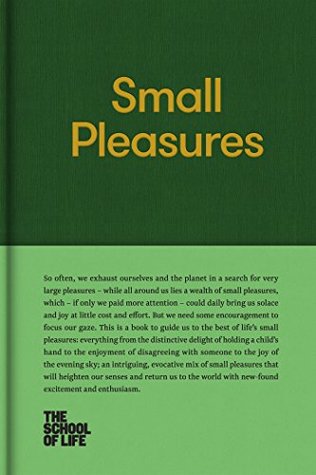
So often, we exhaust ourselves and the planet in a search for very large pleasures - while all around us lies a wealth of small pleasures, which - if only we paid more attention - could daily bring us solace and joy at little cost and effort. But we need some encouragement to focus our gaze.
This is a book to guide us to the best of life's small pleasures: everything from the distinctive delight of holding a child's hand to the enjoyment of disagreeing with someone, to the joy of the evening sky; an intriguing, evocative mix of small pleasures that will heighten our senses and return us to the world with new-found excitement and enthusiasm.
Chapters include:
- Being Up Late at Night
- A Book That Understands You
- Pleasant Exhaustion After a Productive Day
- Whispering in Bed in the Dark
- Midnight Walks
- Flirtation
- Finding Your Feet Abroad
- The Ideology of Small Pleasures
The School of Life: Small Pleasures - what makes life truly valuable Paperback
- Details
- Written by: Kamran Mofid
- Hits: 4664

Photo:Medium
It is only a couple of weeks to go, before, what, some of our most ‘distinguished’ and ‘honourable’ leaders, such as Nigel Farage, Boris Johnson, and Jacob Rees-Mogg- to name but a few- have called ‘The Independence Day’, when Britain will free itself from the shackles and chains of European imperialism and colonisation, and becomes great again.
The Heroes of Brexit!

Photo:gloucestershirelive.co.uk
I wanted to do something. I wanted to say and write something, healing myself, from the terrible thoughts going on in my mind, that how is it that a civilised, cultured, engaged, tolerant people, allowed themselves to be fooled by so much lies, propaganda, heightened xenophobia and rubbish promises?
And Lest We Forget

Nigel Farage: one of the leading proponents to leave the EU, standing infront of his immigrant poster which many people believe depicts "echoes" of the 1930s literature.
Photo: bbc.co.uk

'The EU’s goals and ambitions are the same as Hitler’s': Boris Johnson
Photo: express.co.uk
Long List of Brexit Lies:
- We send £350m a week to Brussels
- We can’t stop Turkey joining
- We can’t stop a European army
- We are still liable to pay eurozone bailouts
- The UK rebate can be changed against our will
- Our VAT exemptions will be ended
- Cameron’s deal was not legally binding
- EU law is adopted by unelected bureaucrats
- We can’t control our borders in the EU
- Criminals arriving in Germany can get EU passports and come over here
- Health tourism costs us billions
- EU needs UK trade more than vice versa
- Past referendum results have been ignored
- Auditors still refuse to sign off the accounts
- CAP adds £400 to British food bills
- British steel suffers because of the EU
- Irish border will be unaffected by Brexit
- UK can’t deport EU criminals
- UK is always outvoted
- 60-70% of laws come from EU
- Renationalisation of industries is impossible
- We get no veto on future treaty change or integration
- The budget ceiling can increase without our consent
- We thought we were only joining a free trade zone
- (Compiled by Richard Corbett MEP, Leader of the Labour Members of the European Parliament)
- For more lies and corruption see: Britain Has Become a Sinking Ship of Systemic Corruption, Cronyism and Chumocracy
Brexit has become a mental health issue
As I began to write, my 'Quartz Daily Brief' email arrived. I began to read, it was mainly about the disastrous Brexit. I thought, I cannot better that!
So, here you have it. I very much wish to share it with you. Moreover, in the last two years and more, I have written extensively on this matter. I will share a small sample with you again.
Britain is my home, my chosen country. I do love this green and pleasant land. In my own way, I am praying that all goes well for the UK and Europe. We must live together in peace and harmony, regardless. And hopefully, one day soon, in the not too distant future, we will again have leaders who are honest, truthful and will take us back into the heart of Europe again, where we belong. Carpe Diem!
Brexit: What is it??
Photo:theblogmire.com
‘In just three weeks, the UK is scheduled to leave the EU, to which it has belonged for the past 46 years. At this late hour, no one knows what exactly will happen.
A series of votes in Parliament next week could provide clarity or, as has been the case since the 2016 Brexit referendum, convolution. The votes on the terms and timing of Britain’s exit could still lead to a number of scenarios. Among them: a softer version of Brexit with closer ties to the EU, a second referendum, a general election, and the dreaded “no-deal Brexit” in which the UK crashes out of the bloc with no transitional arrangements in place. The first vote on Tuesday is for prime minister Theresa May’s deal, which has already been rejected once. If it is rejected again, “no one knows what will happen,” May said Friday.
EU Referendum: An Open Letter to British people - One man's view of Britain and the British
Whatever does happen, damage has already been done. Many companies have decided they can’t live with so much uncertainty, and have quit the UK to varying degrees. Bank of America is spending $400 million to transfer its European headquarters to Dublin. EasyJet, the UK’s largest airline, has had to transfer its ownership to non-British Europeans. Smaller companies without deep pockets for legal advice—and staff devoted to Brexit contingency planning—are more or less stuck. They are either running their businesses as usual and hoping for the best, or devoting time and money to stockpiling and other actions with the worst-case scenario in mind. Regardless, the vote’s impact on the economy hurts everyone. Even amid a global slowdown, the UK economy stands out for its sluggishness. Investment has plummeted since the referendum, and many European migrants who are key workers for low-wage sectors have already stopped coming.
Eurosceptics should visit Coventry Cathedral: The EU's Higher Purpose
Even if Brexit is softened, delayed, or canceled, the reputational damage the UK has inflicted upon itself won’t be easily repaired. Businesses won’t completely reverse their decisions to open offices abroad, uproot staff, or redirect investments away from Britain. The UK will be poorer for deciding to leave the EU, no matter how, when, or even whether it eventually quits the bloc.’ —Eshe Nelson, Quartz Daily Brief, 9 March 2019
Coventry’s Message of Hope to the World on the Armistice centenary and Remembrance Sunday

At this time of nationalism and bombast, the Coventry message of hope reminds us of our shared humanity across backgrounds, faiths, civilisation and cultures. And at a time when our country is divided, pitting itself against our European neighbours, we’d do well to remember the hopeful and enduring story of Coventry.
- Details
- Written by: Kamran Mofid
- Hits: 4331

Michel de Montaigne, the patron philosopher of the ordinary life. Photo:thefamouspeople.com
‘More than ever, modern life forces us to confront our own mediocrity. Our computers and phones constantly bombard us with news of the achievements of exceptional people: actors winning awards; athletes performing incredible feats; royals being praised for their beauty and philanthropy. As we sit and scroll, we can’t help but feel distinctly ordinary - and inferior - by comparison.
Consolation for our plight can come from unexpected places. Michel de Montaigne is the patron philosopher of the ordinary life. In his masterwork, the Essais, he attacks the pretensions of the aristocrats and intellectuals of his day, daring to criticise their work and achievements and reminding us of their fundamental humanity (“Kings and philosophers shit, and so do ladies”). At the same time, he venerates the lives of average, unheralded people - “In practice, thousands of little women in their villages have lived more gentle, more equable and more constant lives than Cicero.”
The next time we take stock of the success of others, we should keep Montaigne's perspective in mind and remember that wealth, fame, esteem or glory are no guide to the worth of a person, and that living a virtuous, ordinary life is achievement enough.’
The Wonders of an Ordinary Life
‘We live in an age with a high regard for extraordinary lives – that is, lives that the vast majority of us will never lead. Our heroes have made outsized fortunes, appeared on gigantic screens and demonstrated unique virtue and talent. Their achievements are both dazzling and continuously, in the background, humiliating.
In the late 1650s, the Dutch artist Johannes Vermeer painted a picture called The Little Street. Doing so was a quiet but momentous and revolutionary act, with an impact that challenges our values to this day.
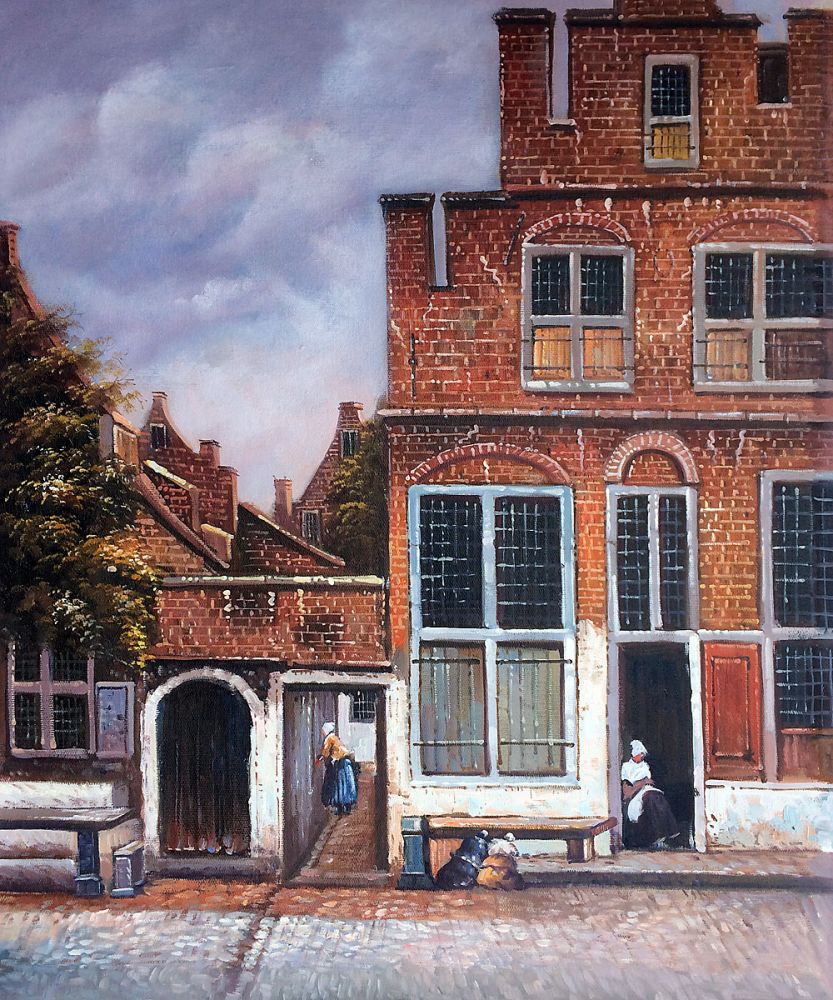
Little Street by Johannes Vermeer. Photo: overstockart.com
It showed nothing more outwardly impressive than an ordinary street in Vermeer’s home town of Delft. Someone was doing a little sewing; some kids were playing on the stoop, a woman was busy in the yard. It is one of the greatest paintings in the world.
Up to this point, the most prestigious cultural works had emphasised the merits and value of aristocratic, military and religious lives, that is, of lives filled with extraordinary moments and advantages. The great epic poets, Homer and Virgil, had written of heroic warriors; Renaissance artists had produced magnificent visions of saints and angels.
And the routines of kings, queens and aristocrats were constantly celebrated and held up for admiration on the most prestigious canvases.
But Johannes Vermeer went in another direction. He wanted to show us what could be appealing and honourable about very different sorts of activities: keeping a house tidy, sweeping the yard, babysitting, sewing or – as in his equally significant painting of a kitchen maid – preparing lunch...Continue to read
Me, Myself, And I: What made Michel de Montaigne the first modern man?
The Power of 'Good Enough'
Photo:auntieemsguide.com
How settling can make people happier and more satisfied than gunning for "the best"
Too many choices? Are you a "maximiser" or "satisficer”?
Do you always search for the “best” or are you happy with “good enough”? Are you searching for the good life, inner-peace, contentment and happiness?
Then, opt for “Good Enough” in Life
In Praise of ‘Enoughness’ and 'Lagomist' Economy
In Praise of Good Enough
Excellence is overrated. Let’s embrace being good enough instead
Schools, bodies, relationships – this quest to be outstanding can be damaging, even to people who really are outstanding
‘We live in a society obsessed with being exceptional. Whether it is as workers, parents, students, lovers or cooks, we are expected to be outstanding. We must strive to be the best employee, craft an outstanding body, have an amazing relationship, all while being exceptionally happy. Even the most ordinary institutions also are expected to be nothing less than excellent. Companies want to be “world class”, schools have become “academies of excellence”, and humble local GP surgeries strive to be “outstanding”. Being good enough is seen as simply not good enough.
Our quest to be excellent has many positive consequences, but it also can be damaging. Lionising excellence can create huge inequalities. When high performers are showered with rewards, the great mass of us who are average miss out. This can spark resentment in those who feel that they don’t measure up. But the obsession with being exceptional does just harm the great mass of average people. It can also do damage to people at the top as well.
Recent research on “insecure overachievers” has found that a burning drive to always be outstanding often leaves even the most exceptional performers feeling like they are not good enough). This can create severe damaging physical and mental health problems. Ultimately, the quest to be outstanding means all of us feel like we will never measure up.
If excellence is a harmful trap, how can we get out of it? More than 50 years ago, the psychotherapist, DW Winnicott provided an answer. During his work with parents and children, he noticed that those striving to be the perfect mother or father would often end up creating problems – for themselves as well as the child. Well-adjusted children often had parents who were “good enough”. They weren’t so neglectful that their child was harmed. Nor were they so amazing that the child felt they couldn’t escape the overwhelming shadow of their parent.’...Continue to read
All in all, to my mind, Good Enough is Good Enough: A reflection on the toll exacted by perfectionism
‘High ambitions are noble and important, but there can also come a point when they become the sources of terrible trouble and unnecessary panic.
One way of undercutting our more reckless ideals and perfectionism was pioneered by a British psychoanalyst called Donald Winnicott in the 1950s. Winnicott specialised in relationships between parents and children. In his clinical practice, he often met with parents who felt like failures: perhaps because their children hadn’t got into the best schools, or because there were sometimes arguments around the dinner table or the house wasn’t always completely tidy.
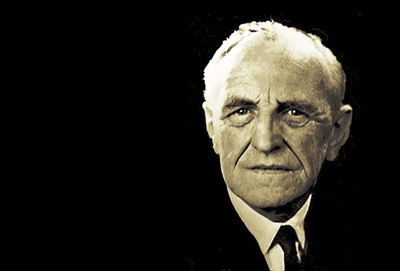
Donald Winnicott. Photo:bing.com
Winnicott’s crucial insight was that the parents’ agony was coming from a particular place: excessive hope. Their despair was a consequences of a cruel and counterproductive perfectionism. So as to help them reduce this, Winnicott developed a charming phrase: what he called ‘the good enough parent’. No child, he insisted, needs an ideal parent. They just need an OK, pretty decent, usually well intentioned, sometimes grumpy but basically reasonable father or mother. Winnicott wasn’t saying this because he liked to settle for second-best, but because he knew the toll exacted by perfectionism – and realised than in order to remain more or less sane (which is a very big ambition already) we have to learn not to hate ourselves for failing to be what no ordinary human being ever really is anyway.
The concept of ‘good enough’ was invented as an escape from dangerous ideals. It began in relation to parenthood, but it can be applied across life more generally, especially around work and love.
A relationship may be ‘good enough’ even while it has its very dark moments. Perhaps at times there’s little sex and a lot of heavy arguments. Maybe there are big areas of loneliness and non-communication. Yet none of this should lead us to feel freakish or unnaturally unlucky. It can be good enough.
Similarly, a ‘good enough’ job will be very boring at points, it won’t perfectly utilise all our merits; we won’t earn a fortune. But we may make some real friends, have times of genuine excitement and finish many days tired but with a sense of true accomplishment.
It takes a good deal of bravery and skill to keep even a very ordinary life going. To persevere through the challenges of love, work and children is quietly heroic. We should perhaps more often sometimes step back in order to acknowledge in a non-starry-eyed but very real way that our lives are good enough – and that this is, in itself, already a very grand achievement.’
The above article, ‘Good Enough is Good Enough’ was first published in The Book of Life.
Photo:youtube.com
How Can I Be More Normal? Watch the Video
Photo: shutterstock.com
..And now, come and be my fellow-traveler on a journey of self-discovery: Come and visit My Wisdom Corner. Surprise yourself. You will love it!
What is this life all about?
Why am I here? What’s my Life’s purpose? How can I make the most of my Life?
The Wisdom Corner
“Come, come, whoever you are. Wanderer, worshiper, lover of leaving. It doesn't matter. Ours is not a caravan of despair. come, even if you have broken your vows a thousand times. Come, yet again , come , come.”- Jalaluddin Rumi, The Persian Sage of Beauty, Wisdom and Love.
Come, come, whoever you are, come
- Selling off our Motherland: The Biggest Crime of the Broken Economic Model
- Are you physically and emotionally drained? I know of a good solution!
- US is urged to regain its humanity
- Saving the Web of Life: The Time is now to Tune into Peace, Love and Wisdom with a Spiritual Revolution
- It is so humbling to know that I knew all these all along!