- Details
- Written by: Kamran Mofid
- Hits: 1855
A study of beads made from ostrich eggshells, used to strengthen social networks, to ensure cooperation during tough times, suggests the humans of the Kalahari Desert region came together, founded ‘insurance policies’, and took actions in the interest of the common good, to help each other, as long as 30,000 years ago.
'Humans Have Been Taking Out Insurance Policies for at Least 30,000 Years'*
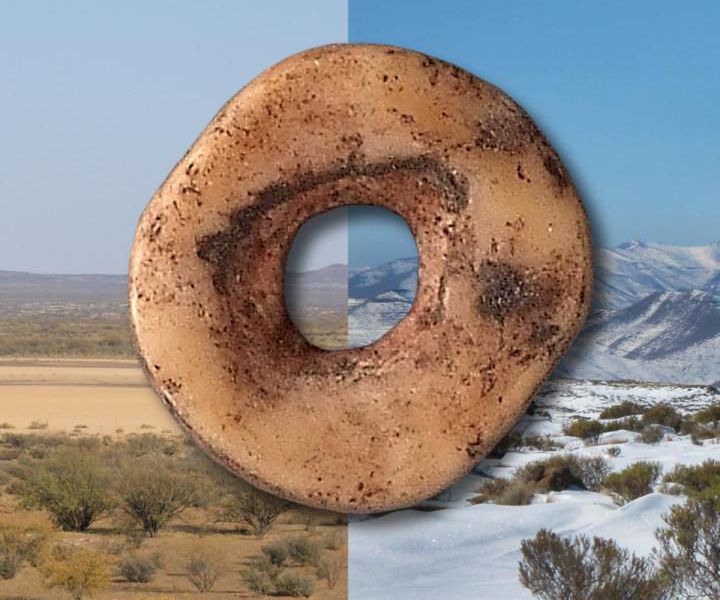
'Ostrich eggshell beads were exchanged between ancient hunter-gatherers living in distant, ecologically diverse regions of southern Africa, including deserts and high mountains.'
(Image courtesy of Brian A. Stewart, Yuchao Zhao, and the University of Michigan Museum of Anthropological Archaeology/John Klausmeyer), Via Smithsonian Magazine
‘Foragers today who live in southern Africa's Kalahari Desert know that a drought or war can threaten their community's survival. To mitigate these risks, they enter into partnerships with kin in other territories, both near and far, so that if they have a bad year, they can head to another area to gather water and food.
"It's a really good adaptation to a desert environment like the Kalahari, which has huge spatial and temporal variability in resource distribution," says Brian Stewart, an archaeologist at the University of Michigan. "It can be very rainy in one season and in the next absolutely dry, or it can be very rainy in your area and then 10 kilometers away, it's just nothing." According to new archaeological research led by Stewart, this kind of partnership—which acts as a kind of insurance against one side of the partnership having a down year—has been happening for at least 30,000 years.
In the study, which was published today in the journal Proceedings of the National Academy of Sciences, Stewart and his colleagues examined ostrich eggshell beads found during archaeological excavations at two high elevation rock-shelters in Lesotho, a country enclaved within South Africa. Since the 1970s and 1980s, archaeologists have been finding finished beads made from ostrich eggshells at prehistoric campsites in the area, Stewart says, even though ostriches are notably absent from the region. Based on this fact, and on anthropologists' comparisons with the systems used by modern hunter-gatherers, scientists assumed the ostrich beads to be part of the foragers’ long-distance insurance partnerships. That is, people from many miles away brought the beads and traded them to cement the social ties needed to ensure cooperation when one group of people endured tough times.
"Because of how effective this system is at shoring up risk, it's been used by a lot of archaeologists as a blanket explanation for why people exchange stuff," Stewart says. But, he adds, this idea hadn't really been tested for the archaeological record.
To figure out where the beads from Lesotho were created, Stewart and his colleagues examined their strontium isotope levels. Earth’s crust is abundant with a slightly radioactive isotope of rubidium that, over time, decays into strontium. As a result, different rock formations have different strontium signatures, and local animals can acquire those unique signatures via food and water. In this way, researchers can figure out where a 30,000-year-old ostrich came from.
"Now with globalization and our food moving all over the place—we can eat avocados in December in Boston, for instance—our strontium signatures are all messed up," Stewart says. "In the past, they would have been more pure to where we're actually from."
‘The natural instinct of human beings is towards cooperation and sharing. However, distorted by competition, personal ambition and nationalism, self-interest and greed have become pre-eminent motivating forces, distorting action and corrupting the policies of governments.
Competition is a pervasive element within all aspects of contemporary society, it is thought by many to be a positive and natural part of the human condition, and one that drives innovation and change. Loyal believers in competition assert that in the world of business it serves the consumer by driving down prices and creating virtually unlimited material choice, and will, some claim, be the driving force for environmental salvation. To be blessed with a competitive spirit, it is argued, strengthens an individual’s ability to succeed and overcome rivals; it stimulates “development” and advances in all areas — after all, if the urge to compete and achieve were negated, then what would motivate action?...
‘Cooperation is a fundamental quality of the time; it sits within a trinity of the age alongside unity and sharing. The expression of each of these galvanising principles strengthens and expands the manifestation of the other two; cooperation naturally evokes acts of sharing, which builds unity. Likewise, when we unite, cooperation and sharing occur. The introduction of these essential principles of change into all areas of contemporary life will lay a foundation of social harmony and allow the socio-economic structures to be re-imagined to meet the needs of all.’
Text and Photo: The need for cooperation and unity
The study showed that the majority of the beads from the Lesotho rock shelters were carved from the eggshells of ostriches that lived at least 60 miles (100 km) away. A few even came from about 190 miles (300 km) away, including the oldest bead, which was about 33,000 years old. "The really surprising thing was just how far they were coming in from, and how long that long distance behavior was going on," Stewart says.
"It's a really good adaptation to a desert environment like the Kalahari, which has huge spatial and temporal variability in resource distribution," says Brian Stewart, an archaeologist at the University of Michigan. "It can be very rainy in one season and in the next absolutely dry, or it can be very rainy in your area and then 10 kilometers away, it's just nothing." According to new archaeological research led by Stewart, this kind of partnership—which acts as a kind of insurance against one side of the partnership having a down year—has been happening for at least 30,000 years.
In the study, which was published today in the journal Proceedings of the National Academy of Sciences, Stewart and his colleagues examined ostrich eggshell beads found during archaeological excavations at two high elevation rock-shelters in Lesotho, a country enclaved within South Africa. Since the 1970s and 1980s, archaeologists have been finding finished beads made from ostrich eggshells at prehistoric campsites in the area, Stewart says, even though ostriches are notably absent from the region. Based on this fact, and on anthropologists' comparisons with the systems used by modern hunter-gatherers, scientists assumed the ostrich beads to be part of the foragers’ long-distance insurance partnerships. That is, people from many miles away brought the beads and traded them to cement the social ties needed to ensure cooperation when one group of people endured tough times.
"Because of how effective this system is at shoring up risk, it's been used by a lot of archaeologists as a blanket explanation for why people exchange stuff," Stewart says. But, he adds, this idea hadn't really been tested for the archaeological record.
To figure out where the beads from Lesotho were created, Stewart and his colleagues examined their strontium isotope levels. Earth’s crust is abundant with a slightly radioactive isotope of rubidium that, over time, decays into strontium. As a result, different rock formations have different strontium signatures, and local animals can acquire those unique signatures via food and water. In this way, researchers can figure out where a 30,000-year-old ostrich came from.
"Now with globalization and our food moving all over the place—we can eat avocados in December in Boston, for instance—our strontium signatures are all messed up," Stewart says. "In the past, they would have been more pure to where we're actually from."
The study showed that the majority of the beads from the Lesotho rock shelters were carved from the eggshells of ostriches that lived at least 60 miles (100 km) away. A few even came from about 190 miles (300 km) away, including the oldest bead, which was about 33,000 years old. "The really surprising thing was just how far they were coming in from, and how long that long distance behavior was going on," Stewart says.
Archaeologists have documented, in the Kalahari and elsewhere, the deep history of long-distance movements of utilitarian items such as stone tools and ochre pigment, which can be used as a sunscreen or a way to preserve hides. In East Africa, researchers have recorded instances of obsidian tools being carried more than 100 miles (160 km) as early as 200,000 years ago.
"When you have stone or ochre, you don't really know that this exchange is representing social ties," says Polly Wiessner, the anthropologist who first documented the exchange partnerships among the Ju/’hoãnsi people in the Kalahari Desert in the 1970s. "However, these beads are symbolic. This is one of our only sources for such early times to understand social relations."
Wiessner suspects that the closer-range ties—the ones around 60 miles—that Stewart and his colleagues found indeed represent people who pooled risk and shared resources. However, she says, it’s possible that the few examples of beads that came from further away could have been acquired through trade networks.
"Often at the edge of risk-sharing systems, feeder routes extend to bring in goods from other areas by trade or barter and so the recipient does not know people at the source," says Wiessner, who wasn't involved in Stewart’s study but reviewed it for the journal. "It doesn't mean people had face-to-face contact from that far away."
Wiessner points out that people living 30,000 years ago were anatomically modern humans, so she would expect them to have large social networks. Similarly, Lyn Wadley, an archaeologist with the University of the Witwatersrand in South Africa, says, "I think that gift exchange is likely to have a much earlier origin." Wadley, who has studied the social organization of Stone Age hunter-gatherers but wasn't involved in the new study, also found the results convincing.
The new study suggests that the exchange network would have spanned at least eight bioregions, from arid scrubland to subtropical coastal forests. Stewart and his colleagues speculate that the system may have arisen during a period of climate instability, when access to a diversity of resources would have been crucial.
"This is just another piece in the puzzle of the incredible flexibility of our species," Stewart says. "We are able to innovate technologies that just make us so good at adapting very quickly to different environmental scenarios."
*This article by Megan Gannon was first published in Smithsonian Magazine on 9 March 2020.
Related reading:
In a time of panic, please don’t forget to be kind.
“In a world where you can be anything, be kind.”
...And Now Lest We Forget
Why We are Living Through an Epidemic of Selfishness and Greed

Photo:eand.co
The Age of Inhumanity: Selfishness, Competition, Digitalisation, Virtuvalisation and Neoliberalisation, Creating a Zombie World!
The shaming of a bunch of demagogue political, economic and educational leaders that have fooled the world, pushing a SELFISH and Parasitic ideology and philosophy on the world, with tragic outcomes and consequences.
The Damning Impact of a Toxic Philosophy: The Tragedy of Ayn Rand
The Damning Impact of a Toxic Ideology: Neoliberal Legacy of Thatcher and Reagan
The Damning Impact of a Toxic Ideology: Neoliberal Legacy of Koch Brothers
Is Neoliberal Economics and Economists 'The Biggest Fraud Ever Perpetrated on the World?'
Neoliberalism destroys human potential and devastates values-led education
Brexit, Trump and the failure of our universities to pursue wisdom
- Details
- Written by: Kamran Mofid
- Hits: 1748
This is the plea of a mother of a two-year-old son with cystic fibrosis, a chronic health condition that makes him particularly vulnerable to respiratory viruses.
Panic-buying and hoarding has major consequences on the weak and vulnerable in our society.
Food banks run out of milk and other staples as shoppers panic-buy
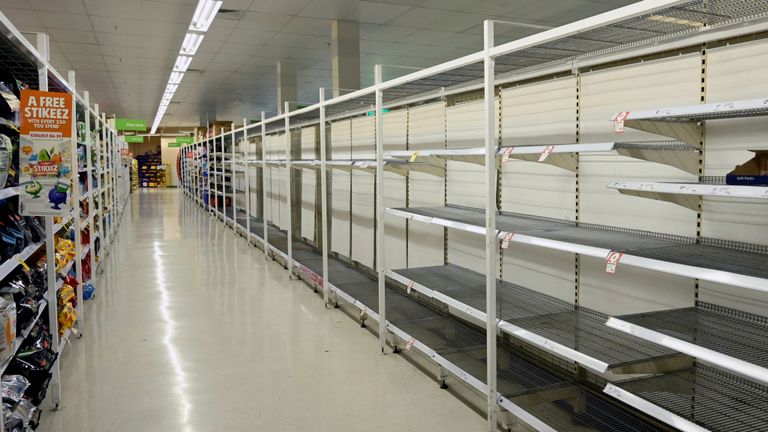
'Some shelves are empty in supermarkets in Sydney after panic buying.'-Photo:news.sky.com
As coronavirus spreads, I am terrified that Australia's fear and greed could cost my son his life*
'Stockpiling essential supplies and ignoring quarantine advice can have deadly consequences for the most vulnerable among us.'
‘In a time of panic, please don’t forget to be kind.
Before you roll your eyes at this worthy statement, know it doesn’t come from a place of virtue. It comes from the mother of Harry, my two-year-old son with cystic fibrosis, a chronic health condition that makes him particularly vulnerable to respiratory viruses.
I write this from a place of deep anxiety, stemming from the familiarity I have with the smells of fear and tears accompanying an intensive care unit in a children’s hospital. A year ago, I watched as my son was sedated and put on oxygen because of complications arising from rhinovirus – the common cold – combined with two other respiratory viruses. I shudder to think what Covid-19 could do to his already compromised lungs.
But I am more worried about the human reaction to the virus in the weeks to come than I am about the actual virus. And the virus is terrifying. I predict we will witness, as we have already started to, the worst of humanity, including people fighting over toilet paper in a supermarket, people hoarding supplies meaning that others miss out, people going to work when they’re sick or letting their kids out of the house when they should be quarantined. Two weeks is a long time to spend at home to limit the spread of the virus, but I am urging people to please abide by the rules, because doing so will protect the vulnerable. Doing so will protect Harry.

Sally Killoran’s son Harry.-Photo: The Guardian
Because of Covid-19’s infancy, we are yet to fully understand how it will affect people with cystic fibrosis, or the many others with compromised immune systems. However, with the death toll rising it is obvious there is cause for serious concern. According to Centers for Disease Control data collated by John Hopkins University, the virus has claimed more than 3400 lives globally, with more than 100,000 cases reported. Reading about the acceleration of cases in Australia in the last week, including the evacuation of Epping Boys High, the words horse and bolted come to mind when talking about containment.
Which is why I am urging you to resist your fear-driven greedy impulses and please remain kind. As our leaders scramble to get ahead of the virus, and amidst media and celebrity-endorsed obfuscation around stockpiling goods, it’s up to us as a nation to control how we personally respond. I ask that you do this with compassion.
As the mother of Harry, I am begging you to think of the flow-on effect your actions have on the vulnerable. Reports of a man who ignored advice to self-quarantine in Hobart yesterday meant he made the inadvertent – but preventable – decision to put many people at risk, and this act may cause the vulnerable to pay the utmost price.
I am asking that on the day you waver over whether or not to send your child into public with flu-like symptoms (fever, sore throat, shortness of breath, cough) please think of Harry, whose life could be limited if this virus takes hold of his already fragile lungs. While this new strain of flu has only been seen to have mild symptoms in children, think of how your child could pass it on to their friend’s father who is fighting cancer, or another friend’s mother with a newborn at home, or a child who regularly visits their elderly grandparents in their nursing home. Think of your child’s friend whose baby sister has spinal muscular atrophy, think of the child in hospital fighting acute lymphoblastic leukaemia, or with another autoimmune disease that Covid-19 could decimate.
I am asking people to be kind, and not to panic in a time when everyone seems scared, because the ridiculous run on toilet paper last week highlighted the fact people are not thinking of others. And while toilet paper isn’t going to save Harry’s life, other goods like hand sanitiser and face masks could help keep him, and his friends with auto-immune problems, safe.
The Department of Health has very clearly said that face masks are not to be used by the healthy. It states: “Masks are not currently recommended for use by healthy members of the public for the prevention of infections like coronavirus. Instead, face masks should be used by people who are experiencing flu-like symptoms so they can protect others from spreading the virus.”
Yet last week I visited at least eight pharmacies and could not buy a face mask for my son to wear when he visits hospital next week for his regular CF clinic. In fact, I have resorted to hassling the kind doctors at the Sydney Children’s Hospital in Randwick to send me face masks so that he can wear them to avoid people coughing on him while he is walking through the hospital. The fact I am wasting the precious time of under-resourced doctors and nurses is appalling, and something I am ashamed of, yet I have been driven to do this because others have hoarded them in case of emergency and I cannot physically buy any in stores.
If we all panic, and are governed by fear-driven greed to take more than we need, who is going to protect the most vulnerable? Yesterday I was dismayed when I saw a social media post from the mum of Harper, who has leukaemia, who couldn’t buy any tissues at her local shop. What has Australia come to when a mum can’t buy tissues for her daughter with leukaemia, on her way home from hospital?
I am asking people, please be kind and don’t take more than what you need. Anyone who enters our house needs to wash their hands with hand sanitiser before they’re welcome, to protect Harry. I know soap and water also do a good job at killing viruses but hand sanitiser is quick and easy and when dealing with children it does the desired job of killing germs, and fast. Yet I can no longer buy hand sanitiser from a shop nearby, and ordering it online will take weeks. Which makes me wonder, where has it all gone? If you have a stockpile at home, please don’t let is gather dust: use it or donate some to your neighbours, because everyone has the same right as you to protect themselves. Now is the time to be using it and buying it, not hoarding it in case you need it later. The crisis is upon us, and it will do no good to hoard supplies for years when we need to use them now.
Last week my husband had an accident and ended up with five stitches in his finger, requiring surgery. I drove around to four different chemists and supermarkets trying to buy him paracetamol. He needed it. In the end, I resorted to asking a woman in the queue in front of me whether she would mind if she gave me one of the five packets of Panadol Rapid she had in her basket, because my husband needed them for pain management that minute. She obliged, and admitted she didn’t actually need Panadol, but they were the only ones left in the store so she thought she should buy them all in case she couldn’t get them again. I get it! It’s a scary time, but if everyone reacts like this, who is going to buy paracetamol for the pensioners when they need it, or for Aunty Beryl who is in chronic pain, or for Harry when he has a fever?
Before you panic, be kind, and think of the vulnerable, and how your actions can affect them.’
*This article by Sally Killoran was first published in The Guardian on 9 March 2020.
...And this was another cry, another plea for KINDNESS...
“In a world where you can be anything, be kind.”
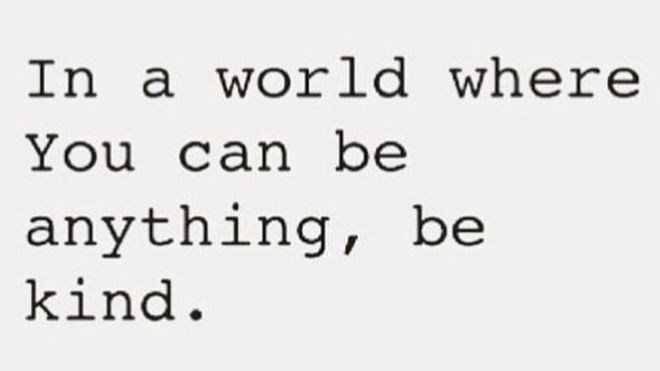
"In a world where you can be anything, be kind," Caroline Flack wrote on Instagram in December 2019.
...And Now Lest We Forget
Why We are Living Through an Epidemic of Selfishness and Greed
Photo:eand.co
The Age of Inhumanity: Selfishness, Competition, Digitalisation, Virtuvalisation and Neoliberalisation, Creating a Zombie World!
The shaming of a bunch of demagogue political, economic and educational leaders that have fooled the world, pushing a SELFISH and Parasitic ideology and philosophy on the world, with tragic outcomes and consequences.
The Damning Impact of a Toxic Philosophy: The Tragedy of Ayn Rand
The Damning Impact of a Toxic Ideology: Neoliberal Legacy of Thatcher and Reagan
The Damning Impact of a Toxic Ideology: Neoliberal Legacy of Koch Brothers
Is Neoliberal Economics and Economists 'The Biggest Fraud Ever Perpetrated on the World?'
Neoliberalism destroys human potential and devastates values-led education
Brexit, Trump and the failure of our universities to pursue wisdom
- Details
- Written by: Kamran Mofid
- Hits: 3053
"In a world where you can be anything, be kind," Caroline Flack wrote on Instagram in December 2019.
There is no simple explanation for why someone chooses to take their own life and it is rarely due to one particular factor. But after the 40-year-old TV presenter took her own life on 15 February 2020, those words have assumed an added resonance for many around the world.
In the hours and days after news of Flack’s death broke, many thousands of tweets were posted with the words ‘Be Kind’ – a reminder, in the most basic sense, that we need to treat each other better, we need to be kinder. The motto seemed to be a cry for help and change, a collective realisation that things had gone too far.
On Facebook and other social media outlets, there was a renewed effort from women to be kinder to one another, too – one viral trend encouraged them to tag and compliment their friends. “It’s time for us to fix each other’s crowns,” read someone’s caption. The ‘Be Kind’ motto also appeared as ‘ribbons’ on profile pictures.
To my mind, if we could keep this kindness notion in the forefront of how we operate, and if we can harness and nurture that, this can prove to be an incredibly powerful thing, a force for good.
- Crisis after crisis and the crucial voices of hope
- Is Neoliberal Economics and Economists 'The Biggest Fraud Ever Perpetrated on the World?'
- The Broken Economic Model and the Inhumanity of the Lost Decade of Austerity
- Cortona Week 2020- A Week of Fulfilment, Joy and Friendship
- How can we measure what makes a country great?